Fontainebleau Grades and Colour Circuits Explained (Font to V)
 Petr Hess, strength & conditioning coach
Updated 2 Nov 2026 · 6 min read
Key takeaways
Best for: Gym climbers planning a first Font trip
- Roughly, Font 4 is V0, 6A is V3, 7A is V6 and 8A is V11.
- Circuit colours usually run from white (children) and yellow through orange, blue and red to black.
- A circuit's colour is an average, so single problems can be harder, and white can also mark very hard circuits.
- Around V0–V2, warm up on yellow then climb orange; around V3–V5, warm up on orange then try blue.
- Expect to climb one or two grades below your usual indoor level for the first few days.
Fontainebleau bouldering grades use the Font scale: a number from 1 to 9, with the letters A, B and C and an optional "+" from grade 6 upwards (6A, 6A+, 6B … 8C+, 9A). Roughly, Font 4 is V0, 6A is V3, 7A is V6 and 8A is V11. On top of the grades, Font's colour circuits group problems by difficulty, from white (children) and yellow (easy) up to black. Here's how both systems work and how to use them on your first trip.
This article is part of our Fontainebleau bouldering guide, which covers seasons, getting there, areas and ethics.
How the Font scale works
The Font scale was developed in the Fontainebleau forest south of Paris and is now the standard bouldering scale across most of Europe, and in many gyms worldwide. It reads like this:
- Grades 1–5+ are plain numbers, with a "+" for a slightly harder problem (5, 5+). Problems below grade 3 are rarely found.
- From 6 upwards, each number is split into A, B and C, and each of those can take a "+". So the order is 6A, 6A+, 6B, 6B+, 6C, 6C+, 7A and so on.
- The top of the scale is currently 9A, the grade of the hardest boulder problems in the world.
Mammut notes that grades from 6A upwards are generally considered advanced. Boulder grades are usually written with a capital letter (7A) to separate them from French sport climbing grades (7a), which use similar symbols but are a different scale. Don't compare the two directly.
Font grade to V grade conversion
The V-scale (Hueco scale) is used mostly in North America. The two scales line up reasonably well at higher grades, but at lower grades one V grade covers more ground than one Font grade, so several Font grades share a V grade. The table below matches our grade converter:
| Font grade | V grade | Rough level |
|---|---|---|
| 4, 4+ | V0 | Beginner |
| 5 | V1 | Beginner |
| 5+ | V2 | Beginner |
| 6A, 6A+ | V3 | Intermediate |
| 6B, 6B+ | V4 | Intermediate |
| 6C, 6C+ | V5 | Intermediate |
| 7A | V6 | Advanced |
| 7A+ | V7 | Advanced |
| 7B, 7B+ | V8 | Advanced |
| 7C | V9 | Expert |
| 7C+ | V10 | Expert |
| 8A | V11 | Expert |
| 8A+ | V12 | Expert |
| 8B | V13 | Elite |
| 8B+ | V14 | Elite |
| 8C | V15 | Elite |
| 8C+ | V16 | Elite |
| 9A | V17 | Elite |
Treat every conversion as a rough guide, not an exact formula. Grading is subjective, and a problem's style (slab, roof, mantel, traverse) changes how hard it feels to you far more than the number does.
Why Font grades feel stiff
Almost everyone who arrives from a gym finds Font hard at first. Wikipedia's article on Fontainebleau climbing notes that Bleau grades are generally more severe than grades elsewhere, and a France Today beginner's guide puts it down partly to the very high standard of the local climbers who set and graded the problems. The type of climbing adds to it:
- Friction instead of positive holds. Many holds are rounded slopers, and footholds are often just texture. Gym holds are usually more positive.
- Mantel top-outs. Outdoors you have to climb onto the top of the boulder. That's a skill many indoor climbers have never practised.
- Polish. Classic problems have been climbed for decades, and their holds and footholds can be worn smooth.
- Conditions. The same problem can feel a grade harder on a warm, humid afternoon than on a cool, dry morning.
- Gym grades. As Mammut points out, gyms are often generous with grading, so outdoor problems feel harder than expected.
A practical rule for your first trip: expect to climb one or two grades below your usual indoor level for the first few days, and judge your progress by how your movement improves, not by the numbers.
The colour circuit system
A circuit is a set of problems of similar difficulty, linked in order and marked with paint in one colour. The first painted circuit was made in 1947 at Cuvier Rempart, and circuits were originally used by Parisian climbers to train stamina for the mountains. Circuits typically have from 20 up to 75 problems, and a few are much longer.
The colour tells you the overall difficulty of the circuit. The standard system uses the French alpine adjectival grades:
| Colour | Adjectival grade | Meaning | Approx. Font grade |
|---|---|---|---|
| White (children) | Enf. | Enfants (children) | Very easy, low boulders |
| Violet, salmon, light green | F | Facile (easy) | 1–2 |
| Yellow | PD | Peu difficile (not very hard) | 2–3 |
| Orange | AD | Assez difficile (fairly hard) | 3–4 |
| Blue | D | Difficile (hard) | 4–5 |
| Red | TD | Très difficile (very hard) | 5–6 |
| Black, white or fluorescent pink | ED | Extrêmement difficile (extremely hard) | 6–7 |
Some important caveats:
- The colour is an average. A circuit can contain individual problems well above its typical grade, and some include highballs.
- Grades carry a + or −. Guidebooks list circuits such as "AD" or "D+", so two blue circuits can differ quite a bit. For example, at Buthiers Canard the yellow circuit is listed as PD−, orange as AD, blue as D+ and black as ED.
- White means two things. White is used for children's circuits, but also for some of the hardest circuits. Always check the guidebook.
- There are exceptions. Some historic circuits keep non-standard colours, such as the mauve circuit at La Dame Jouanne.
How circuits are marked on the rock
Once you know the symbols, following a circuit is easy:
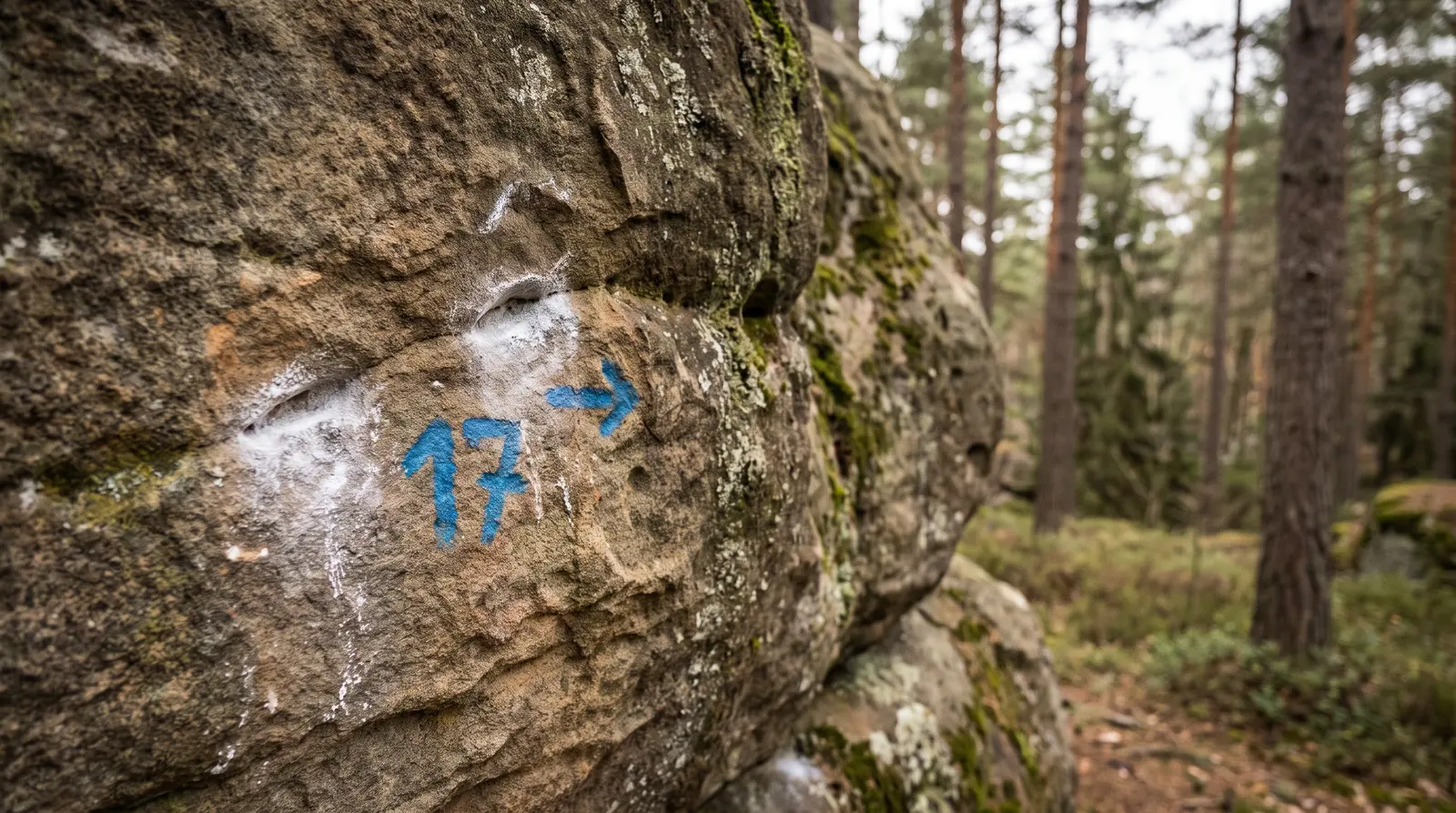
- The start. The first boulder (départ) has a white rectangle showing the circuit number and grade, in the circuit's colour.
- Numbers. Each problem has a painted number in sequence. Easier "link" boulders get an arrow without a number.
- Arrows. A small arrow on each problem shows the direction of climbing. Painted dots and arrows also guide you to the next boulder.
- Variants. A "b" (bis) or "t" (ter) after a number, or a small triangle, marks an alternative version of a problem.
- Double passes. "A" (aller) and "R" (retour) mark a boulder you climb twice, on the way out and back.
- Special marks. A dashed line marks a forbidden hold, a single dot a suggested foothold, and a dot in a broken circle a jump.
- The finish. The last boulder (arrivée) is marked with a circled "A".
Paint fades over time, so on some older circuits the numbers are hard to find. A guidebook map or Bleau.info helps.
Which circuits suit first-timers
- Complete beginners and families: white children's circuits and yellow circuits. They are low, mostly on good landings, and ideal for learning to top out.
- Gym climbers around V0–V2: warm up on yellow, then climb orange. Orange problems teach you the sandstone footwork you'll need later.
- Gym climbers around V3–V5: warm up on orange, then try blue. Expect some blue problems to shut you down at first, and check our bouldering trip packing list so you have the pads and skin kit for longer days.
- Red and black: leave these for later trips, and check the guidebook for highballs and landing hazards before you start one.
You don't need to finish a circuit. Many climbers do a section of one as a warm-up, then spend the rest of the day on individual problems. Others treat a full circuit as an endurance day. From an S&C point of view, a 40-problem circuit is a lot of volume for fingers and skin, so build up to it rather than doing a full circuit every day.
Circuit etiquette
- Share the problem. On busy weekends, groups often queue at the same boulder. Take your turn, and don't leave your pad blocking a problem you're not using.
- Climb in the marked direction, especially on popular circuits, so you don't collide with other groups.
- Don't add or touch up paint, and never add your own marks to the rock.
- Follow the forest rules: no climbing on wet rock, minimal chalk brushed off afterwards, clean shoes and a soft brush. Our Fontainebleau guide lists them all.
FAQ
What is 6A in V grades?
6A Font is roughly V3, and so is 6A+. The V-scale is coarser at lower grades, so two Font grades often share one V grade. Treat any conversion as approximate.
What is the easiest circuit colour in Fontainebleau?
White circuits marked for children (enfants) are the easiest, followed by yellow. Yellow is the usual warm-up circuit for adults. Note that a few very hard circuits are also painted white, so check the guidebook.
Why do Fontainebleau grades feel so hard?
Font problems rely on friction, slopers, small footholds and mantel top-outs rather than the positive holds of many gyms. The grades were also set by very experienced local climbers, and many sources describe Font grading as more severe than elsewhere.
Is the Font bouldering scale the same as French sport grades?
No. They use similar symbols (6a, 7a and so on), but a Font boulder grade and a French route grade measure different things and are not interchangeable. Font boulder grades are usually written with capital letters, such as 7A.
Sources
- Wikipedia, Fontainebleau rock climbing
- Alex Beale, Bouldering Grades: The Complete Guide, 99Boulders (2021)
- Mammut, Bouldering difficulty scales explained (2025)
- Paul Highams, The Magic of Fontainebleau, Tunbridge Wells Mountaineering Club (2011)
- Rebecca Crowe, A Beginner's Guide to Climbing in Fontainebleau, France Today (2025)
- theTopo, Buthiers Canard area description