Fontainebleau Bouldering Guide for First-Timers
 Petr Hess, strength & conditioning coach
Updated 2 Nov 2026 · 10 min read
Key takeaways
Best for: First-time visitors to Fontainebleau
- Go in spring or autumn, and never climb wet sandstone, which can take 24 hours or more to dry.
- Start at beginner-friendly areas such as Cul de Chien, Roche aux Sabots or L'Elephant.
- On day one, learn the rock on a yellow circuit, then try a few orange problems.
- Expect to climb a few grades below your indoor level for the first days.
- Plan an easier day after two hard ones, and stop before your skin is worn through.
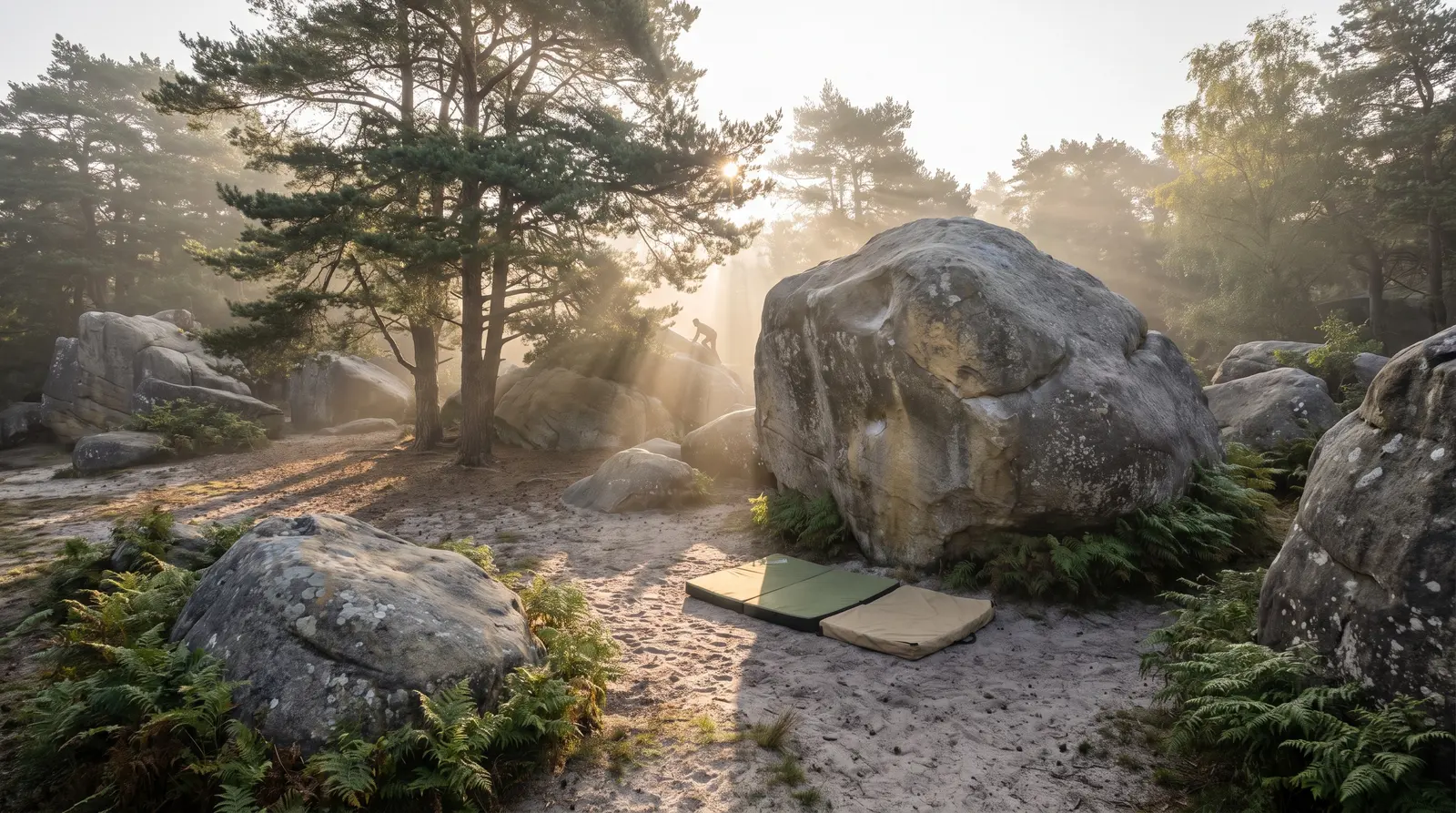
Fontainebleau ("Font" or "Bleau") is a forest of sandstone boulders about 70 km (45 miles) south of Paris, and for a first trip it is hard to beat: thousands of problems at every level, soft sandy landings and colour-coded circuits that tell you exactly what to climb next. Go in spring or autumn, never climb on wet rock, start on the easy circuits at beginner-friendly areas such as Cul de Chien, Roche aux Sabots or L'Elephant, and bring a guidebook or app. This Fontainebleau bouldering guide covers everything else you need to plan the trip.
I'm a strength and conditioning coach, not a climbing guide or a local, so this guide is built from published sources (cited at the bottom) and the local climbing community's own rules. Where it touches on training and skin, it's from an S&C point of view.
Why Font is worth the trip
Bouldering in Fontainebleau has a long history. Climbers from Paris trained here for the Alps from the late 19th century, the first guidebook appeared in 1945, and the first painted circuit was made in 1947 at Cuvier Rempart. Today the forest and its neighbouring woods hold tens of thousands of problems: one travel guide counts over 27,000 problems across 245 areas, from grade 2 slabs to some of the hardest boulders in the world.
Three things make it special for a first trip:
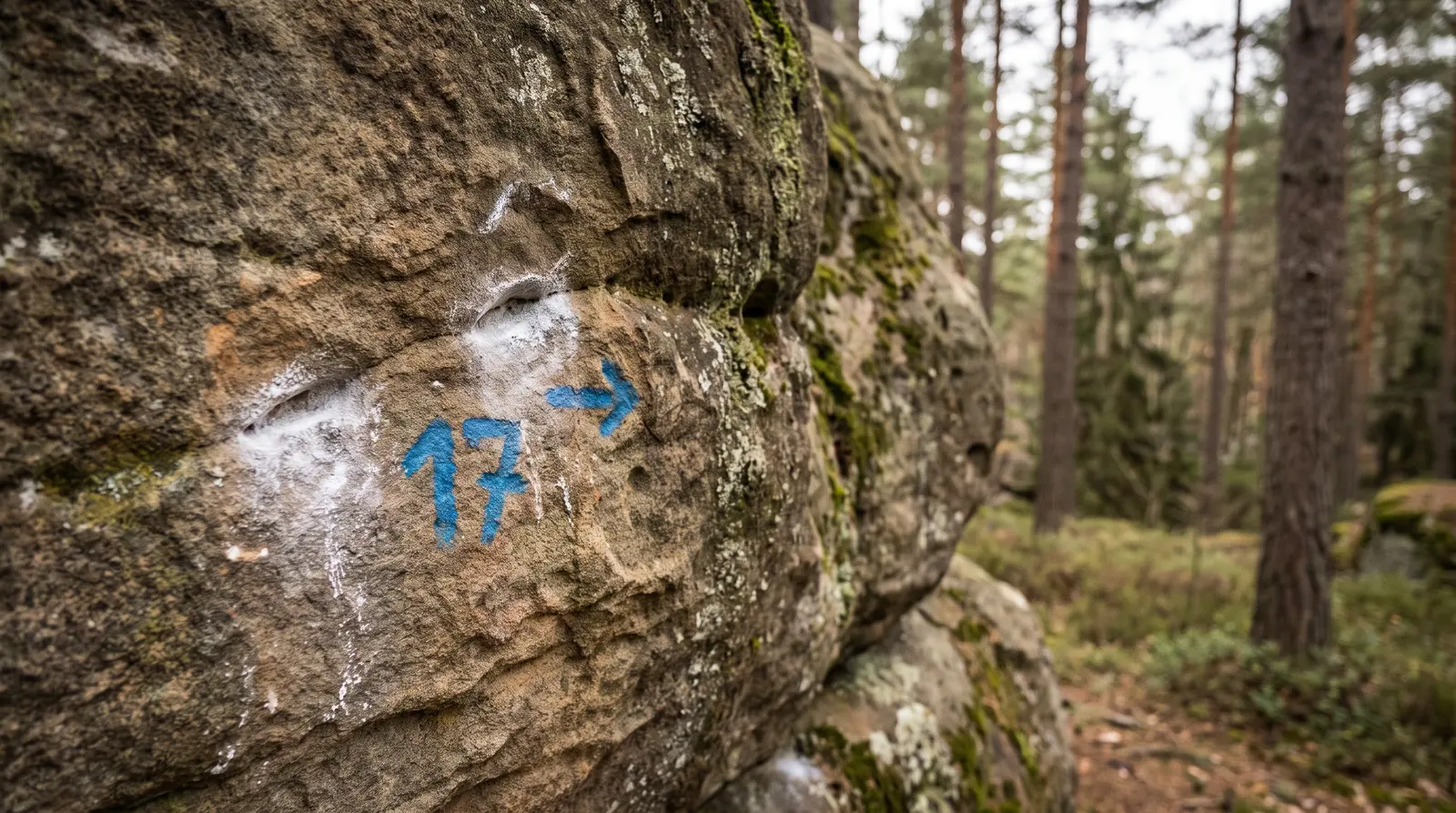
- The circuits. Problems of similar difficulty are linked by painted numbers and arrows, so you can climb dozens of boulders at your level without hunting for them. Our article on Fontainebleau grades and colour circuits explains the system in detail.
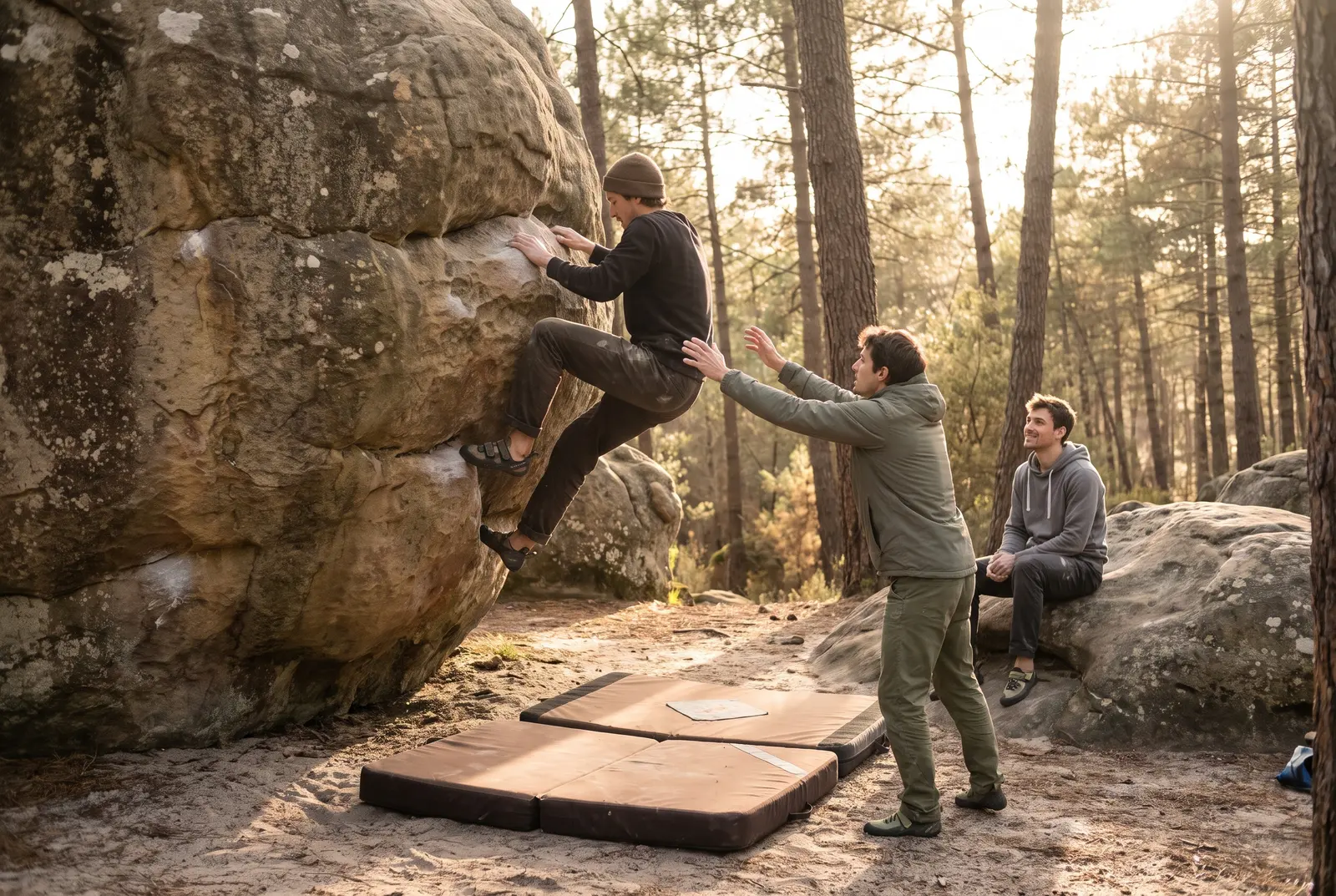
- The landings. Many boulders sit on flat sand, which makes falling (and spotting) more forgiving than at many other crags.
- The variety. Slab, vertical walls, roofs, traverses and plenty of slopers and mantels. It is a full education in moving on rock.
One warning before you go: Font grades feel stiff, especially if you're used to gym grades. Plan to climb a few grades below your indoor level for the first days. If you think in V grades, our grade converter translates Font grades to the V-scale.
Best season, and why you never climb on wet sandstone
You can boulder in Font year-round on dry days, but spring and autumn are generally recommended: mild temperatures, a better chance of dry rock and fewer crowds than in summer. Summer can be hot enough to make long circuit days tiring, while winter brings damp spells and occasionally snow. Easter, school holidays and sunny weekends are the busiest times, and popular areas such as Bas Cuvier and Franchard Isatis get crowded.
The single most important rule: do not climb on wet rock. Font sandstone is weak when damp, and holds can break or wear away under your feet and fingers. Bleau.info, the main online database of the forest, lists this first among its ethics rules, and the BMC notes that sandstone can take 24 hours or more to dry after rain, depending on sun and wind. Sheltered, shaded boulders stay damp longer than exposed ones on ridges. If the rock feels cold and clammy or looks dark, go for a walk instead.
Getting there, with or without a car
By car
Fontainebleau is about an hour's drive from Paris. A car is the easiest option: the forest covers around 250 square kilometres, areas are spread out, crash pads are bulky, and most climbing areas have car parks. Two practical notes from the local rules and travel guides: car parks in the forest are closed between 22:00 and 06:00, and car break-ins are not unusual, so don't leave valuables in sight.
Without a car: train, bus and bike
You can do a whole trip without a car if you choose your areas carefully. Transilien line R runs from Paris Gare de Lyon to the forest in about 40–50 minutes. Check the current fare and the last return train before you set off.
- Bois-le-Roi station serves the northern areas. Rocher Canon is about 45 minutes on foot or 15 minutes by bike, according to one climbing shop's car-free guide.
- Fontainebleau-Avon station serves areas close to town. Le Calvaire is about 20 minutes on foot, Mont Ussy and Rocher d'Avon about 30 minutes on foot.
- Bus line 1 from Fontainebleau-Avon stops near Bas Cuvier and Franchard Isatis, the BMC reports. Weekend services can be less frequent.
- Bikes help a lot. You can take your own bike on line R trains, and shops in Fontainebleau town rent them.
Carrying a crash pad on a long walk-in is tiring, so a car-free trip usually means one pad per pair or small group and fewer area changes per day.
Beginner-friendly areas
Almost every area has easy circuits, but some are more welcoming than others for a first visit:
| Area | Why it suits first-timers | Watch out for |
|---|---|---|
| Cul de Chien (Trois Pignons) | Smaller area with mostly beginner problems; dries quickly after rain | Some polished footholds |
| Roche aux Sabots (Trois Pignons) | Often recommended for families and younger climbers | Busy on weekends |
| L'Elephant | Many problems and good landings | Some harder lines mixed in |
| 95.2 (Trois Pignons) | Recommended for families and beginners | Car access needed |
| Bas Cuvier | Compact, historic, wide range of grades, reachable by bus | Crowds and polished holds |
| Apremont | Large area with several sub-sectors and plenty of easy terrain | Further from town |
If you prefer quiet, travel guides mention Chamarande, Troglodyte, Rocher de la Reine and Pignon Poteau as less crowded places to build confidence. The Trois Pignons area as a whole is a good base for beginners, with a lot of variety close together. Franchard is another classic, best saved for when you have a few days of sandstone in your fingers.
Colour circuits in brief
A circuit is a series of numbered problems of similar difficulty, marked with paint in the circuit's colour. Small arrows show where to go next and which way to climb. The colour tells you the overall difficulty. From easiest to hardest, the usual order is white (children), yellow, orange, blue, red and black (some very hard circuits are also white). There are local exceptions and individual problems can be harder than the circuit's average.
For a first day, pick a yellow circuit as a warm-up and to learn the rock, then try orange. The full colour-by-grade table and the meaning of the markings are in our guide to Font grades and circuits.
Guidebooks and apps
With so many problems, you need a guidebook or app. The ones climbers most often recommend:
- Fontainebleau Climbs: The Finest Bouldering and Circuits (Jo and Françoise Montchaussé, Jacky Godoffe). A selective guide covering around 40 areas, strong on circuits and maps. A good first buy for mixed-ability groups.
- Fontainebleau Fun Bloc (David Atchison-Jones, Jingo Wobbly). Photo-topo based, with thousands of problems; reviewers see it as a good fit for groups of mixed ability.
- Essential Fontainebleau (John Watson, Colin Lambton). Another all-levels option.
- 5+6 Fontainebleau and Fontainebleau 7+8 (Bart van Raaij). For experienced climbers looking for the best individual problems in those grade ranges.
- Bleau.info. A free, community-run database of areas, circuits and problems, with photos and directions. Excellent for planning.
- 27 Crags. A topo app with Fontainebleau areas, handy for finding boulders on your phone.
For a first trip, one circuit-focused guidebook plus Bleau.info is plenty. A paper guide also saves your phone battery on long days in the forest.
Where to stay
You can't sleep in the forest itself: wild camping and overnight stays in the car parks are banned, and Bleau.info warns of fines. Instead, climbers usually stay in the villages around the forest:
- Fontainebleau and Avon: the most practical base without a car, with the train station, shops and bike rental.
- Barbizon: a village with good amenities close to Apremont.
- Milly-la-Forêt: close to the Trois Pignons areas. The La Musardière campsite here is within walking distance of some bouldering.
- La Chapelle-la-Reine: home to a climber-friendly hostel with dorms, private rooms and garden camping.
- Grez-sur-Loing: Le Pré campsite, a larger site with a shop.
- Gîtes: rentable houses and flats across the area, often good value for groups.
Book early for spring weekends and holidays, and check campsite opening dates before you travel.
Crash pad rental
If you're flying in, renting is usually easier than bringing pads. Local outdoor shops, climbing gyms in and around Paris and some gîtes and hostels rent crash pads, and guidebooks are often available too. Pads can sell out in busy periods, so reserve ahead. For how many you need for your group, see how many crash pads to bring. If you're thinking of buying your own, our guide to the best crash pads covers sizes and foam types.
Always carry your pad between boulders; dragging it damages the vegetation and speeds up erosion.
Sandstone technique and skin care
Font sandstone is rough and grippy, but the movement is different from most gyms. A few things that help:
- Trust your feet. Many holds are rounded, and footholds can be little more than texture. Keep your heels low, weight the shoe and move smoothly. Precise footwork matters more than pulling hard.
- Slopers need body position. Keep your hips under the hold and your arms straight. Friction is better when the rock is cool and dry, so save your hardest tries for cool mornings and late afternoons.
- Learn to mantel. Outdoors you finish by climbing onto the top of the boulder, not by dropping from the last hold. Practise pressing down with your palms and getting a foot high on easy boulders first.
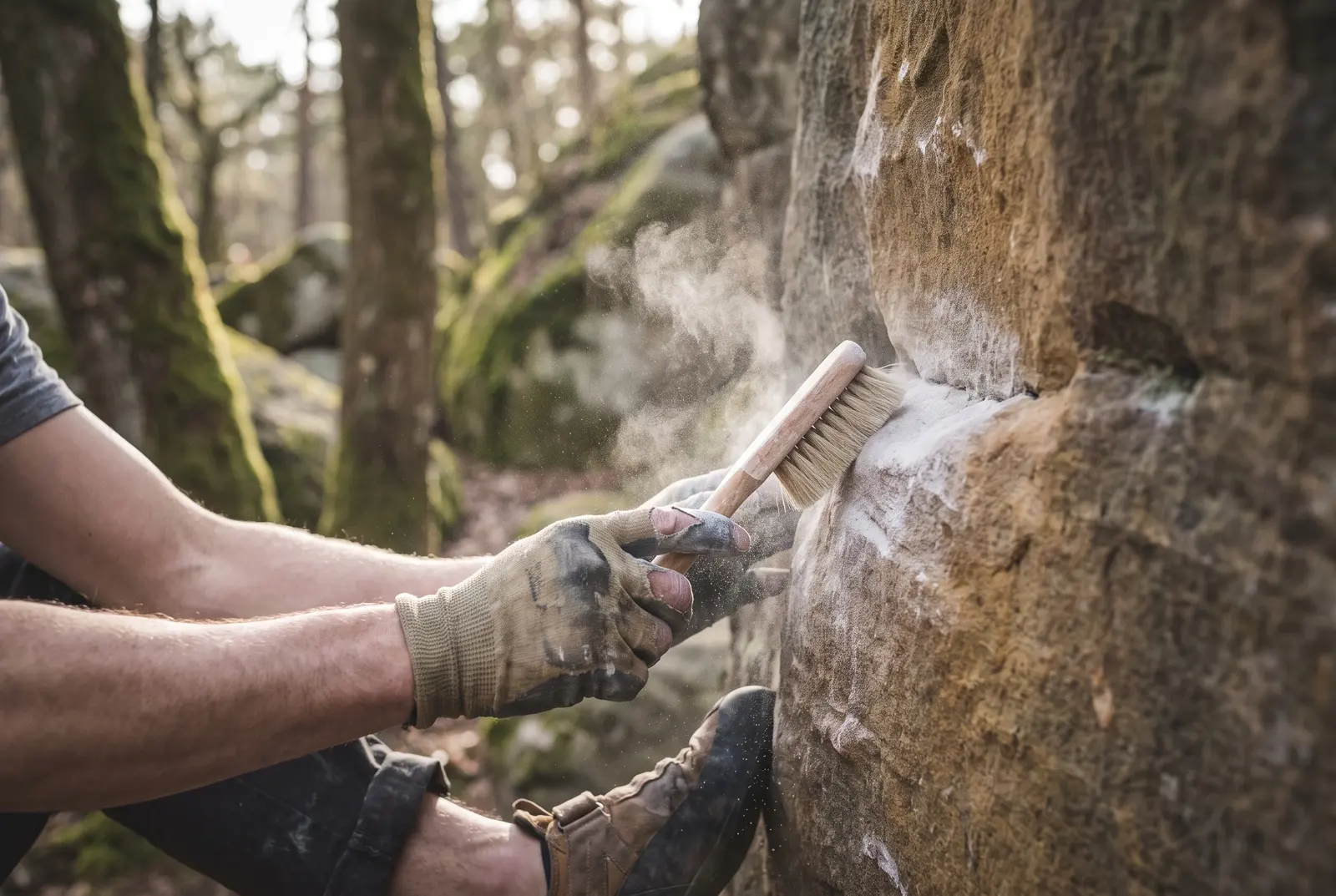
- Brush and clean your shoes. Wipe sand off your soles before every attempt. It helps you stick and stops sand from polishing the holds.
From a conditioning point of view, the bigger risk on a Font trip is volume. Circuits make it easy to do 40+ problems in a day, often far more than you would do indoors. Warm up properly (see our climbing warm-up), plan an easier day after two hard ones, and stop before your skin is worn through. The rough rock files your fingertips quickly. Keep nails short, file down rough edges in the evening, use a moisturiser or climbing balm overnight, and tape only to protect a split while it heals. If you have finger, elbow or shoulder pain, read our injuries section and see a qualified professional rather than climbing through it.
Ethics: how to look after the forest
Most of the forest is state land managed by the Office National des Forêts, and the local climbing community asks visitors to follow a short set of rules. From Bleau.info and the BMC:
- No climbing on wet rock, and don't dry holds with vigorous brushing.
- Use chalk sparingly and brush it off before you leave. Don't make chalk tick marks.
- Brush gently with a soft brush. The BMC suggests a very soft brush rather than a stiff toothbrush-style one.
- Clean your shoes before each attempt.
- Never chip or modify holds.
- Carry, don't drag, your pad, and stay on paths.
- No fires. Smoking is banned in the forest from 1 April to 31 October.
- Keep it quiet: no music or shouting.
- Take all rubbish home and use a toilet before you go into the forest.
- Respect closed areas and fences, including protected reserves, and don't climb on boulders with engravings.
- Dogs must stay close and under control, and on a lead from 15 April to 30 June.
You may also see locals using pof, a resin wrapped in cloth that is a long-standing Bleau tradition. It isn't used by everyone and opinions on it differ. As a first-timer, a little chalk that you brush off afterwards is the simplest choice.
What to pack
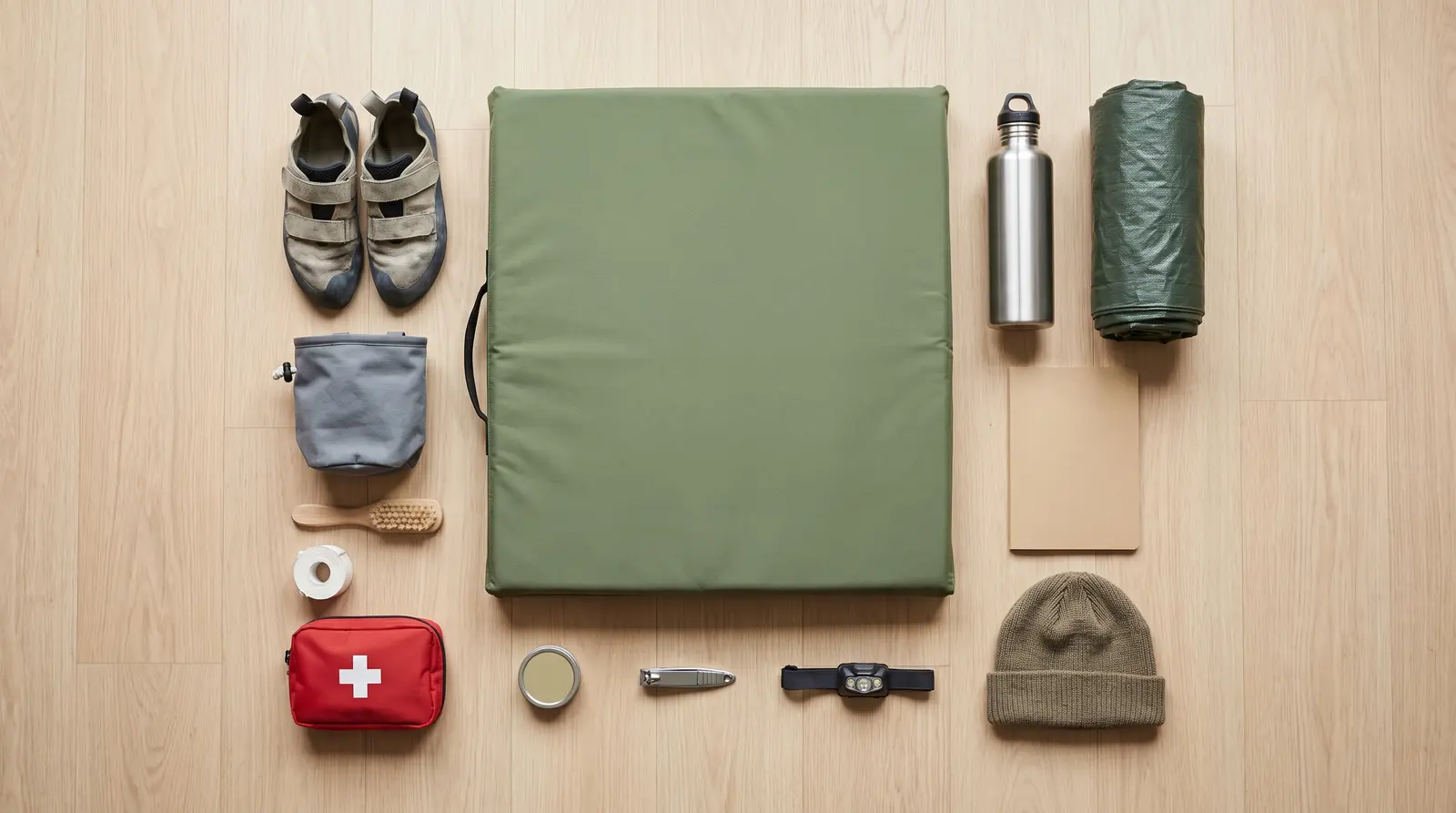
The basics for a Font trip (our full bouldering trip packing list has the details):
- Climbing shoes, ideally a comfortable pair for circuits and a more precise pair for harder problems (see climbing shoes for beginners)
- Crash pad(s), owned or rented
- A soft brush, chalk bag and a small amount of chalk
- A small mat, towel or old cloth for wiping your shoes
- Guidebook and/or the Bleau.info and 27 Crags apps, plus a power bank
- Skin kit: nail clippers, file or sandpaper, balm, finger tape
- Warm layer and rain jacket (forest shade gets cold)
- Water, food and a rubbish bag, since there are few facilities in the forest
- Bike lock if you're travelling car-free
Planning your first trip to Font
A simple plan that works for most first-timers:
- Pick a season (spring or autumn) and a base village that fits your transport.
- Choose 2–3 beginner-friendly areas and keep a backup that dries quickly in case of rain.
- Day 1: a yellow circuit to learn the rock, then try a few orange problems.
- Days 2–3: orange or blue circuits, plus a few individual problems you like.
- Rest or easy day after two or three days on, depending on your skin.
- Check the weather every evening and be ready to swap areas, or take a rest day, if the rock is wet.
Come back with sore skin, a few classic circuits ticked and a better understanding of how to stand on your feet. That's a successful first trip to Font.
FAQ
When is the best time to go bouldering in Fontainebleau?
Spring and autumn are usually the best seasons: temperatures are mild and the rock is more often dry. You can climb year-round on dry days, but summer can be hot and tiring, winter is often damp, and school holidays and Easter are very busy.
Can you go bouldering in Fontainebleau without a car?
Yes, with some planning. Transilien line R runs from Paris Gare de Lyon to Bois-le-Roi and Fontainebleau-Avon, and areas such as Rocher Canon, Le Calvaire and Mont Ussy are within walking or cycling distance of those stations. A bike makes a big difference, and you can take it on line R trains.
Do I need a crash pad in Fontainebleau?
For most problems, yes. Landings are often flat and sandy, and some easy circuits have low boulders, but a pad protects you and the ground under the boulder. If you don't own one, local shops, gyms and some accommodation rent pads; book ahead in busy periods.
Do I need outdoor bouldering experience for Fontainebleau?
No. Font is one of the best places in the world to start bouldering outside, because the easy colour circuits are low, well marked and graded for beginners. Expect the grades to feel harder than in your gym, and start on yellow or orange circuits.
Sources
- Bleau.info, Ethics
- British Mountaineering Council, Escape Paris for the nearby bouldering paradise of Font, by public transport (2024)
- British Mountaineering Council, Best practice for bouldering on sandstone in Font (2024)
- Emily Marty, Bouldering in Fontainebleau: All You Need for a Great First Trip, Climbing House (updated 2025)
- LeShuttle, Bouldering in Fontainebleau (traveller guide)
- Wikipedia, Fontainebleau rock climbing