How to Tape Fingers for Climbing: H-Tape, Ring Tape and Flappers
 Petr Hess, strength & conditioning coach
Updated 2 Nov 2026 · 5 min read
Key takeaways
Best for: Climbers taping for pulley support or skin damage
- Use rigid, non-stretch athletic tape torn into thin strips.
- H-tape is the most recommended method for pulley support after an injury.
- Ring tape works best on the base segment just below the middle joint, not directly over the A2.
- Tape split tips and flappers only as a last resort, anchored around the joint below the wound.
- Evidence that tape prevents injuries is weak; take it off if the finger turns pale, purple or numb.
To tape fingers for climbing, use rigid athletic tape torn into thin strips. For pulley support after an injury, the H-tape is the most commonly recommended method; for split tips and flappers, cover the wound and anchor the tape below the next joint. Tape firmly but never so tight that the finger changes colour or goes numb, and don't expect tape to prevent injuries: the evidence for that is weak.
I'm a strength and conditioning coach, not a physiotherapist. Below are the common taping methods as described by clinicians and climbing sources, plus an honest look at the research.
Why do climbers tape their fingers?
Climbers use tape for two quite different reasons:
- Skin protection: covering split tips, flappers and worn skin so you can finish a session or a climbing trip. Crack climbers also build tape "gloves" over the back of the hand to protect skin from the rock.
- Injury support: wrapping a finger with a strained or ruptured pulley, or a sore joint, during rehab and the return to climbing.
What you need: rigid, non-stretch athletic tape that sticks well. Friction Labs suggests tearing it into strips around ¼ inch (about 6 mm) wide for skin taping; for pulley taping, slightly wider strips are common. Clean, dry skin helps the adhesive hold, so wash off chalk first.
Method 1: H-tape for pulley injuries
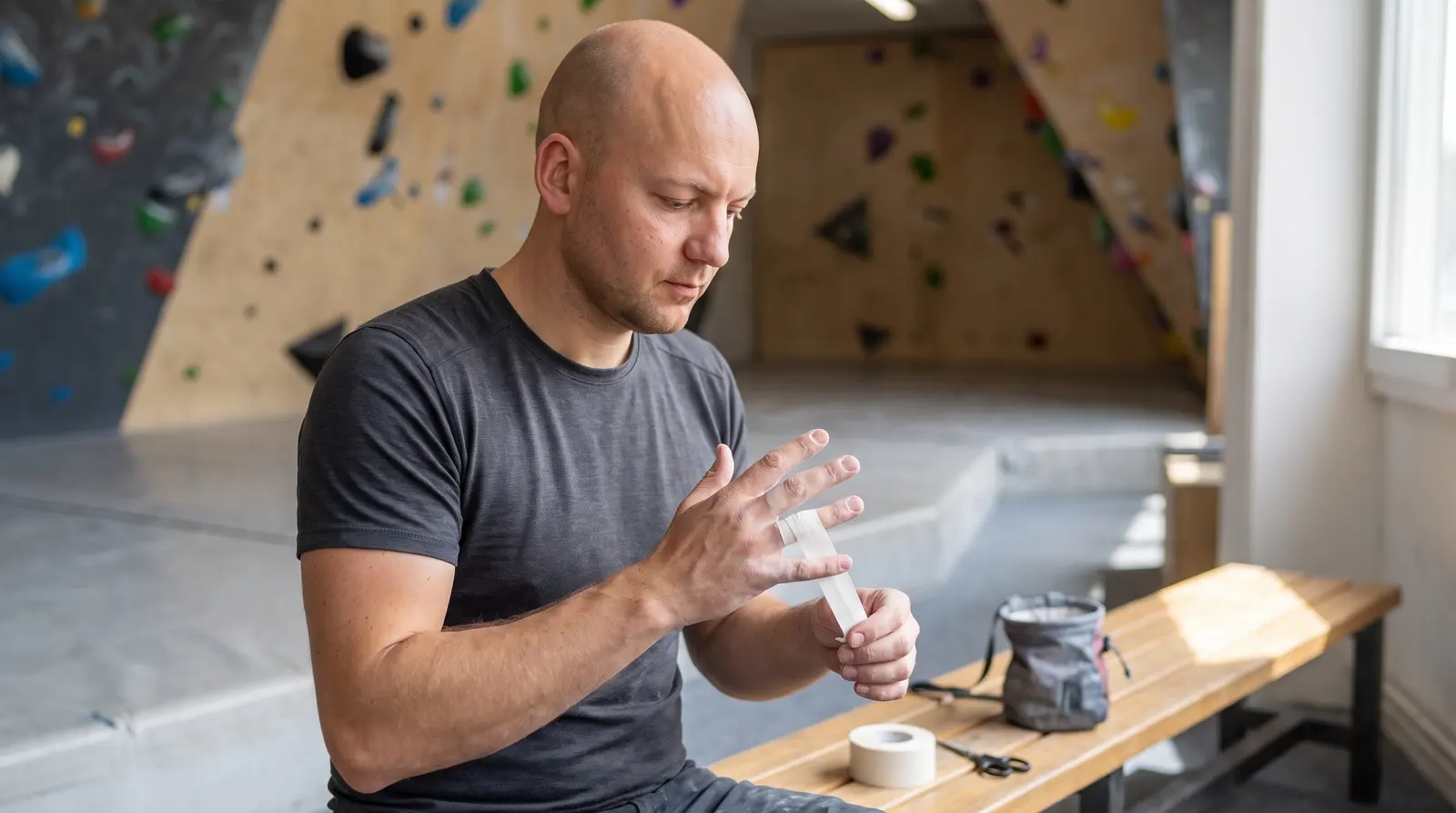
The H-tape was popularised by climbing doctor Volker Schöffl's group for climbers recovering from pulley injuries. It sits around the finger above and below the middle joint, with a bridge on the palm side.
- Tear a strip of tape about 10–12 cm long and 1.5 cm wide (roughly 4–5 × ½ inch).
- Tear or cut it lengthwise from both ends, leaving an uncut bridge of about 1 cm in the middle. You now have an H shape.
- Place the bridge on the palm side of the middle (PIP) joint of the injured finger.
- Wrap one pair of tails around the finger below the joint (over the base segment, where the A2 pulley sits).
- Wrap the other pair above the joint (around the middle segment).
- Press the tape down firmly and check you can still bend the finger.
KletterRetter notes that the tape needs to be quite tight to stay in place while you climb, but that it "will not completely relieve pain or act as a replacement for a pulley". Physiotherapist Carrie Cooper adds that a wider bridge restricts bending more, which can be useful early in rehab.
Method 2: Ring (circumferential) tape
The simplest pulley tape is a ring wrapped around the finger. Placement matters: in Schweizer's 2000 study, tape placed directly over the A2 pulley reduced bowstringing by only 2.8%, while tape placed at the far end of the base segment, just below the middle joint, reduced it by 22%.
- Tear a strip about 1–1.5 cm wide.
- Wrap it around the base segment of the finger, just below the middle joint, overlapping each turn enough to hold.
- Keep the tape flat with no wrinkles, and smooth the end down.
- Bend and straighten the finger. It should feel snug, not painful.
Method 3: Split tips and flappers
For skin, the goal is to cover the wound without losing too much feel. IndiRock calls fingertip taping a "last resort" because it reduces sensitivity and friction.
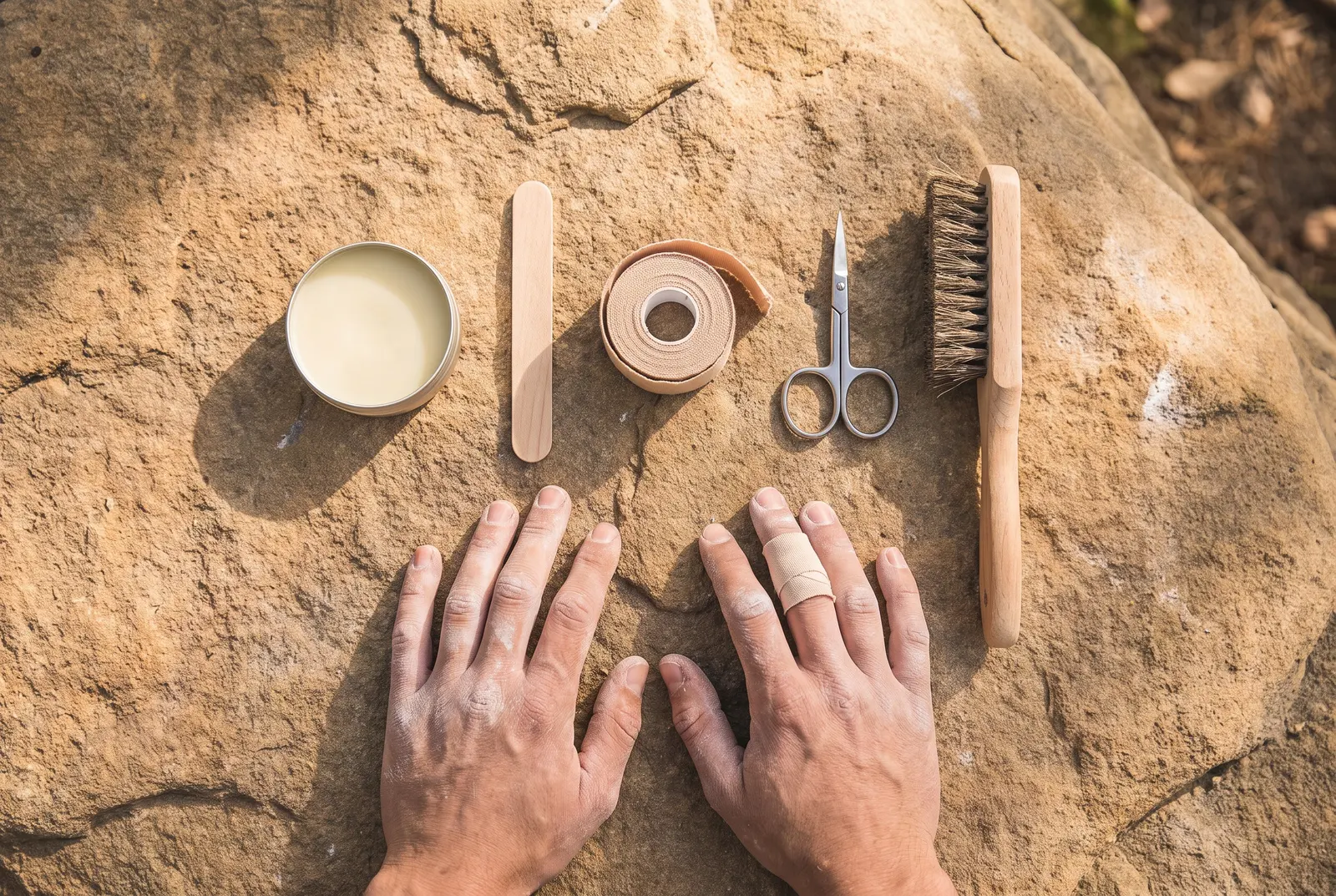
For a flapper or cut on the finger:
- Stop any bleeding and clean the wound first.
- Lay a thin strip of tape on the back of the finger and wrap it over the wound, overlapping a few times.
- Anchor the end around the joint below the wound so it doesn't peel off on the first move.
For a split or worn fingertip:
- Lay a 5–10 cm strip lengthwise over the fingertip, from the pad over to the nail side.
- Wrap a second strip around the finger, starting high and working down, to hold the first one in place.
Friction Labs is honest that tape on a flapper won't last long or offer much protection. Often the better call is to end the session and let the skin heal.
How tight should finger tape be?
Firm enough that it doesn't roll or slide, loose enough to keep blood flowing. As IndiRock puts it: "Don't tape too hard! You don't want it to hurt or to have a purple finger." Take the tape off and reapply it if your finger turns pale or purple, throbs, or feels numb or tingly. Take tape off after the session rather than leaving it on for days.
Does taping actually work? What the evidence says
The research on pulley taping is small and mostly low quality, so be cautious about any strong claims:
| Question | What studies found | Certainty |
|---|---|---|
| Does tape reduce bowstringing of the flexor tendons after pulley injury? | Circular and H-tape reduced it by about 15–22% | Low to moderate |
| Does tape reduce force on the A2 pulley? | Circular tape reduced it by about 11–12% | Low |
| Does tape stop a pulley from rupturing? | No difference in rupture force in cadaver studies | Very low to low |
| Does tape make healthy fingers stronger? | No effect on strength or muscle activation | Moderate |
| Does H-tape help crimp strength after injury? | Increased single-finger crimp strength by 13% | Low |
Source: Larsson and colleagues' 2022 systematic review, which concluded that no firm recommendations for taping can be made. Schweizer called circular taping "minimally effective" at relieving force on the A2 pulley and "probably ineffective in preventing pulley ruptures".
In practice, that means:
- Tape can help as a supporting tool during rehab and the return to climbing, and for covering damaged skin.
- Tape doesn't help as everyday injury prevention on healthy fingers. Carrie Cooper warns that habitual taping "for the sake of taping" isn't a good idea, and suggests weaning off tape as the finger recovers.
- Tape is never a reason to keep crimping on an injured pulley. The Larsson review stresses that progressive loading through exercise should be the main focus of rehab.
If you're taping because of a pulley injury, read our guide to the A2 pulley injury to understand grading, rehab and when to see a specialist.
Quick reference: which tape for which problem
| Problem | Method | Where it goes | Watch out for |
|---|---|---|---|
| Recovering pulley injury (A2, A3) | H-tape | Around the finger above and below the middle joint, bridge on the palm side | Use it during rehab and return to climbing, not as a substitute for loading |
| Pulley support, simple option | Ring tape | Base segment, just below the middle joint, not directly over the A2 | Placement matters more than the number of turns |
| Split tip or flapper | Wound cover | Over the cleaned wound, anchored around the joint below | Costs feel and friction, so treat it as a last resort |
| Healthy fingers | No tape | None | The evidence doesn't support taping to prevent injuries |
Whatever you tape, check the finger stays a normal colour and has normal feeling, and take the tape off after the session.
FAQ
Does taping your fingers prevent climbing injuries?
There is no good evidence that it does. A biomechanical study by Schweizer found circular taping only minimally reduced the force on the A2 pulley and called it probably ineffective at preventing ruptures, and a 2022 systematic review found taping had no effect on strength in uninjured climbers.
How tight should climbing finger tape be?
Firm enough that it doesn't slide during climbing, but never so tight that your finger goes pale, purple, numb or tingly. If any of that happens, take the tape off and reapply it looser.
Is H-tape better than ring tape?
H-tape is the method most often recommended after a pulley injury. In the research reviewed by Larsson and colleagues, both circular tape and H-tape reduced bowstringing of the flexor tendons by about 15 to 22%, and H-tape improved crimp strength in previously injured climbers. The evidence is limited, so neither should be seen as protection.
What tape should I use for climbing?
Use rigid, non-stretch athletic tape that sticks well and tears easily into thinner strips. Stretchy kinesiology tape won't give the same support for pulley taping.
Sources
- Schweizer A. Biomechanical effectiveness of taping the A2 pulley in rock climbers. J Hand Surg Br (2000)
- Larsson R, Bernhardsson C, Nilsson L. To tape or not to tape: annular ligament (pulley) injuries in rock climbers, a systematic review. BMC Sports Sci Med Rehabil (2022)
- Carrie Cooper DPT, To Tape or Not To Tape: H-Taping
- KletterRetter, How to tape pulley injuries (updated 2022)
- IndiRock, Climbing tape: why and how to use it (2023)
- Friction Labs, How To Tape Hands and Fingers for Rock Climbing