Climbing Finger Injuries: Types, Symptoms and Rehab Guide
 Petr Hess, strength & conditioning coach
Updated 2 Nov 2026 · 8 min read
Key takeaways
Best for: Climbers with finger pain who want to know what it might be
- Fingers and hands account for roughly half of climbing injuries; pulley injuries alone make up about 15–20%.
- Most finger problems are pulley strains, tendon sheath irritation (tenosynovitis) or joint capsulitis.
- A pop, swelling or bruising on the palm side, bowstringing or a finger you can't bend fully all need a professional assessment.
- Rehab follows the same pattern: short protection, relative rest, then progressive loading set by whoever diagnosed it.
- Finger pain in teenagers can be a growth plate injury and should always be checked.
Most climbing finger injuries fall into a few groups: pulley strains and ruptures (the most common), flexor tendon and lumbrical injuries, tendon sheath irritation (tenosynovitis), joint capsule problems (capsulitis) and, in teenagers, growth plate stress injuries. A sudden pop, swelling, bruising or a finger you can't bend normally needs a professional diagnosis. Milder overuse pain usually responds to reducing load early, before it turns into a long layoff.
I'm a strength and conditioning coach, not a doctor or physiotherapist. This guide explains the common injuries in plain language so you know what you might be dealing with and when to get help. It does not replace a diagnosis.
Why climbers hurt their fingers
The hand and fingers are the most commonly injured area in climbing. A 2022 systematic review by Larsson and colleagues put fingers and hands at 42–65% of all climbing injuries, with pulley injuries alone making up about 15–20%. A 2026 scoping review of 45 studies came to the same conclusion: across bouldering and sport climbing, the hand and fingers top the list.
The reason is load. Each finger has two flexor tendons that bend it. Five ring-shaped bands called annular pulleys (A1 to A5) hold those tendons close to the bone. When you crimp a small edge, the tendons pull hard against the pulleys, especially A2 at the base of the finger and A4 near the middle joint. According to the Larsson review, the A2 pulley regularly takes forces of up to around 380 N in climbing, and a full crimp can load it up to 36 times more than an open-hand grip.
A 2023 systematic review of risk factors for overuse injuries (Quarmby et al.) found that higher climbing intensity, bouldering, lower finger strength, frequent use of the crimp grip and a previous injury were all linked with a higher risk. Interestingly, warm-up, stretching and taping were not linked with lower risk in the studies they reviewed, although the evidence is limited.
The main types of climbing finger injuries
| Injury | Typical cause | Where it hurts | Typical signs |
|---|---|---|---|
| Pulley strain or rupture (A2, A4) | Hard crimping, foot slip, sudden load | Palm side of the finger, at the base or near the middle joint | Pop or tearing feeling, local pain, swelling, pain when crimping |
| Flexor tenosynovitis | Overuse, sudden increase in volume | Along the palm side of the finger | Diffuse ache, sometimes swelling, worse after climbing |
| Capsulitis / synovitis | Repeated crimping, twisting, knocks | Back or sides of the middle (PIP) joint | Swollen, stiff joint, dull ache, often eases once warm |
| Lumbrical strain or tear | Pockets and split-finger positions | In the palm | Palm pain when one finger is straight and its neighbours bent |
| Growth plate stress injury (youth) | High finger loads during growth | Middle (PIP) joint of the finger | Joint pain and swelling in a teenager |
Pulley strain and pulley rupture
Pulley injuries are the classic climbing finger injury. Most affect the A2 pulley, followed by A4, and in several studies the ring finger is the one most often hurt. Some climbers feel pain for a few weeks before a rupture; others get a sudden injury with no warning. Common symptoms listed in a 2022 review by Bosco and colleagues include a tearing sensation, sometimes a loud pop, local pain, swelling, tenderness and bruising over the pulley, plus weakness and pain when gripping.
Doctors usually grade pulley injuries with the Schöffl system:
| Grade | What it means | Usual management |
|---|---|---|
| 1 | Pulley strain | Conservative: functional therapy, taping |
| 2 | Partial A2 or A3 rupture, or complete A4 rupture | Conservative: short immobilisation, then functional therapy and taping |
| 3 | Complete A2 or A3 rupture | Usually conservative with a protective ring; debated |
| 4 | Multiple ruptures, or rupture plus another injury | Surgical repair |
Ultrasound is the main imaging tool; the Bosco review reports a sensitivity of 98% and specificity of 100% for it, with MRI used when doubt remains. For the full picture see our guide to the A2 pulley injury, and for timelines read how long an A2 pulley takes to heal.
Flexor tendon injuries and tenosynovitis
The flexor tendons and the sheath around them can also get irritated. Tenosynovitis means irritation or inflammation of that tendon sheath. Volker and Isabelle Schöffl, two of the best-known climbing medicine researchers, describe it as one of the most frequent finger problems in climbers alongside pulley injuries. It is usually an overuse problem that builds up when climbing volume or intensity rises faster than the tissue can cope. The pain tends to be more spread out along the finger than the pinpoint pain of a pulley injury.
More serious tendon injuries, such as a tendon pulling off the bone, are rare but need urgent care. A finger you suddenly cannot bend at the tip is a reason to see a doctor the same day.
Lumbrical injuries
The lumbricals are small muscles in the palm that attach to the deep flexor tendons. Because neighbouring fingers share a tendon system, holding one finger straight while the others bend (as in one- or two-finger pockets) can strain them. In a 2018 study of 60 patients with lumbrical tears, 57 were climbers. Injuries were graded I to III, everyone was treated with adapted functional therapy, and all returned to climbing, although grade III tears took significantly longer to heal.
Capsulitis and joint injuries
Capsulitis (or synovitis) is irritation of the capsule around a finger joint, most often the middle (PIP) joint. A 2023 clinical paper by Jared Vagy describes it as the second most common finger injury in climbers, accounting for roughly 6–10% of all climbing injuries. The typical picture is a puffy, stiff joint with a dull ache on the back or sides, which often feels better once you warm up. That "it's fine after the warm-up" feeling is exactly why capsulitis tends to linger: climbers keep loading it. Collateral ligament sprains at the side of the joint can look similar and are worth having checked.
Growth plate injuries in young climbers
Climbers who are still growing have open growth plates at the ends of their finger bones, and these are weaker than adult bone. A 2025 scoping review pooled 149 growth plate stress injuries in 98 adolescent climbers aged 10 to 18 (average 14). Almost all of them (98%) were at the PIP joint, and most were fractures. Return to climbing took anything from 2 weeks to 6 months, and 91% got back to climbing. Early diagnosis matters, so any persistent finger joint pain in a teenage climber should be seen by a doctor, not taped and ignored.
Symptoms and red flags: when to see a professional
Many minor tweaks settle with a short period of reduced load. These signs mean you should stop climbing and get a proper assessment:
- You heard or felt a pop, followed by pain.
- Swelling or bruising on the palm side of the finger.
- Bowstringing: the tendon visibly lifts away from the bone when you bend the finger against resistance.
- You can't fully bend or straighten the finger, or it looks deformed.
- Numbness, tingling or a change in colour of the finger.
- Finger joint pain in a climber who is still growing.
- Pain that gets worse, or doesn't improve after a couple of weeks of easier climbing.
Look for a doctor, hand specialist or physiotherapist who sees climbers. Ask about ultrasound if a pulley injury is suspected. A clear diagnosis tells you which grips are safe and saves you guessing.
Rehab: the general principles
Rehab depends on the exact injury, so your plan should come from the person who diagnosed it. Most finger rehab protocols in the research share a few principles:
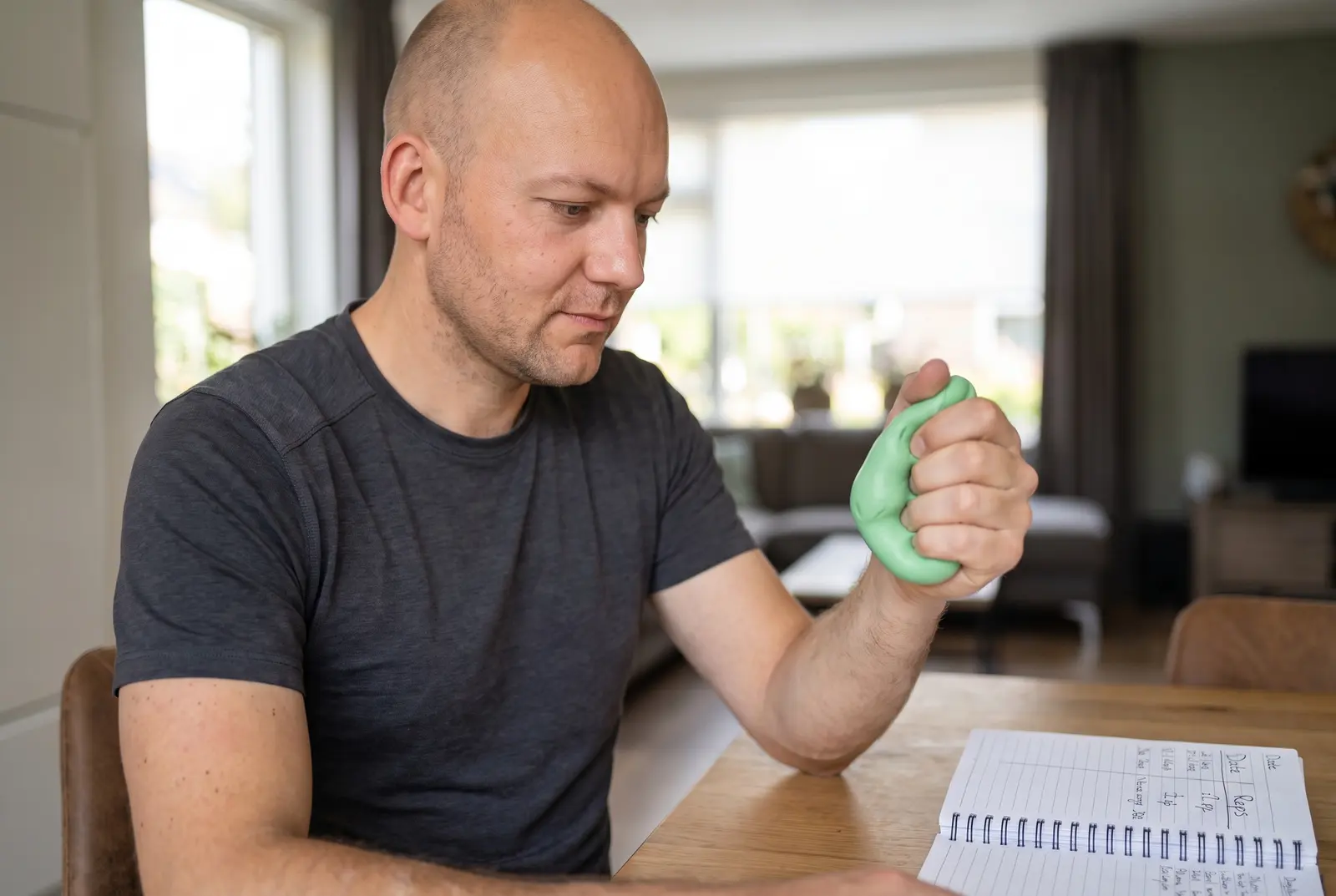
- Short protection phase. More serious pulley injuries may need around 10 to 14 days of immobilisation in the Schöffl protocol; minor ones may not need any.
- Relative rest, not total rest. Avoid the grips that hurt (usually crimps) while keeping the rest of your training going.
- Progressive loading. The Larsson review stresses that the main focus of pulley rehab should be progressive tissue loading through exercise, with taping only as an extra.
- Gradual return to climbing. Start on big holds with an open hand, then add smaller holds and crimping last.
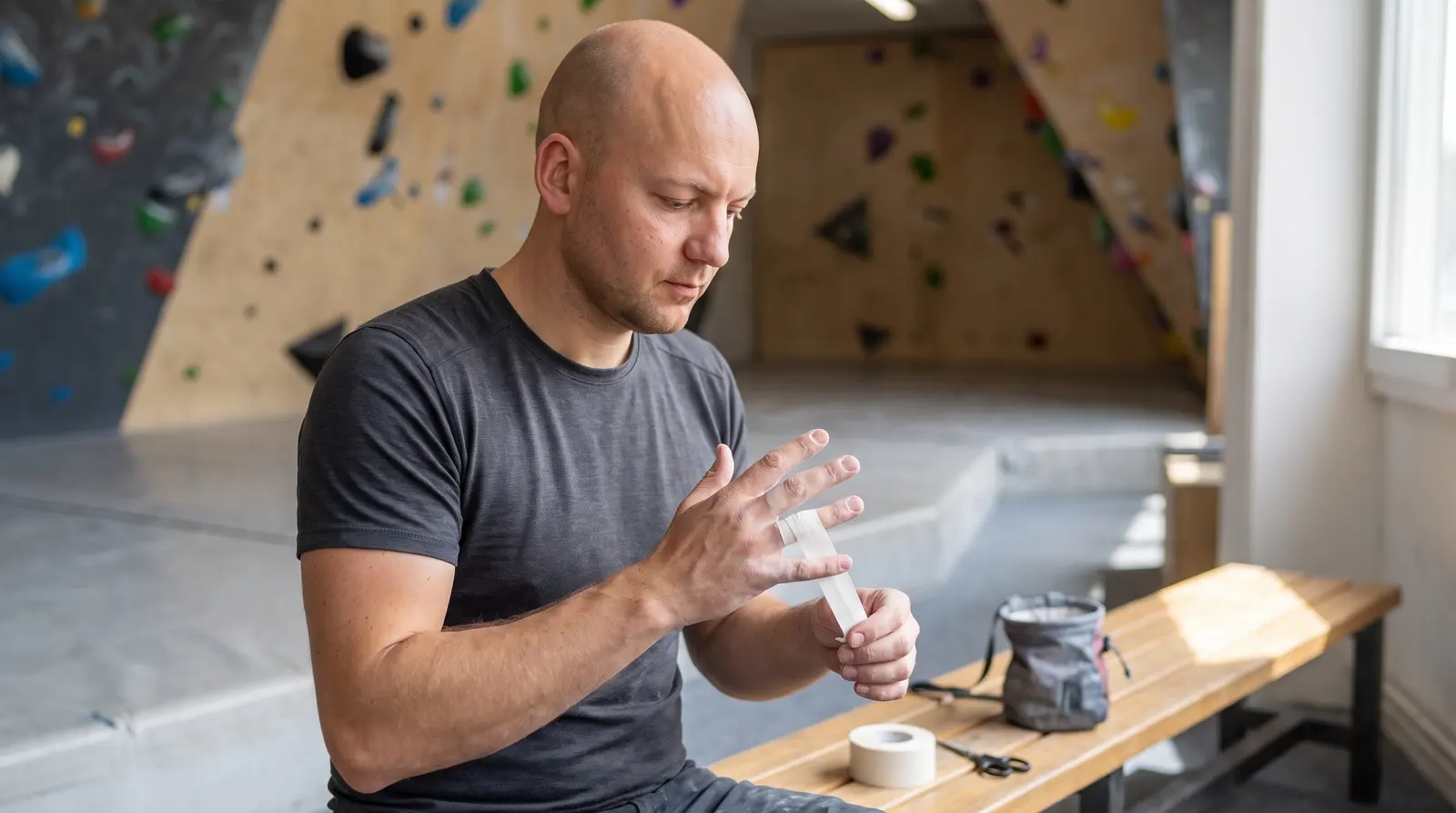
In Schöffl's protocol, grade 1–2 pulley injuries typically return to climbing after six to eight weeks and grade 3 injuries after about three months, often with protective taping for several months afterwards. Taping is common in rehab, but the evidence for it is limited; our guide on how to tape fingers for climbing explains what tape can and can't do.
Preventing finger injuries
No routine removes all risk, but the risk factors above point to sensible habits:
- Build load gradually. Increase climbing volume, intensity or finger training one step at a time. Sudden jumps are a common trigger for overuse injuries.
- Train finger strength sensibly. Lower finger strength is a risk factor, so stronger fingers help, but only with controlled, progressive loading. Our guide to safe, structured hangboard training covers dosage and readiness.
- Use more open-hand grips. The full crimp puts by far the most load on the A2 pulley. Keep crimping, but don't make it your only grip.
- Warm up properly. The research on warm-ups and injury risk is unclear, but a gradual build-up prepares you for hard moves. Use our climbing warm-up routine.
- Respect early warning signs. Pain that lingers into the next day is a signal to reduce load, not to tape up and push through.
- Protect young climbers. No maximal hangboarding or campusing during growth spurts, and get finger pain checked early.
Finger problems often travel up the arm, too. If your elbow aches after hard sessions, read about climber's elbow.
The bottom line
Most climbing finger injuries are pulley strains, tendon sheath irritation or joint capsulitis, and most heal well with the right diagnosis and a patient, progressive return. The biggest mistakes are ignoring a pop, climbing through pain that keeps coming back, and assuming a teenager's sore finger is "just a tweak". When in doubt, get it checked.
FAQ
What is the most common climbing finger injury?
Injuries to the finger flexor pulleys, mostly the A2 and A4 pulleys. A 2022 systematic review estimated that pulley injuries make up about 15 to 20% of all climbing injuries. Capsulitis of the middle finger joint is reported as the second most common finger problem.
How do I know if my finger injury is serious?
See a doctor or hand specialist promptly if you heard or felt a pop, have swelling or bruising, can see the tendon lifting away from the bone when you bend the finger, cannot bend or straighten the finger normally, or have numbness. Any finger joint pain in a climber who is still growing should also be checked.
How long does a climbing finger injury take to heal?
It depends on the injury and its grade. In Schöffl's treatment protocol, mild pulley injuries (grade 1 to 2) typically allow a return to climbing after about six to eight weeks and grade 3 injuries after about three months. Overuse problems such as capsulitis can take longer if the load is not managed.
Should I stop climbing with a finger injury?
Stop the activity that hurts and get a diagnosis if the pain is sharp or came with a pop. For mild overuse pain, many clinicians use relative rest: reducing intensity and avoiding painful grips rather than stopping all movement. A physiotherapist or doctor can tell you what is safe for your specific injury.
Sources
- Larsson R, Bernhardsson C, Nilsson L. To tape or not to tape: annular ligament (pulley) injuries in rock climbers, a systematic review. BMC Sports Sci Med Rehabil (2022)
- Bosco F et al. Closed flexor pulley injuries: A literature review and current practice. J Orthop (2022)
- Vagy J. Clinical management of finger joint capsulitis/synovitis in a rock climber. Front Sports Act Living (2023)
- Lutter C, Schweizer A, Schöffl V et al. Lumbrical muscle tear: clinical presentation, imaging findings and outcome. J Hand Surg Eur Vol (2018)
- Finger growth plate injuries in adolescent sport climbers: A scoping review. PM&R (2025)
- Quarmby A et al. Risk factors and injury prevention strategies for overuse injuries in adult climbers: a systematic review. Front Sports Act Living (2023)