Climber's Elbow: Causes, Exercises & Can You Keep Climbing?
 Petr Hess, strength & conditioning coach
Updated 2 Nov 2026 · 7 min read
Key takeaways
Best for: Climbers with pain on the inside, outside or front of the elbow
- Climber's elbow is usually forearm tendon overuse: inside (like golfer's elbow) or outside (like tennis elbow).
- Tendon pain is local and hurts on loading; nerve pain spreads, burns or tingles into the ring and little finger.
- Exercise beats passive treatment, but modestly; no single exercise type is clearly best.
- Rehab usually runs calm it down → isometrics → slow strengthening, with the dose set by a physio.
- You can often keep climbing by changing what you climb: less crimping, campusing and big dynamic moves.
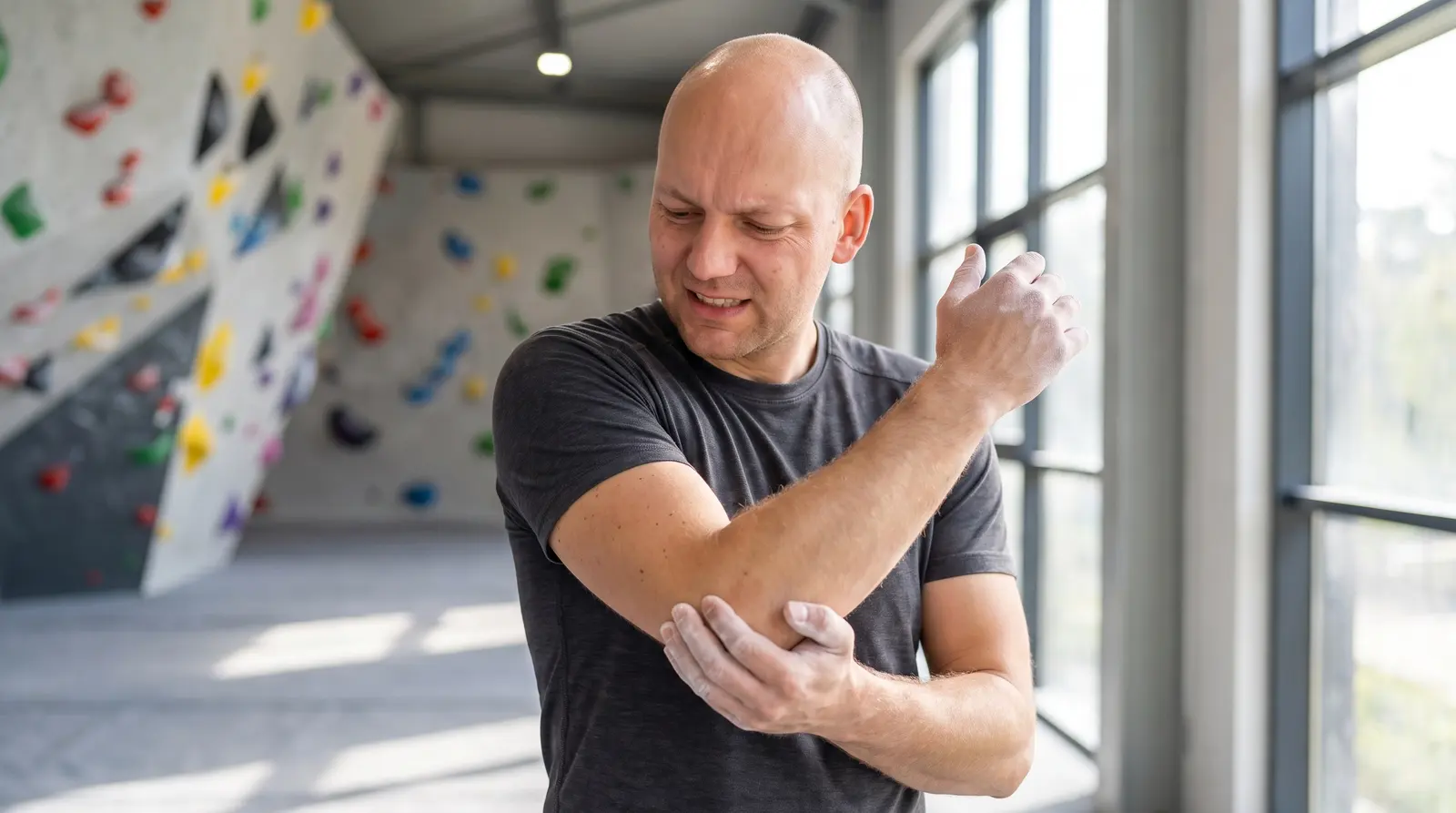
Climbing elbow pain is usually an overuse problem of the forearm tendons: on the inside of the elbow (like golfer's elbow) or on the outside (like tennis elbow). Less often it comes from the brachialis muscle at the front of the elbow or from an irritated nerve. Most tendon cases respond to a period of smarter loading and progressive strength exercises rather than complete rest, but numbness, weakness or sudden sharp pain need a professional assessment.
I'm a strength and conditioning coach, not a physiotherapist or doctor. This article summarises what the research and climbing clinicians say, in general terms. It can't tell you what is wrong with your elbow.
What is climber's elbow?
"Climber's elbow" is not one diagnosis. Climbers use the name for any overuse pain around the elbow, and different sources apply it to different structures. The elbow sits at the end of the forearm muscles that grip every hold, so it takes a share of the same load that strains fingers. If you also have finger pain, our guide to climbing finger injuries covers the pulleys and tendons further down the chain.
The four common sources of elbow pain in climbers:
| Type | Where it hurts | Often provoked by |
|---|---|---|
| Medial (golfer's elbow) | Inside of the elbow, bony point and the forearm just below it | Small crimps, slopers, compression, gastons, hard gripping |
| Lateral (tennis elbow) | Outside of the elbow | Sidepulls, crimping |
| Brachialis strain | Deep in the front of the elbow | Pulling hard from straight, locked-out arms |
| Ulnar nerve irritation | Inside of the elbow plus tingling into the ring and little finger | Long periods with the elbow bent, leaning on the elbow |
Medial elbow pain (golfer's elbow)
This is the classic climber's elbow. Pain sits on the inside of the elbow, where the wrist and finger flexor muscles and the pronator teres attach to the medial epicondyle. A physiotherapy clinic in Colorado that treats many climbers describes it as a localized tendinopathy of these flexor-pronator tendons, aggravated by small crimps, slopers, compression moves and repetitive gripping. The usual story is a jump in load: more sessions, a new board, a crimpy project or a hangboard block started too fast.
Lateral elbow pain (tennis elbow)
Pain on the outside of the elbow involves the wrist and finger extensors, which stabilise the wrist every time you grip. It is the same problem as tennis elbow (lateral epicondylalgia, also called lateral epicondylitis), and it is where most of the research on elbow tendinopathy comes from. A physiotherapist writing for Climbing magazine lists sidepulls and crimping as typical triggers.
Brachialis strain
The brachialis sits under the biceps and is the main elbow flexor in every forearm position, so it works hard on every pull. Kenhub's anatomy library describes climber's elbow as brachialis tendonitis from forceful contraction, especially when you pull up from a hyperextended (fully straight) elbow. Typical signs are a gradual ache at the front of the elbow, sometimes swelling, and stiffness when straightening the arm.
Nerve problems
Not all elbow pain is a tendon. The ulnar nerve runs behind the inner elbow (the "funny bone"). Irritation there, called cubital tunnel syndrome, causes elbow pain with numbness and pins and needles in the ring and little finger, and later hand weakness, according to the Merck Manual. Keeping the elbow bent for long periods and leaning on it make it worse. Nerve symptoms are a reason to see a clinician rather than self-treat.
Tendon or nerve? Quick clues
- Tendon pain is usually local, you can often press on a tender spot, and it hurts when you load the muscle (gripping, lifting a kettle or a bag).
- Nerve pain tends to spread, burn or tingle, and often involves the pinky and ring finger. It often gets worse with the elbow bent for a long time.
These are clues, not tests. A physiotherapist or sports doctor can tell the difference properly, and they can also rule out ligament problems and neck-related pain that can feel similar.
What the evidence says about exercises
Most of the research is on lateral elbow tendinopathy in non-climbers, so we have to borrow from it carefully. The main points:
- Exercise beats passive treatment, but modestly. A 2021 systematic review by Karanasios and colleagues (30 trials, 2,123 patients) found that exercise did better than passive treatments and corticosteroid injections for lateral elbow tendinopathy. The effect was small and the certainty of evidence low.
- Eccentrics are not magic. The same review found no difference between eccentric-only and combined concentric-eccentric programs.
- Isometrics are an option, not a cure. A 2020 meta-analysis by Clifford and colleagues found isometric exercise was not superior to isotonic exercise for pain relief in tendinopathy, though it may suit some people as part of a progressive program.
- The FlexBar "Tyler Twist" has small-trial support. In a trial of about 21 patients with tennis elbow, adding a daily eccentric wrist extensor exercise with a rubber bar (3 sets of 15, slow lowering) improved pain more than standard therapy. The sample was small and the summary's author worked for the bar's manufacturer.
A general loading approach
Clinicians usually progress tendon rehab in stages. Use this as a picture of how it works, and let a physiotherapist set your actual starting point and dose.
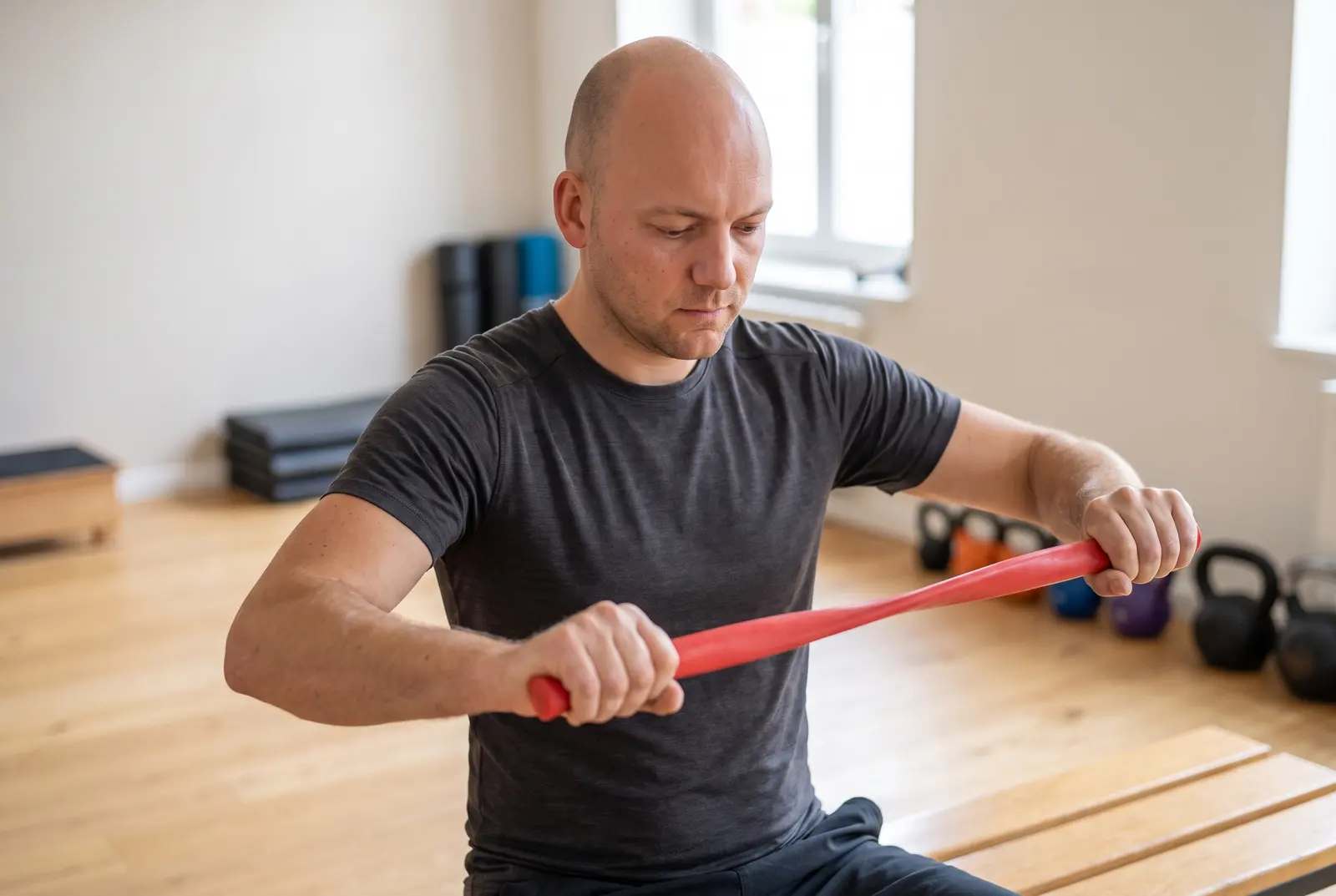
- Calm it down. Reduce or stop the moves that provoke pain. A physio writing for Climbing magazine suggests mid-range isometric holds (around 45 seconds, five reps, two to three times a day) while pain is irritable.
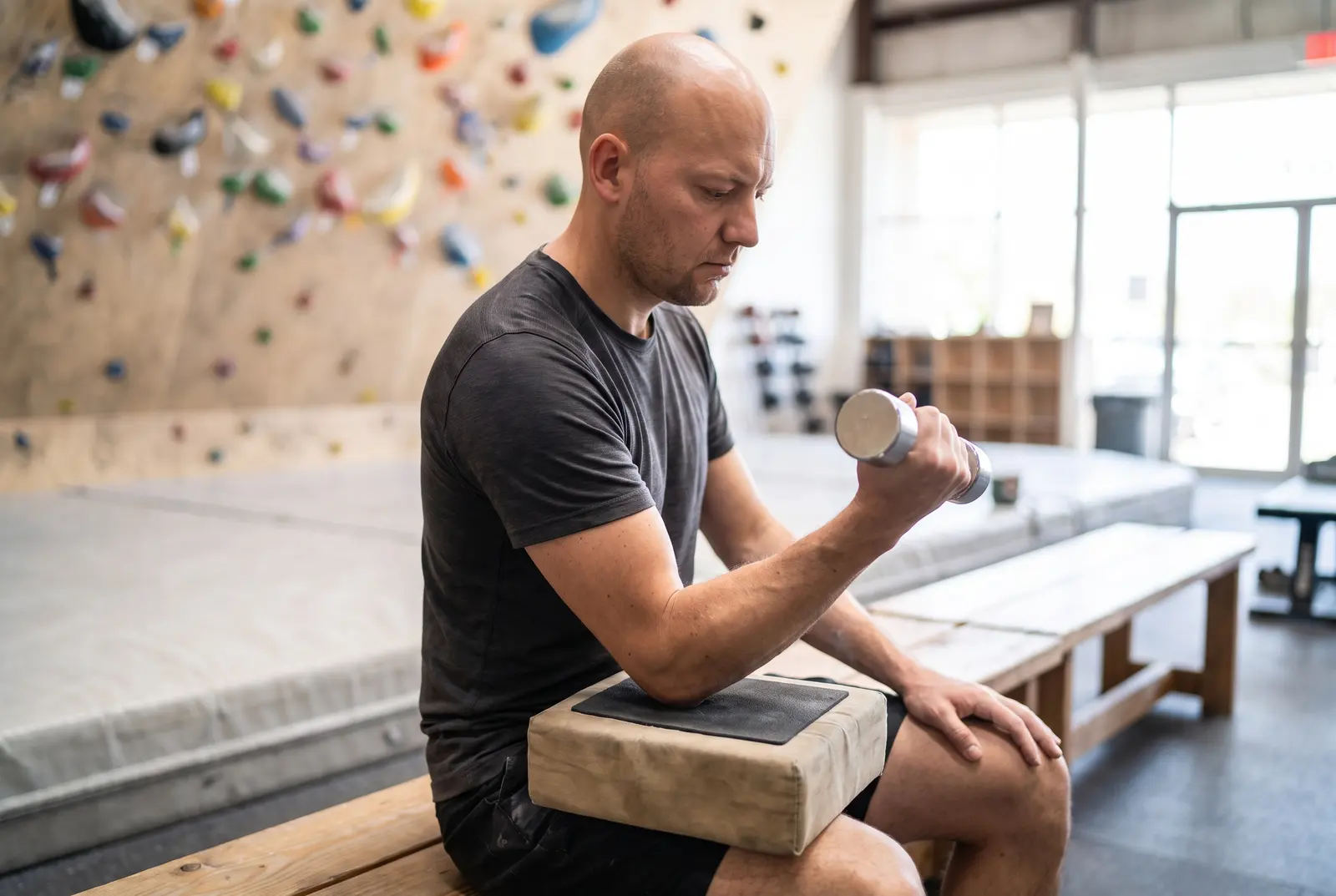
- Load it slowly. Move on to slow wrist curls (palm up for the inside of the elbow, palm down for the outside), pronation or supination with a hammer, and finger curls. Slow reps with a light weight you can control are the usual start; the FlexBar trial above used 3 sets of 15 daily.
- Load it heavier. For long-standing tendon pain, the same Climbing article recommends heavier, slower loading about three times per week, accepting a mild, familiar level of pain that settles afterwards.
- Return to climbing. Rebuild volume on big holds first, then add intensity. Progress only when the exercises and modified climbing feel fine the next day.
Beyond the elbow itself, stronger shoulders and better pulling mechanics may share the load. Push-ups, presses, rotator cuff and extensor work belong in most climbers' weeks anyway; see our guide to antagonist training for climbers for a simple routine.
Can you keep climbing?
Often, yes, in a modified way. Many climbers keep climbing through mild tendon pain by changing what they climb, not just how much. Practical ways to modify activity:
- Avoid campusing, big dynamic moves to bad holds, mantles and the specific hold types that hurt.
- Swap crimpy board sessions for slab, vertical walls and open-hand holds.
- Pause hangboarding and pull-up training while pain is flaring.
- Never increase volume and intensity at the same time when you return.
- Track pain during climbing and the next morning. Pain that builds from session to session means the load is too high.
If you have a recent, irritable flare-up, a short break from hard climbing may be needed until daily activities are pain-free. Long-standing tendon pain usually takes months, not weeks: one physio describes tendon remodeling as taking around three to four months.
When to see a professional
See a physiotherapist or doctor if:
- you felt a pop, sudden sharp pain or noticed swelling or bruising during a move;
- you have numbness, tingling or weakness in the hand, especially the ring and little finger;
- you can't fully straighten or bend the elbow;
- the pain wakes you at night or is there at rest;
- the pain is not improving after two to three weeks of reduced load, or keeps returning.
The good news is that most climbing elbow pain is a load problem with a load solution. Get a proper diagnosis, change what irritates it, and build strength back up patiently.
FAQ
Is climber's elbow the same as tennis elbow?
Not exactly. Climbers use the name for several problems. Pain on the outside of the elbow is usually the same tendon problem as tennis elbow (lateral epicondylalgia), pain on the inside is like golfer's elbow (medial epicondylalgia), and some sources use climber's elbow for brachialis pain at the front of the elbow.
Can I keep climbing with elbow pain?
Often yes, in a modified way, if the pain is mild, settles quickly and does not build from session to session. Cut the moves and holds that provoke it and avoid raising volume and intensity at the same time. Sharp pain, swelling, numbness or pain that keeps getting worse are reasons to stop and get assessed.
How long does climber's elbow take to heal?
It varies a lot. A recent flare-up may settle within weeks with load changes, while long-standing tendon pain often needs a few months of consistent exercise. One physiotherapist writing for Climbing magazine describes tendon remodeling as taking around three to four months.
Are eccentric exercises the best treatment?
Eccentrics are a reasonable option, but they are not clearly better than other strengthening. A 2021 systematic review on lateral elbow tendinopathy found no difference between eccentric-only and combined concentric-eccentric programs, and the certainty of evidence was very low.
Sources
- Karanasios S. et al., Exercise interventions in lateral elbow tendinopathy have better outcomes than passive interventions, but the effects are small (BJSM blog summary of the systematic review, 2021)
- Clifford C. et al., Effectiveness of isometric exercise in the management of tendinopathy: a systematic review and meta-analysis of randomised trials, BMJ Open Sport & Exercise Medicine (2020)
- Page P., A new exercise for tennis elbow that works! (summary of Tyler et al.), North American Journal of Sports Physical Therapy (2010)
- Climbing Magazine, How Climbers Recover From Chronic Elbow Injuries (2022)
- Mend Colorado, Medial Elbow Pain in Rock Climbers (2021)
- Steinberg DR., Cubital Tunnel Syndrome, Merck Manual Consumer Version (2024)