Antagonist Training for Climbing: 8 Exercises That Matter
 Petr Hess, strength & conditioning coach
Updated 2 Nov 2026 · 5 min read
Key takeaways
Best for: Climbers wanting balanced shoulders and forearms
- Target pushing muscles, rotator cuff external rotators, shoulder blade muscles and forearm extensors.
- Do two 20-minute sessions a week, running exercises as supersets with about 60 seconds' rest.
- Core exercises include push-ups, dips, overhead press, band external rotation, Y and T raises and reverse wrist curls.
- Add a little weight or a harder variation once you hit the top of the rep range on every set.
- Do antagonist work after climbing or hangboarding, leaving the wrist exercises for last.
Antagonist training for climbing means strengthening the muscles that do the opposite of pulling and gripping: your pushing muscles, the small muscles that rotate and stabilise the shoulder, and the forearm extensors. Two short sessions a week with eight simple exercises are enough for most climbers. It is a sensible, low-cost habit, but the research does not prove it prevents injuries on its own.
I coach strength and conditioning for a living, and climbing is the sport I do for fun. This is one of the places where those two worlds overlap most clearly, so here is how I would set it up.
What is antagonist training, and why do climbers need it?
Every joint has muscles on both sides. The agonist does the main job; the antagonist does the opposite movement and helps control the joint. Climbing is mostly pulling: your lats, biceps and finger flexors work hard on almost every move. The opposite muscle groups get far less direct work.
That is not quite the same as saying they are unused. Triceps work on mantles and press-outs, and your shoulder stabilisers fire on every move. The point of antagonistic work is not to "switch on" sleeping muscles. It is to give them enough load to keep up with what climbing asks of the pulling side.
Think of it as one block inside a wider bouldering training program, not a separate programme you need to chase.
What the evidence actually says
The idea that a muscle imbalance leads to injury is plausible, but the direct proof is thin. Here is what we know:
- Climbers' shoulders do look different. In a study of 31 sport climbers and 27 non-climbers, the climbers had relatively stronger internal rotators: their external-to-internal rotation work ratio was 0.79, compared with 1.03 in non-climbers. The authors were clear that the clinical meaning of this difference had not yet been examined (Wong & Ng, 2009).
- Shoulders and fingers get hurt most. A 2024 review lists fingers and shoulders as the most frequent overuse injury sites in climbing. In a survey of 114 elite female competition climbers, shoulders made up 38% and fingers 34% of reported injuries.
- Strength training probably helps. The same review notes that resistance training was linked to fewer overuse injuries in two retrospective climbing studies, and it suggests that stronger fingers and a stronger shoulder girdle may lower injury risk. Retrospective data cannot show cause and effect, though.
So my honest summary: no study has shown that antagonist workouts alone prevent climbing injuries. But the cost is low, the shoulder data point in a sensible direction, and general strength training has a good track record across sports. That is enough reason to do it. If you already have pain, read up on common elbow and shoulder injuries in climbing and get it assessed before loading it.
Which muscles to target
- Pushing muscles: chest, triceps and the front of the shoulder.
- Rotator cuff external rotators: the muscles that rotate your upper arm outwards.
- Shoulder blade muscles: lower and middle trapezius and serratus anterior, which keep the shoulder blade moving well under load.
- Forearm and wrist extensors: the muscles on the back of the forearm. Coach Eric Hörst describes them as stabilisers during gripping and links neglecting them to elbow pain on the outside of the arm.
The 8 best antagonist exercises for climbers
You need only a bench, dumbbells, a resistance band and a wrist roller.
| Exercise | Main target | Sets × reps |
|---|---|---|
| 1. Push-ups (or dumbbell bench press) | Chest, triceps, front shoulder | 3 × 8–15 |
| 2. Dips (bench dips if new) | Triceps, chest | 3 × 6–10 |
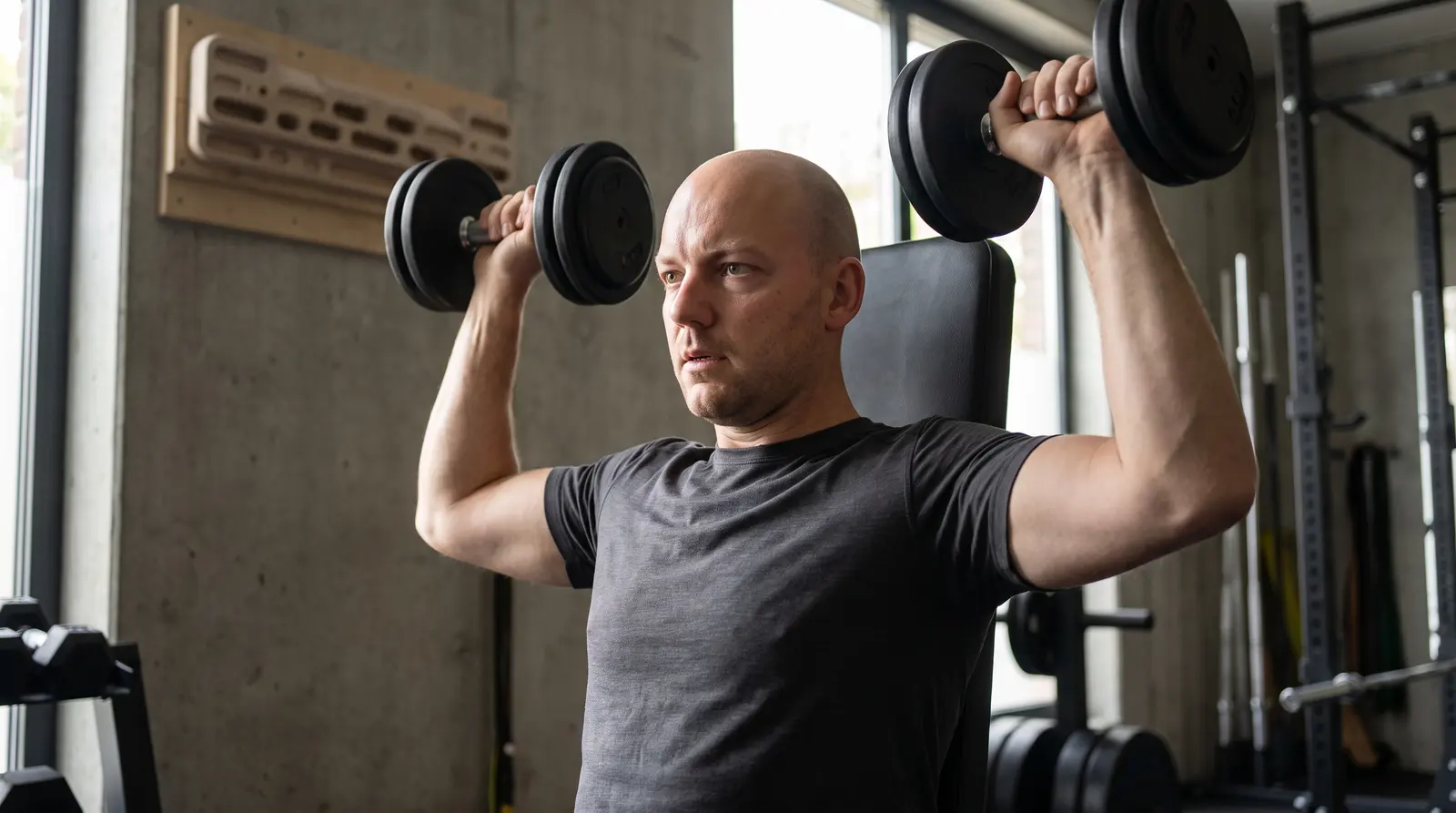
| 3. Standing dumbbell overhead press | Shoulders, triceps | 3 × 8–10 |
| 4. Band or side-lying external rotation | Rotator cuff | 2–3 × 12–15 |
| 5. Prone Y and T raises | Lower and middle trapezius | 2 × 10 each |
| 6. Scapular push-ups | Serratus anterior | 2 × 12–15 |
| 7. Reverse wrist curls | Wrist and finger extensors | 3 × 15–20 |
| 8. Wrist roller (roll up with an overhand grip) | Forearm extensors, grip endurance | 2–3 × 2–3 rolls |
Quick technique notes
- Push-ups and bench press: keep your body in one straight line and let the shoulder blades move. Raise the feet or add a weight vest when 15 reps feel easy.
- Dips: only go as deep as your shoulders tolerate. If the front of the shoulder complains, stay with push-ups.
- Overhead press: ribs down, no big arch in the lower back. Press until your arms are by your ears.
- External rotation: elbow tucked to your side (a towel between elbow and ribs helps), rotate the forearm out slowly. Use light weight; this is control work.
- Y and T raises: lie face down on an incline bench with thumbs up. Lift with your shoulder blades, not your neck. Bodyweight or 1–2 kg is plenty.
- Scapular push-ups: arms straight, let the chest sink between the shoulder blades, then push the floor away.
- Reverse wrist curls: forearms on your thighs, palms down, lift the back of the hand with a light dumbbell. Lower in 2–3 seconds.
- Wrist roller: arms in front of you, roll the weight up with an overhand grip, then lower it under control.
A 20-minute routine, twice a week
Run the exercises as supersets: do the first move, then the second, rest about 60 seconds, and repeat.
Session A
- Push-ups + band external rotation, 3 rounds
- Dips + prone Y and T raises, 3 rounds
- Reverse wrist curls, 3 sets
Session B
- Dumbbell overhead press + scapular push-ups, 3 rounds
- Dumbbell bench press + band external rotation, 2–3 rounds
- Wrist roller, 2–3 sets
Progress the same way you would any strength training: when you hit the top of the rep range on every set, add a little weight or a harder variation. A 2024 review on resistance training for climbers describes low-volume, high-resistance training twice per week as a feasible approach, and Hörst recommends at least two antagonist sessions a week.
How to fit it around climbing
- After climbing is the easiest slot. Pushing muscles are fresh after a bouldering session, so the quality of the work stays high.
- Keep hard finger work first. On days you follow a hangboard program, do the hangs while fresh and the antagonist work afterwards. Leave the wrist exercises for last.
- Rest days work too. A light session on a non-climbing day is fine, as long as it does not leave your forearms sore for the next climbing day.
FAQ
Which muscles are antagonists in climbing?
The muscles that do the opposite of pulling and gripping: chest, triceps and front shoulders (pushing), the rotator cuff external rotators, the lower and middle trapezius and serratus anterior (shoulder blade control), and the forearm and wrist extensors.
How often should climbers do antagonist training?
Twice a week is a practical minimum for most recreational climbers. Short sessions of about 20 minutes, done after climbing or on an easy day, are enough to make progress if you keep adding reps or weight over time.
Does antagonist training prevent climbing injuries?
It may help, but the evidence is limited. Climbers do show different shoulder strength ratios than non-climbers, and resistance training has been linked to fewer overuse injuries in retrospective data, but no climbing trial has proven that antagonist work by itself prevents injuries.
Are there antagonist sports that complement climbing?
Few sports are true opposites of climbing. Activities with a lot of pushing or overhead support, such as handstand practice or general gym training, come closest. A short, planned strength routine is easier to dose than adding a whole new sport.
Sources
- Wong & Ng, Strength Profiles of Shoulder Rotators in Healthy Sport Climbers and Nonclimbers, Journal of Athletic Training (2009)
- Saeterbakken et al., The Connection Between Resistance Training, Climbing Performance, and Injury Prevention, Sports Medicine - Open (2024)
- Saeterbakken, Schöffl, Schweizer & Grønhaug, Editorial: Injuries, injury prevention and training in climbing, Frontiers in Sports and Active Living (2024)
- Eric Hörst, Video: Novel Warm-up Exercise for the Forearm Extensor Muscles, Training For Climbing (2015)
- Eric Hörst, Video: Effective Forearm Antagonist Training for Climbers, Training For Climbing (2017)