Bouldering Plateau: How to Break Through V4 (and V6)
 Petr Hess, strength & conditioning coach
Updated 2 Nov 2026 · 6 min read
Key takeaways
Best for: Boulderers stuck at V4 or V6 for months
- Confirm the plateau: no new V4/V5 sends in 3 months, no more V3 flashes, and no new V5 moves.
- Use the self-assessment table to pick your biggest limiter as the main focus, plus one secondary limiter.
- If technique limits you, repeat easy problems with one cue and climb your weakest style twice a week.
- Limit boulder on 3–4 hard problems with 4–6 good attempts each and 3 minutes' rest.
- Follow the 6–8 week plan: build in weeks 1–3, overload in weeks 4–6, deload in week 7, test in week 8.
A bouldering plateau usually means one specific limiter, not a general lack of talent. The fix is to work out which one is holding you back (technique, strength, power, your head or recovery) and change your training for 6–8 weeks to target it.
This guide is for climbers who already flash most V2–V3s and have been stuck around V4 (or later V6) for months. If you are newer than that, start with how to get better at bouldering. If you want the full weekly structure behind this article, see our bouldering training program.
Is it really a plateau?
First check that you have actually stopped improving. Progress near your limit is slow, and gym grades are noisy.
Coach Kris Hampton of Power Company Climbing suggests a simple test: confirm you are truly plateaued, then ask whether your training and tactics still fit the climber you are now, not the one who set them up a year ago. A quick way to check:
- Have you sent any new V4 or V5 in the last 3 months?
- Do you flash or second-go more V3s than you did 6 months ago?
- Can you now do single moves on V5 that you could not do before?
If the answer to all three is "no", you've plateaued. If any is "yes", you are still progressing, just slower. Keep going and be patient.
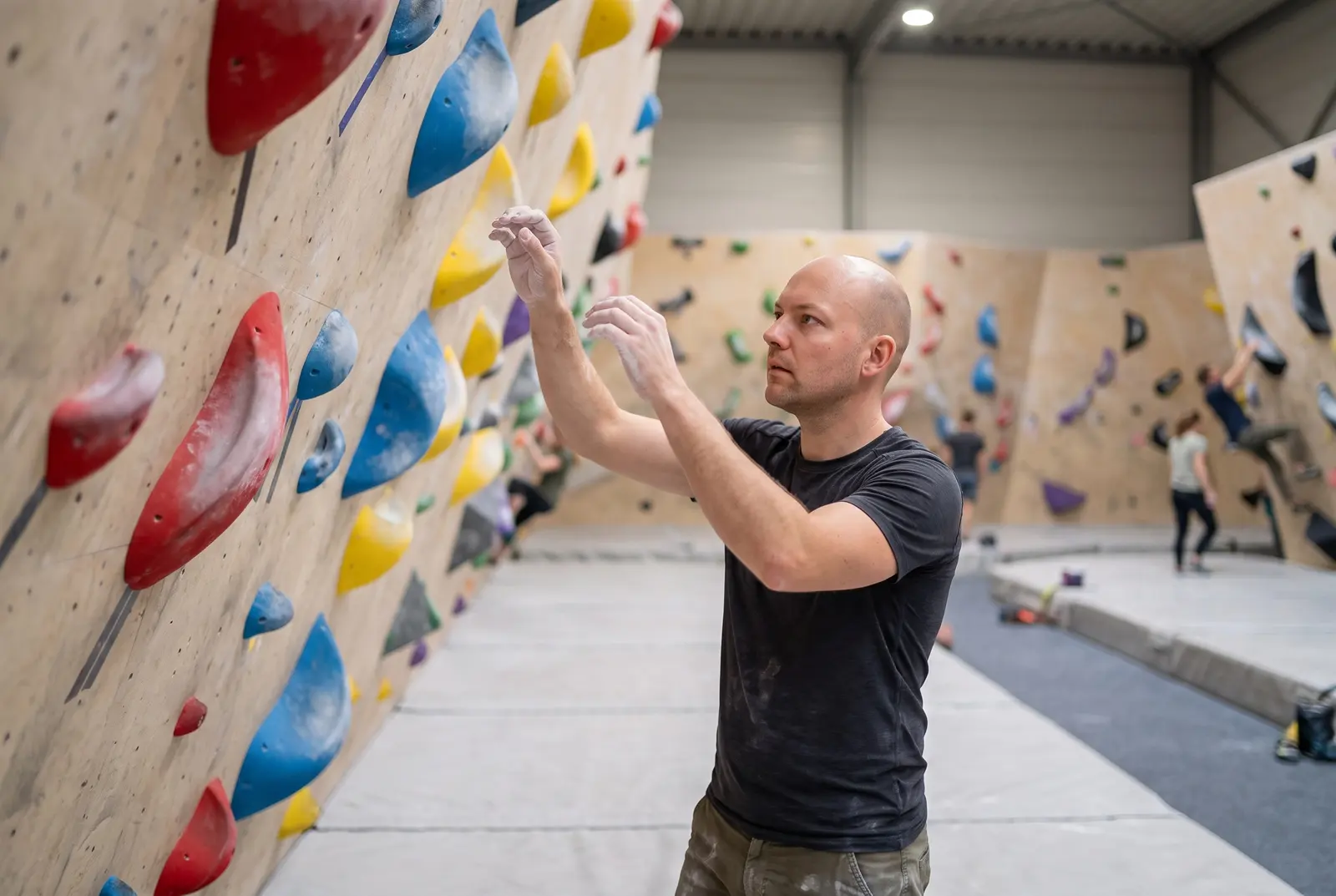
Why climbers get stuck at V4 and V6
Up to about V3, most problems have big holds and good feet. You can climb them with enthusiasm and a few weeks of practice. Around V4 (roughly 6B+ in Font, check our grade converter), problems start to ask for three things at once: precise footwork on bad footholds, body tension on overhangs, and enough finger strength to hold small crimps and slopers.
The V6–V7 wall is similar but sharper. Moves become more powerful (dynos, big deadpoints, toe hooks), holds get worse, and finger strength matters more.
Diagnose your limiter: a 10-minute self-assessment
In strength and conditioning, you find the weakest link before you write a plan. Answer these honestly after your next few sessions.
| Limiter | Typical sign on the wall | Quick test |
|---|---|---|
| Technique | Feet cut or slip; you fall off moves that stronger-looking climbers do easily; you "muscle" everything. | Climb a V2 with silent feet. If you can't place every foot quietly, technique is a limiter. |
| Finger strength | You understand the moves but can't hold the crimp or sloper long enough to do them. | Compare a 10-second hang on a 20 mm edge with our finger strength benchmarks. |
| Power | You can hold every hold statically, but miss dynamic moves and deadpoints by a few centimetres. | Can you do 3–5 explosive pull-ups where your chest reaches the bar fast? |
| Body tension / core | Feet swing off on the overhang; you can't keep toes on after a big move. | Hold a front-lever tuck or hanging knee raise with control for 10 s. |
| Head / tactics | You give up on hard problems after 2–3 goes; you climb the same style every session. | Count how many attempts you make on boulders at your limit per week. |
| Recovery | You climb 4–5 days a week, always feel tired and sore, fingers ache. | Take 4 easy days and check if you suddenly climb better. |
Most climbers have two limiters. Pick the biggest one as your main focus and one secondary.
Technique mistakes that cause a bouldering plateau
For most V4 climbers, technique is still the biggest gap. The most common issues:
- Lazy feet. Looking at the hand hold, then slapping a foot "somewhere". Look at your foot until it is placed.
- Square hips on steep walls. Turning your hip into the wall (drop knees, back-steps) puts weight onto your feet and saves your fingers.
- Straight arms at the wrong time. Hang on straight arms between moves, bend them only to move.
- Only one style. Crimpy vertical climbers struggle on slopers, compression and dynos.
Fix these with deliberate practice: repeat easy problems with one cue (silent feet, hips in, straight arms), climb your weakest style twice a week, and do a few problems at your limit with full rests between attempts. This is limit bouldering: 3–4 hard problems, 4–6 good attempts each, 3 minutes rest.
Strength and power: when the body is the limiter
Finger strength is the physical factor most clearly linked to bouldering grade. In a 2025 study of 19 male climbers, climbing-specific finger strength showed a very strong correlation with bouldering performance (r = 0.89), while pull-up strength showed only a moderate one (r = 0.55). Lattice Training's large dataset shows the same trend: average added load on a max hang rises steadily from the V1–V4 group to higher grades. That is correlation, not proof, but it tells you where to look.
The good news is that fingers respond to structured training. In a 2022 randomised study, intermediate-to-advanced climbers who added 10 weeks of hangboard training twice a week improved finger strength on a 23 mm edge clearly more than a group who just kept climbing. The study did not measure climbing grades, so treat it as "stronger fingers", not "guaranteed V5".
If fingers are your limiter, follow a progressive hangboard program. Add general strength training twice a week: pull-ups, rows, push-ups and a core move, 3–5 sets of 3–6 heavy reps.
Safe finger training
Tendons and pulleys adapt more slowly than muscles. To stay safe:
- Warm up for at least 15 minutes, including easy climbing, before any hard hangs or limit bouldering.
- Use an open-hand or half-crimp grip; avoid full crimp on the hangboard.
- Increase load by small steps (1–2 kg or slightly smaller edge) only when the current level feels solid.
- Stop at sharp or localised finger pain. Skip campusing and the campus board until you are well past V6.
Progressive overload in climbing
Progressive overload means making training slightly harder over time so your body keeps adapting. In the gym it is easy: add weight. On the wall, you can add overload in a variety of ways:
- Harder problems: more attempts on boulders at or above your max grade.
- Worse holds: repeat a problem using smaller holds or bad footholds.
- Steeper angle: move from vertical to 30–40° on a systems board or board sessions.
- More quality volume: one more hard problem per session, not more junk mileage.
A 6–8 week plan to break the plateau
Based on 3 days a week. If you climb more, add an easy technique session, not another hard day.
Weeks 1–3: build
- Day 1, limit bouldering: warm-up, 3–4 projects at your limit, then 20 minutes of strength (pull-ups, rows, core).
- Day 2, technique: 45 minutes on V2–V3 in your weakest style with one cue per problem, then short hangboard session if fingers are a limiter.
- Day 3, mixed: flash attempts on new V3–V4s, finish with antagonist work (see antagonist training).
Weeks 4–6: overload
Same structure. Add one more project per limit session, add small load to hangs, and move one session a week to a steeper wall or board.
Week 7: deload
Cut volume by about half. Keep intensity, drop strength work. You should leave each session feeling fresh.
Week 8: test
Go back to the problems that stopped you in week 1 and re-run the self-assessment. If you sent something new, repeat the cycle with a new focus. If not, look at the next limiter on your list.
Manage fatigue while projecting
More climbing is not always better. If you climb 5 days a week and feel flat, you are probably under-recovered. Sleep, food and at least one full rest day between hard sessions are part of the training regimen. Sometimes it's best to step away from the rock for a few days.
Every climber hits a plateau. Find your real limiter, train it for 6–8 weeks, then reassess.
FAQ
Is it normal to get stuck at V4?
Yes. V4 is where many gym climbers stop improving from climbing alone, because problems start to need precise footwork, body tension and stronger fingers at the same time. Many climbers hit a second wall around V6–V7.
How long does a bouldering plateau last?
It depends on what is causing it. If nothing in your training changes, it can last for years. Once you fix the real limiter, most climbers see movement within one or two training cycles of 6–8 weeks.
Should I start hangboarding to break a V4 plateau?
Only if your fingers are the limiter and you have been climbing regularly for at least a year or two without finger problems. Start with low loads, two short sessions a week, and stop at any finger pain.
Can taking a break help a climbing plateau?
Sometimes. If you feel flat, sore and unmotivated, a lighter week or a short break often helps more than extra sessions, because fitness only builds when you recover.
Sources
- Buraas, Brobakken & Wang, Climbing performance in males: the importance of climbing-specific finger strength, European Journal of Applied Physiology (2025)
- Hermans et al., The Effects of 10 Weeks Hangboard Training on Climbing Specific Maximal Strength, Explosive Strength, and Finger Endurance, Frontiers in Sports and Active Living (2022)
- Ollie Torr / Lattice Training, Finger Strength For Climbers Increases, In Relation To Grade (2026)
- Kris Hampton / Power Company Climbing, The Question Climbers Should Ask Themselves to Avoid Plateaus