Finger Strength Benchmarks by Climbing Grade
 Petr Hess, strength & conditioning coach
Updated 2 Nov 2026 · 7 min read
Key takeaways
Best for: Trained climbers checking whether fingers limit them
- Test 7-second two-arm hangs on a 20mm edge, adding load over 4–8 sets with 2 minutes' rest.
- Score the test as total load ÷ bodyweight × 100 so climbers of different sizes can compare.
- Lattice's average added load rises from about +19 kg at V1–V4 to about +53 kg at V12+.
- Well below your grade's average suggests a max hang block; well above suggests working on technique or power.
- Retest after a 6–12 week block under the same conditions, comparing mainly with your own earlier results.
Stronger fingers go with harder grades, but no single number fits everyone. In Lattice Training's data from over 6,000 climbers, the average two-arm max hang rises from about +19 kg on top of bodyweight at V1–V4 to about +53 kg at V12+. Use these figures to see where you stand compared with other climbers. Don't treat them as a pass mark.
This guide covers how to measure finger strength reliably, what the published data actually says, and why your result explains only part of your climbing grade. If you want to train the weakness you find, the hangboard program guide picks up from here.
How to test max finger strength reliably
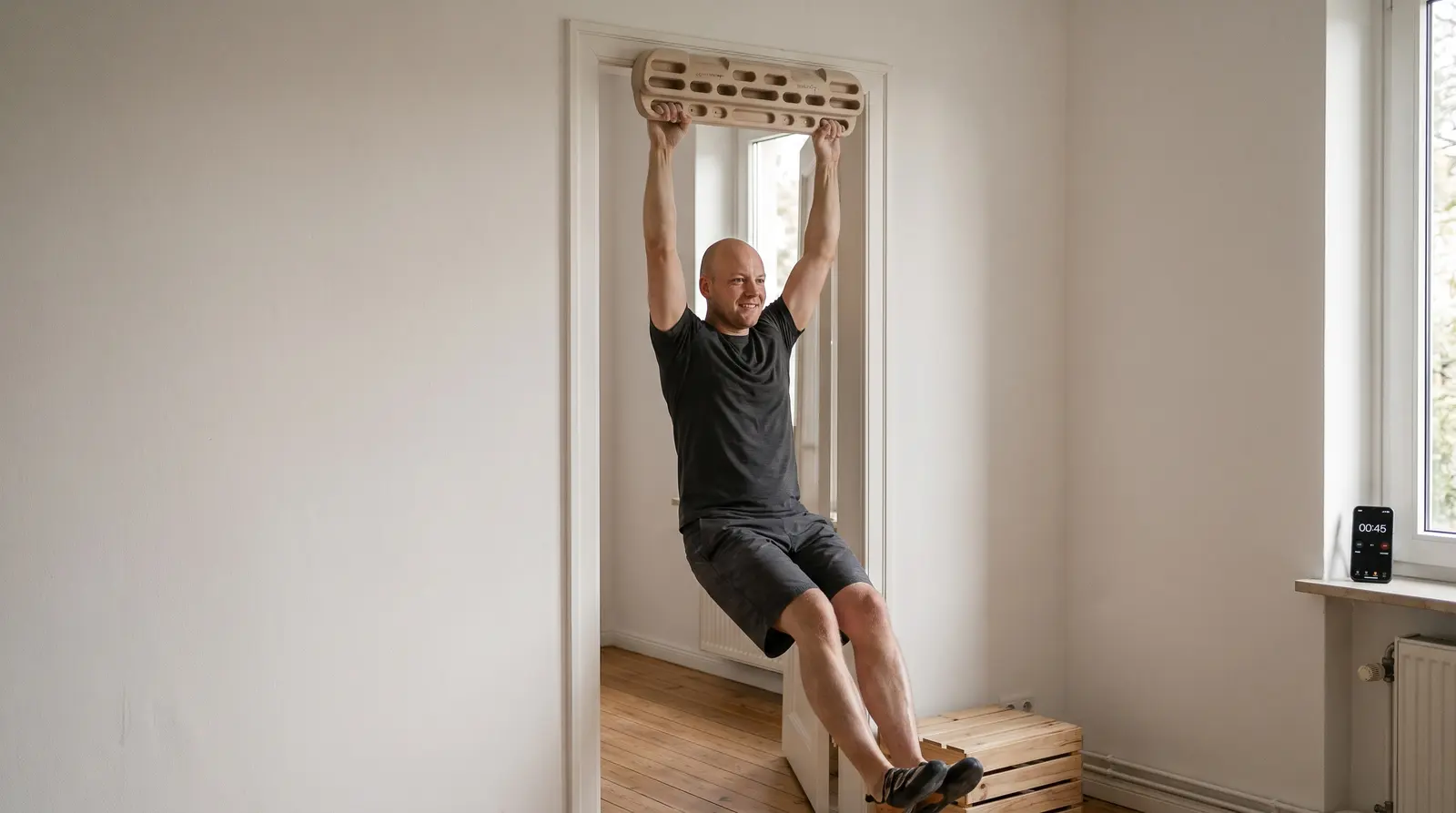
A benchmark is only worth something if you test the same way every time. The most widely used test is a two-arm max hang on a 20mm edge. Lattice's official self-assessment for its 20mm testing rung works like this:
- Edge: a 20mm edge. A 2025 systematic review found that fixed edges of 20–23 mm gave the most stable results across studies.
- Grip: half crimp or four-finger open hand. Pick one and stick with it. Lattice's guidance says not to full crimp.
- Hang time: 7 seconds on both arms, with no change of grip. If your fingers shift, the set counts as a fail and your feet go straight back down.
- Structure: 4–8 sets with 2 minutes' rest between them. Start at moderate effort and add load each set, so you reach your max before fatigue sets in.
- Timing: after a rest day, after a specific warm-up, and with good skin.
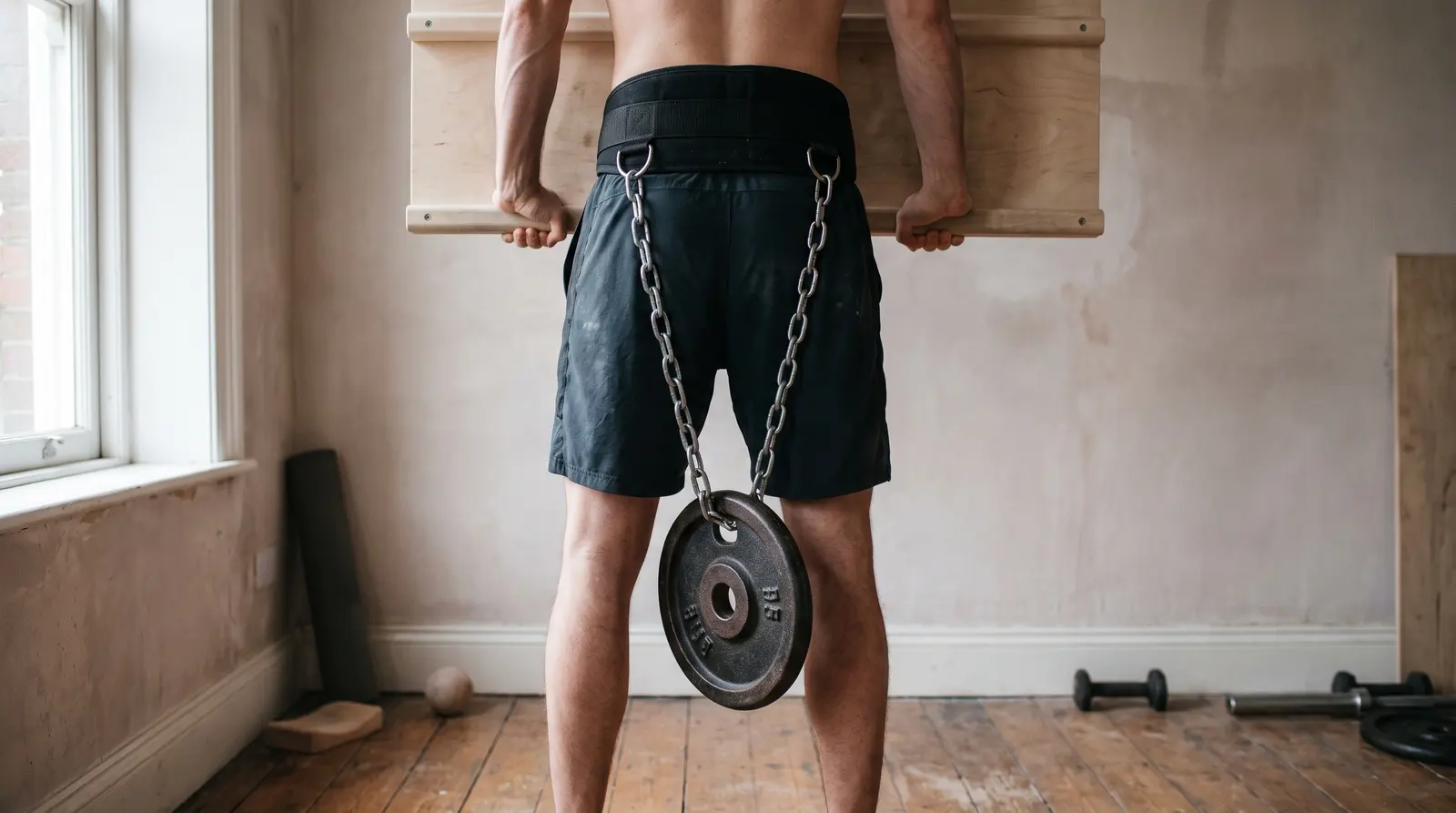
- Load: hang weight from a harness to add load. To take load off, use a pulley and counterweight.
Lattice calculates the score as total load ÷ bodyweight × 100. A 70 kg climber who adds 10 kg holds 80 kg in total, which is 114% of bodyweight. Expressing the result as a percentage of body weight lets you compare climbers of different sizes.
Some research protocols use slightly different settings. The 2025 Norwegian study discussed below used a 22mm edge and a 5-second hang, and Lattice's 2017 analysis used a 5-second hang. The exact choice matters less than keeping it the same every time you test.
Why the half crimp is the usual choice
In a 2017 analysis of its assessment data, Lattice found that half crimp strength correlated better with boulder grade than open-hand strength. For route grade, the two grips correlated about equally. The systematic review also reported its highest reliability scores (ICC often above 0.90) for a standardized half crimp on 20–23 mm edges. Tests where climbers chose their own grip varied more.
A simple warm-up before testing
- 5–10 minutes of general movement to raise your heart rate.
- Easy climbing on big holds, then progressively smaller ones.
- A few submaximal hangs on the test edge at roughly 50%, 70% and 85% effort.
- Then start the test sets, resting 2 minutes between each.
Finger strength benchmarks by grade
The largest public dataset comes from Lattice Training. In a 2026 post, Ollie Torr reported average added load on two-arm max hangs for over 6,000 tested climbers, grouped by V-grade band. The post does not state the edge or hang time behind each data point, so treat the figures as approximate reference values.
| Grade band (V-scale) | Average added load, all climbers (Lattice) | Illustration: % bodyweight for a 70 kg climber* |
|---|---|---|
| V1–V4 | +19.0 kg | ≈127% |
| V5–V7 | +24.2 kg | ≈135% |
| V8–V11 | +38.4 kg | ≈155% |
| V12+ | +52.9 kg | ≈176% |
*The last column is just arithmetic, (70 + added kg) ÷ 70. It is not a Lattice figure. Lighter climbers add less absolute weight for the same percentage, and heavier climbers add more. If you use Font grades, the grade converter translates V-grades.
For women, Lattice reports average added load rising from +6.6 kg at V1–V4 to +29.5 kg at V12+. Torr links the lower absolute numbers partly to lower body mass across the female cohort. Comparing percentage of body weight within your own group is fairer than comparing raw kilograms.
What the research adds
- Buraas, Brobakken and Wang (2025): 19 male climbers with redpoint grades from 6b+ to 8c tested a 5-second hang on a 22mm edge. They added a mean of 31 kg (range 10–55 kg). Finger strength correlated with self-reported best grade at r = 0.76 and with their bouldering test score at r = 0.89. Handgrip strength from a dynamometer showed no meaningful link to best grade.
- Giles et al. (2021): in 55 female climbers grouped from lower advanced to elite, the elite group had greater finger strength and upper-body power. Finger strength and upper-body power were the attributes most associated with ability.
In short, climbing-specific finger strength on an edge tracks grade far better than a generic grip test. That is why benchmarks use a hangboard or fingerboard edge and not a hand dynamometer.
How to interpret your result
Compare your number with the average for your grade band:
- Well below average: finger strength may be what's holding you back, especially on crimpy boulders with small holds. A structured block of max hangs is a sensible next step.
- Around average: balanced. Keep a maintenance dose of finger strength training and spend most of your effort on climbing.
- Well above average: your fingers are probably not the limit. Look at technique, movement skill, power, contact strength or tactics. Our guide to breaking a bouldering plateau covers how to find the real bottleneck.
Use your own earlier results as the main comparison. Retest after a 6–12 week block under the same conditions. A steady rise in your % bodyweight tells you more than any table.
The limits of finger strength benchmarks
Benchmarks are useful, but they are easy to misuse. Keep these limits in mind:
- Finger strength is only part of grade. Even a strong correlation like r = 0.76 leaves plenty of variation unexplained. Movement skill, body position, power, endurance, head game and experience fill the gap.
- Sample bias. Big datasets come from people who chose to test, and those people tend to be climbers who train. That can push averages toward climbers who already train their fingers.
- Protocol differences. Edge depth, edge shape, wood versus resin, grip, hang time and what counts as a fail all change the number. A result on one board doesn't transfer cleanly to another.
- Small studies. The lab research behind these figures uses samples of tens of climbers. Those studies are cross-sectional, so they show association, not proof that training finger strength will raise your grade.
- Discipline. Boulder grades usually track max finger strength more closely than sport climbing route grades, which also depend heavily on endurance.
Measuring without added weights
The systematic review found that electronic force sensors and force platforms generally gave more reliable results than hanging weights or uninstrumented wooden edges. A portable force gauge such as a Tindeq lets you pull on an edge and read the force directly. That makes one-arm tests easy and shows left–right differences that two-arm hangs can hide. See our gear section for the categories of equipment. Whatever you use, compare a result only with results from the same device and setup.
No hangboard at home? You can still build and track finger strength with the methods in finger strength without a hangboard, such as lifting a loaded edge or block.
Turning the benchmark into training
A test only pays off if it changes what you train. If your fingers lag behind your grade, two short hangboard sessions a week alongside your climbing is a common, manageable starting dose. Lattice's own rung guide suggests 6 × 10-second hangs at 85% of your tested max total load, with 2 minutes' rest. The full progression is in the hangboard program. If your fingers are already ahead of your grade, put that time into climbing harder problems and following a structured bouldering training program.
FAQ
How much weight should I hang for my climbing grade?
In Lattice Training's data from over 6,000 climbers, the average two-arm max hang was about +19 kg on top of bodyweight at V1–V4, +24 kg at V5–V7, +38 kg at V8–V11 and +53 kg at V12+. These are averages with a wide spread, not targets.
Is finger strength the best predictor of bouldering grade?
It is one of the strongest single physical predictors in the studies available, but it still explains only part of the picture. In a 2025 study of 19 male climbers, finger strength correlated strongly with grade, yet technique, tactics, power and experience still matter.
Should beginners test their max finger strength?
Usually not. Lattice recommends its self-assessment for climbers who already train on a fingerboard and climb above about V5 or 7b+. Newer climbers gain more from climbing itself and from building a base first.
How often should I retest finger strength?
Testing before and after a training block, every 6–12 weeks or so, is enough for most people. Always test under the same conditions: same edge, grip, hang time, warm-up and time of day.
Sources
- Lattice Training (Ollie Torr), Finger Strength For Climbers Increases, In Relation To Grade (2026)
- Lattice Training, Lattice Rung Test Instructions (2018)
- Lattice Training, Open or half crimp for performance profiling in climbing? (2017)
- Buraas BF, Brobakken MF, Wang E., Climbing performance in males: the importance of climbing-specific finger strength, Eur J Appl Physiol (2025)
- Giles D. et al., Anthropometry and performance characteristics of recreational advanced to elite female rock climbers, J Sports Sci (2021)
- Pérez-Cordero J. et al., Reliability of finger strength assessment methods in climbing: a systematic review, Front Sports Act Living (2025)