How to Train Finger Strength Without a Hangboard
 Petr Hess, strength & conditioning coach
Updated 2 Nov 2026 · 5 min read
Key takeaways
Best for: Climbers without a hangboard at home
- Limit boulder on short problems of 3–6 hard moves, resting 2–4 minutes between attempts.
- On a lift block, start with a 20 mm edge, half crimp, 10-second holds and 5–6 sets per hand.
- Progress lift-block training by adding weight rather than shrinking the edge.
- Treat finger rolls as support work, 2–3 sets of 8–12 slow reps, and grippers or rice buckets as warm-up.
- Start with 1–2 finger sessions a week, at least 48 hours apart, counting hard bouldering days as finger days.
You can train finger strength without a hangboard by putting high, controlled load through your fingers in other ways: limit bouldering, board climbing, lifting a loaded edge (a "lift block" or "no-hang" device), and isometric pulls against a fixed edge. Grippers and rice buckets help a little, but they don't load the fingers the way real holds do. Whatever you pick, the rules are the same: short, hard efforts, plenty of rest and slow progression.
If you own a fingerboard and want a structured plan, see our hangboard program. This guide is for climbers without one, or who are travelling or prefer other tools.
Can climbing itself build finger strength?
Yes, especially early on. Beginners and many intermediate climbers get stronger fingers simply by climbing more, but unstructured climbing becomes a weak stimulus over time. In a 10-week randomised trial, intermediate-to-advanced climbers who added hangboard training improved peak force on a 23 mm edge more than a group who only kept climbing (Hermans et al., 2022). The lesson isn't "you need a hangboard". It's that your fingers need specific, near-maximal load, and you can create that in several ways.
1. Limit bouldering and board climbing
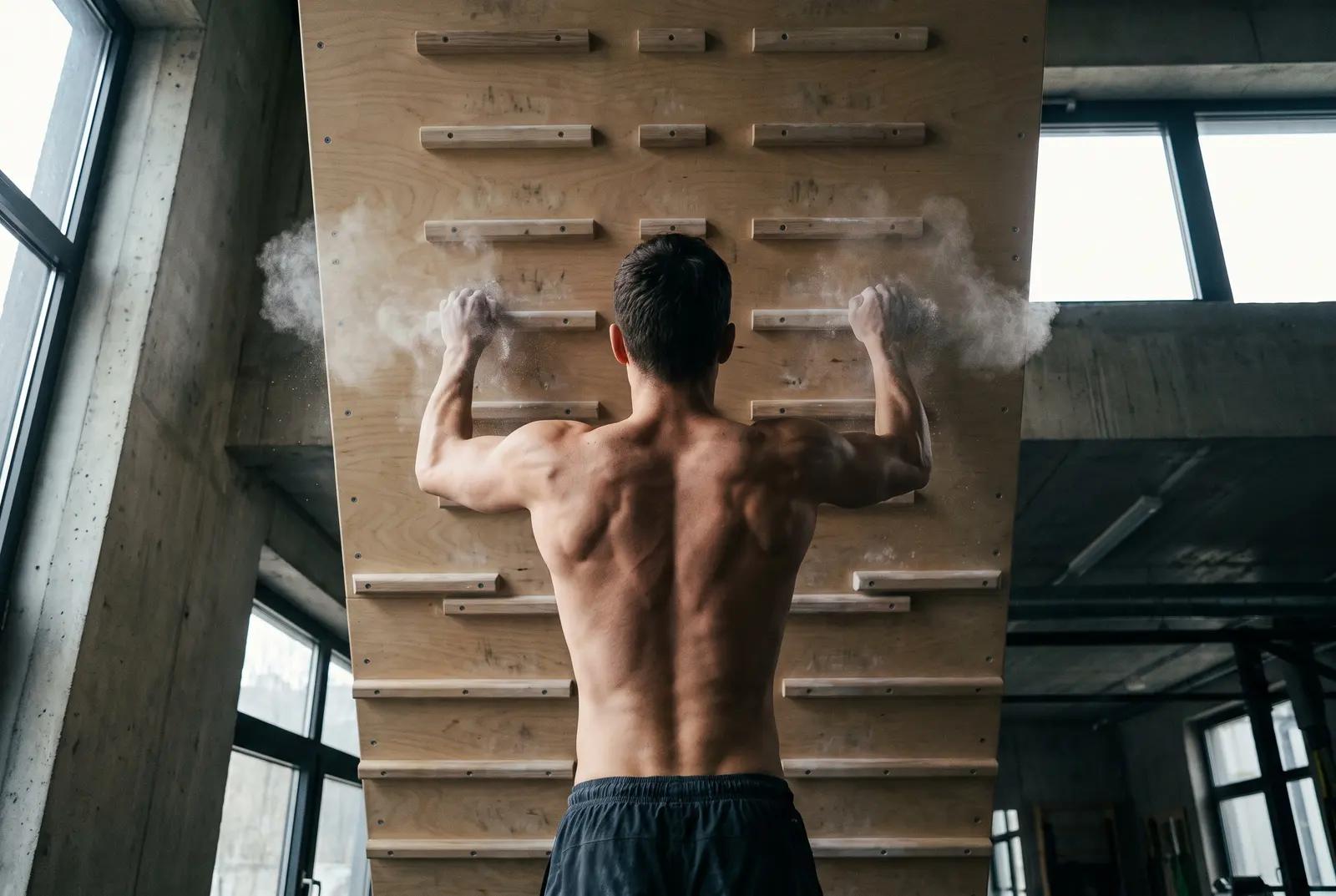
The most climbing-specific option is to pick problems at or near your limit on small holds: crimps, slopers and pockets you can only just hold. A system board or a steep training board (Moon, Kilter, Tension and similar) is ideal because the holds are standardised and you can repeat moves.
- Try short problems of 3–6 hard moves, not long pumpy circuits.
- Rest 2–4 minutes between attempts so each one is a quality effort.
- Stop when you start failing moves you did earlier in the session.
To fit this into a full week, see our bouldering training program.
2. Lift blocks and loaded edges ("no-hangs")
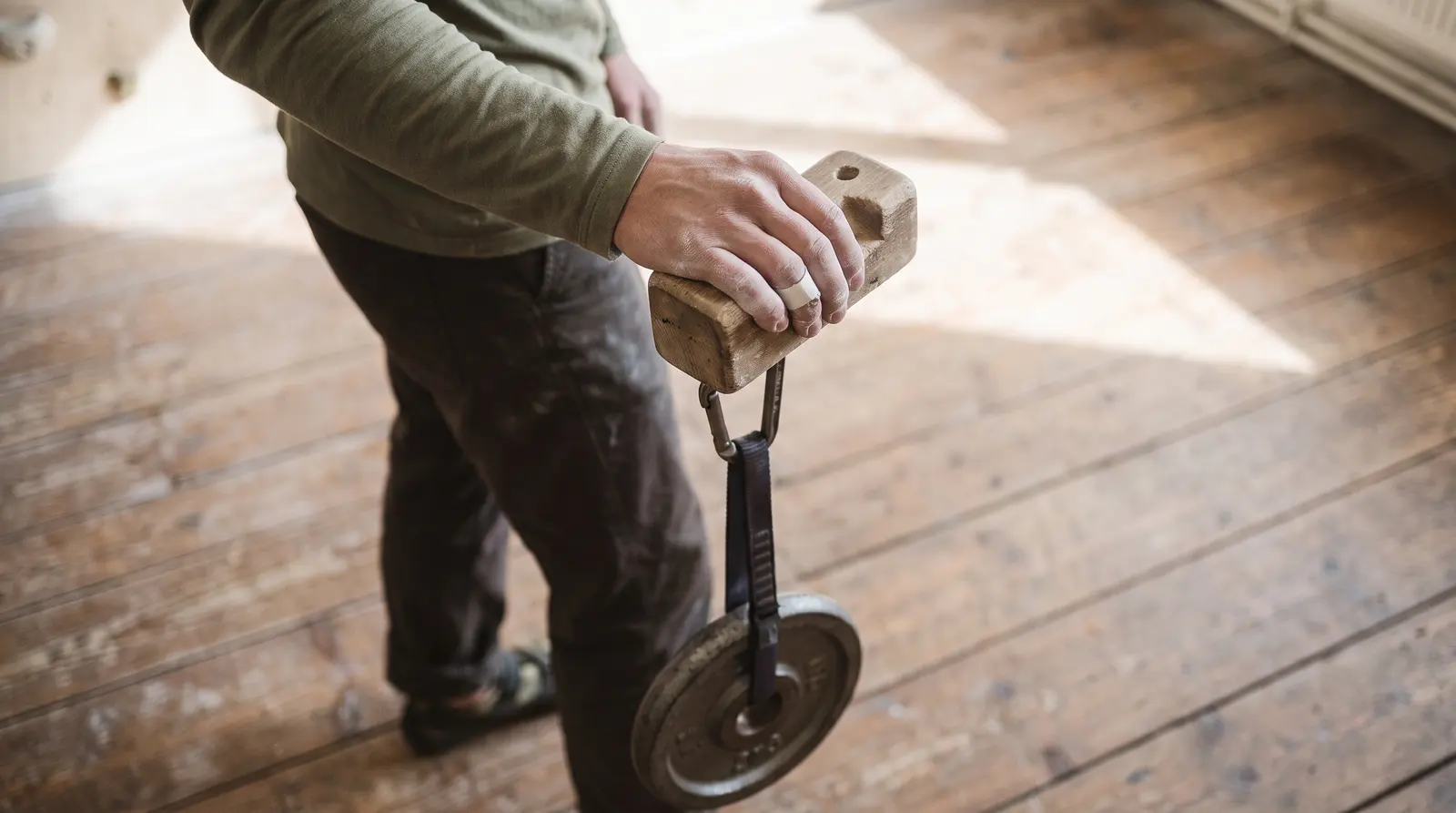
A lift block is a small edge with a loading pin or cord underneath. You grip the edge with one hand and lift a weight (a kettlebell, plates or a bag of water bottles) off the floor. It's the closest thing to hangboarding without hanging, and in some ways easier to control:
- Precise load. You can work with far less than body weight, in small steps.
- One hand at a time. Useful for spotting and fixing left-right differences.
- Specific grips. Half crimp, open hand, three-finger drag, or a grip that includes a weak pinky.
A simple starting point: a 20 mm edge, half-crimp grip, 10-second holds per hand, 5–6 sets, with about 2 minutes between efforts on the same hand. Pick a load you could hold for roughly 13–15 seconds, so you finish each rep with a few seconds in reserve. Keep your back straight and lift with your legs, and make sure the cord pulls straight down through the middle of the edge so one finger isn't overloaded.
There's good reason to focus on load rather than shrinking the edge. In an 8-week trial, climbers who added weight each week improved grip strength significantly more than controls, while the group that progressed by using smaller edges did not (Mundry et al., 2021). On a lift block, adding weight is the natural way to progress.
3. Isometric pulls against a fixed point
If you don't have weights, anchor a block or a sturdy wooden edge to the floor or a heavy object with a strap, then pull up on it as hard as your grip allows for 7–10 seconds. A cheap crane scale or a load cell inline tells you how hard you're pulling, which makes progression far easier. Without one, you're guessing, so keep it to about 80–90% effort.
4. Finger rolls
Hold a barbell or dumbbell in your fingertips, let it roll down to the ends of your fingers, then curl it back into a fist. They build forearm flexor strength through a full range. They are not the same as holding a static crimp, so treat them as support work: 2–3 sets of 8–12 slow reps with a moderate load.
5. Grippers and the rice bucket: be realistic
Spring grippers train a full-hand closing grip that you rarely use on rock. Rice-bucket drills (gripping, opening and twisting your hands in a bucket of rice) are mostly a light warm-up and an easy way to work the finger extensors. We found no controlled studies showing either one improves crimp or open-hand strength for climbing. Use them for general hand health and antagonist training, not as your main finger strength exercise.
Comparing the options
| Method | Equipment | Transfer to climbing | Best for |
|---|---|---|---|
| Limit bouldering / board | Gym or home wall | High | Everyone who can climb |
| Lift block | Edge + weights | High (grip-specific) | Home, travel, uneven hands |
| Isometric pull | Edge + strap (+ scale) | High if loaded hard | No weights available |
| Finger rolls | Barbell or dumbbell | Moderate | Accessory forearm strength |
| Grippers / rice bucket | Cheap | Low | Warm-up, hand health |
How fast will you see results?
Expect the first clear changes within a month or two. In a 4-week study of advanced climbers training twice a week, maximal finger strength rose by about 14% with maximal hangs and 12% at 80% intensity, while very light training (60%) did not significantly change it (Devise et al., 2022). In research by Eva López-Rivera, climbers who started with lower finger strength gained far more from four weeks of maximal hangs than already strong climbers did (summarised by Lattice Training). These were hangboard studies, but the principle carries over: train heavy, not long.
To check where you stand, use our finger strength benchmarks.
Safety and progression
Pulley injuries are the most common injury seen in climbers' hands (Schöffl et al., 2020), so treat finger training with respect:
- Warm up with easier holds and lighter loads before any max effort.
- Start with 1–2 sessions a week, at least 48 hours apart. Count hard bouldering days as finger days.
- Increase load in small steps, and only when every rep in a session feels controlled.
- Favour half crimp and open hand. Avoid full crimping at max loads.
- Stop on any sharp pain, a pop or swelling at the base of a finger.
FAQ
Can I build finger strength without a hangboard?
Yes. Hard bouldering, board climbing and loaded edges such as lift blocks or isometric pulls all put high, controlled load through the fingers. A hangboard is convenient, not essential.
Do grippers and rice buckets build climbing finger strength?
Not much. Grippers train a full-hand closing grip and rice buckets mostly add volume and extensor work. Neither loads the fingers the way a crimp or open-hand hold does, so treat them as extras, not your main tool.
How fast does finger strength training produce results?
In controlled hangboard studies, measurable gains appeared within 4 to 10 weeks of two or three sessions a week, and climbers starting from a lower level improved most. Tendons and pulleys adapt more slowly, so build load gradually.
How do I maintain finger strength when I can't climb?
Keep one or two short, heavy sessions a week on a lift block or an isometric pull from a fixed edge. Keep the intensity high and cut the volume rather than the other way round.
Sources
- Hermans E. et al., The Effects of 10 Weeks Hangboard Training on Climbing Specific Maximal Strength, Explosive Strength, and Finger Endurance, Frontiers in Sports and Active Living (2022)
- Mundry S. et al., Hangboard training in advanced climbers: A randomized controlled trial, Scientific Reports (2021)
- Devise M. et al., Effects of Different Hangboard Training Intensities on Finger Grip Strength, Stamina, and Endurance, Frontiers in Sports and Active Living (2022)
- Lattice Training, Research Discussion: Eva Lopez-Rivera Finger Strength (2018)
- Schöffl V. et al., Tendon Injuries in the Hands in Rock Climbers: Epidemiology, Anatomy, Biomechanics and Treatment – An Update, Muscles, Ligaments and Tendons Journal (2020)