Hangboard Program: The Complete Guide to Stronger Fingers
 Petr Hess, strength & conditioning coach
Updated 2 Nov 2026 · 9 min read
Key takeaways
Best for: Climbers 1–2 years in, limited by small holds
- Start only after one to two years of consistent climbing, with no current finger, wrist or elbow pain.
- Hangboard twice a week on a 20mm edge, fresh before climbing, leaving at least 48 hours between sessions.
- Run max hangs first: about 10 s with a load you could hold ~13 s, ~3 min rest, then switch to repeaters.
- Add only a kilo or two after a clean week; repeat the week or go back if fingers feel tweaky.
- Stop and get checked after sharp pain at a finger's base, a pop, or pain lasting into the next day.
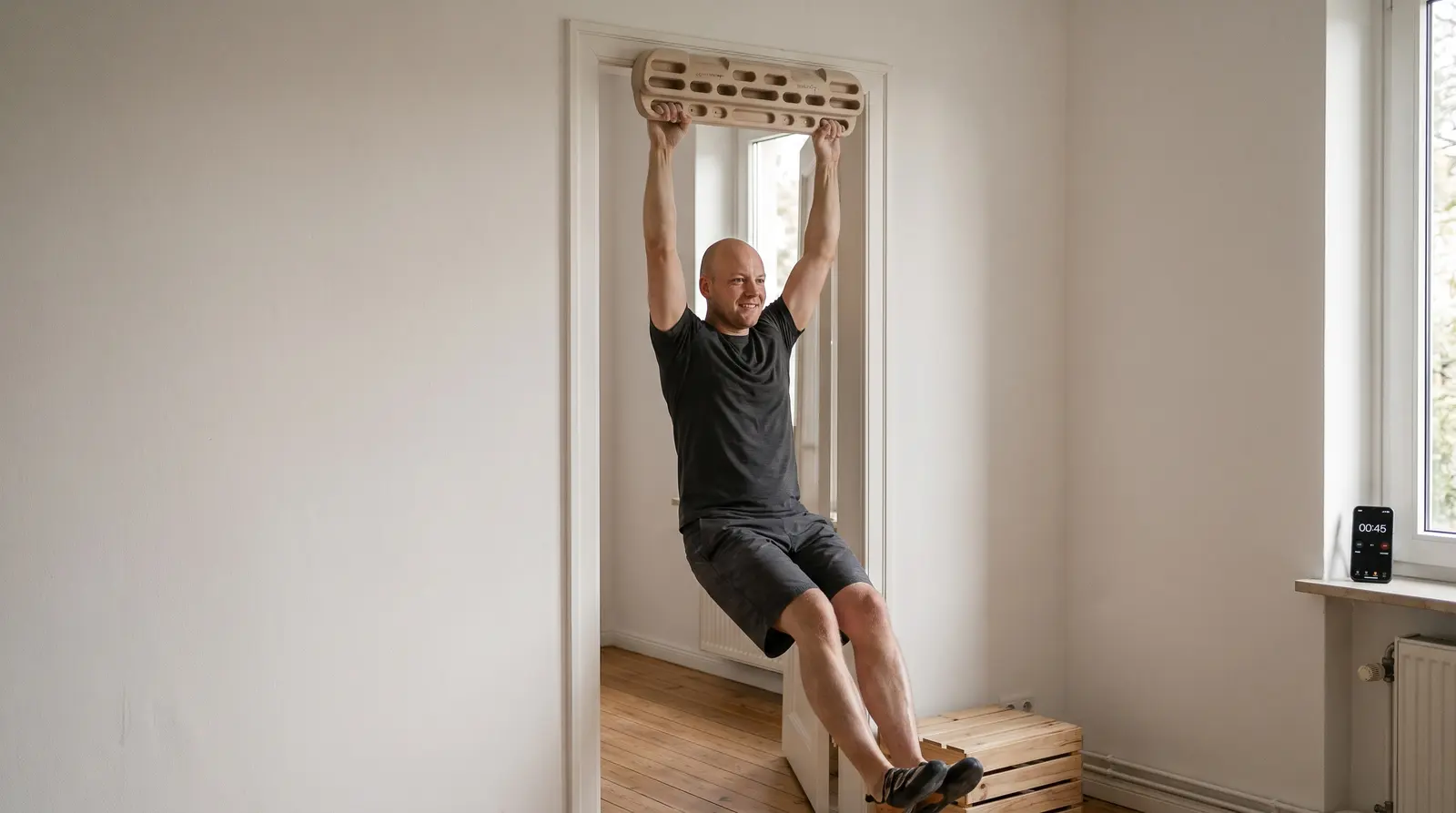
A good hangboard program is short, specific and boring on purpose: two sessions a week of controlled hangs on a 20mm edge, a few weeks of building strength with max hangs, then a block of repeaters for strength endurance. Get the dose right and your fingers get stronger; get it wrong and you get injured. This guide gives you the principles, a sample 8-week plan and the rules for staying safe.
I write this as a strength and conditioning coach, not a climbing coach or physio. Climbing is my favourite complement to the training I do with individuals and clubs in Prague, and the principles below are the same ones I apply to any strength work: measure, load progressively, recover. If you want a starting point, check your numbers against these finger strength benchmarks first. If you don't own a board yet, read about building finger strength without a hangboard, and if you want the full weekly picture, see our bouldering training program.
Does a hangboard program really work?
Yes, with a caveat about who has been studied. In a randomised trial, 23 advanced male boulderers (mean grade 7b+ Fb) either added fingerboard training or kept bouldering for 4 weeks. The fingerboard group gained significantly more grip strength and hang endurance than the bouldering-only group (Medernach et al., 2015).
In another study, 26 advanced sport climbers (around 7c+/8a) did dead hangs twice a week for 8 weeks at the start of their climbing sessions. Both the max hang group and the intermittent hang (repeater-style) group improved grip endurance, by 34% and 45% respectively (López-Rivera & González-Badillo, 2019).
The caveat: these were experienced climbers. For a true beginner, more actual climbing almost always beats hangboard time, because technique is still the main limiter.
Are you ready to start hangboarding?
Hangboarding is a powerful climbing training tool, which is exactly why timing matters. Tendons and pulleys adapt more slowly than muscle, so your forearm can outgrow the tissues it pulls on.
| Good candidate | Wait or modify |
|---|---|
| Climbing consistently for at least one to two years | Brand-new climber still learning footwork |
| Finger strength clearly limits you on small holds | You fail on moves for technique or fear reasons |
| No current finger, wrist or elbow pain | Recent pulley injury or ongoing finger pain |
| Adult, or older teen with supervision and low loads | Under 14: no maximal dead hangs |
Climbing Magazine's readiness guide suggests climbing "a year or two first", keeping beginners on low loads without added weight, and keeping climbers under 14 away from maximal dead hangs. Young climbers face a specific risk: the BMC reports that growth plate fractures account for up to 90% of finger injuries in adolescent climbers.
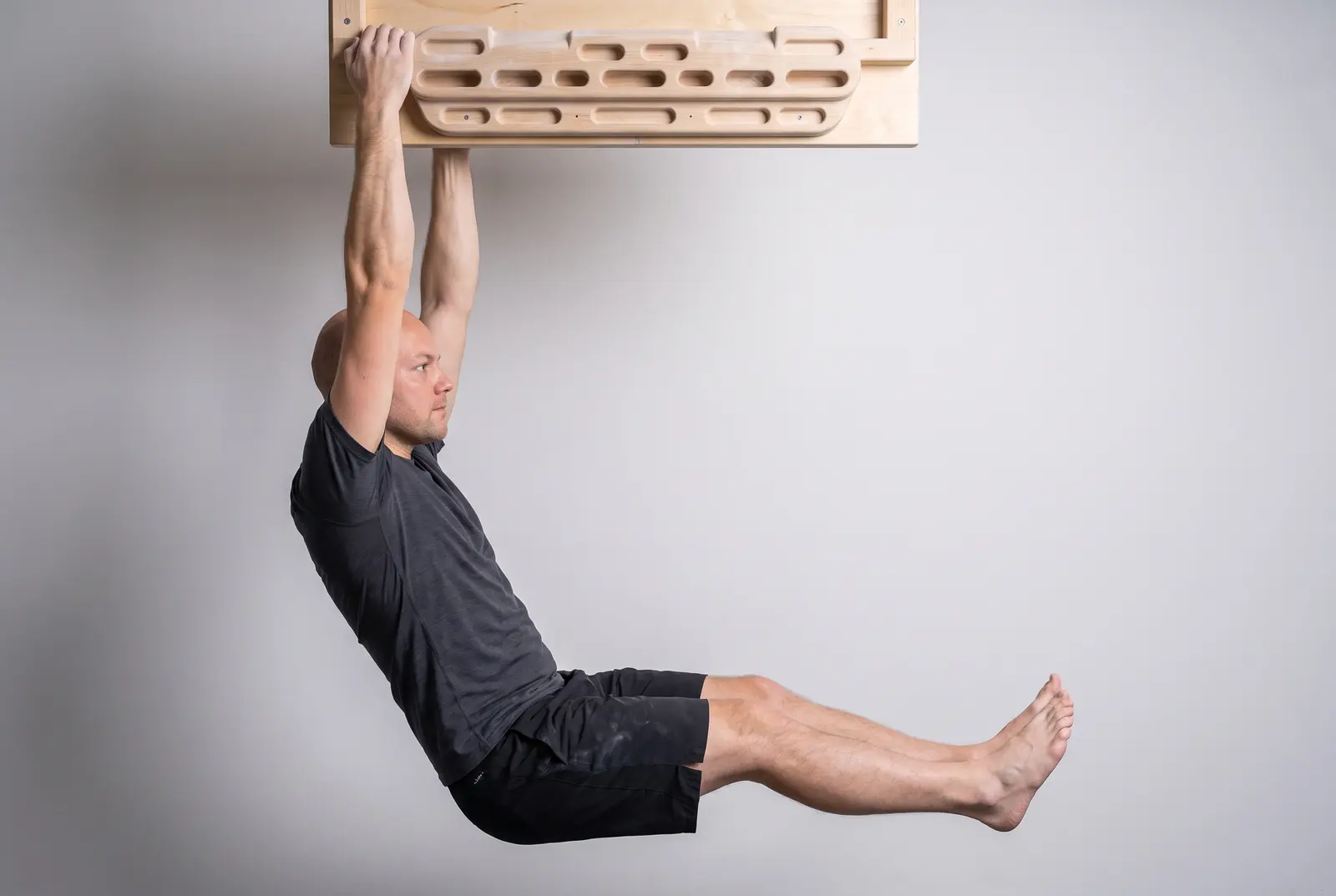
The basic principles of hangboard training
Every hangboard workout is built from the same five variables. Change one at a time.
- Edge size – how deep the hold is.
- Grip type – open hand, half crimp, full crimp; how many fingers used.
- Load – bodyweight, assisted, or with added weight.
- Time under tension – hang time per rep and total TUT per session.
- Frequency – sessions per week.
Lattice treats these as one combined training load. Large jumps in any of them are a major injury risk, so increase the load in small steps.
What edge size should you use?
Lattice uses a 20mm edge for most of its testing and training, and recommends "20mm or less" for intermediate to elite climbers. Beginners do better on bigger holds. Very small edges mostly test your skin and pain tolerance, not your maximal strength.
There are two ways to make a hang harder: use smaller holds, or keep the 20mm edge and add weight. For most people, keeping the edge constant and adjusting the load is easier to track. Edge radius varies between boards, so compare yourself only on the same board.
Which grip types should you train?
No single grip is "correct". Strong climbers use a range of positions. A sensible core is:
- Half crimp (four fingers, roughly 90° at the middle joint) – the main strength grip. Learn the half crimp position with proper form before adding load.
- Open hand / three-finger drag – lower pulley stress; good for beginners and for days when crimping feels sore.
- Full crimp – train with caution and modest loads, if at all. Lattice notes it carries extra injury risk at high loads.
Stick with four fingers on two arms until you have a solid base. Fewer fingers concentrate force on individual tendons and pulleys.
One arm or two arms?
Two-arm hangs are the staple for beginners and intermediates. One-arm hangs are an extra stimulus for advanced climbers, not a replacement.
Max hangs vs repeaters
Most hangboard routines are built on two protocols. They train different qualities.
| Max hangs | Repeaters (intermittent hangs) | |
|---|---|---|
| Main goal | Maximal finger strength | Strength and endurance (power endurance on small holds) |
| Hang time | About 10 s | Short hangs with short rests, e.g. 10 s on / 5 s off, or 7 s on / 3 s off |
| Intensity | Load you could hold ~13 s (stop ~3 s short of failure) | Edge or load that lets you complete every rep with good form |
| Rest | ~3 min between sets | ~1 min between sets of 4–6 reps |
| Sets per session | 3–5 | 3–5 |
| How it feels | Heavy, not pumpy | You will get pumped, but shouldn't be super pumped by set one |
The max hang and repeater parameters above come from the 2019 López-Rivera study: 10-second hangs with a load that would allow roughly 13 seconds, 3 minutes of rest; and intermittent sets of 10 s on, 5 s off. Keeping a margin before failure is what keeps max hangs repeatable and safer.
Which should you do first? Boulderers and anyone who fails on single hard moves usually benefit most from max hangs. Sport climbing on longer routes leans more on repeaters. The López-Rivera authors suggested alternating both methods over longer training periods, which is what the sample program below does.
How long should you hang, and how hard?
Keep every hang below failure. As a rule of thumb, finish each rep feeling you had 2–3 seconds left. If your grip opens, your shoulders shrug up to your ears, or your fingers shift on the edge, the rep is over.
Test before you train. Climbing Magazine suggests a 2–3 second test hang before the main set, then 30–45 seconds of rest. If the test feels harder than expected, reduce the load. That day's readiness matters more than the number written in your plan.
How often to hangboard, and when
Two sessions per week is the standard dose. It's what both studies above used, and Climbing Magazine recommends 2–3 sessions a week for beginner-intermediate climbers over blocks of about 4–6 weeks. Leave at least 48 hours between sessions.
Do your hangboard session when you are fresh: after a warmup, before a climbing session, not after hard bouldering. In the López-Rivera study, hangs were done at the start of climbing sessions. Each session takes 20–30 minutes plus warmup.
Remember that your fingers count everything. A Moonboard session, a day at the crag or a limit bouldering night all load the same tendons. If you add a hangboard program, take some volume out somewhere else.
Warmup before every hangboard session
Climbing Magazine recommends at least 15–20 minutes. A simple version:
- 5 minutes of general pulse raiser (rowing, skipping, easy traversing).
- Shoulder mobility and scapula shrugs on a jug.
- Foot-assisted hangs on the training edge, building from about 50% to 80% effort.
- Two or three easy test hangs at bodyweight on the edge you will use.
Sample 8-week hangboard program
This is a conservative training program for an intermediate climber who meets the readiness criteria above. Use two sessions per week, a 20mm edge (or bigger if needed), half crimp and open hand. You don't need a PDF, the Crimpd app or a fancy hang board to follow it. A notebook is enough.
| Week | Focus | Protocol (per session) |
|---|---|---|
| 1 | Technique and baseline | Foot-assisted hangs, 5 × 10 s at about 70% effort, 2 min rest. Note the edge you can hang on comfortably. |
| 2 | Max hangs, intro | 3 sets × 10 s, load you could hold ~13 s, 3 min rest. Half crimp. |
| 3 | Max hangs | 4 sets × 10 s, same rule. Half crimp + 1 set open hand. |
| 4 | Max hangs | 5 sets × 10 s. Add weight (1–2 kg) only if every rep was clean last week. |
| 5 | Repeaters, intro | 3 sets of 4 reps × 10 s on / 5 s off, 1 min between sets. |
| 6 | Repeaters | 4 sets of 5 reps, same timing. |
| 7 | Repeaters | 5 sets of 5 reps, same timing. |
| 8 | Deload and retest | Session 1: 2–3 easy sets. Session 2: retest your 10 s max hang on the same edge. |
Progression rule: if all reps in a session were clean, nudge the load up next week (a kilo or two, or a slightly smaller edge). If any rep failed or your fingers felt "tweaky", repeat the week or go back one. Listen to your body; the plan is a guide, not a contract.
The week structure (3 → 4 → 5 sets) mirrors the build-up used in the López-Rivera study, scaled for non-elite climbers. After week 8, take a week of normal climbing, then start a new block with slightly higher loads.
Safety: the rules that keep fingers healthy
- Never train to failure. Stopping a few seconds short keeps every rep high quality, and your risk for injury rises when form breaks down near the limit.
- Keep shoulders engaged. Slightly bent elbows and active shoulders, not a passive dead hang off your joints.
- One change at a time. Don't increase load, reduce edge size and add a session in the same week.
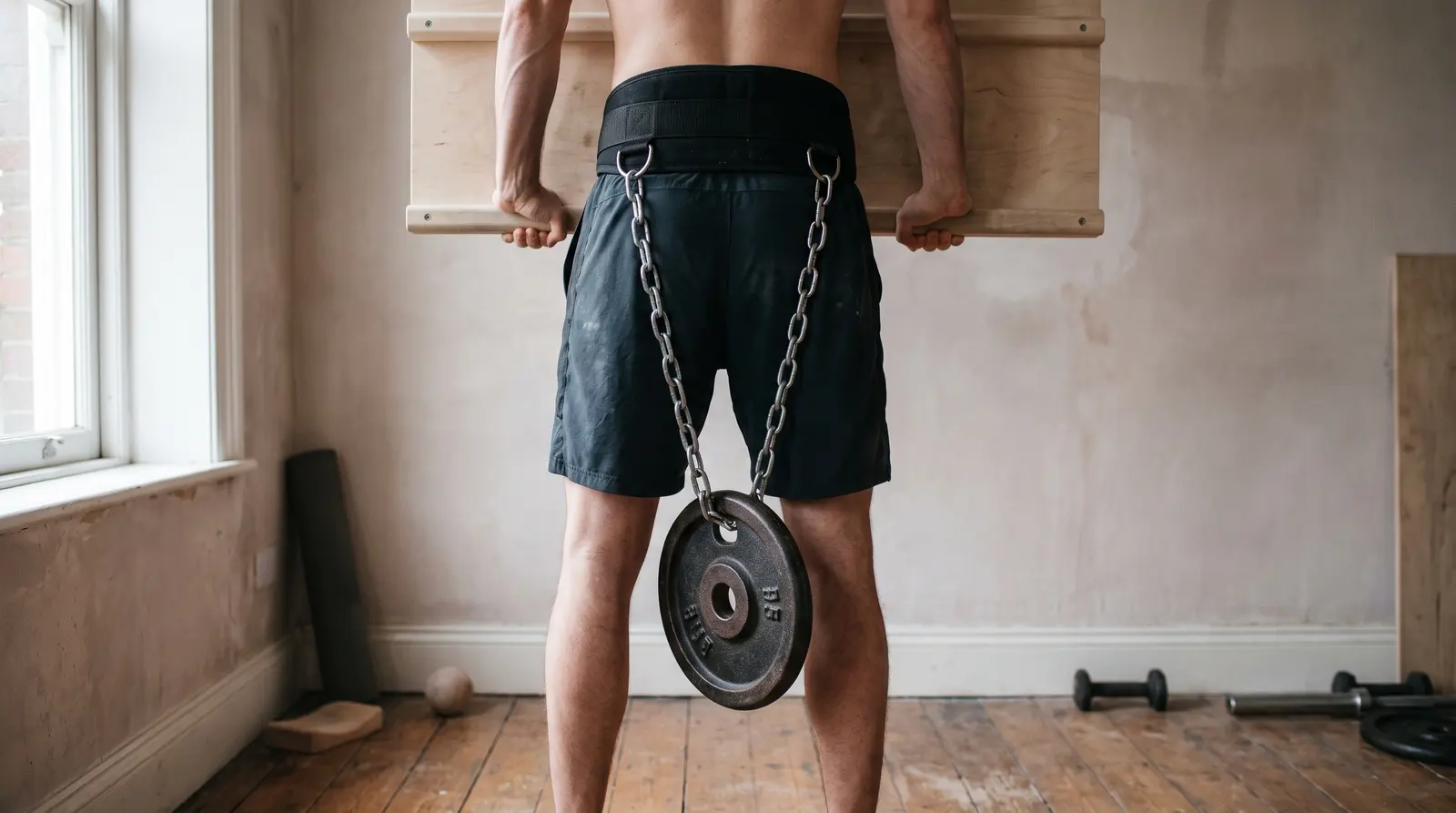
- Use assistance if needed. A pulley with a counterweight, or feet on a chair, lets lighter or weaker climbers train at the right intensity instead of skipping the workout.
- Balance the pulling. Hangboarding adds a lot of finger and pulling work. Pair it with antagonist training for the shoulders, wrists and pushing muscles.
- Young climbers: no maximal hangs under 14, and any finger pain under 18 should be seen by a doctor, as the BMC symposium stressed.
Making the program fit your climbing
Strong fingers are only useful if you can use them on the wall. Keep at least two climbing sessions per week during a hangboard block, and treat the board as one of several strength exercises, not your whole training. Even strong boulderers use structured finger work as a supplement to climbing, not a substitute for it.
Retest every 8–12 weeks on the same edge, write the numbers down, and compare them with the benchmarks linked above. When your finger strength stops being the weak link, shift your focus back to technique, power or endurance on the wall. That is how a hangboard program should work: a targeted tool you use for a few weeks at a time, then put away.
FAQ
Do hangboard programs really work?
Yes, for climbers who are ready for them. Randomised studies on advanced climbers found clear gains in grip strength and endurance after 4 to 8 weeks of structured hangboarding done twice a week. Results for beginners are less studied, and for them more climbing usually brings faster progress.
How often should I hangboard?
Two sessions per week is the standard starting dose for beginner to intermediate climbers, with at least 48 hours between sessions. Some guides allow up to three, but keep total climbing load in mind, because your fingers do not know the difference between a hangboard and a crimpy boulder.
Should I do max hangs or repeaters first?
Most climbers do well starting with short, heavy-ish hangs (max hangs) to build strength, then switching to repeaters for strength endurance. In one study, alternating the two over longer periods was suggested as a sensible approach.
Is hangboarding safe for teenagers?
Climbers under about 14 should not do maximal dead hangs. Growing fingers are vulnerable to growth plate injuries, so young climbers should stick to low-load, supervised work and lots of varied climbing. Finger pain in anyone under 18 should be checked by a doctor.
Sources
- López-Rivera E, González-Badillo JJ. Comparison of the Effects of Three Hangboard Strength and Endurance Training Programs on Grip Endurance in Sport Climbers. Journal of Human Kinetics (2019)
- Medernach JP, Kleinöder H, Lötzerich HH. Fingerboard in Competitive Bouldering: Training Effects on Grip Strength and Endurance. J Strength Cond Res (2015)
- Lattice Training, Lattice Training's Ultimate Guide to Better Hangboarding, Climbing.com (updated 2025)
- Climbing Magazine, Are You Ready to Start Hangboarding? (2021)
- British Mountaineering Council, Breaking Barriers: The BMC Climbing Injury Symposium 2016