Hangboard for Beginners: When to Start and Your First 6-Week Plan
 Petr Hess, strength & conditioning coach
Updated 2 Nov 2026 · 7 min read
Key takeaways
Best for: Climbers about a year in, new to hangboarding
- Check readiness first: about a year of climbing twice weekly, no finger pain, and a 20–30 second jug hang.
- Warm up for at least 15–20 minutes and finish with a 2–3 second test hang.
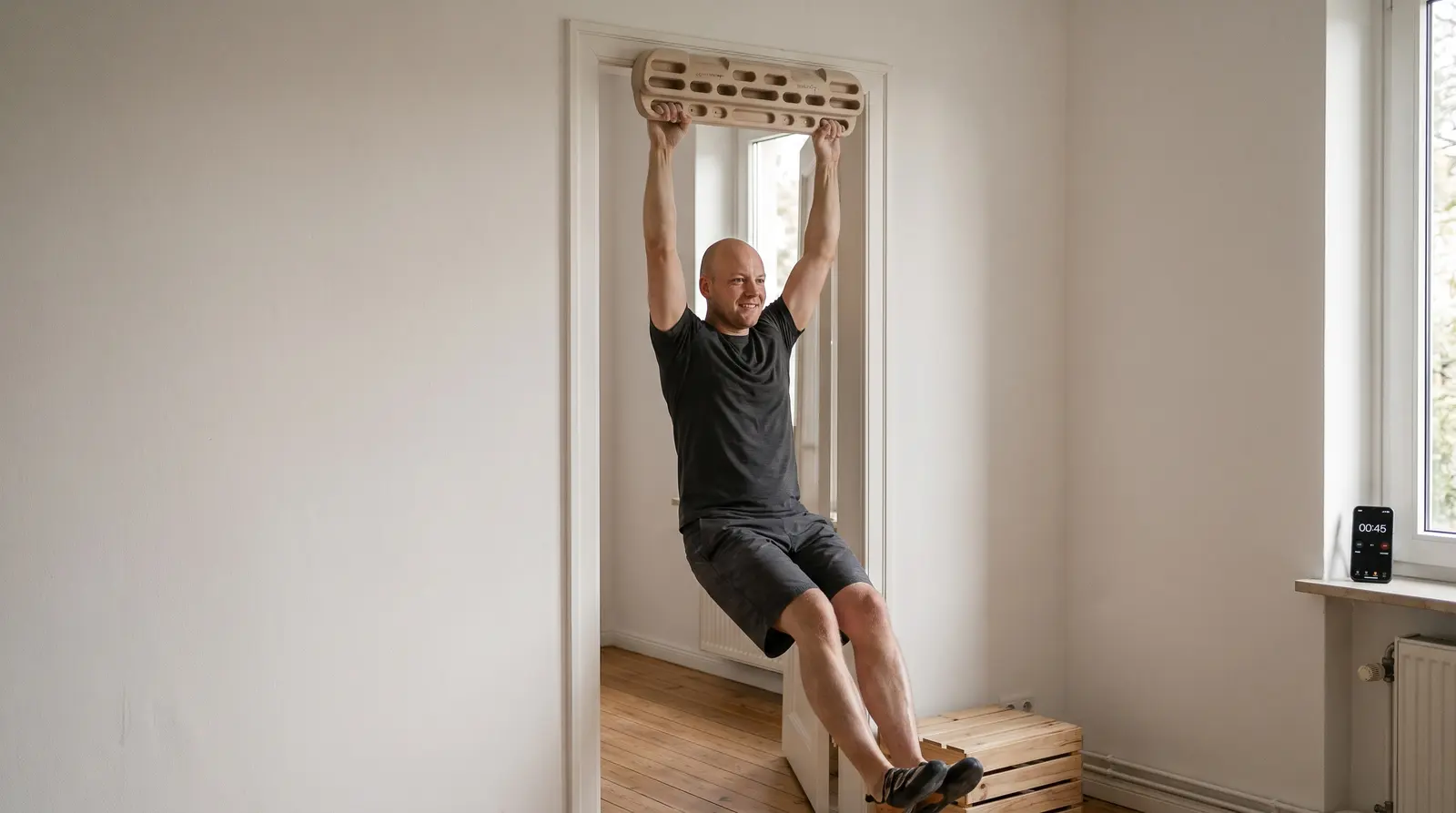
- Hang with two arms and four fingers, open hand first, taking weight off with your feet or a pulley.
- Train twice a week, at least 48 hours apart, using 7 s on / 3 s off repeaters at moderate effort.
- Change one variable per week, and progress only after completing a session successfully twice in a row.
A hangboard is a good tool for beginners only once you have a base: most guides suggest climbing for a year or two first, with no finger pain and solid technique. When you do start hangboarding, keep it simple: two short sessions a week, two arms, big edges, some weight taken off with your feet or a pulley, and every hang stopped well before failure. The 6-week plan below shows exactly how.
I write this as a strength and conditioning coach, not a climbing coach or physio. This page is the gentle on-ramp. Once you have finished it, our full hangboard program takes you into max hangs, repeaters and longer training blocks.
Should beginners hangboard, or just climb more?
For most new climbers, the honest answer is: climb more. In your first year, you fail on moves because of footwork, body position and reading the route, not because your fingers are weak. Every session on the wall also trains your fingers, in a form that transfers directly to climbing.
The second reason is tissue. Muscles get stronger within weeks, but tendons, pulleys and other connective tissue adapt more slowly. A new climber who adds hangboard training too early can end up with forearms that pull harder than their fingers can tolerate. That gap is where a finger injury tends to happen.
Climbing Magazine's readiness guide suggests it "makes more sense to climb a year or two first", and that juniors under 14 should avoid deadhanging for maximum strength. If you are not there yet, you can still build finger strength without a hangboard through targeted climbing.
Readiness checklist: are you ready to start hangboarding?
Tick all of these before your first session:
- Climbing history: roughly a year or more of consistent climbing, at least twice a week.
- The right limiter: you regularly fall off because you cannot hold small edges, not because of technique or fear.
- Healthy fingers: no current pain in the fingers, wrist or elbow, and no recent pulley injury.
- Basic control: you can hang from a jug for 20 to 30 seconds with engaged shoulders.
- Age: adult, or an older teen training at low loads with supervision. No maximal hangs under 14.
- Time to recover: you can fit two short sessions a week without stacking them on hard bouldering days.
Is there evidence that hangboarding works below elite level? Some. In a 2022 randomised trial, 35 intermediate to advanced recreational climbers (redpoint 6a or harder) either kept climbing or added a 10-week hangboard program twice a week. The hangboard group improved maximal finger strength on a 23mm rung more than the climbing-only group (Hermans et al., 2022). The program started on easy settings and only progressed when sets were completed without failure, which is the same logic used below.
What you need
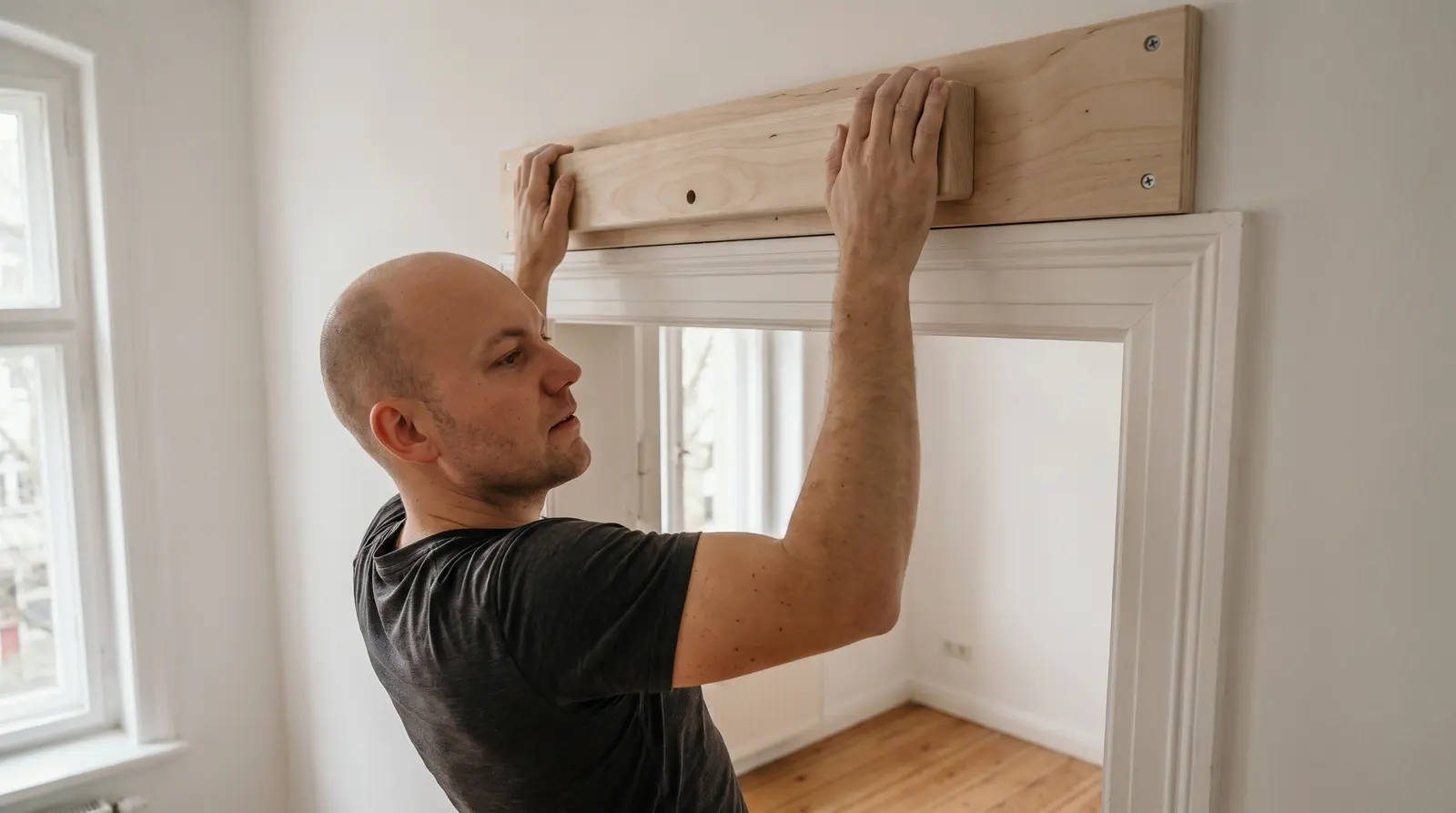
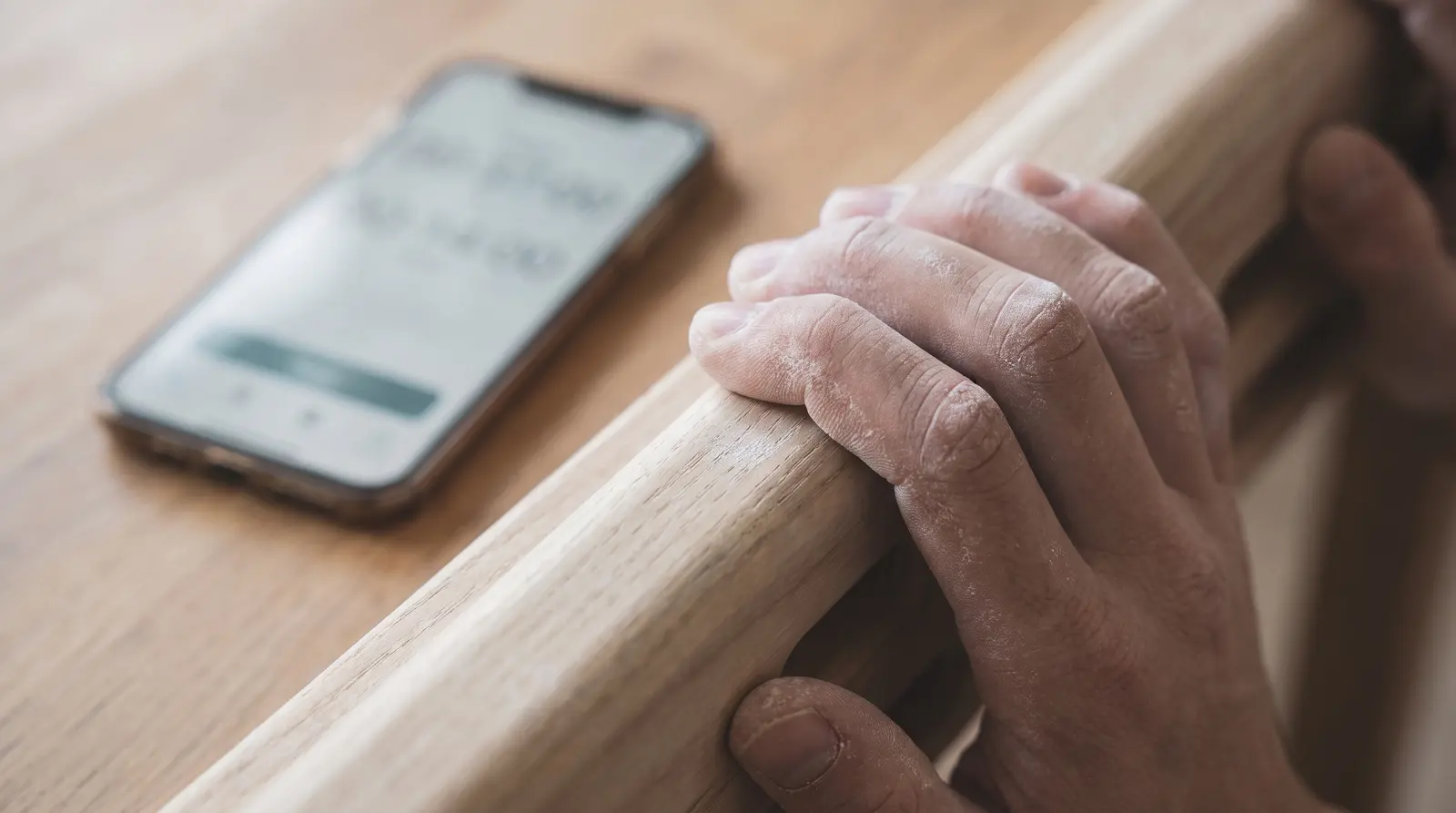
A board with large, positive edges and a jug, mounted securely, plus a way to take weight off: a chair for your feet, or a pulley and counterweight. Labelled edge sizes make progress easier to track, and the material (wood or resin) matters less than having big, comfortable edges to start on. For specific models, see our guide to the best hangboards for beginners. Chalk, a timer and a notebook complete the kit.
Warm-up: never skip it
Climbing Magazine recommends a warm-up of at least 15 to 20 minutes before hangboarding. Raise your pulse, mobilise the shoulders and wrists, do a few scapular pull-ups on a jug, then a couple of easy foot-assisted hangs on your training edge. Our climbing warm-up routine covers it step by step.
Finish with a test hang: ease onto the edge and hang for 2 to 3 seconds, then rest 30 to 45 seconds. If it feels harder than usual, use more assistance that day.
Good form on the hangboard
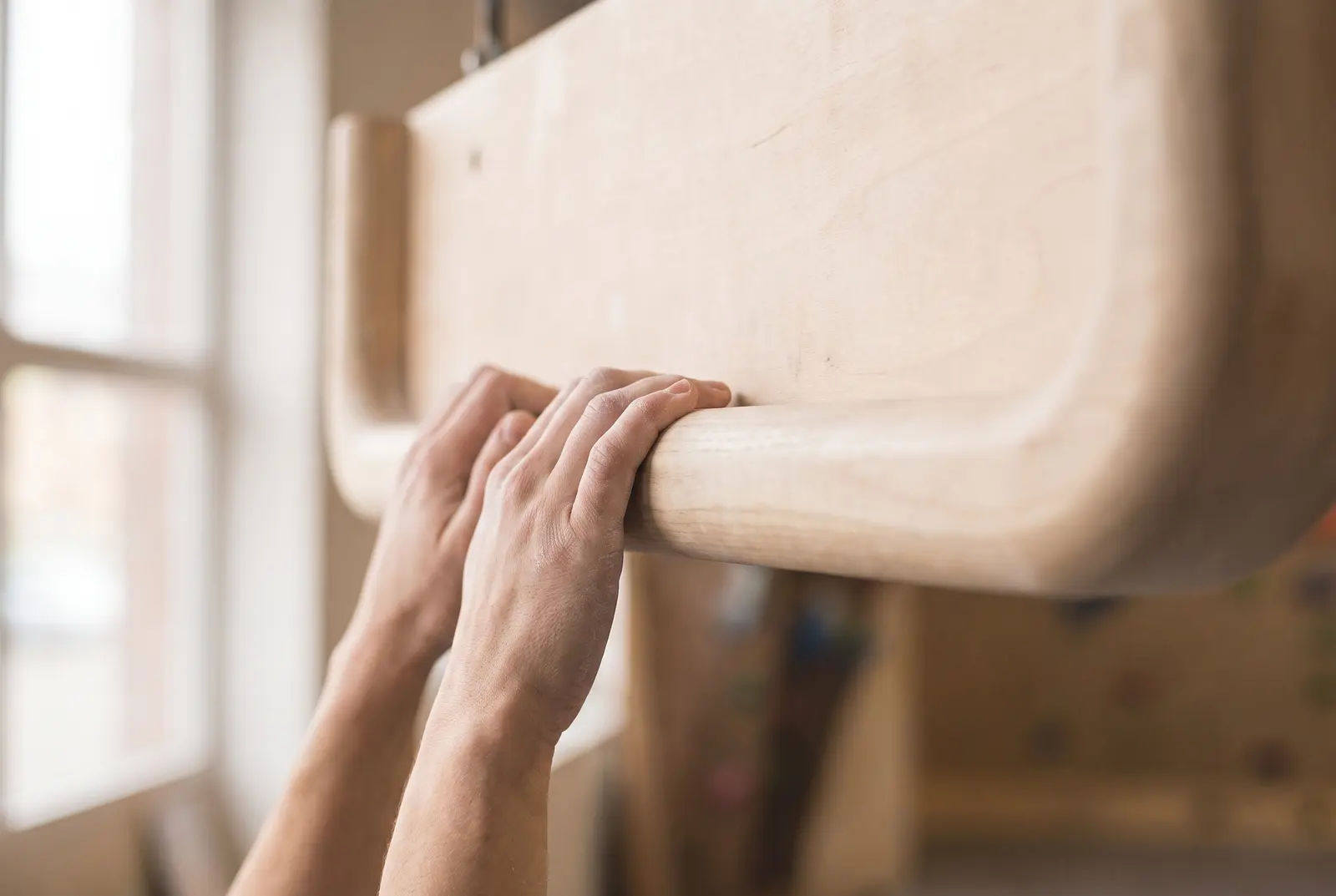
- Ease on, step off. Never jump onto small edges or drop off them. Load gradually with your feet still on the chair.
- Shoulder blades engaged. Pull them slightly down and back. Avoid hanging passively with your shoulders up by your ears.
- Elbows soft, not locked. A tiny bend keeps the load in the muscles rather than the joints.
- Four fingers, two arms. Hands about shoulder width apart.
- Grip positions: start with an open hand (or three-finger drag), then add the half crimp position once you are comfortable. Lattice advises beginners to limit full crimping; leave the full crimp alone for now.
- Stop when form breaks. If your grip opens, fingers slide or shoulders shrug, the rep is over.
Your first 6-week hangboard routine
This is a conservative training routine, not a tested protocol. It uses short repeaters (7 seconds on, 3 seconds off), the format Lattice calls most climbers' "go-to exercise" for strength endurance, at a low intensity. Do two sessions a week with at least 48 hours between them. Use the biggest edge you can hang on comfortably for 10 seconds with some assistance; a 20mm edge or larger is a typical starting point.
Effort is rated out of 10, where 10 is the hardest hang you could possibly hold. Stay at the level listed.
| Week | Session (do twice a week) | Effort |
|---|---|---|
| 1 | Learn the position: 5 × 10-second foot-assisted hangs, open hand, 2 min rest between hangs. | 4–5/10 |
| 2 | Repeaters: 3 sets of 5 reps (7 s on / 3 s off), open hand. 3 min between sets. | 5–6/10 |
| 3 | 4 sets of 5 reps, same timing. First set half crimp if it feels fine. | 5–6/10 |
| 4 | 4 sets of 6 reps. Take a little weight off the assistance if week 3 felt easy twice in a row. | 6/10 |
| 5 | 5 sets of 6 reps: alternate open hand and half crimp sets. | 6–7/10 |
| 6 | Deload and retest. Session 1: 2 easy sets. Session 2: note how much assistance you need for one clean 10-second hang. | Easy, then test |
Each session takes about 15 to 20 minutes after the warm-up. Write down the edge, the grip and how much assistance you used.
How to progress safely
- One change at a time. Less assistance, a smaller edge, more reps or more sets: pick one per week, never several.
- Earn the change. Lattice suggests progressing only after you have completed a session successfully at least twice in a row.
- Prefer less assistance to smaller edges. Keep the same edge and reduce the help; the smallest holds mostly test your skin.
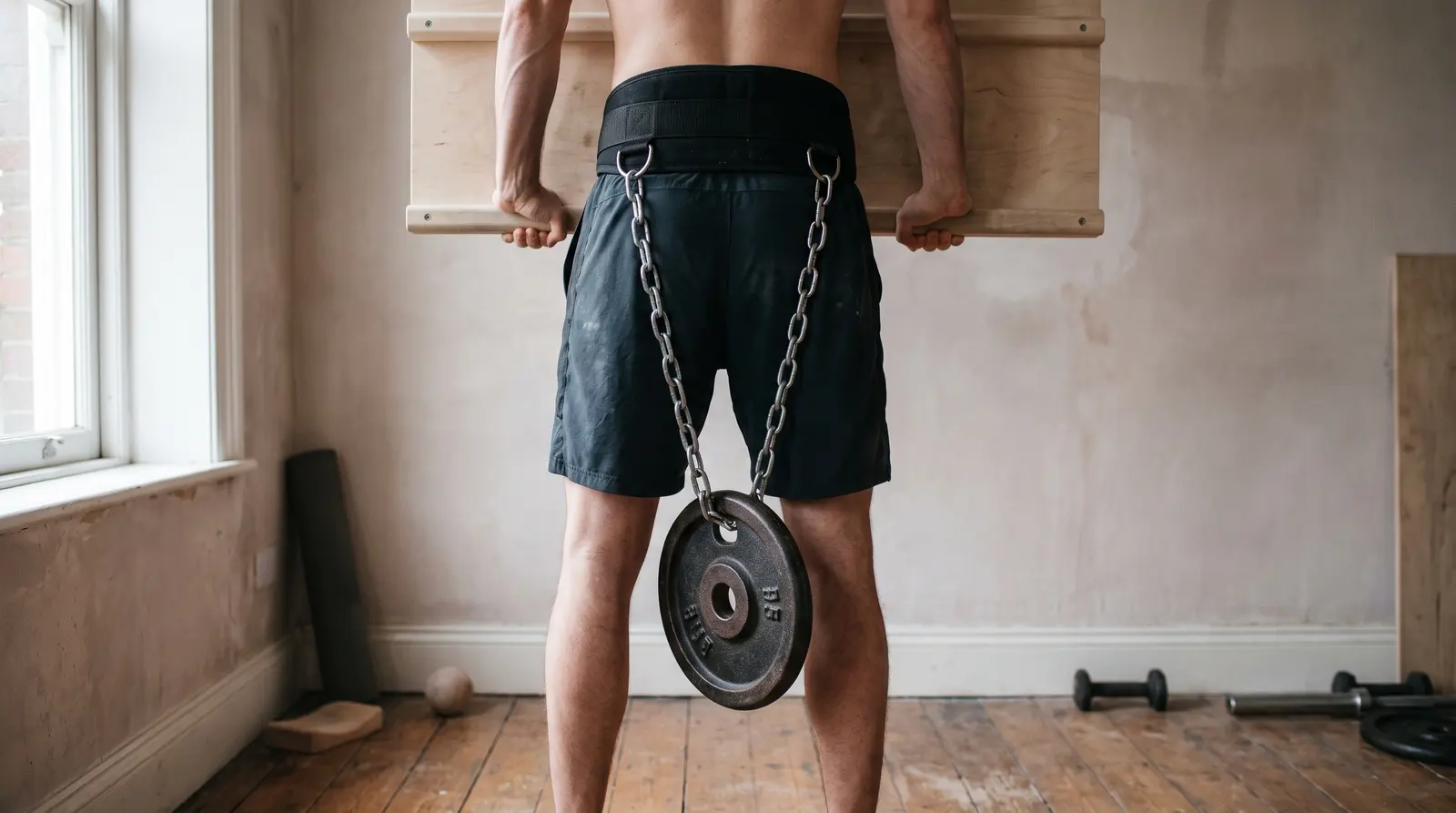
- Add weight later, not now. Once you can complete the plan at bodyweight with clean form, you are ready for the full program, where adding weight becomes an option.
- Listen to your body. If your fingers feel tweaky, repeat the week or go back one.
How often and how long should beginners hangboard?
Two sessions a week is enough. Climbing Magazine gives a range of 2 to 3 sessions a week over blocks of about 4 to 6 weeks for newer climbers, and Lattice points out that frequency is the training variable to watch most closely, because adding sessions raises total load fast.
The best time is after your warm-up and before you climb, or on a separate day. Avoid hanging after a hard session at the climbing gym, when your fingers are already tired. Keep at least two climbing sessions a week during the block, and drop one hard bouldering session if the total starts to feel like too much. Your fingers do not care whether the load came from a board or from the climbing wall.
Injury risks and how to avoid them
Most climbing injuries are overuse injuries, and about half involve the fingers. The BMC injury symposium reported that pulley ruptures make up around 60% of finger injuries in climbers, and that growth plate fractures account for up to 90% of finger injuries in adolescent climbers.
Reduce the chance of injury with a few simple habits:
- Never train to failure; finish each set feeling you had a couple of reps left.
- No full crimp, one-arm or two-finger hangs in your first block.
- No hangboarding on a day when your fingers already hurt.
- Balance all the pulling with some pushing and shoulder work.
After the six weeks
If you finished the plan with healthy fingers and clean form, compare your retest with week 1. Then either repeat the block with slightly less assistance, or move on to a structured strength and endurance block. Treat the hangboard as one training tool among several: it supports your climbing, it does not replace it.
FAQ
Should a beginner climber use a hangboard?
Usually not in the first year. Climbing Magazine suggests climbing a year or two first, because technique is the main limiter early on and tendons and pulleys adapt more slowly than muscle. After that, low-load, two-arm hangs on big edges are a reasonable addition.
How often should a beginner hangboard?
Two short sessions a week, with at least a day between them, is plenty. Climbing Magazine gives 2 to 3 sessions a week over blocks of about 4 to 6 weeks as the range for beginners and intermediates; starting at the low end leaves room for your normal climbing.
What edge size should beginners use?
Bigger than you think. Lattice uses a 20mm edge for most of its testing, but suggests that beginners who climb on larger holds benefit from training on larger edges. Pick an edge you can hang comfortably for 10 seconds with some help from your feet or a pulley.
Is hangboarding bad for your fingers?
Not when the dose is right, but it is easy to overdo. Most finger injuries in climbers are overuse injuries, and pulley ruptures make up around 60% of them according to the BMC. Stay well short of failure, avoid full crimping at high loads and stop if you feel sharp pain.
Sources
- Climbing Magazine, Are You Ready to Start Hangboarding? (2021)
- Lattice Training, Lattice Training's Ultimate Guide to Better Hangboarding, Part 1, Climbing.com (updated 2025)
- Lattice Training, Lattice Training's Guide to Better Hangboarding, Part 2, Climbing.com (updated 2025)
- Hermans E, Saeterbakken AH, Vereide V, et al. The Effects of 10 Weeks Hangboard Training on Climbing Specific Maximal Strength, Explosive Strength, and Finger Endurance. Frontiers in Sports and Active Living (2022)
- British Mountaineering Council, Breaking Barriers: The BMC Climbing Injury Symposium 2016