Best Hangboards for Home: Beginner to Advanced Picks
 Petr Hess, strength & conditioning coach
Updated 2 Nov 2026 · 9 min read
Key takeaways
Best for: Climbers choosing a first or upgraded hangboard
- Beginners need jugs, edges of 25mm and up and a 20mm edge, as on the Beastmaker 1000 or Metolius Simulator 3D.
- Pick a board with labeled edge depths, such as the Tension Grindstone or Lattice Triple Rung, to repeat tests reliably.
- Wood is easier on the skin; resin offers more hold types but can wear skin faster.
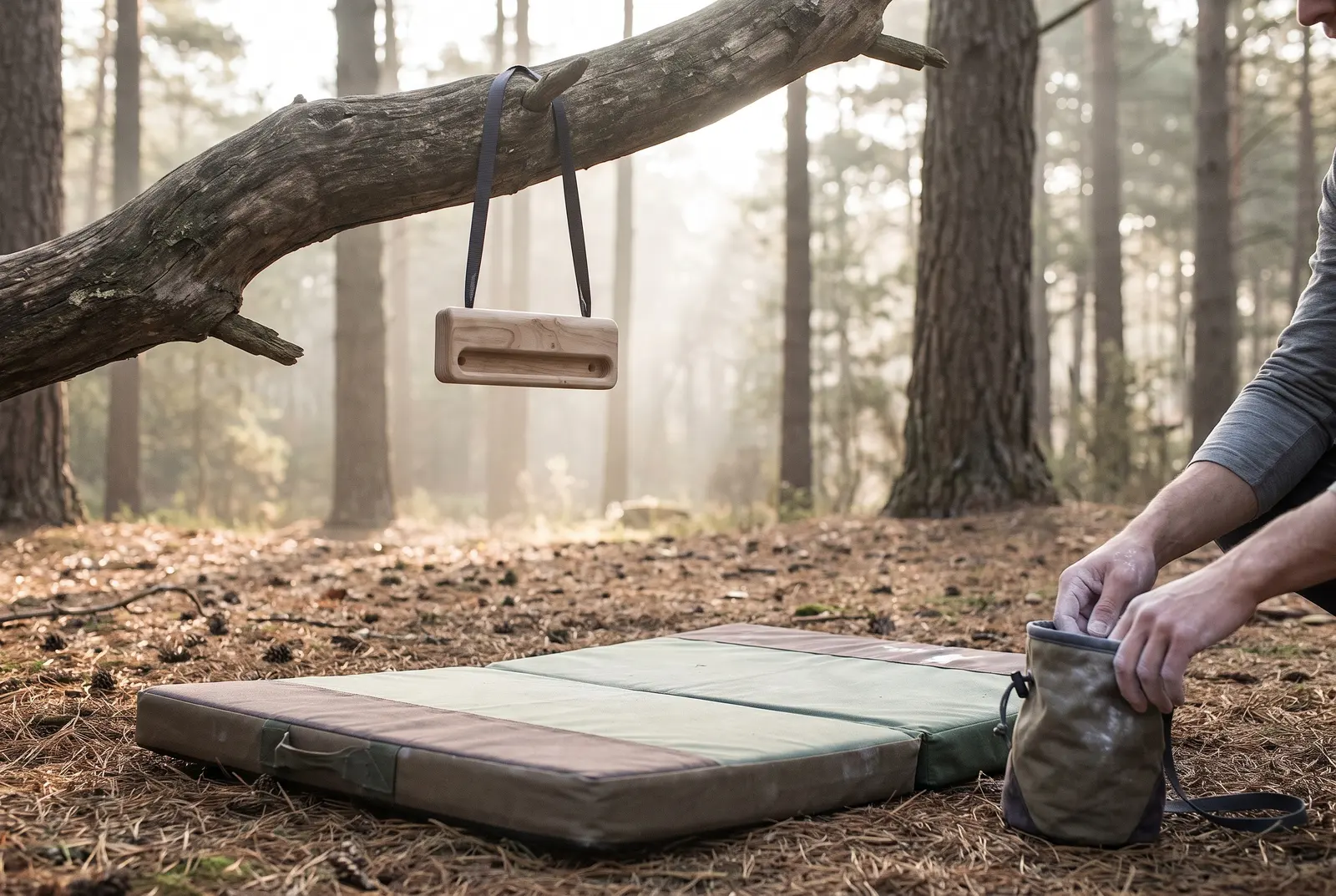
- If you can't drill, use a portable board like the Tension Flash Board, a freestanding frame or a lift block.
- Start below bodyweight with feet on a chair or a pulley, using open-hand or half crimp grips only.
The best hangboard is the one that matches your level and your space. For most beginners, a forgiving board with jugs, slopers and a 20mm edge, such as the Beastmaker 1000 or Metolius Simulator 3D, is the safest bet. Intermediate and advanced climbers usually get more from a board built around labeled edge depths, such as the Tension Grindstone or Lattice Triple Rung. If you can't drill into a wall, a portable hangboard like the Tension Flash Board is the simplest answer.
I'm a strength and conditioning coach, not a climbing coach, so I look at a hangboard the way I look at any training tool: can you load it precisely, progress it in small steps, and do it at home without wrecking your skin or your joints? That's the lens for the picks below. If you're kitting out a home setup more broadly, our crash pad guide covers the landing side.
Best hangboards at a glance
Edge depths and holds below come from each manufacturer's product page. Where a maker doesn't publish depths, we say so instead of guessing. Prices change often, so we use tiers: budget (under about $60), mid ($60–$150) and premium (above $150). Prices and stock were checked in November 2026.
| Best for | Model | Material | Edges and holds (per maker) | Price tier |
|---|---|---|---|---|
| Best overall for edge training | Tension Grindstone | Wood | Top jug, 50mm one-arm edge, 30, 25, 20, 15, 10 and 8mm edges | Premium |
| Best beginner hangboard (wood) | Beastmaker 1000 | Wood (beech) | 2 jugs, 20° and 35° slopers, deep to small 4-finger pockets (smallest 10mm), 2- and 3-finger pockets | Mid |
| Best for beginners on a budget (resin) | Metolius Simulator 3D | Resin | Wide mix of jugs, slopers, pockets and edges on a tapered arc; depths not listed | Mid |
| Simplest training and testing board | Lattice Triple Rung | Wood | 45mm warm-up edge, 20mm benchmark edge, 10mm edge | Mid |
| Best hold variety | Trango Rock Prodigy Training Center | Resin | Two-piece board; variable-depth edge rails, pinches, pockets, jugs; depths not listed | Premium |
| Best for advanced climbers | Beastmaker 2000 | Wood (beech) | 22mm middle edge, 20°, 35° and 45° slopers, 2- and 3-finger pockets, monos | Mid |
| Best portable hangboard | Tension Flash Board | Wood | 8, 10, 15 and 20mm edges | Mid |
| Lightest travel hangboard | Lattice Mini Bar | Wood (tulipwood) | 10mm and 20mm edges, jug, mini pinch | Budget |
| Best for pull-ups and doorframes | Metolius Rock Rings 3D | Resin | Two hanging rings with jugs, slopers and pockets; depths not listed | Budget |
How to choose a hangboard
Five questions narrow the field quickly. Answer them before you look at brand names.
1. What is your level?
A hangboard is a strength training tool, and finger tendons and pulleys adapt more slowly than muscle. If you've been climbing for less than about a year, climbing itself is usually enough finger training. When you are ready, read our guide to the hangboard for beginners first, then pick a board with plenty of large holds.
- Beginner: jugs for warm-ups and pull-ups, deep edges (25mm and up), and a 20mm edge you can grow into.
- Intermediate: a clear 20mm edge, a 15mm edge, and room to add weight or remove load with a pulley.
- Advanced: small edges (10mm and below), pockets and monos for specific weaknesses, and labeled depths so you can track progress.
2. Wood or resin?
This is the biggest material choice, and it mostly comes down to skin and variety.
- Wooden hangboards are smoother and easier on the skin, which matters if you train two or three times a week. Beastmaker argues on its product pages that wood beats resin for grip, porosity and texture. That is a maker's claim, but it is also why most boards built for structured finger training (Beastmaker, Tension, Lattice) are wood.
- Resin boards can be molded into complex shapes, so you get more hold types: slopers, pinches, pockets and jugs on one board. They have more texture, which helps grip but can wear skin faster over long sessions.
3. Which edge sizes do you need?
Edge size is the most important spec on any hangboard. The 20mm edge is the closest thing climbing has to a standard: Lattice calls the 20mm rung on its Triple Rung its "benchmark" edge and uses it for its free finger strength assessment. Our finger strength benchmarks guide explains how to use it for testing.
Look for at least one comfortable edge deeper than 20mm for warming up, a 20mm edge for most of your work, and a 10mm edge if you climb hard. Boards with labeled depths, such as the Grindstone or Triple Rung, make it much easier to repeat the same test months later.
4. How will you mount it?
A full-size board is usually screwed to a sturdy backing board above a doorframe or fixed into wall studs. Follow the manufacturer's mounting guide; note that Trango, for example, says the Rock Prodigy Training Center does not include mounting hardware. If you rent or can't drill, consider:
- a freestanding frame or a pull-up bar setup,
- a portable hangboard on a sling, or
- a no-hang lifting block such as the Tension Block, which you pull from the floor with a weight attached.
Whatever you choose, the anchor must hold more than your bodyweight with a margin, including the extra load of a dynamic move.
5. How much space do you have?
Most boards need clear space for your body to hang straight below them and room to drop safely. Width varies a lot: the Beastmaker 1000 and 2000 are 580mm wide and 150mm high, the Grindstone 22 in (about 56cm) wide and 6 in high, while the Metolius Simulator 3D is 711 x 222mm. OutdoorGearLab named the Beastmaker 1000 its most space-efficient pick because it packs a lot of holds into a 6-inch-tall board.
Our top picks, explained
Tension Grindstone: best overall for edge training
The Grindstone is a wooden edge board with a full-width bar-style jug, a 50mm center edge for one-arm work, and pairs of 30, 25, 20, 15, 10 and 8mm edges. OutdoorGearLab rated it Best Overall and called it the most comfortable board in its test. The labeled depths make progression and retesting simple. It is a premium board, and it was listed as sold out on Tension's store when we checked, so you may need a retailer. Beginners with very little finger strength may find it short on big holds beyond the jug and deep edges.
Beastmaker 1000: best beginner hangboard
Beastmaker says the 1000 Series was designed for "those who are a bit newer to climbing and training" and suits climbers from about V1 to V10. It has two jugs, 20° and 35° slopers and a range of pockets from very deep down to a small 10mm four-finger hold. OutdoorGearLab also notes a 20mm edge. It's now made from FSC-certified beech and costs around £105 on Beastmaker's UK store. At 150mm high it fits above most doorframes.
Metolius Simulator 3D: best resin board for beginners
The Simulator 3D has a large variety of jugs, slopers, pockets and edges arranged on an arc that tapers outward and downward, which Metolius says improves ergonomics. It comes with a training guide and mounting hardware and lists at around $120 on Metolius's site. OutdoorGearLab found it offered good variety and comfort for its price. Metolius doesn't publish edge depths, so it's less suited to precise testing.
Lattice Triple Rung: simplest board for training and testing
The Triple Rung has only three edges: 45mm for warming up, 20mm for training and testing, and 10mm for small-edge strength. Lattice says the edges have a large radius (about half the edge depth), which reduces the effect of skin friction and makes test results more comparable. If you follow a structured hangboard program based on max hangs and repeaters, this is often all you need. It has no jugs or pockets, so you'll want a pull-up bar nearby.
Trango Rock Prodigy Training Center: best hold variety
The Rock Prodigy Training Center is based on the training system of Mark and Mike Anderson, authors of The Rock Climber's Training Manual. Its two separate halves let you set the width to your shoulders, and index bumps on the edge rails help you place your fingers the same way each time. OutdoorGearLab gave it its Best Hold Variety award. It lists at around $175 on Trango's site and does not include mounting hardware, so budget for that and for the extra wall space.
Beastmaker 2000: best for advanced climbers
Beastmaker is clear that the 2000 Series "is not a hangboard for beginners". It's built around smaller holds: its well-known 22mm middle edge, 20°, 35° and 45° slopers, several two-finger pockets and monos. Choose it if you already climb hard and want to target specific grips.
Best portable hangboards
A portable hangboard is ideal if you rent, travel, or want to warm up at the crag. The trade-off is fewer holds and less stability than a fixed board.
- Tension Flash Board: a compact wooden cylinder with 8, 10, 15 and 20mm edges. Hang it from a pull-up bar, tree or bolt, or pull against your foot. OutdoorGearLab named it Best Bang for the Buck. Tension's list price is around $99.
- Lattice Mini Bar: a tulipwood bar weighing 150g with 10mm and 20mm edges, a jug and a mini pinch. It can be hung, used with a resistance band, or loaded with weights. Lattice lists a maximum load of 130kg.
- Metolius Rock Rings 3D: two separate resin rings on single-point suspensions that let your joints rotate naturally. They're good for pull-ups and general grip work, less so for precise edge training. Around $50 for the pair.
Training tips before your first session
- Warm up properly. Start on jugs and deep edges, then build up load gradually. A short climbing warm-up routine works at home too.
- Start with less than bodyweight. Keep your feet on a chair or use a pulley to take weight off. This is the easiest way to progress safely.
- Use open-hand or half crimp grips. Avoid full crimping on a hangboard.
- Keep it short and consistent. Short, regular sessions are easier to recover from than long, exhausting ones. Our hangboard program lays out progressions by level.
- Stop if anything hurts. Sharp finger pain is a reason to stop and get it checked. See our climbing injuries hub.
Want to measure your pulls rather than just hang? A force gauge adds that, and our Tindeq Progressor buyer's guide explains whether it's worth it.
Bottom line
If you're new to finger training, start with the Beastmaker 1000 or Metolius Simulator 3D. If you want precise, labeled edges for a structured program, get the Tension Grindstone or the simpler, cheaper Lattice Triple Rung. Advanced climbers looking for small holds and pockets should look at the Beastmaker 2000, and anyone who can't drill should start with the Tension Flash Board. Whichever you choose, the board matters far less than training on it sensibly and consistently.
FAQ
What is the best hangboard for beginners?
A board with big, comfortable holds and a 20mm or deeper edge. Beastmaker says its 1000 Series was designed for climbers newer to training, and the Metolius Simulator 3D and Lattice Triple Rung are also friendly starting points. Most beginners should climb regularly for a while before they start structured hangboard training.
Is a wood or resin hangboard better?
Wood is smoother and kinder to skin, so it suits frequent, structured finger training. Resin boards can be molded into more shapes, such as slopers, pockets and pinches, and have more texture. Many climbers who train fingers seriously choose wood.
What edge size should a hangboard have?
For most climbers a 20mm edge is the most useful, because it is the common benchmark for training and testing. Beginners also need deeper edges or jugs to warm up, while advanced climbers benefit from 10mm or smaller edges.
Can I use a hangboard without drilling into my wall?
Yes. Portable boards such as the Tension Flash Board, Lattice Mini Bar or Metolius Rock Rings hang from a pull-up bar, beam or sling. You can also mount a full-size board on a freestanding frame. Whatever you use, check that the anchor can safely hold your full bodyweight.
Sources
- OutdoorGearLab, The 5 Best Hangboards (updated Nov 2024)
- Beastmaker, Beastmaker 1000 Series – Beech (product page)
- Tension Climbing, Grindstone (product page)
- Lattice Training, Triple Rung (product page)
- Metolius, Simulator 3D Training Board (product page)
- Trango, Rock Prodigy Training Center (product page)