Tindeq Progressor: Is It Worth It? A Buyer's Guide
 Petr Hess, strength & conditioning coach
Updated 2 Nov 2026 · 7 min read
Key takeaways
Best for: Climbers already following a structured finger plan
- Buy it if you train fingers in a structured way; skip it in your first year or two of climbing.
- The Progressor 200 (2000 N, 80 Hz) is plenty for finger training; the 500 suits heavy whole-body pulls.
- Tare the device before each test and use static, non-stretchy attachments to reduce variability.
- Its peak force readings matched a lab force plate almost perfectly (ICC 0.99) in 25 experienced climbers.
- Treat the app's critical force result as a useful trend number, not an exact training zone.
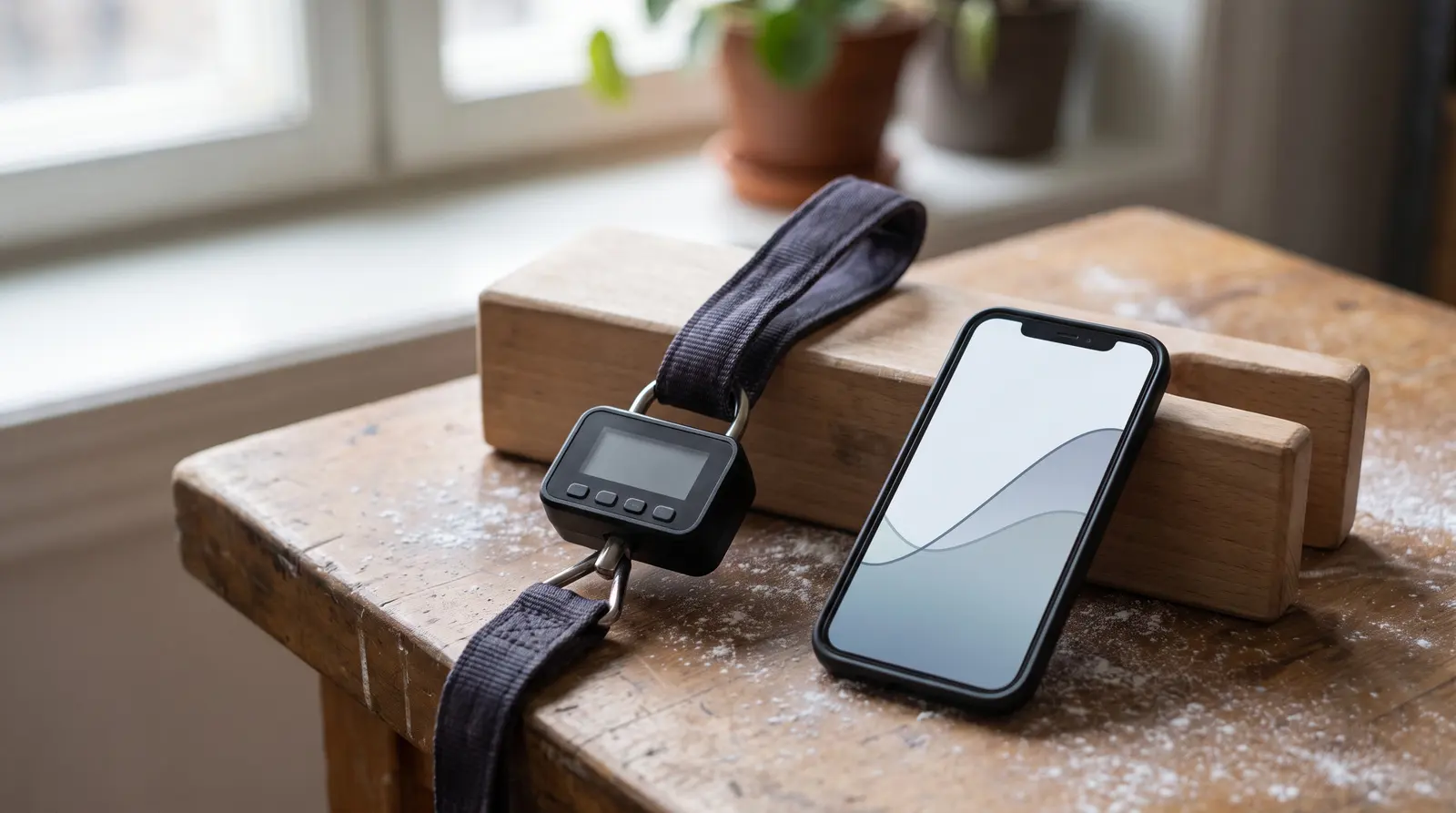
The Tindeq Progressor is worth it if you already train your fingers in a structured way and want real numbers to set loads and track progress. It's a small Bluetooth force sensor with a free app, and one independent study found its peak force readings match a lab force plate very closely. If you only climb and hang now and then, you can skip it and spend the money on a good hangboard instead.
As a strength and conditioning coach, I like measuring force because it removes guesswork. A dynamometer is a standard tool in S&C. The question for climbers is whether that precision is worth the money for you.
What is the Tindeq Progressor, and who is it for?
The Progressor is a portable dynamometer made by Tindeq, a small Norwegian company. It's a load cell that sits between you and an anchor. You clip one end to a hangboard, edge or sling and the other to a fixed point or weight, and it sends live force readings to your smartphone over Bluetooth.
For climbers, that means you can measure exactly how hard your fingers pull on an edge instead of estimating it from bodyweight plus added weight. It's useful for:
- climbers who test finger strength and want comparable numbers over time,
- anyone training on a hangboard who wants to hit precise intensities,
- coaches and physios who need objective data for athletes or rehab, and
- climbers who want to train fingers without a full hangboard setup.
Tindeq Progressor models
Tindeq currently sells two models. The older Progressor 150 and 300 were replaced by the 200 and 500, which use a USB-C rechargeable battery and an ABS casing. All specs below are from Tindeq's product pages.
| Model | Max load | Sampling | Precision | Status |
|---|---|---|---|---|
| Progressor 150 | 1500 N (about 150 kg) | – | – | Replaced by the 200 |
| Progressor 200 | 2000 N (about 200 kg) | 80 Hz | 0.25% of full scale | Current, around $160 excl. VAT |
| Progressor 300 | 3000 N (about 300 kg) | – | – | Replaced by the 500 |
| Progressor 500 | 5000 N (about 500 kg) | 80 Hz | 0.25% of full scale | Current, around $220 excl. VAT |
For finger training and testing, the Progressor 200 is plenty. The 500 makes sense for heavy whole-body pulls, such as an isometric mid-thigh pull, or for clinics. The 200 weighs about 150g, so it fits easily in a crag bag.
How do you set up and use the Tindeq?
Setup is simple: turn on Bluetooth, switch on the Progressor, pair it in the app, then tare it (zero it) before each test. Common ways to use the Tindeq include:
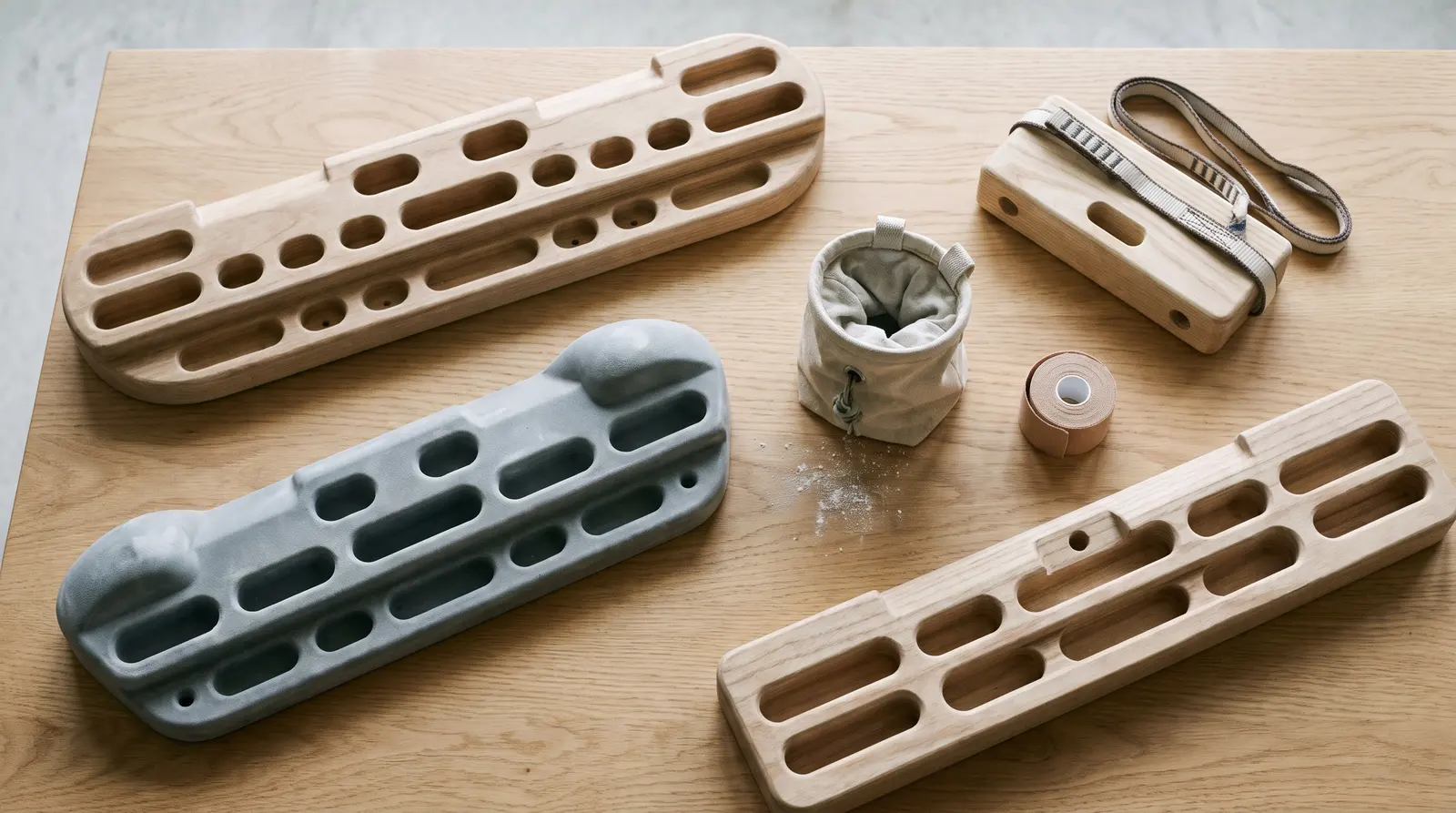
- Under a hangboard: hang a portable edge from the Progressor, which hangs from above. You see the force your fingers carry. Halve the reading per hand if you hang on two.
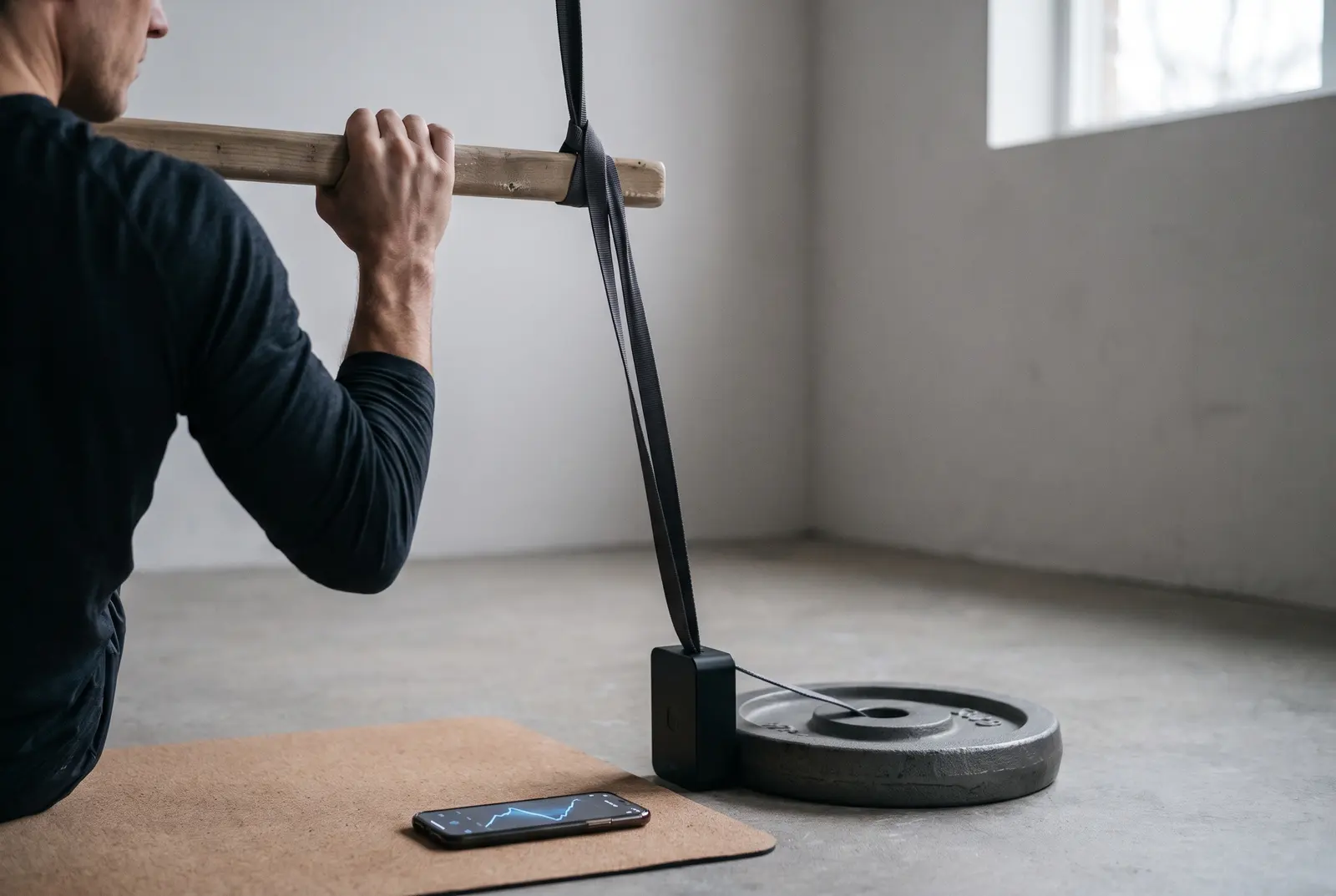
- Pulling against an anchor: attach an edge or lifting block to the Progressor and clip it to a floor anchor or a sling around your foot. You control intensity by pulling harder or softer, with no weights needed.
- With a lifting block: clip it between your block and a weight to measure what your fingers actually lift.
Use static, non-stretchy attachments. A French coaching site that reviewed the first-generation models notes that elastic links and a tilting setup add variability. Mounting the edge semi-rigidly on a board helps.
The app and tests: peak force, RFD and critical force
The Tindeq app is free for iOS and Android. According to its App Store listing, the main modes are:
- Peak Force / Peak Load: your maximal pull, with comparison to bodyweight and normative values. You can measure left and right at the same time with two units.
- Rate of force development (RFD): how fast you produce force, with automatic onset detection.
- Endurance: hold a target force for a set time, with sound cues above and below target.
- Repeaters: timed on/off hangs with left/right options. Reviewers like the color-coded force zones for interval sessions.
- Critical Force: estimates critical force and W′ from a single all-out test. The French review describes it as a beta feature using 24 maximal efforts.
- Training programs, custom sessions, PDF reports and CSV export. There is also an open API for anyone who wants to build their own tools.
Peak force is the most practical number for most climbers. Pair it with our finger strength benchmarks to see where you stand, and use it to choose between max hangs and endurance work. Our max hangs vs repeaters guide explains that choice.
How accurate and reliable is the Tindeq Progressor?
This is where the Progressor has a real edge over cheaper options: there is published evidence.
- Validity: Labott and colleagues (2022) tested 25 experienced climbers on one-arm rung pulls and 90° lock-offs, measured by the Tindeq and a lab force plate at the same time. The two agreed almost perfectly (ICC 0.99). Mean rung pulling force was 464 N on the Tindeq and 465 N on the force plate.
- Reliability: repeat tests were reliable within and between days. For rung pulling, the between-day ICC was 0.95 with a 6.2% coefficient of variation.
- Limits: the study only tested experienced climbers and maximal static pulls, and the authors note that Tindeq gives limited technical detail on filtering. Endurance and critical force modes were not tested.
The critical force concept itself is still being debated. Giles et al. (2019) found that a single-session test gave a critical force close to a multi-session version (ICC 0.90). But a 2024 study by Baláš and colleagues found that critical force from the mean of the last three contractions in a 4-minute all-out test overestimated the force climbers could actually sustain. So treat critical force as a useful trend number, not an exact training zone.
Tindeq Progressor vs Weiheng WH-C06 and other alternatives
| Device | Type | App | Published accuracy data | Price tier |
|---|---|---|---|---|
| Tindeq Progressor 200 | Climbing dynamometer, 200 kg, 80 Hz | Official app, peak force, RFD, repeaters, critical force | Yes (Labott et al., 2022) | Mid |
| PitchSix Force Board | Climbing dynamometer, 300 kg, 40 Hz | Official app, peak force and critical force assessments | None found | Mid |
| Griptonite Motherboard (with Beastmaker) | Hangboard backboard with force sensors | Grippy app, left/right bias, peak force | None found | Premium |
| Weiheng WH-C06 | Generic Bluetooth crane scale | No climbing app from the maker; third-party apps such as Hangtime Grip Connect | None found | Budget |
The WH-C06 is the budget option climbers mention most. It reads force, and open-source projects like Grip Connect support it, but it isn't designed for climbing and we found no independent accuracy study. If you only want occasional peak force numbers and enjoy tinkering, it can work. If you want reliable data and a polished app, the Tindeq is the safer choice.
Main strengths and drawbacks
Strengths
- Validated against a lab force plate for maximal pulls.
- Small, light and portable; it works with or without a hangboard.
- Free app with many test modes, CSV export and an open API.
Drawbacks
- Testing one hand at a time makes sessions longer.
- App quality draws mixed feedback: some user reviews on Tindeq's site report crashes in older app versions, and the iOS app has a 3.6 rating.
- RFD is measured separately from your peak force test rather than in the same pull.
- Prices on Tindeq's store exclude VAT, so local taxes may apply.
Who should buy it?
Buy it if you train fingers at least weekly, want to compare tests over months, coach other climbers, or are returning from a finger injury with a professional who wants objective loading data. It also suits anyone who wants to train finger strength without a hangboard.
Skip it if you're in your first year or two of climbing, or you don't follow a plan yet. In that case, a good board from our best hangboards guide and a training notebook will give you far more for the money.
FAQ
Is the Tindeq Progressor worth it?
It is worth it if you train fingers in a structured way and want objective numbers to guide load and track progress. If you only climb and hang occasionally, a hangboard and a simple log will do most of the job for less money.
Which Tindeq should I buy, the Progressor 200 or 500?
The Progressor 200 (2000 N, about 200 kg) covers almost all finger and climbing tests. The Progressor 500 (5000 N) is aimed at stronger whole-body pulls such as an isometric mid-thigh pull, and at clinicians.
How accurate is the Tindeq Progressor?
A 2022 study of 25 climbers found its peak force readings agreed almost perfectly with a lab force plate (ICC 0.99) for one-arm hangboard pulls and lock-offs, and repeat tests were reliable. The study did not test its endurance or critical force functions.
Can I use a Tindeq without a hangboard?
Yes. You can attach a portable edge or lifting block to the Progressor and pull against a fixed anchor, such as a sling around your foot or a floor anchor, so the device measures how hard you pull.
Sources
- Tindeq, Progressor 200 Rechargeable (product page)
- Labott B.K. et al., Validity and Reliability of a Commercial Force Sensor for the Measurement of Upper Body Strength in Sport Climbing, Frontiers in Sports and Active Living (2022)
- Tindeq, Tindeq Progressor app (Apple App Store listing)
- La Fabrique Verticale, Meeting with the Tindeq Progressor (2026)
- Giles D. et al., The Determination of Finger Flexor Critical Force in Rock Climbers, IJSPP (2019)
- Baláš J. et al., Measuring critical force in sport climbers: a validation study of the 4 min all-out test on finger flexors, Eur J Appl Physiol (2024)