How to Get Better at Bouldering: 17 Tips That Work
 Petr Hess, strength & conditioning coach
Updated 2 Nov 2026 · 10 min read
Key takeaways
Best for: Newer boulderers progressing toward V3–V5
- Climb two or three times a week and try at least one style you usually avoid each session.
- Drill silent feet for ten minutes at the start of each session on problems two or three grades below your max.
- Read each problem from the ground: start and finish holds, hand sequence, then the feet for each move.
- Project problems slightly above your level right after the warm-up, resting 3–5 minutes between hard attempts.
- Add strength work twice a week, such as 3–4 sets of 3–8 pull-ups, leaving a rep or two in reserve.
The fastest way to get better at bouldering is to climb often, on purpose: work on footwork and body position, read each problem before you pull on, and spend real time on problems slightly above your level. Strength training helps, but for most beginners and intermediates technique and smart session structure bring bigger gains than any exercise. Below are 17 tips that work, roughly in the order I would prioritise them.
I'm a strength and conditioning coach, not a climbing coach, and bouldering is my favourite complement to my own training. These tips are what I'd tell a friend at the gym, backed by research where research exists. If you want the whole picture laid out week by week, see our bouldering training program.
Technique: the biggest lever
1. Climb more, and climb more variety
Time on the wall is the base of everything. Every session you add to your movement library: how to move on slab, how to hold a sloper, when to flag. A beginner who climbs two or three times a week will almost always improve faster than one who climbs once a week and trains hard at home.
Variety matters as much as volume. If you only climb steep jugs, slab will feel impossible. Each session, try at least one style you avoid: slab, overhang, compression, crimps, pinches or dynamic moves.
2. Make footwork your first priority
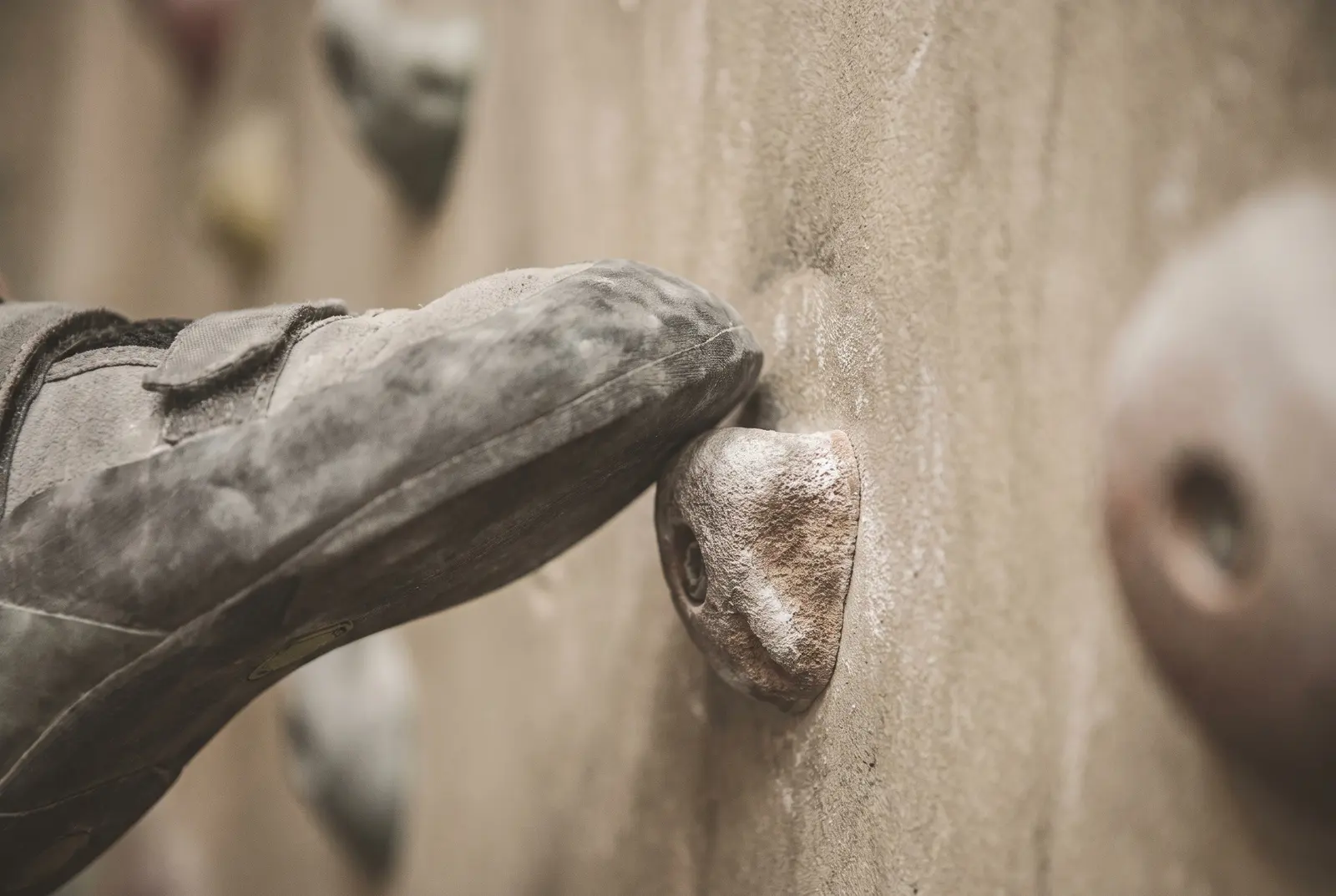
Most new climbers pull with their arms and treat the feet as an afterthought. Your legs are far stronger than your arms, so every bit of weight you put through a good foothold is weight your fingers don't have to hold.
Drill: silent feet. On problems two or three grades below your max, place each foot so quietly that nobody hears it. Look at the foothold until your shoe is on it, then look up. Ten minutes of this at the start of every session builds precise footwork faster than you'd expect.
Drill: glue feet. Once a foot is on a hold, it doesn't move or readjust. This forces you to place it right the first time.
3. Learn to use your hips
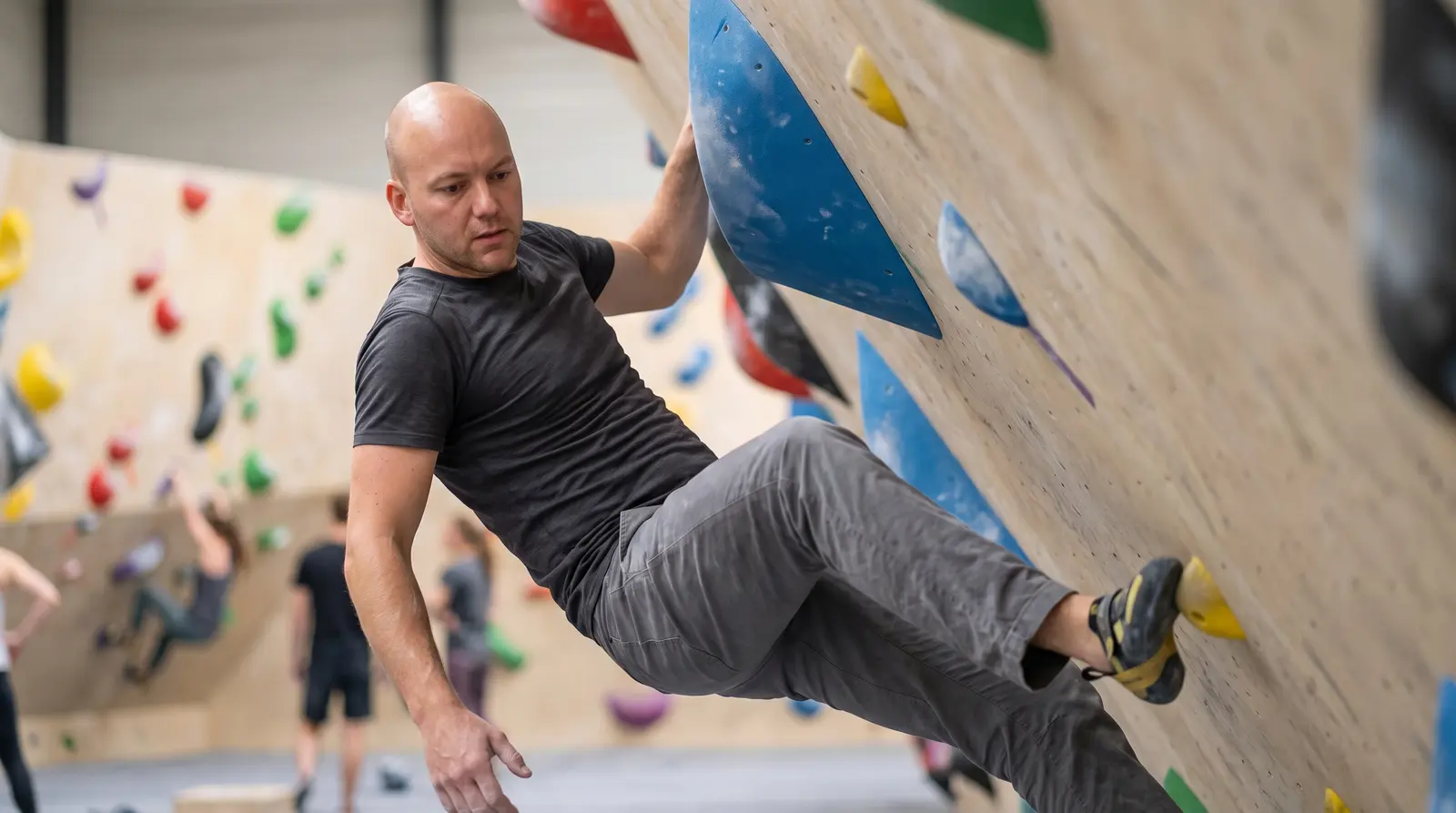
Good body position means keeping your hips close to the wall and your weight over your feet. On steep terrain, turning one hip into the wall (a backstep or drop knee) lets you reach further with straighter arms. On slab, standing upright with your hips out and weight over your toes keeps your shoes stuck.
Drill: same problem, three ways. Climb one easy problem face-on, then with your left hip turned in, then the right. Notice which version needs the least grip.
4. Climb with straight arms
A straight arm hangs on bone and tendon; a bent arm burns muscle. Between moves, hang on straight arms and use your legs to push you up and across. Bend the arms only for the moment you need to lock off or pull through.
5. Learn the core movement vocabulary
Beginners often get stuck on V1–V3 not because they lack strength but because they don't know the move. Learn and practise these on purpose:
- Flagging – sticking a leg out to balance instead of placing it on a hold.
- Heel and toe hooks – using your feet to pull, not just to push.
- Drop knees and backsteps – turning the hips to extend reach.
- Mantling – pushing down on a hold to get on top of it, essential for outdoor topouts.
- Dynos and deadpoints – controlled dynamic movement that catches the hold at the top of your momentum.
Pick one per week and try it on every problem where it might fit, even if it isn't the easiest beta.
6. Read the problem before you climb
Standing at the bottom and planning your moves is a real skill. In a study of sport climbers, a three-minute route preview did not change whether people finished the route, but they made fewer and shorter stops on the way up (Sanchez et al.). A 2024 eye-tracking study of boulderers found that previewing behaviour differed with skill level and boulder difficulty, with better climbers scanning harder boulders more and for longer (Medernach et al.).
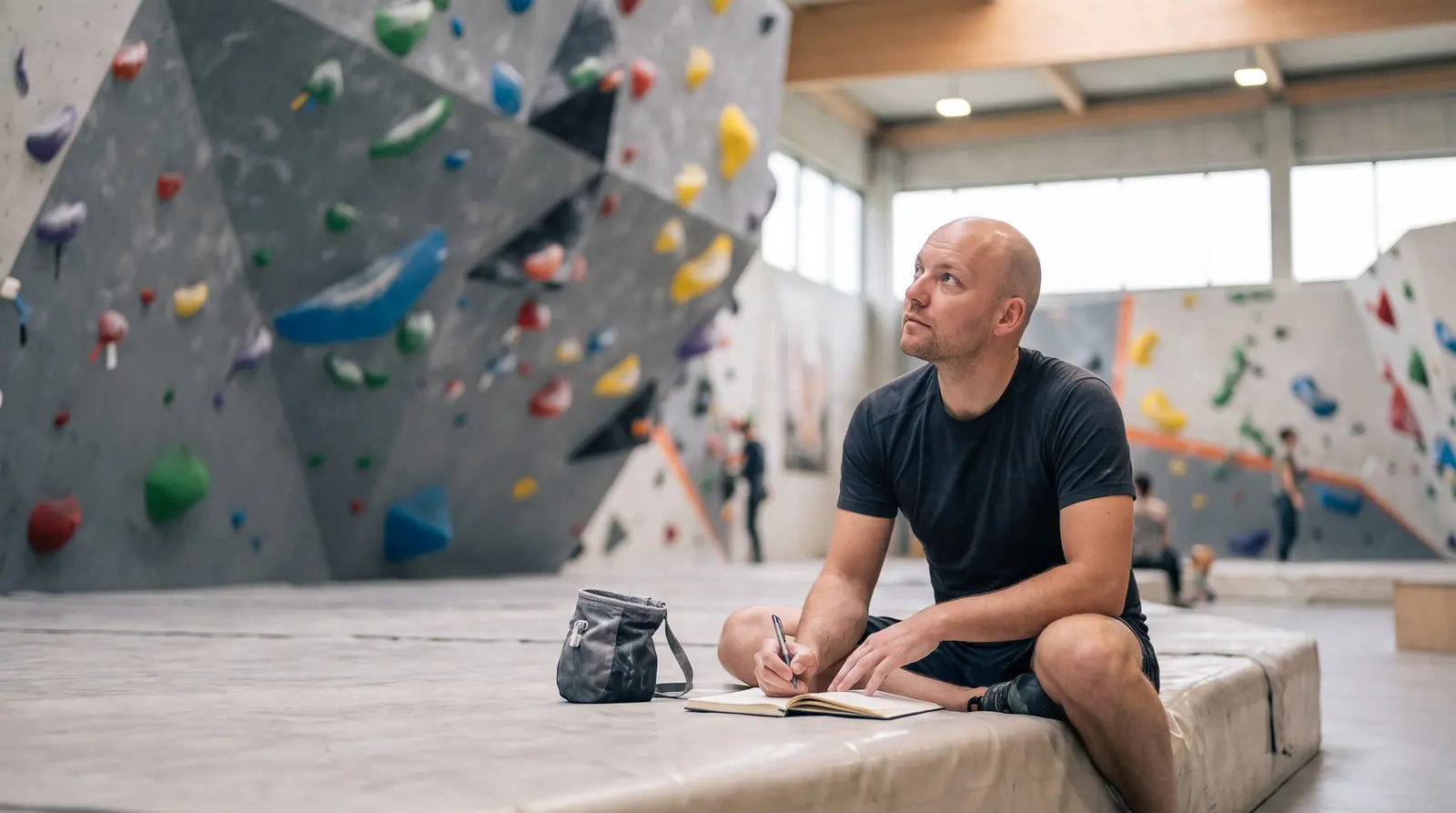
How to read a boulder problem: find the start and finish holds, trace the likely hand sequence, then find the feet for each hand move. Mime the moves from the ground. Ask which hand goes first and where your hips need to be. After the attempt, compare what you planned with what actually happened.
7. Watch, copy and film
Can you learn bouldering without a trainer? Yes, and most climbers do. Watch stronger climbers on problems you've tried and copy their beta. Film yourself on a project: the video shows straight-armed hangs, scuffed feet and hips stuck far from the wall in a way your memory never will. Climbing with friends who push you, share beta and spot you is one of the cheapest coaches there is.
Structuring your sessions
8. Warm up properly
Spend 10–15 minutes going from general to specific: light cardio and mobility for shoulders, hips and wrists, then several easy problems, then a few moderate ones before trying anything hard. A good warm-up isn't optional; your fingers and shoulders need to be ready for the high loads of hard moves.
9. Choose grades smartly
Grades are inconsistent between gyms, so treat them as a rough guide. (If you climb outdoors or travel, our grade converter shows how V grades map to Font grades.) A useful split for each session:
| Part of session | Difficulty | Goal |
|---|---|---|
| Warm-up and drills | 2–4 grades below your max | Perfect movement, silent feet |
| Main block | At your max and one grade above | Learn new moves, project |
| Volume / cool-down | 1–2 grades below your max | Mileage on varied styles |
Don't rush up the grades. Being able to flash most problems at one grade, across different styles, is a better sign you're ready to move up than one lucky send.
10. Project, don't just flash
Spending several sessions on one problem slightly above your level is one of the best ways to improve at bouldering. Break the problem into sections, work the hardest move in isolation, then link. Projecting teaches you to try hard, to fine-tune body position, and to keep searching for better beta instead of giving up after two goes.
11. Do your hardest climbing early, while fresh
Learning hard moves and pulling on small holds needs a fresh nervous system and fresh fingers. Put your projects right after the warm-up, rest 3–5 minutes between hard attempts, and save easy volume for the end. When your attempts get sloppy, stop working the project; tired attempts on hard crimps are where injuries tend to happen.
12. Rest is part of training
How often should you climb? For most beginners and intermediates, two to four sessions a week with at least one rest day between hard sessions works well. Muscles recover in days, but tendons and finger pulleys adapt more slowly. Climbing every day "to improve faster" is a common way to end up injured instead.
A simple week that works for many people:
- Monday: bouldering – drills, then projecting.
- Tuesday: rest or easy mobility.
- Wednesday: bouldering – volume on varied styles, then 20 minutes of strength work.
- Thursday: rest.
- Saturday: bouldering – projecting or a trip to outdoor boulders.
Signs you need more rest: finger joints that ache the morning after, skin that splits easily, or sessions where everything feels harder than usual.
Strength, mobility and conditioning
13. Is finger strength important for beginners?
Finger strength matters. A 2019 systematic review of performance factors in climbing found that hand and forearm strength and endurance are highly important in elite climbers, alongside efficient technique and focus (Saul et al.). But for a beginner, the climbing itself is already a strong finger stimulus, and technique is usually the bigger limiter.
Finger injuries are the price of overdoing it: closed flexor pulley injuries are among the most commonly diagnosed overuse problems in climbers, most often at the A2 pulley (Bosco et al.). Build finger load gradually, avoid full-crimping small edges at maximal effort when you're tired, and stop at sharp pain in the finger.
14. Do you need a fingerboard?
Not to get started. Opinions differ on when to start: many climbers wait until they've climbed consistently for a year or so, while some coaches see no reason to wait if you're motivated and start very conservatively (Anderson & Anderson). My take as a strength coach: a fingerboard is a tool for when climbing alone stops giving steady progress. If and when you start, follow a structured hangboard program with conservative loads. If you don't want a board, there are good ways to build finger strength without a hangboard.
15. Train general strength and your core
Some simple strength training goes a long way, especially if you're new to exercise. Twice a week, after climbing or on separate days:
- Pull-ups (or assisted pull-ups): 3–4 sets of 3–8 good reps.
- Core work: hanging knee raises, hollow-body holds, front-lever progressions. A strong core keeps your feet on steep walls.
- Legs: split squats or pistol squat progressions for high steps and rock-overs.
- Antagonists: push-ups, overhead presses and external rotations for the shoulders. Climbing is almost all pulling, so balancing it is worth the time; see our guide to antagonist training.
Keep good form and leave a rep or two in reserve. The point is to support your climbing, not to exhaust yourself before a session.
16. Improve hip and hamstring mobility
Many moves, like high steps, wide stems and heel hooks, are limited by hip mobility rather than strength. A few minutes a day of deep squats, frog stretches, couch stretches and hamstring work makes a visible difference within weeks. Mobility training is cheap and low-risk, and few beginners do it.
Mindset and the long game
17. Get comfortable falling and failing
Fear of falling holds back many new boulderers. Practise controlled falls from low heights: land on both feet, bend your knees and roll back rather than reaching out with your arms. Once falling feels routine, you'll commit to moves you used to back off.
Failing is information too. After each failed attempt, name one specific thing to change: a foot, a hip, the grip, the timing. That habit is what separates climbers who keep improving from those who just repeat attempts.
When progress stalls
Most people improve quickly at first, then hit a slower phase somewhere around V3–V5. That's normal: the easy gains from learning basic movement are done, and progress needs more targeted work. Go back through this list and be honest about which tips you skip. If you've covered the basics and still feel stuck, read our guide to breaking through a bouldering plateau.
The short version: climb often and in many styles, obsess over your feet, read every problem, project at the edge of your ability, rest enough, and add strength training gradually. Do that consistently for a few months and you'll get better at bouldering, whatever your starting point.
FAQ
How long does it take to get good at bouldering?
It varies a lot with how often you climb, your training background and your body. Most people move through the easy grades quickly in the first months if they climb two to three times a week, then progress slows and needs more deliberate practice. Judge yourself by steady progress over months, not by a fixed timeline.
Can I learn bouldering without a trainer?
Yes. Most boulderers learn by climbing a lot, watching better climbers, filming themselves and copying good movement. A coach or a short technique course can speed things up, especially for footwork, but it is not required.
Is finger strength important for beginners?
Finger strength matters at every level, but for beginners it is rarely the main limiter. Technique, footwork and simply climbing more usually bring faster gains, and the climbing itself already loads your fingers. Tendons and pulleys adapt more slowly than muscles, so add finger training gradually.
Should I boulder every day to improve faster?
No. Fingers, skin and tendons need rest to adapt. Two to four sessions a week with rest days in between is a sensible range for most beginners and intermediates; more is not automatically better.
Sources
- Saul D, Steinmetz G, Lehmann W, Schilling AF. Determinants for success in climbing: A systematic review. J Exerc Sci Fit (2019)
- Sanchez X, Lambert P, Jones G, Llewellyn DJ. Efficacy of pre-ascent climbing route visual inspection in indoor sport climbing. Scand J Med Sci Sports (2012)
- Medernach JP, Sanchez X, Henz J, Memmert D. Cognitive-behavioural processes during route previewing in bouldering. Psychol Sport Exerc (2024)
- Bosco F et al. Closed flexor pulley injuries: A literature review and current practice. J Orthop (2022)
- Anderson M, Anderson M. Q&A #3: When Should I Start Training for Climbing? The Rock Climber's Training Manual (2012)