Kilter vs MoonBoard vs Tension Board: Which Should You Train On?
 Petr Hess, strength & conditioning coach
Updated 2 Nov 2026 · 9 min read
Key takeaways
Best for: Boulderers choosing a board to train on
- Choose the MoonBoard at 40° for steep, crimpy power training if you already climb around V4 or above.
- Choose the Kilter Board for an adjustable angle, from vertical to 70°, that suits a wide range of levels.
- Choose the Tension Board 2 mirror layout for precision, footwork and left-right balance.
- Expect to climb a grade or two below your gym grade at first, especially on Moon and Tension benchmarks.
- One or two board sessions a week is plenty; warm up off the board first.
The short answer: choose the MoonBoard if you are already strong and want steep, crimpy, hard-graded power training; the Kilter Board if you want an adjustable, fun board that suits a wide range of levels; and the Tension Board 2 if you want wood-and-plastic precision training, a mirror layout for left-right balance and an adjustable angle. All three are excellent. The best one is usually the one your gym has, or the one that fits your ceiling.
I am a strength and conditioning coach, not a board-setting guru, so this comparison is built from the makers' own specifications and independent reviews, not from me ranking holds by feel. I have linked the official pages so you can check the numbers yourself, because sizes and layouts change.
What are the Kilter, Moon and Tension boards?
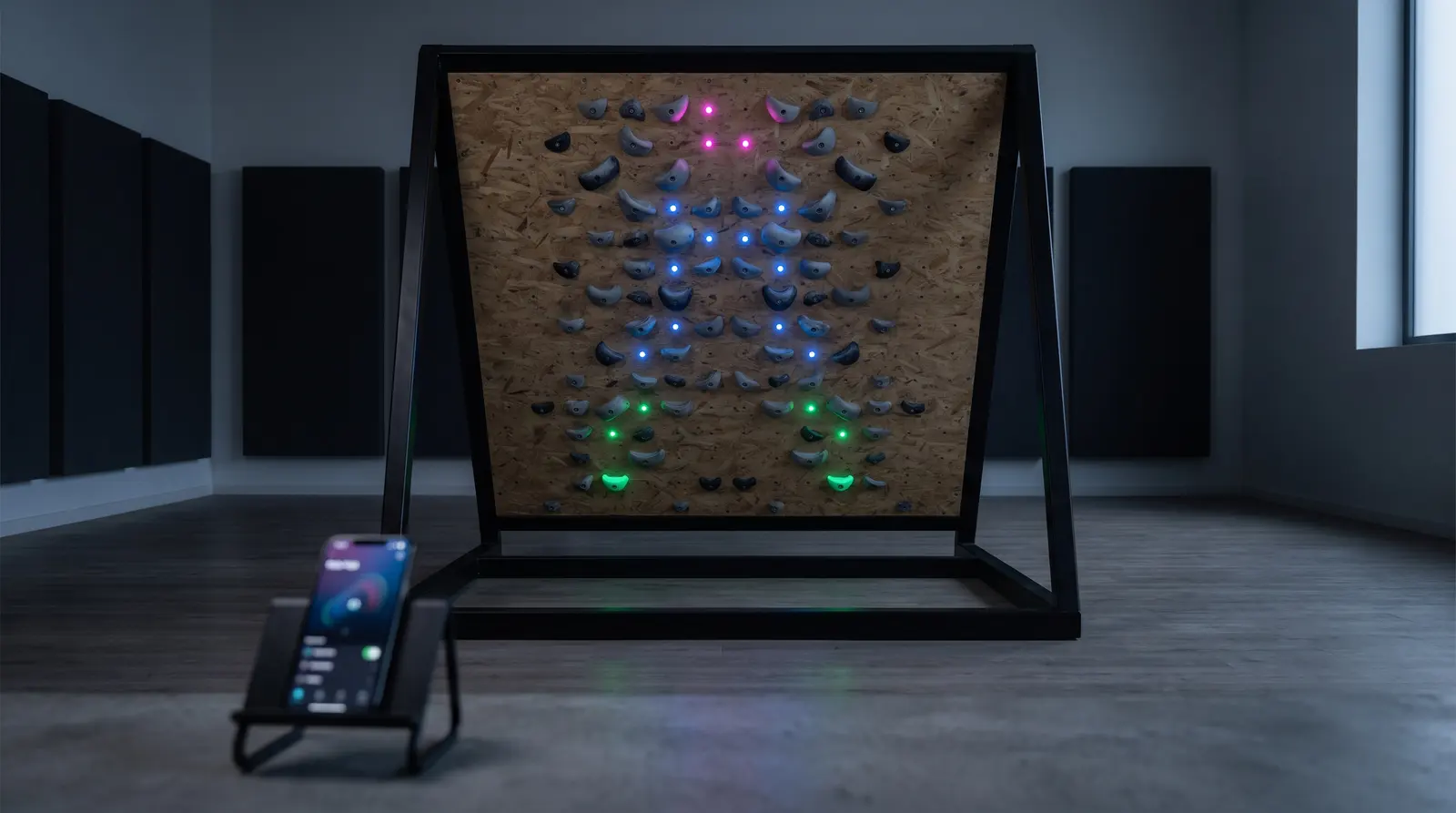
All three are standardised training boards: steep panels with an identical layout of holds wherever in the world they are installed. Each hold has an LED next to it, and a phone app lights up a problem from a shared database. A V5 on a MoonBoard in Sheffield uses exactly the same holds as a V5 on a MoonBoard in Denver, so problems, grades and logbooks travel with you.
- MoonBoard (Moon Climbing, UK) is the original. Moon Climbing launched the first app-driven light-up wall in 2016, and the board is fixed at 25° or 40°.
- Kilter Board (Kilter / Setter Closet, USA) is built for adjustable frames from vertical to 70° overhanging, with big, ergonomic plastic holds.
- Tension Board (Tension Climbing, USA) started as an all-wood, symmetrical board. The Tension Board 2 (TB2) mixes wooden and dual-texture plastic holds and offers a mirror or a spray layout.
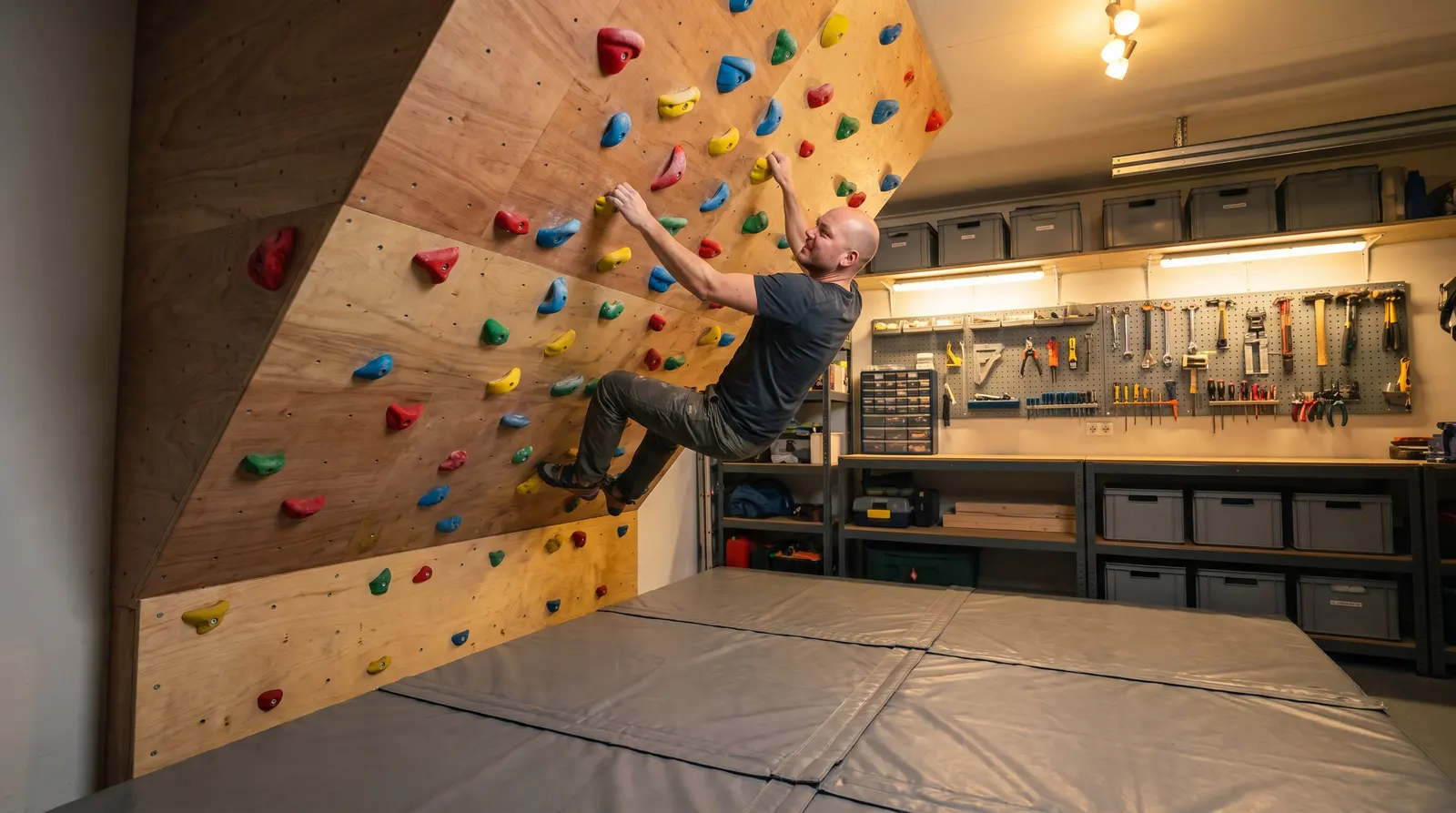
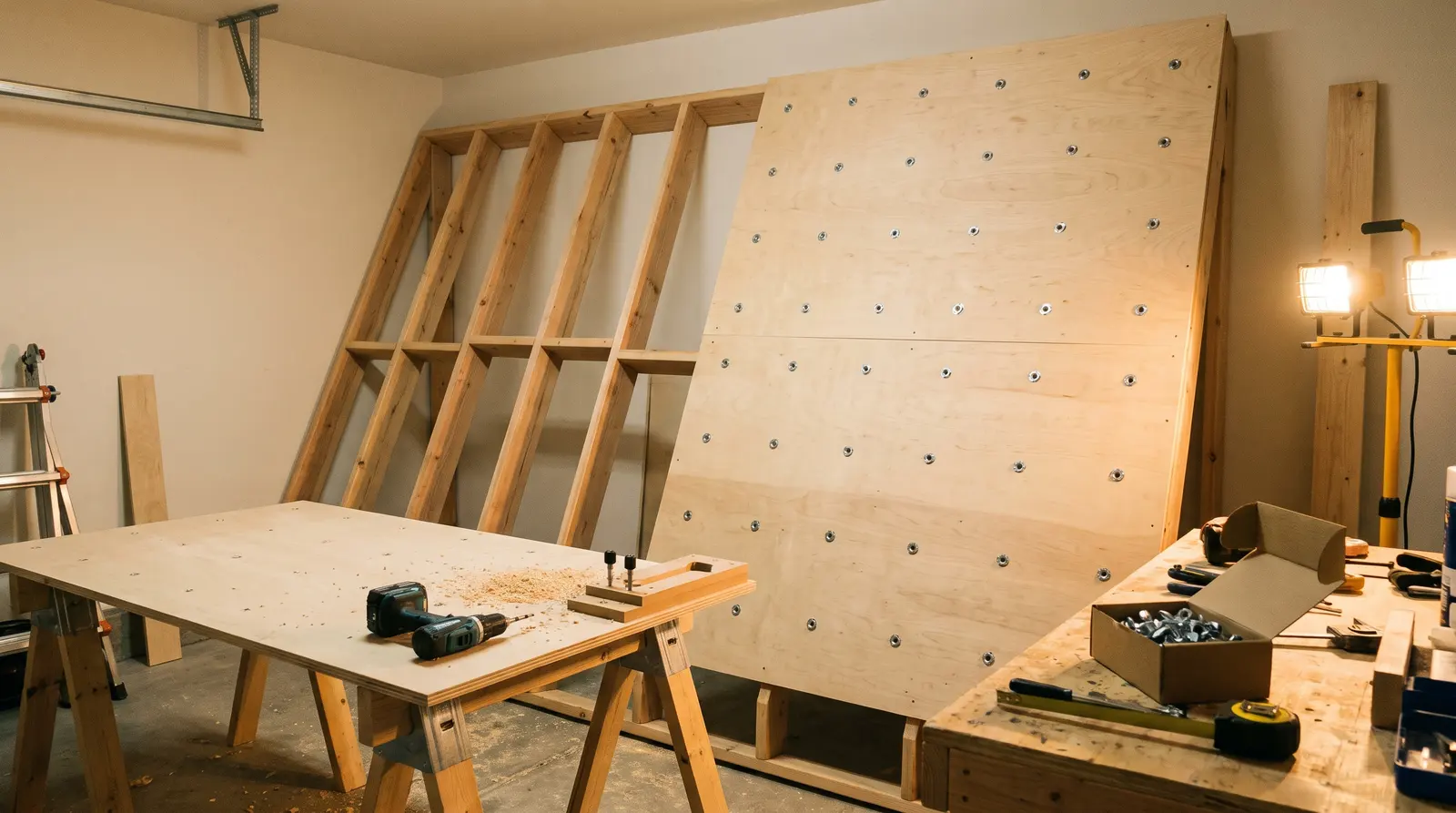
If you are thinking about putting one at home rather than climbing it at the gym, read our guide to building a home climbing wall first. The frame, angle and ceiling height decide which of these boards is even possible in your space.
Kilter vs MoonBoard vs Tension Board: comparison table
Kilter lists sizes as width x height in feet, Tension lists height x width, and Moon gives millimetres. I have kept each maker's own format so you can match it to their pages.
| MoonBoard | Kilter Board | Tension Board 2 | |
|---|---|---|---|
| Full-size board | 2,440 mm (8 ft) wide; at 40°: 3,174 mm high, 2,350 mm deep; at 25°: 3,688 mm high, 1,550 mm deep | Original layout: 7x10, 8x12, 12x12 and 16x12 ft (W x H); smaller sizes are crops of the 12x12 master | 12x8, 12x12 and 12x16 ft (H x W) |
| Home / small version | Mini MoonBoard: 2,440 mm wide, 2,020 mm high, 1,569 mm deep, 40° only | Homewall (Fullride) layout: 7x10, 10x10, 8x12 and 10x12 ft (W x H) | 10x8 and 10x12 ft (H x W) |
| Angle | Fixed: 25° or 40° (Mini: 40° only) | Adjustable, 0° (vertical) to 70° | Usually on adjustable frames; the app lets you pick the angle |
| Holds | Several setups (2016, 2019, 2024 and others, plus Mini setups); wood, PU and, on 2024, polyester holds; 2024 has 198 hand holds | Plastic holds; Homewall comes as Mainline, Auxiliary or both combined (Fullride) | Wood plus dual-texture polyurethane holds; one hold set, two layouts (mirror or spray) |
| Footholds | Fixed footholds on the kickboard, optional screw-ons on the panels | Kicker panel on all 12-ft-tall versions | 11 foothold shapes; no holds on the kicker, small feet in the lowest rows |
| LEDs | LED System; V3 lets several boards run side by side | LED under each hold; lights optional on Homewall kits | Optional LED kit with light caps |
| App | Free MoonBoard app with Benchmark problems | Kilter Board app, set up for your size and layout | Tension Board app, same interface style as Kilter |
| Grading reputation | Hard. 2024 starts at about 6B/V4 and is described as sandbagged | Most approachable; easier problems at lower angles | Hard but consistent; covers roughly V1/2 to double digits |
Sources: Moon Climbing's board guide, Kilter's help page and product pages, Tension Climbing's TB2 page, and Matt Samet's review for Climbing. If a size matters for your build, confirm it on the official page before you buy timber.
How the three boards feel different
MoonBoard: steep, small and honest
The MoonBoard is the board most climbers mean when they say "board climbing". At 40°, which is by far the more common angle, it rewards raw pulling power, crimp strength and body tension. Moon itself says the 40° angle "demands greater strength and power and a dynamic approach", while 25° puts more emphasis on footwork.
Older setups had a reputation for sharp lips, slippery plastic and very small holds. Samet, who has trained on MoonBoard sets since 2017, called the 2024 setup the best MoonBoard yet: no crimps smaller than four fingers, grippier polyester holds and more varied shapes. But it is still hard. The 2024 problems start around V4, and the fixed angle makes it harder to warm up on the wall itself.
Grades depend on the setup. Moon gives a range from 5+/V2 to 8b+/V14 across setups. The Benchmark problems are the ones most climbers use to judge the grade, and they have a long-standing reputation for being stiff: Gripped wrote that many MoonBoard Benchmarks are about two grades harder than comparable Tension Board problems.
Kilter Board: adjustable, big moves, wide appeal
The Kilter Board is designed for adjustable frames from vertical to 70°. That single feature changes everything: a new board climber can try problems at 20° or 25°, and a strong climber can crank it to 50° or more. Kilter's own help page says advanced climbers stay challenged at 45°–60°.
The holds are large, rounded and ergonomic, and the movement tends to be bigger and more dynamic than on a MoonBoard. Many climbers describe it as the most fun of the three, with comfortable, skin-friendly holds. The trade-off is that friendly, larger holds train small-crimp strength less directly than a MoonBoard does.
The Original layout is the gym standard. The Homewall layout (sold as Mainline, Auxiliary or both together as "Fullride") has a much higher density of holds per square foot and a different hold style, so it fits smaller walls and still gives plenty of options.
Tension Board 2: precision, wood and symmetry
The original Tension Board was all wood and fully symmetrical, so every problem had a mirror twin. Gripped described this as its biggest strength: climbing a problem and its mirror quickly shows you which side, hand or movement is weaker. Wood is also kind to skin, but it gives less friction, so you have to grip with intent and place your feet precisely.
The TB2 keeps that idea and adds dual-texture plastic holds shaped with Mimic Holds. You buy one hold set and choose a mirror layout (balanced training) or a spray layout (more varied, more rock-like positions), and you can switch later. Tension describes four hold difficulty levels, from easy to hard. In Samet's review, the TB2 was the most versatile of the new boards, suitable for climbers from about V1/2 up to double digits, with an app that works like the Kilter app.
One quirk: TB2 has no footholds on the kicker panel and only small feet in the lowest rows, so problems reward body tension and can feel short on the 12x8 size.
Which board should you choose?
By goal
- Maximum finger and pulling power for hard bouldering: MoonBoard at 40°. It is the most specific power tool of the three, as long as you are already climbing around V4 or above.
- General improvement, big moves, training with friends of different levels: Kilter Board. The adjustable angle gives everyone something to climb.
- Precision, footwork and left-right balance: Tension Board 2, especially in the mirror layout.
- Outdoor-style crimps and pinches: TB2 spray layout or MoonBoard 2024. Both include wood holds and more realistic positions than older sets.
- Coming back from a layoff: an adjustable board (Kilter or TB2) at a low angle. Get any pain checked first; our injuries hub covers the common finger and elbow problems.
By space
Ceiling height is usually the deciding factor at home.
- Low ceiling: the Mini MoonBoard needs about 2,020 mm of height at 40°. The 7x10 and 10x10 Kilter Homewall sizes need about 102 inches (2.6 m) of clearance at 40° with a 10-inch kicker, and less at steeper angles.
- Standard garage: a 12-ft-tall board at 40° needs roughly 137–149 inches (3.5–3.8 m) of clearance on Kilter's charts, depending on layout. A full MoonBoard at 40° is 3,174 mm high.
- Width: the MoonBoard is always 2,440 mm (8 ft) wide. Kilter sizes run from 7 ft to 16 ft wide, and the TB2 comes 8, 12 or 16 ft wide.
By budget
Costs vary a lot by size and options, and none of the hold kits include the frame, panels, padding or shipping. As a snapshot from the official stores today, a 7x10 Kilter Homewall Mainline kit with lights is listed at around $5,800, and a 10x8 Tension Board 2 with all sets and the LED kit at around $8,370. Climbing's reviewer described the MoonBoard 2024 as relatively low cost compared with its rivals. For the full picture, including timber, mats and lighting, see our breakdown of home climbing wall cost.
Board training vs hangboard training
A hangboard and a board train overlapping qualities, but not the same ones.
- Hangboard: isolates finger strength. Load, edge size and time are precise, so it is easy to measure progress and control the dose. It does not train movement, footwork or body tension.
- Board: trains finger strength in context, together with pulling power, core tension, foot precision and the timing of hard moves. The load is less controlled, because each move is different.
From a strength and conditioning point of view, I would treat a board session as your main high-intensity climbing session and a structured hangboard program as a short, targeted supplement, not as two full sessions stacked on the same day. Both put heavy load on your fingers, and fingers do not care which tool did it.
Training tips for any board
- Warm up off the board first. A general warm-up, then easy climbing, then a few easier board problems. On a fixed 40° MoonBoard there may be no truly easy problems, so warm up on the gym wall. Our climbing warm-up covers the steps.
- Keep sessions short and intense. Board climbing is high-intensity work. Rest properly between attempts, usually a few minutes, and stop when your movement quality drops.
- Start below your gym grade. Board grades are often harder than commercial gym grades. Expect to climb a grade or two lower at first, especially on Moon and Tension benchmarks.
- Use the angle. On adjustable boards, change the angle to change the stimulus: steeper for power, less steep for technique and volume.
- Mirror your problems. On a TB2 mirror layout, climb both sides. On other boards, look for problems that challenge your weaker side.
- Log what you climb. All three apps let you log ascents. Treat that as your training diary.
- Count it in your weekly load. One or two board sessions per week is plenty for most recreational climbers. Plan them inside a full bouldering training program so you are not adding hard board sessions on top of an already full week.
The bottom line
There is no single best training board. The MoonBoard is the classic power tool for already-strong boulderers, the Kilter Board is the most flexible and approachable, and the Tension Board 2 is the precision and balance option with the widest grade range of the new boards. If you train at a gym, use whichever board it has and use it consistently. If you are building at home, let your ceiling height, budget and goals choose for you, and plan the wall around the board rather than the other way round.
FAQ
Which is harder, the Kilter Board, MoonBoard or Tension Board?
The MoonBoard has the strongest reputation for stiff grades: its 2024 setup starts at about V4 and Climbing's reviewer described it as sandbagged even at that. The Tension Board 2 is widely seen as hard but fair, and the Kilter Board is usually considered the most approachable, mostly because you can lower the angle. Grades on any board are only loosely comparable to outdoor grades.
Which board is best for a beginner?
An adjustable board is the friendliest choice for newer boulderers. The Kilter Board and the Tension Board 2 both run on adjustable-angle frames, so you can climb easier problems at lower angles. A standard MoonBoard is fixed at 25 or 40 degrees, and the 40-degree version is aimed at strong climbers.
Can I build a Kilter, Moon or Tension board at home?
Yes. All three brands sell hold sets and LED kits for home walls: the Kilter Board Homewall (Fullride) layouts from 7x10 ft, the MoonBoard DIY kit and the Mini MoonBoard, and the Tension Board 2 from 10x8 ft. You still need a strong frame, panels and padding, and none of the hold kits include those.
Is board climbing better than hangboarding?
They do different jobs. A hangboard trains finger strength in a controlled, measurable way. A board trains finger strength together with body tension, footwork and powerful movement. Many climbers use both, with the board as their main climbing session and short hangboard blocks for targeted finger work.
Sources
- Moon Climbing, Choose Your MoonBoard (2026)
- Kilter / Setter Closet, Help: Kilter Board FAQ and clearance charts (2026)
- Kilter / Setter Closet, Kilter Board Full Ride (Homewall) product page (2026)
- Tension Climbing, Tension Board 2 product page (2026)
- Matt Samet, What's Best For You: the Tension Board 2, the 2024 MoonBoard, or the Woods Board?, Climbing (2024)
- Gripped, Tension Board versus the MoonBoard