Best Bouldering Shoes: Buyer's Guide by Terrain (2026)
 Petr Hess, strength & conditioning coach
Updated 2 Nov 2026 · 11 min read
Key takeaways
Best for: Climbers upgrading from a first pair to bouldering shoes
- In Treeline Review's tests, the La Sportiva Solution Comp was best all-round, the Scarpa Instinct VSR best outdoors and the Mantra best indoors.
- Match the shoe to your terrain: aggressive downturn for overhangs, very soft shoes for slab and volumes.
- Softer shoes give more sensitivity and hooking but need stronger feet; stiffer shoes support you on small outdoor edges.
- Brands disagree on downsizing, so follow each brand's chart; leather uppers stretch while synthetic ones barely do.
- Pain that lasts after you take the shoes off, or numbness that doesn't fade, means the shoe is wrong for your foot.
The best bouldering shoes for most intermediate climbers are moderately downturned, soft-to-medium Velcro shoes with plenty of rubber on the toe and heel. In Treeline Review's tests, the La Sportiva Solution Comp was the best all-rounder, the Scarpa Instinct VSR the best for outdoor bouldering, and the La Sportiva Mantra the best for indoor volumes and smears. We haven't tested them ourselves, and fit matters as much as terrain: find shoes that fit securely without pain, then choose among them for the terrain you climb most.
This guide is about the step up from a first pair. If you're still choosing your first shoes, start with our best climbing shoes for beginners guide instead. We haven't tested these shoes ourselves. The shortlist is built from published independent tests (mainly Treeline Review and OutdoorGearLab), retailer and manufacturer specifications, and broad climber consensus. More guides live in our gear section, and you can read how links work in our affiliate disclosure.
Prices and stock change often; the button opens the retailer or brand page so you can check today's price.
Best bouldering shoes at a glance
Specs come from the product listings linked in each section. Brands update models without changing names, so check the current version before you buy.
| Model | Best for | Shape and stiffness | Closure / rubber | Main drawback |
|---|---|---|---|---|
| La Sportiva Solution Comp | All-round steep bouldering | Aggressive downturn, slight asymmetry; medium stiffness | Velcro; 3.5 mm Vibram XS Grip 2 | Narrow toe box and heel |
| Scarpa Instinct VSR | Outdoor edges, wider forefoot | Slight-to-medium downturn, aggressive tip; soft | Velcro; 3.5 mm Vibram XS Grip 2 | Strap has limited adjustment |
| La Sportiva Skwama | One shoe for gym and rock | Moderate downturn, strong asymmetry and pre-tension; soft | Velcro; 3.5 mm XS Grip 2, 0.8 mm midsole | A bit soft for sustained edging |
| La Sportiva Mantra | Slab, volumes, indoor smears | Aggressive downturn; extremely soft, sole wraps the sides | Slip-on; Vibram XS Grip 2 | Weak on tiny footholds, no adjustment |
| Scarpa Veloce | First soft gym shoe, wide feet | Neutral last, slight downturn; soft | Zigzag Velcro; 4 mm sole | Can cause hot spots for some feet |
| Scarpa Drago | Hard steep problems, hooks | Highly asymmetric, aggressive; very soft | Velcro; 3.5 mm XS Grip 2 | Uncomfortable, narrow, wears fast |
| Evolv Shaman Trance | Steep bouldering with wide feet | Aggressive downturn, tensioned rubber midsole | Multi-strap; 3.5 mm EVO 74 | Strap can slip, toe less precise |
How to choose bouldering shoes for your second pair
A first pair is usually flat, stiff and comfortable. A bouldering shoe trades some of that comfort for three things: downturn, sensitivity and rubber where you hook. Here's how each one matters.
Downturn and asymmetry
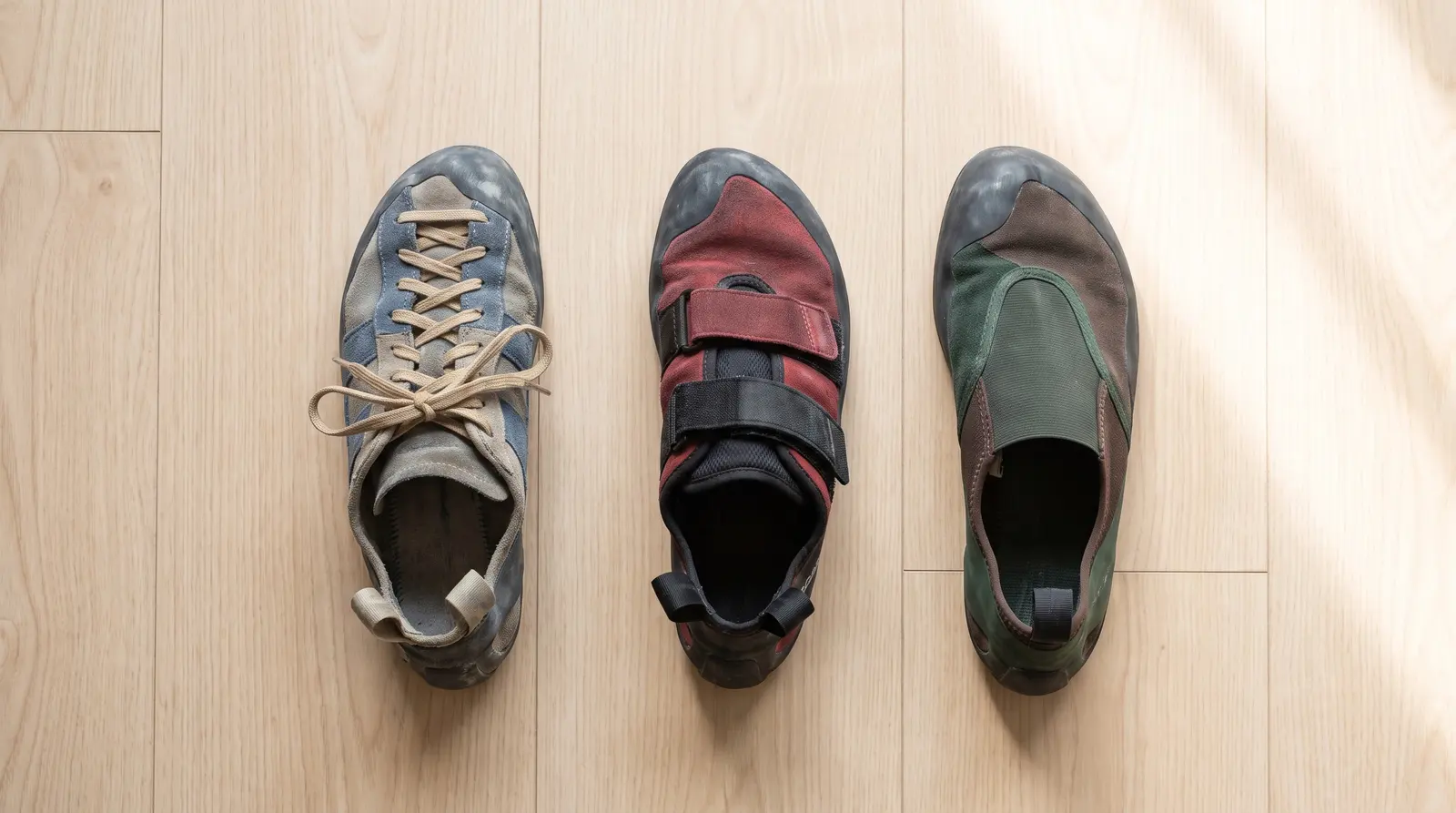
Downturn is the curve of the shoe from heel to toe. Treeline Review explains that downturn helps you push and pull with your toes on overhangs, while asymmetry concentrates power at the big toe. Both make a shoe less comfortable to walk in. On steep walls, a downturned shoe lets you keep a toe on a hold while your hips sag away from the wall. On slab, the same curve can stop you from getting the whole forefoot flat on the rubber, which is why flatter or very soft shoes still win there.
Softness: sensitivity vs support
Softness is the biggest difference from beginner shoes. Treeline sums up the trade-off: softer shoes give more sensitivity, smearing and hooking ability, which suits indoor climbing; stiffer shoes support your foot on tiny holds and over long sessions, which suits outdoor and rope climbing. A soft shoe needs stronger feet. From a strength and conditioning point of view, that's worth knowing: your toe flexors and calves do the work the midsole used to do, so expect your feet to tire faster during the first weeks.
Closure: Velcro, slipper or laces
For bouldering, Velcro is the default because you take your shoes off between attempts. Slippers are even faster and the most sensitive, but there's nothing to tighten, so the fit has to be right out of the box. Laces give the most precise fit but are slow; they make more sense for routes than for bouldering.
Toe and heel rubber for hooks
Modern problems use toe hooks and heel hooks constantly, especially on steep boards and around big volumes. Look for a rubber patch over the top of the toes and a heel cup that fits your heel tightly. A loose heel rolls off holds, no matter how good the rubber is. If you're still learning what those holds are called, our guide to the types of climbing holds explains slopers, pinches, volumes and more.
Fit: length, width and heel
Length is only part of fit. Czech brand OCÚN describes three common toe shapes (Egyptian, Roman and Greek) and three widths, and notes that wide feet often come with a higher instep and need a higher-volume last. Narrow La Sportiva shapes like the Solution Comp won't suit everyone, while Scarpa's Instinct VSR and Veloce and Evolv's Shaman Trance are widely described as roomier. If your feet are broad, see our dedicated guide to climbing shoes for wide feet.
The shortlist, by terrain
La Sportiva Solution Comp: best all-round bouldering shoe
Treeline Review names the Solution Comp its best overall bouldering shoe, citing a precise, elongated toe, a good balance of sensitivity and stiffness, sticky rubber, and strong toe and heel hooking indoors and out. The listing specifies a microfibre and suede upper, a hook-and-loop closure, 3.5 mm Vibram XS Grip 2 rubber, an aggressive downturn with slight asymmetry, and rubber over the toe for hooks.
The fit is the catch. Treeline describes a long, narrow toe box and a narrow heel that may be too small for bigger heels. The women's version is lower volume with a slimmer heel. Treeline also notes that La Sportiva's regular Solution has a bigger heel and is stiffer, which can suit wider heels better.
- Best for: steep gym problems, board climbing and outdoor overhangs, if your foot is narrow to normal.
- Main drawback: narrow shape; one Treeline strap frayed after over a year of use.
- Skip it if: you have wide feet or a large heel, or you mostly climb slab.
Scarpa Instinct VSR: best for outdoor edges and wider forefeet
Treeline Review rates the Instinct VSR its best outdoor bouldering shoe: precise and powerful on tiny crystals, with strong toe and heel hooking and ridged toe rubber. The listing specifies a microfibre and suede upper, Velcro closure, 3.5 mm Vibram XS Grip 2 rubber, a slightly asymmetric last with a slight-to-medium downturn and an aggressive tip, and describes the fit as a relatively wide forefoot with a narrow heel.
Treeline calls the fit short and wide, wider in the toe box than the Solution Comp, and notes that a low-volume (LV) version exists for narrow heels. Reviewers on the listing report that the upper stretches noticeably, so many size down.
- Best for: outdoor boulders with small edges, and climbers whose forefoot is too wide for La Sportiva.
- Main drawback: limited strap adjustability; the wide toe can't fit some small pockets, according to Treeline.
- Skip it if: you have narrow feet (look at the LV) or want a shoe for long routes; Treeline calls it too soft for multi-pitch.
La Sportiva Skwama: best one-shoe quiver for gym and rock
OutdoorGearLab gives the Skwama its Editors' Choice for sport climbing and bouldering, describing it as a one-stop shop for steep climbing with a supportive heel for hard hooking and a broader toe box than most aggressive La Sportiva shoes. Lacrux, marking ten years of the model, praises its feel on slabs, its performance on volumes and small indoor edges, and its stable S-heel for heel hooks.
The listing specifies a leather and microfibre upper, Velcro closure, 3.5 mm Vibram XS Grip 2, a 0.8 mm LaSpoFlex midsole and strong pre-tension. Because the upper is leather, it keeps stretching: OutdoorGearLab and Lacrux both flag this, and Lacrux suggests going a half to a full size smaller.
- Best for: an intermediate climber who wants one downturned shoe for everything from slab to roofs.
- Main drawback: a bit soft for sustained edging (OutdoorGearLab); Lacrux saw the toe rubber lift at the tip.
- Skip it if: you mostly climb vertical edges outdoors and want stiffness.
La Sportiva Mantra: best for slab and volumes
Treeline Review names the Mantra its best indoor bouldering shoe, with the best sensitivity and durability of the pairs it tested. It's a slip-on with no closure and extremely low stiffness, and the listing describes a sole that wraps around the sides of the shoe so there's no hard edge, plus an aggressive downturn and toe-hook rubber. That wraparound sole is what makes it smear so well on volumes and slab.
Treeline is clear about the limits: it's poor on tiny footholds, especially outdoors, pointy holds can hurt, your feet tire faster, and it's not notably strong for hooking. Treeline's tester sized down a full EU size.
- Best for: modern gym setting with big volumes, compression and smears.
- Main drawback: no adjustable fit and little support on small edges.
- Skip it if: you climb outdoors a lot or want only one pair.
Scarpa Veloce: best first soft shoe
The Veloce bridges beginner and performance shoes. The listing describes a vegan microfibre upper, a zigzag Velcro closure, a soft 4 mm sole, a neutral last with slight downturn, toe-hook rubber, and a wide, high-volume fit for slab and vertical bouldering. Treeline Review lists it as runner-up for indoor bouldering, praising its softness while noting that it caused a hot spot for its tester.
- Best for: gym boulderers moving out of stiff beginner shoes, especially with wider feet.
- Main drawback: not built for steep outdoor edges; the neutral shape gives less toe power on overhangs.
- Skip it if: you already climb comfortably in a downturned shoe.
Scarpa Drago: best for hard, steep problems
Treeline names the Drago its best shoe for advanced climbers: excellent power and precision, very sensitive, and rubber covering nearly the whole shoe, which makes it excellent for toe hooks, heel hooks and scumming. The listing specifies a highly asymmetric last with an aggressive downturn, 3.5 mm Vibram XS Grip 2, a 2 mm rubber heel and an extended toe wrap.
It's honest to call this a specialist. Treeline describes it as uncomfortable, narrow and too soft for long days, and expects it to need resoling. There's a Drago LV for lower-volume feet.
- Best for: steep boards, roofs and toe-hook-heavy problems at your limit.
- Main drawback: comfort and durability.
- Skip it if: this would be your only pair, or your footwork is still developing.
Evolv Shaman Trance: best for steep climbing with wide feet
OutdoorGearLab picks the Shaman Trance as its top shoe for climbers with wide feet, describing a broad toe box, mouldable upper and an aggressive downturn that works for bouldering and sport. Evolv lists a vegan synthetic sock-style upper, multi-strap closure, a 1 mm tensioned rubber midsole, 3.5 mm EVO 74 outsole rubber and a 1.2 mm toe patch, and says it's built for climbers who don't want to choose between an aggressive bouldering shoe and a comfortable route shoe. Evolv doesn't recommend downsizing.
- Best for: wide-footed climbers who want real downturn.
- Main drawback: OutdoorGearLab found the strap slips easily and the toe box lacks precision, and questioned rubber durability.
- Skip it if: you have narrow feet (try the Shaman Trance LV) or climb mostly small edges.
Which shoe for which terrain?
| Your terrain | What to look for | Shortlist picks |
|---|---|---|
| Steep and overhanging | Aggressive downturn, tensioned heel, big toe patch | Solution Comp, Drago, Shaman Trance |
| Slab and volumes | Very soft sole, little or no edge, flexible forefoot | Mantra, Veloce |
| All-round gym | Moderate downturn, soft-to-medium stiffness, Velcro | Skwama, Solution Comp, Veloce |
| Outdoor edges | Medium stiffness, sharp toe, sticky rubber | Instinct VSR, Skwama |
If you climb on all four, two pairs is a common solution: a soft shoe for the gym and a slightly stiffer, downturned shoe for rock and steep projects. Keep your old beginner pair for warm-ups and long volume sessions.
Indoor bouldering vs outdoor bouldering shoes
The best climbing shoes for indoor bouldering are usually softer than you'd pick for rock. Gym setting leans heavily on volumes, big slopers and smears, where sensitivity beats support. Rubber wear depends on surface texture, footwork and how often you climb, so indoor use doesn't guarantee a longer sole life; dragging toes across volumes wears the tip.
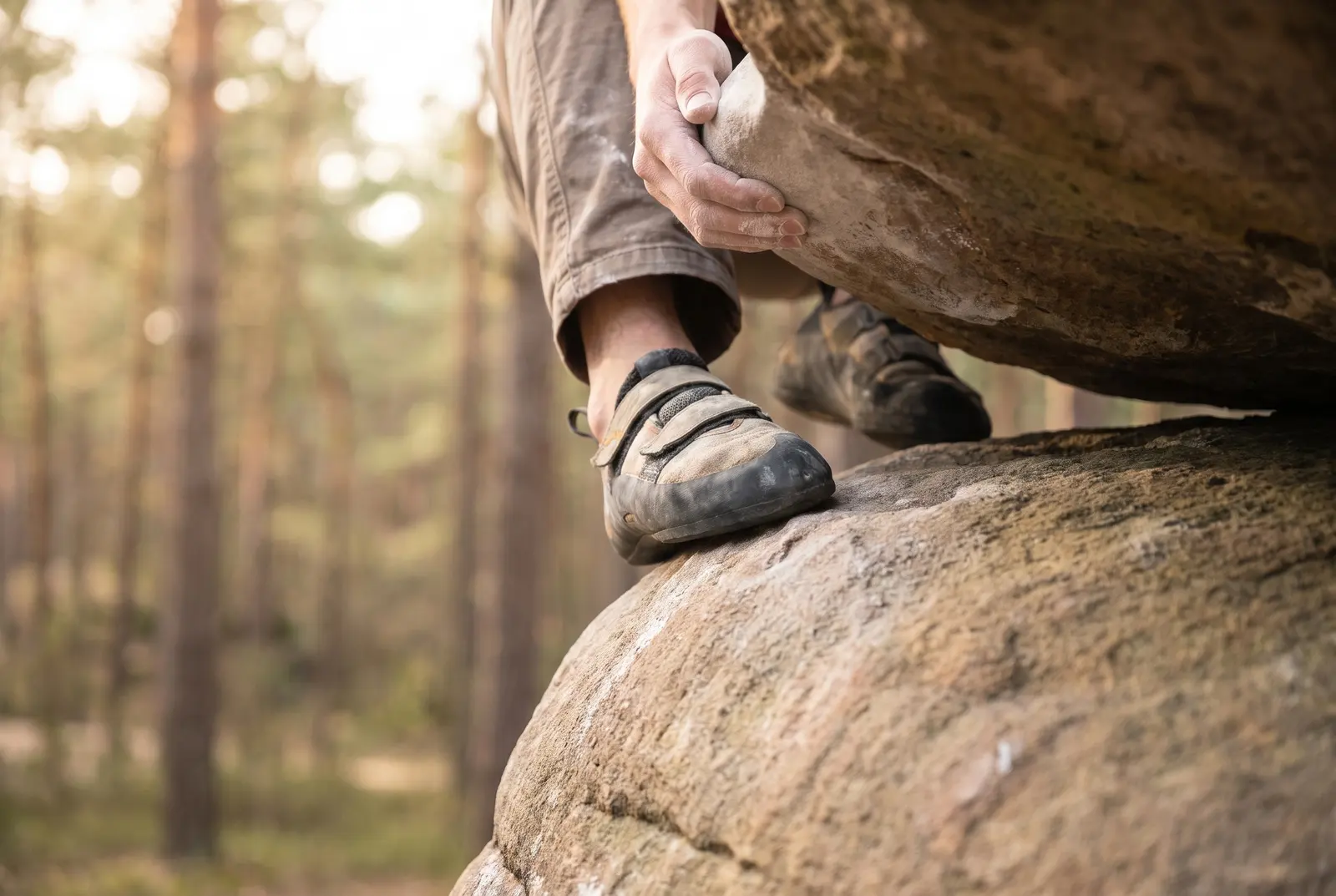
Outdoors, footholds get smaller and sharper. A medium-stiff shoe like the Instinct VSR or Skwama spreads the load on a tiny crystal so your toes don't have to do all the work. Outdoor rubber also needs to stay clean; a dirty sole slips no matter how sticky the compound is. A soft toothbrush or a dedicated brush works for both shoes and holds; see our guide to the best climbing brush.
Do better shoes make you a better boulderer?
Only partly. A downturned shoe helps you pull on small footholds on overhangs, and toe hooks depend on the toe rubber and fit as much as the shape, but only if you place your foot precisely and keep tension through your body. Reviewers repeatedly say the same thing in different words: performance shoes reward good footwork rather than replace it.
A sensible approach is to upgrade when you can name the problem: your toe pops off steep footholds, your stiff shoes can't smear on volumes, or your heel slides off hooks. If the issue is footwork, a structured plan helps more; our guide on how to get better at bouldering covers drills that transfer to any shoe.
Fit checklist before you buy
- Toes slightly curled, not crushed; no sharp pressure on the joints.
- Heel cup tight: stand on your toes and try a heel hook. If the heel lifts or folds, try a smaller size or a lower-volume version.
- No empty space over the instep after you tighten the straps.
- Leather uppers tend to stretch more than synthetic ones, but lining and construction matter too. The Skwama has a leather upper and Scarpa lists microsuede plus leather on the Drago; the Veloce and Shaman Trance are synthetic and mostly won't stretch.
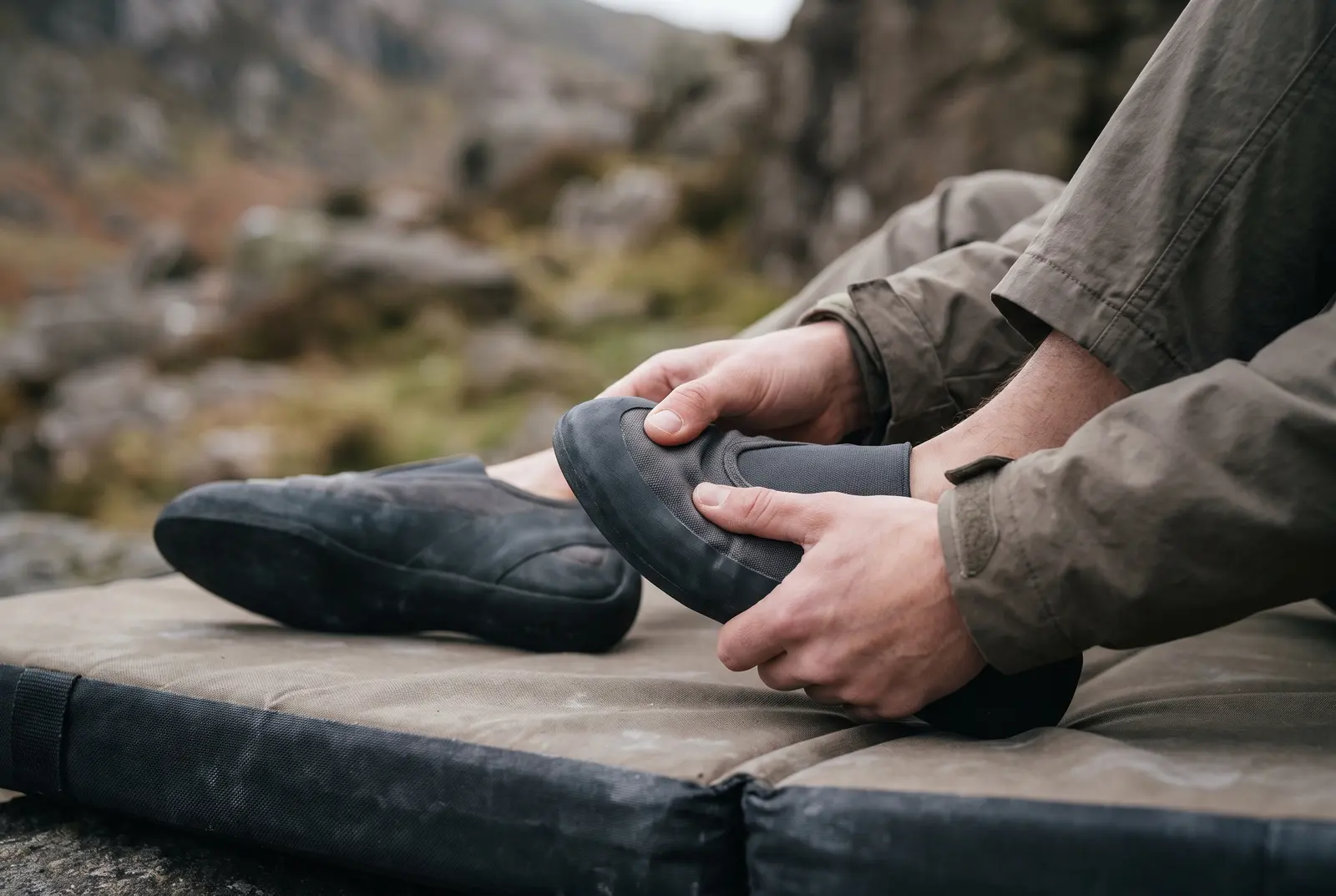
- Wear the shoes for several minutes in the shop. Numbness after five minutes won't improve on a long session.
How long do soft bouldering shoes last?
Soft shoes with thin rubber wear faster than beginner shoes. Treeline expects the Drago to need resoling, and OutdoorGearLab raises durability questions about the soft rubber on several picks. The Solution Comp, Instinct VSR, Veloce and Shaman Trance are listed as resoleable; for the others, ask a resoler before the sole wears thin. Send them off before the rand under the toe wears through, because rand repair costs more. Quiet footwork, clean soles and drying shoes between sessions all extend their life.
Prices and stock change often; the button opens the retailer or brand page so you can check today's price.
FAQ
Are soft shoes better for bouldering?
For indoor bouldering, usually yes. Soft shoes let you feel and smear on volumes and big plastic holds, and they wrap better for toe and heel hooks. Outdoors on small edges, a medium-stiff shoe often works better because it supports your foot on footholds you can barely see.
Do bouldering shoes need to be downturned?
Not for every problem. Downturn helps you pull with your toes on steep and overhanging walls. On slab and vertical terrain a flatter shoe lets you stand flat on the rubber. Most intermediate climbers do well with a moderate downturn that handles both.
How tight should bouldering shoes be?
Snug enough that your toes are slightly curled and the heel doesn't move, but not painful. Bouldering shoes can be tighter than route shoes because you take them off between attempts, yet persistent numbness or sharp pressure means the size or shape is wrong.
Can I use the same bouldering shoes indoors and outdoors?
Yes, many do. Shoes with a moderate downturn and medium stiffness, such as the Scarpa Instinct VSR or La Sportiva Skwama, are popular for both. Very soft gym shoes like the La Sportiva Mantra are better kept for plastic because they give little support on small rock edges.
Sources
- Kai Burkhardt / Treeline Review, Best Bouldering Shoes of 2026 (2026)
- Dom Rickicki and Jack Cramer / OutdoorGearLab, Best Climbing Shoes for Men of 2026 (2026)
- Lacrux, 10 Years of Skwama: The Italian All-Rounder Put to the Test (2026)
- Evolv, Shaman Trance (manufacturer specs)
- OCÚN, How to Choose the Right Climbing Shoes for Your Foot Shape