Best Climbing Shoes for Wide Feet: Buyer's Guide (2026)
 Petr Hess, strength & conditioning coach
Updated 2 Nov 2026 · 9 min read
Key takeaways
Best for: Climbers with wide feet or high insteps
- Well-reviewed picks include the Evolv Shaman Trance and OCÚN Ozone HV for performance, and the Scarpa Veloce and Evolv Defy for comfort.
- Check forefoot, heel and instep separately, because a shoe can fit one zone and fail another.
- With a wide forefoot but narrow heel, try the Scarpa Instinct VSR or the low-volume version of a roomy shoe.
- Don't size up for width: a longer shoe costs precision without fixing pressure, so choose a wider last instead.
- A folded little toe, numbness within minutes or pain after you take the shoes off means the model is too narrow.
The best climbing shoes for wide feet have a broad forefoot, enough volume over the instep and a heel cup that still holds. Well-reviewed options include the Evolv Shaman Trance and OCÚN Ozone HV for performance, the Scarpa Veloce and Evolv Defy for comfort, and the Scarpa Instinct VSR if you have wide feet with a narrow heel. Width is only one of three fit zones, so check forefoot, heel and instep separately.
We haven't tested these shoes. This is a research-based guide: each fit description below is attributed to its source, whether that's the brand, a retailer's spec sheet or an independent test such as OutdoorGearLab, Treeline Review or 99Boulders. If you're buying your very first pair, read our best climbing shoes for beginners guide alongside this one. More guides are in the gear section; see our affiliate disclosure for how links work.
Prices and stock change often; the button opens the retailer or brand page so you can check today's price.
Wide-fit climbing shoes compared
"Not stated" means none of the sources we read described that zone. Fit reports are attributed in each section below.
| Model | Forefoot / toe box | Heel | Instep / volume | Versions (verified) | Main drawback |
|---|---|---|---|---|---|
| Evolv Shaman Trance | Broad (OutdoorGearLab) | Not stated | Mouldable upper (OutdoorGearLab) | Standard and LV (Evolv) | Strap slips, less precise toe |
| OCÚN Ozone HV | Extra volume at the toe joints (OCÚN) | Not stated | For higher insteps (OCÚN) | HV version of the Ozone (OCÚN) | No independent test found |
| Scarpa Instinct VSR | Short and wide (Treeline); relatively wide (listing) | Narrow (listing); may be big for some (Treeline) | High volume (listing) | Standard and LV (Treeline) | Wide toe misses small pockets |
| Scarpa Veloce | Wide, Roman toe shape (listing) | Not stated | High volume (listing) | Velcro model | Hot spot reported by Treeline |
| La Sportiva Skwama | Broader than most aggressive La Sportiva shoes (OutdoorGearLab) | Supportive S-heel (OutdoorGearLab) | Medium (listing) | Standard, Vegan, Lite (Treeline) | Leather keeps stretching |
| Evolv Defy | Broad toe box on the lace version (OutdoorGearLab) | Soft heel (Evolv) | Medium volume (Evolv) | Medium Volume and Low Volume (Evolv) | Flat, not for steep terrain |
| Black Diamond Momentum | Runs large and wide (Treeline) | Slight-to-medium tension (listing) | Not stated | Men's and women's (listing) | Slick rubber per Treeline (earlier rubber) |
Three fit zones: forefoot, heel and instep
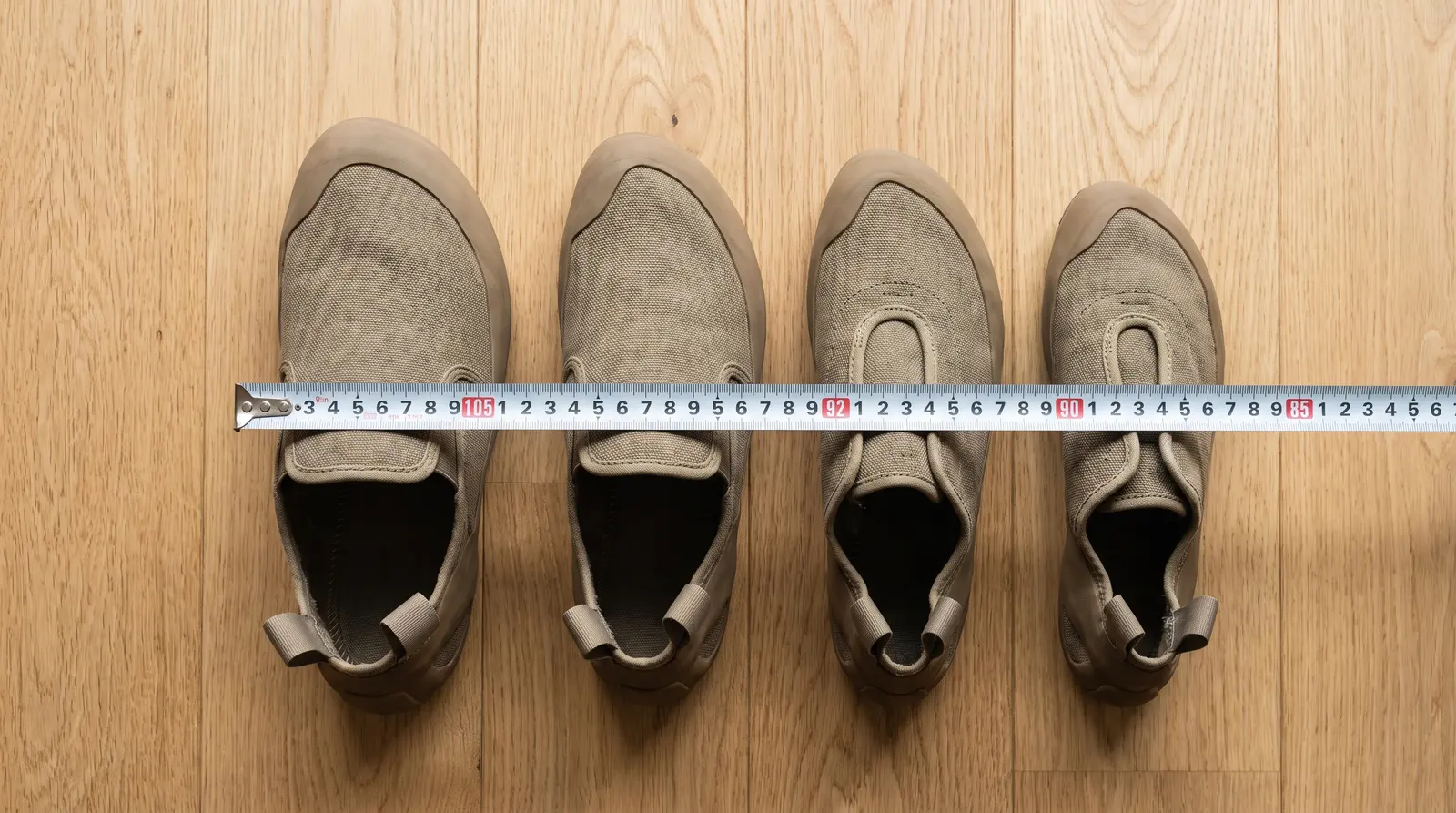
"Wide feet" can mean three different things, and a shoe can be right in one zone and wrong in another.
Forefoot width
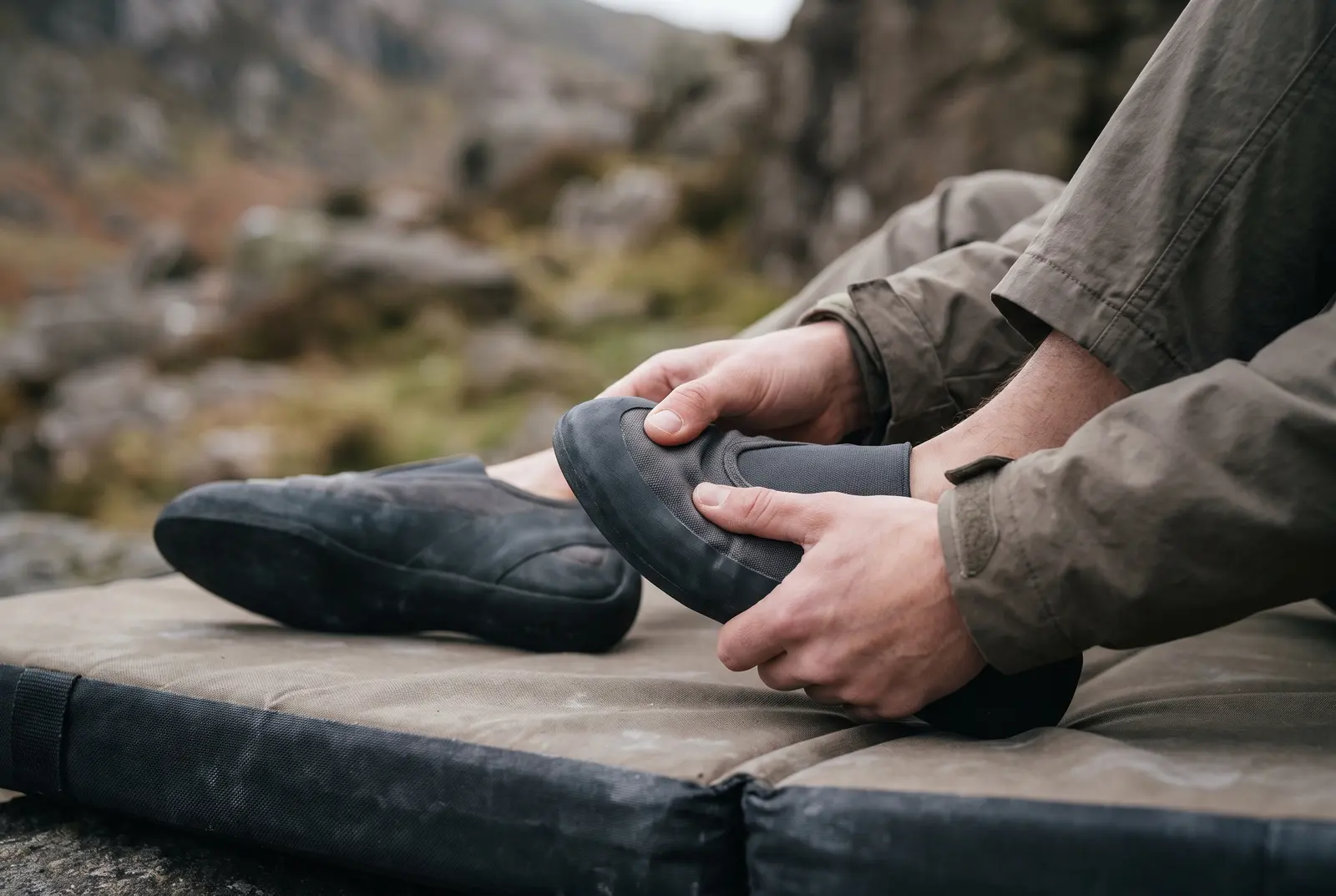
This is what most people mean by wide feet: the ball of the foot and the toes spread wider than the shoe's last. Signs are pressure on the joint at the base of the little toe and the big toe being pushed inward. Asymmetric performance shoes make this worse because they bend the toes toward the big toe. A wider last, or a shoe described as having a broad toe box, is the fix.
Heel volume
Many people with wide forefeet still have a normal or narrow heel. That's the hardest combination to fit, because high-volume shoes often have high-volume heels too, and a loose heel rolls off heel hooks. Look for shoes described as wide in front with a narrower heel, or try the low-volume version of a roomy shoe, which usually tightens the heel and instep. Treeline notes that La Sportiva's regular Solution has a bigger heel than the Solution Comp, which is useful if your heel, not your forefoot, is the wide part.
Instep height
The instep is the top of your foot. OCÚN notes that wide feet often come with a higher instep and need a higher-volume (HV) last; narrow feet usually have a lower instep and slimmer heel and need a low-volume (LV) last. A high instep pressing against the tongue or straps feels like width but is really volume. Velcro and lace closures let you open the shoe more over the instep than slippers.
How to tell if a climbing shoe is too narrow
- Little toe folds under or over its neighbour instead of lying beside it.
- Sharp pressure on the outside of the forefoot, at the joint behind the little toe, that grows over a few minutes.
- The upper bulges over the edge of the sole at the sides, or the rand bites into the side of your foot.
- Numbness or tingling in the toes within a few minutes of standing, not just at the end of a hard session.
- The big toe is forced inward beyond the gentle curl you expect in an asymmetric shoe.
- Your foot rolls off small edges because it sits on top of the sole rather than inside the shoe.
- Pain persists after you take the shoes off. That's a sign to change model, not to "break them in". If it continues, see a qualified professional.
The opposite problem matters too. If the straps close fully and there's still empty space over the instep, or the heel cup wrinkles on a heel hook, the shoe is too high volume for you; look for an LV version.
The shortlist
Evolv Shaman Trance: best for steep climbing with wide feet
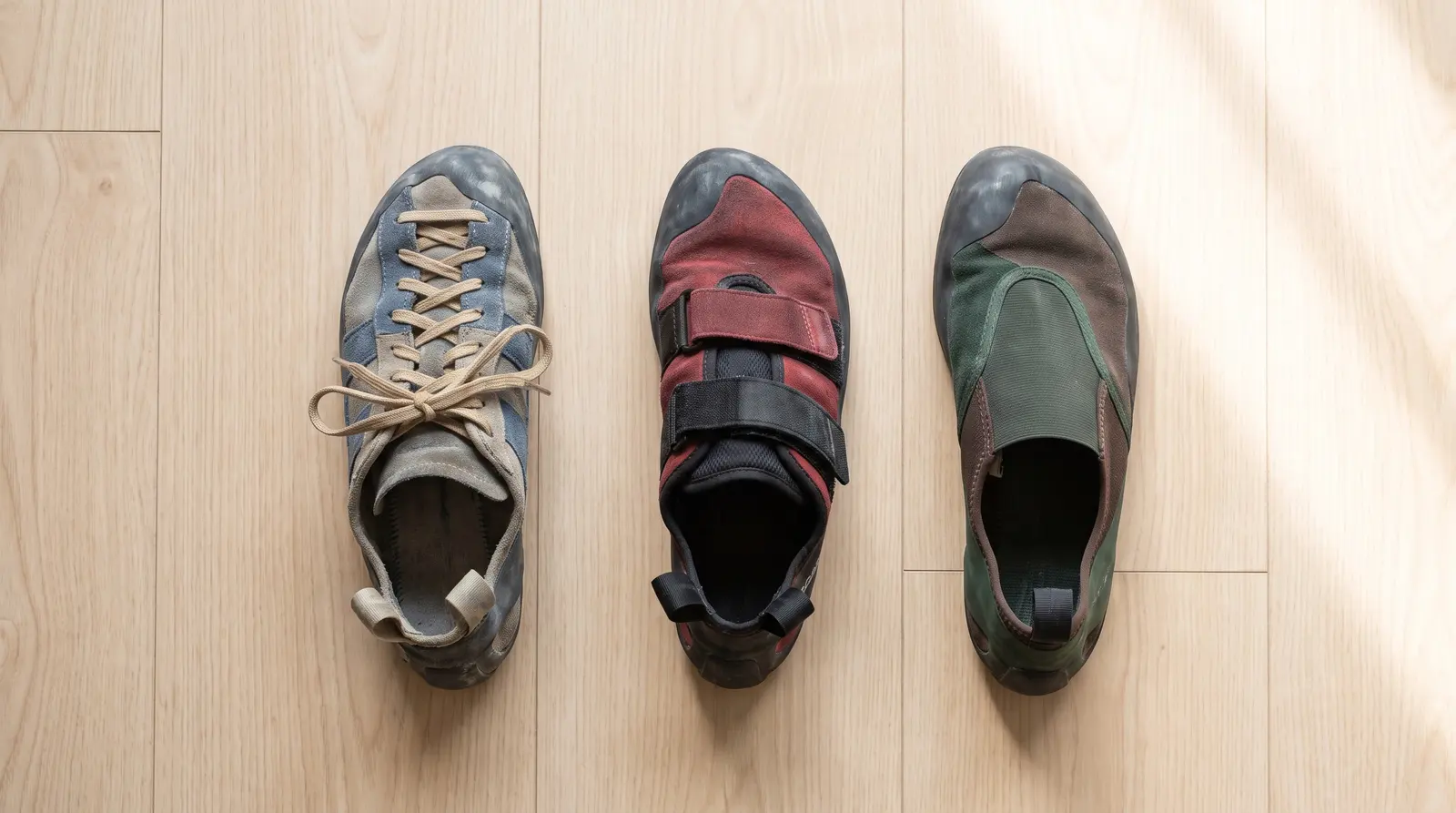
OutdoorGearLab names the Shaman Trance its best shoe for climbers with wide feet, citing a broad toe box and mouldable upper in an aggressively downturned shoe that works for bouldering and sport. Evolv specifies a vegan synthetic sock-style upper, a multi-strap closure, a 1 mm tensioned rubber midsole, 3.5 mm EVO 74 rubber and a toe patch. Evolv advises starting from your street-shoe size and does not recommend downsizing. A Shaman Trance LV is also listed on Evolv's site, which helps if you want the shape with less volume.
- Best for: wide-footed boulderers and sport climbers who want real downturn.
- Main drawback: OutdoorGearLab found the strap slips, the toe lacks precision and the rubber's durability is a concern.
- Skip it if: you want a flat, all-day comfort shoe.
OCÚN Ozone HV: best dedicated wide version
The Ozone HV is one of the few shoes whose brand explicitly calls it a wide version. OCÚN says it's built on the Asymmetrix Plus last, "a wider version of the Asymmetrix last, adding volume in the toe joint area", and describes it as designed for wider feet and higher insteps, best suited to Greek and Roman toe shapes. Specs include a vegan microfibre upper, 4 mm Vibram rubber, a rubberised toe patch for hooks and a seamless heel. OCÚN says most climbers choose their street size or half to one size down.
- Best for: wide feet with a high instep, for bouldering, sport and indoor climbing.
- Main drawback: we didn't find a published independent test, so this pick rests on the brand's fit description.
- Skip it if: your foot is wide but low-volume; the HV adds volume over the instep too.
Scarpa Instinct VSR: best for wide feet with a narrow heel
Treeline Review describes the Instinct VSR as short and wide, with a wider toe box than the La Sportiva Solution Comp, and names it its best outdoor bouldering shoe. A retailer spec sheet lists a relatively wide forefoot, high volume and a narrow heel. Fit reports on the heel disagree, though: Treeline notes the heel may be big for some feet, and it mentions an LV version for narrow heels. The upper is microfibre and suede, and listing reviewers say it stretches.
- Best for: wide forefoot and outdoor edges; heel fit varies, so narrow heels should try the LV version.
- Main drawback: limited strap adjustment, and the wide toe can't fit some small pockets (Treeline).
- Skip it if: you need a lot of instep volume; try the Ozone HV instead.
Scarpa Veloce: best for comfort in the gym
The retailer spec sheet for the Veloce lists a neutral last with slight downturn, a wide-foot, high-volume fit suited to the Roman toe shape, a vegan microfibre upper, a zigzag Velcro closure and a soft 4 mm sole. Treeline Review lists it as runner-up for indoor bouldering. It's a good step from a stiff first pair if your forefoot is broad.
- Best for: wide, high-volume feet in the gym; long sessions.
- Main drawback: Treeline's tester got a hot spot; the flat shape gives less power on steep walls.
- Skip it if: you have a narrow heel or mostly climb overhangs.
La Sportiva Skwama: the La Sportiva most wide feet can wear
La Sportiva is generally described as a narrow brand by 99Boulders, but the Skwama is the exception reviewers name most often. OutdoorGearLab says it has a broader toe box than most aggressive La Sportiva shoes; The Adventure Junkies describe a roomy forefoot that narrows at the toes; Treeline calls the Skwama Vegan wide. A retailer listing, by contrast, rates it as medium volume; that doesn't settle forefoot width on its own, so try it on if your feet are very wide. The leather upper keeps stretching, which helps width but can loosen the fit over time.
- Best for: moderately wide feet that want a precise, downturned all-rounder.
- Main drawback: break-in period and continued stretch (OutdoorGearLab, The Adventure Junkies).
- Skip it if: your feet are very wide or high-volume.
Evolv Defy: best wide-foot first pair
Evolv sells the Defy in a Medium Volume and a Low Volume version, which is unusual for an entry-level shoe. The Medium Volume model has a perforated synthetic upper, single strap, 3.5 mm TRAX SAS rubber and a slight camber and asymmetry, according to Evolv. OutdoorGearLab describes the Defy Lace as having a broad, comfortable toe box. Evolv says it doesn't recommend downsizing and suggests a half to a full size above street size for a snug performance fit.
- Best for: beginners and gym climbers with wide feet.
- Main drawback: OutdoorGearLab questions the durability of the soft rubber and says it isn't great on overhangs.
- Skip it if: you want a downturned bouldering shoe; see our best bouldering shoes guide.
Black Diamond Momentum: roomy budget option
Treeline Review describes the Momentum as comfortable but running large and wide. The retailer listing specifies a synthetic microsuede upper, Velcro closure, 4.3 mm BD BlackLabel rubber and a slightly asymmetric last, and a women's version is also listed. It's a straightforward choice if most beginner shoes squeeze the sides of your forefoot.
- Best for: new climbers with wide feet on a budget.
- Main drawback: Treeline found the rubber slick compared with stickier shoes; Black Diamond now lists updated BlackLabel rubber with improved grip, so that finding may not apply to the current version.
- Skip it if: you already climb steep problems regularly.
Other names you'll see
- Butora Endeavor and Acro: The Adventure Junkies list both in wide versions. We couldn't confirm current availability on Butora's site.
- Five Ten Anasazi models: 99Boulders calls Five Ten a wider-fitting brand and recommends the Anasazi VCS and Anasazi Moccasym; check current stock, as Five Ten's range changes often.
- Scarpa Drago: The Adventure Junkies say it handles wide feet, but Treeline describes its fit as narrow. Try before you buy.
Women with wide feet
Both 99Boulders and The Adventure Junkies note that women's versions are usually narrower and lower in volume. If the women's model of a shoe pinches, the men's or unisex version may fit better, provided the size range goes small enough. Treeline also notes that the women's Solution Comp has lower volume and a slimmer heel, which is great for narrow feet and the wrong direction for wide ones.
Leather vs synthetic for wide feet
99Boulders' general rule is that synthetic uppers won't stretch much while leather uppers stretch, so leather shoes are often sized tighter. Material alone can't settle the size, though: follow each brand's guidance, and note that Evolv says its shoes are not designed to be downsized. The Adventure Junkies add that the rubber never stretches, so the toe box and heel shape must be right from day one. For wide feet, unlined leather can relieve mild side pressure; it won't fix a shoe that's clearly too narrow.
Buying tips
- Try shoes in the afternoon, barefoot or in the thin socks you'll climb in. Our guide to what to wear bouldering covers socks and the rest of your kit.
- Check the three zones in order: forefoot first, then heel (try a heel hook on the shop wall), then instep.
- Stand on a small foothold for a few minutes. Pain that builds while you stand still will be worse on the wall.
- If you like a shoe's shape but it's too roomy, look for an LV version before sizing down, and recheck the forefoot: Scarpa says the Instinct VSR LV also reduces toe-box and instep volume.
- Comfort beats aggression in your first year. If you're just starting, our guide on how to start bouldering explains why.
FAQ
Which climbing shoe brands fit wide feet?
Independent guides most often point to Evolv, Scarpa and Five Ten as roomier brands, while La Sportiva tends to run narrower. Fit varies by model more than by brand, so check each shoe's last. Some brands make dedicated wide or high-volume versions, such as the OCÚN Ozone HV.
Should I size up if a climbing shoe is too narrow?
Usually not. Going longer to gain width leaves dead space at the toe and a loose heel, which makes the shoe imprecise. A wider or higher-volume model in your normal climbing size is the better fix.
Are men's climbing shoes better for women with wide feet?
Often, yes. 99Boulders and The Adventure Junkies both note that women's versions are generally narrower and lower volume, so a woman with a wide forefoot may find the men's or unisex version fits better. Check the size range, because men's sizes may not go small enough.
Will a narrow climbing shoe stretch to fit a wide foot?
Only a little. Unlined leather stretches most, while synthetic uppers barely stretch at all, and the rubber rand doesn't stretch. If a shoe pinches the sides of your forefoot in the shop, it will probably still pinch after break-in.
Sources
- Dom Rickicki and Jack Cramer / OutdoorGearLab, Best Climbing Shoes for Men of 2026 (2026)
- Kai Burkhardt / Treeline Review, Best Bouldering Shoes of 2026 (2026)
- Alex Beale / 99Boulders, The Best Rock Climbing Shoes for Wide Feet
- Kate Sedrowski / The Adventure Junkies, Best Climbing Shoes for Wide Feet (2026)
- OCÚN, How to Choose the Right Climbing Shoes for Your Foot Shape
- OCÚN, Ozone HV (manufacturer specs)