Best Chalk Bucket for Bouldering: Buyer's Guide (2026)
 Petr Hess, strength & conditioning coach
Updated 2 Nov 2026 · 10 min read
Key takeaways
Best for: Boulderers choosing a chalk bucket for gym or crag
- The DMM Edge Boulder is 99Boulders' top pick and the Black Diamond Mondo Chalk Pot its Best Value pick.
- For bouldering a bucket usually beats a waist bag; some climbers keep a small bag for highballs and long traverses.
- Closure matters most: a double drawcord or magnetic roll-top seals well, while a single drawcord often leaves a small hole.
- Look for a wide, flat base, room for both hands, two brush holders that fit your brushes and a zipped pocket.
- Outdoors, close it between attempts and set it on a flat spot, away from where a falling climber lands.
The best chalk bucket for bouldering stands up on its own, fits both hands, seals tightly when you close it and has a couple of brush holders and a zipped pocket. The DMM Edge Boulder is 99Boulders' top pick and the Black Diamond Mondo Chalk Pot its Best Value pick; several other selections rely on manufacturer specifications.
This is a research-based buyer's guide. We haven't tested these buckets ourselves. Specs come from brand and retailer pages (linked), and the picks lean on published independent tests, mainly 99Boulders' chalk bucket test and Treeline Review's chalk bag guide. Some links may become affiliate links; see our affiliate disclosure.
Prices and stock change often; the button opens the retailer or brand page so you can check today's price.
Chalk buckets compared
| Model | Best for | Closure | Key specs | Main drawback |
|---|---|---|---|---|
| DMM Edge Boulder | All-round use | Double drawcord | Approx. 18 x 18 cm, approx. 278 g, pile lining, zip + Velcro pockets | Pricier than most |
| Black Diamond Mondo Chalk Pot | Value, low spillage | Magnetic roll-top | 177 g, 2 zipped pockets, brush pockets | Narrow well, opening every time |
| Wild Country Sequence | Group sessions, brush collectors | Roll-top + buckle, magnetic back-up | 6 litres, 6 brush holders, weighted base | Big to pack |
| Wild Country Spotter | Gym and crag all-rounder | Roll-top + magnetic | 2 brush holders, zipped phone pocket, fleece interior | No published size or weight |
| Edelrid Herkules | Stability | Roll closure | 21 cm deep, 19 cm diameter, zipped pocket with key clip | No independent test found |
| Mammut Boulder Chalk Bag | Travel | Roll-top | 230 x 115 x 120 mm, folds flat, fleece lining | Opening size not published |
| OCÚN Boulder Bag | Light, simple | Roll-down | 198 g, side brush holders, zipped back pocket | Few published specs |
Brands don't all publish dimensions, and they update models without renaming them, so check the current page before you buy.
Chalk bag vs chalk bucket
A chalk bag is worn on a belt at your back. A chalk bucket (also sold as a "boulder bag" or "chalk pot") is a bigger, stiffer container that sits on the ground. Treeline Review sums up the split: bags suit sport, multi-pitch and alpine climbing, where you chalk up on the wall; buckets are used mainly indoors and for bouldering, and hold more chalk, so you refill less often.
| Chalk bucket | Chalk bag | |
|---|---|---|
| Where it lives | On the floor or your crash pad | On your waist |
| Capacity | Large; both hands fit at once | Small to medium; one hand at a time |
| Storage | Pockets for phone, tape, skin file; several brushes | Usually one brush loop, sometimes a small pocket |
| Best for | Bouldering sessions, gym, crag base | Routes, highballs, multi-pitch |
Problems are short and you chalk up between attempts, so a bucket is usually the better tool for bouldering. 99Boulders' chalk bag test makes the same point: bags earn their place on roped climbs, buckets on the boulders. The exception is a tall highball or a long traverse where you want chalk on the move. Some climbers keep a small waist bag for those and a bucket at the base.
What about the best chalk bag for bouldering?
If you only want one container and do some roped climbing too, a medium waist bag that stands up on its own is a fair compromise. In Treeline's 2026 guide the 8BPlus Lilly (wide, stiff rim) is the best overall bag and the Black Diamond Mojo the affordable pick; 99Boulders liked the Arc'teryx Ion's tight closure. For bouldering alone, most climbers end up buying a bucket anyway.
How to choose a chalk bucket
1. Closure: roll-top, drawcord or zip
The closure decides how much chalk ends up in your pad, your car and your backpack. 99Boulders rated leakage with a "poof test" (squeezing a closed, chalk-filled bucket):
- Drawcord: quick and intuitive, but a single cord often leaves a small hole. A double drawcord, as on the DMM Edge, sealed best in that test.
- Roll-top: you fold the rim over and clip it like a dry bag. It seals very well when the rim is even; a seam bump or uneven edge lets chalk out. Magnets on the rim help it close cleanly.
- Combined: a roll-top with a magnetic back-up, or a drawcord plus a lid, spills least. The Wandering Climber's advice is the same: mixing closure types cuts spillage.
- Zip: rare on the main opening, because zips gap at the ends. Zips are great on pockets.
One trade-off: self-closing magnetic rims need reopening every time you chalk up, while a roll-top can stay unrolled during a session. Drawcord performance varies: DMM's double drawcord led 99Boulders' closure test.
2. Stability
A bucket that falls over dumps chalk on the pad. Look for a wide, flat base, stiff walls and, ideally, a weighted or reinforced bottom. Treeline's bouldering pick, the STATIC Ranger, won mainly for a wide base that stands next to a crash pad. Treeline marked down the Organic Lunch Bag because its narrow base, about 11 in tall, makes it easy to knock over. Tall, narrow buckets also make it harder to chalk both hands at once.
3. Brush holders
Two brush holders are enough for most people: one big brush for slopers and one small brush for crimps. Some buckets go further; Wild Country's Sequence has six holders of different sizes, and 99Boulders found eight slots on the Metolius Dust Bin more than it ever used. Check that the holders fit the brushes you own; fat-handled brushes don't fit every loop. Our best climbing brush guide covers which brushes to carry.
4. Pockets
A zipped pocket big enough for a phone is the most useful extra. A second Velcro or mesh pocket holds tape, a skin file and keys. Zips keep chalk dust out better than Velcro.
5. Size and lining
Most dedicated buckets fit two hands. Larger 6-litre models hold enough for a group, but a smaller bucket packs better for travel. A fleece or pile lining holds chalk on the walls and spreads it evenly on your hands, which helps when the bucket is nearly empty. Fill it with loose or block chalk; if you're not sure which, our guide to the best climbing chalk compares the options.
The best chalk buckets for bouldering
DMM Edge Boulder: best overall
The Edge is 99Boulders' top pick and scored highest in its leak test, thanks to a double drawcord. Testers liked the deep, fleece-lined well and pockets that fit a smartphone, and the bucket stands up by itself. Retailer specs list it at about 18 cm in diameter and 18 cm high, about 278 g, with a zip pocket, a Velcro pocket and a pile lining. DMM's current page specifies two brush attachments.
Best for: anyone who wants a proven, low-spill bucket. Drawback: the highest price in 99Boulders' test. Skip it if: you want a magnetic closure you can snap shut with one hand.
Black Diamond Mondo Chalk Pot: best value
99Boulders ranked the Mondo second for closure, behind the Edge, and named it Best Value. Its rim rolls over and clips shut, and magnets help it close. Two spacious zip pockets with expandable flaps are a bonus. The Wandering Climber also called the roll-top its most secure closure. Black Diamond lists it at 177 g, made from repurposed nylon and polyester fabrics (so colors vary), at $34.95 on its US site when we checked in November 2026.
Best for: climbers who hate chalk dust in the car. Drawback: both reviews found the deep, narrow cylinder awkward for chalking two hands at once, and you have to reopen it every time. Skip it if: you have big hands.
Wild Country Sequence: best for group sessions
Wild Country calls the Sequence an "oversized" bucket with 6 litres of capacity, a roll-top with a buckle that doubles as a handle, a magnetic back-up closure and a weighted, reinforced base. It has six brush holders of different sizes, one zipped pocket and one Velcro pocket, and a PFC-free water-repellent finish. Wild Country's US store listed it at around $36 when we checked in November 2026.
Best for: shared sessions and climbers who carry a full brush kit. Drawback: it's big to pack, and we didn't find an independent test. Skip it if: you fly to your bouldering trips with hand luggage.
Wild Country Spotter Boulder Bag: best all-rounder for gym and crag
The Spotter combines a roll-top and a magnetic closure, two brush holders, a zipped phone pocket, a Velcro pocket for tape and a fleece interior, in abrasion-resistant ripstop. Wild Country's UK store lists it at around £32. It's the smaller, simpler sibling of the Sequence.
Best for: one bucket for both gym and outdoor sessions. Drawback: Wild Country doesn't publish size or weight. Skip it if: you want a test-proven bucket; the DMM and Black Diamond have more independent data.
Edelrid Herkules: best for stability
Edelrid describes the Herkules as a "large, spacious chalk bag" that stands on its own thanks to a large contact surface. It's 21 cm deep and 19 cm across, with what Edelrid calls a "100% dustproof" roll closure, several brush holders, a zipped pocket with a key clip and a large mesh bag. It's made from bluesign-certified materials.
Best for: uneven landings where a wide base matters. Drawback: no weight listed and no independent test found. Skip it if: you need a lot of pocket space.
Mammut Boulder Chalk Bag: best for travel
Mammut's bucket uses a dustproof roll-top, a fleece lining, a zipped phone compartment, a mesh compartment for brushes and tape, and a carry handle. Mammut lists it at 230 x 115 x 120 mm and says it folds up for travel. It's made with recycled polyester and is PFC-free. Mammut's EU store lists it at around €32.
Best for: bouldering trips where space in your bag counts. Drawback: Mammut's published dimensions don't establish the usable well size or two-hand access. Skip it if: you need a bucket confirmed to fit both hands at once.
OCÚN Boulder Bag: best lightweight option
OCÚN calls its Boulder Bag a "high-capacity chalk bag for bouldering" with a roll-down closure designed to stop spills. Brush holders sit on the sides, there's a zipped back pocket, and it weighs 198 g in Cordura and coated polyester.
Best for: climbers who want a plain, light bucket. Drawback: OCÚN publishes few details beyond weight and features. Skip it if: you want fleece lining or several pockets.
Other buckets you'll see
- STATIC Ranger (waxed canvas): Treeline's best for bouldering, with a wide base, fleece liner, three brush loops and a lifetime warranty, but at around $62 in Treeline's table it's the priciest bucket here. Treeline calls it "overkill for most settings."
- Organic Lunch Bag: bright and durable, but both 99Boulders and Treeline found weaknesses: a leaky Velcro roll-top and a narrow base that tips.
- Metolius Dust Bin: the cheapest bucket in 99Boulders' test, with eight brush slots and a single drawcord that leaked more than the Edge. We couldn't find it on Metolius's current site.
- Petzl Sakab: listed in Treeline's comparison table at 7.2 oz, without a written review. Petzl's SAKAB page confirms 205 g, a magnetic roll-top closure and two zipped pockets. We found no independent test, so it isn't one of our picks.
Using a chalk bucket outdoors
A bucket is one of the easiest pieces of kit to get right outside, and one of the easiest to get wrong:
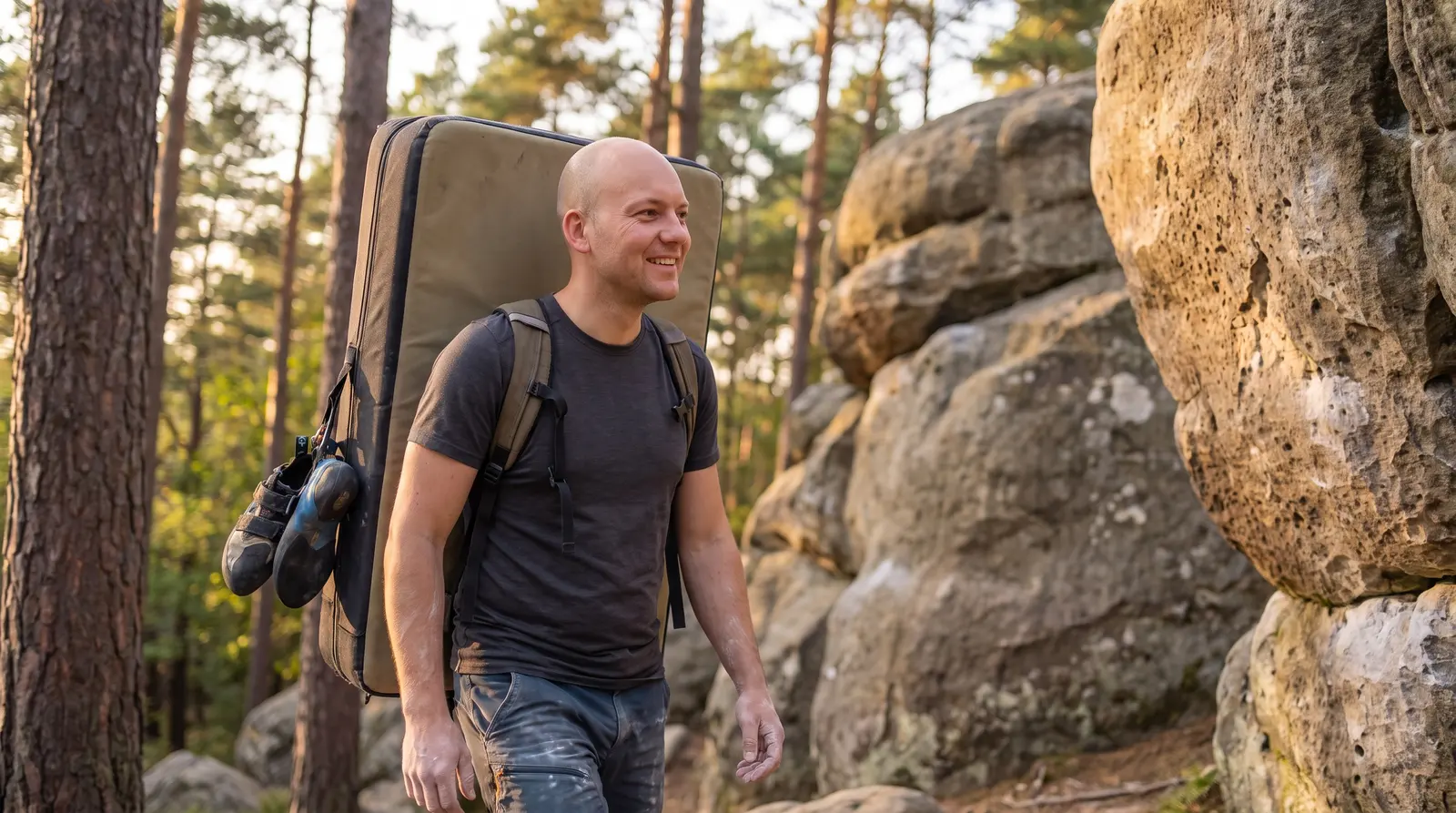
- Close it between attempts. A spilled bucket leaves a white patch at the base of the boulder that others have to look at.
- Put it on a flat spot of your pad or a rock, not on a slope, and not where a falling climber lands.
- Use less chalk and brush holds when you leave. Our guide to bouldering etiquette covers the full set of crag manners.
- Keep your skin kit in the pocket: tape, file and balm. The bouldering trip packing list has the full list.
New to rock? Start with our outdoor bouldering for beginners guide before your first session.
Care
Empty the bucket before washing; Treeline suggests washing chalk bags two or three times a year. Let it dry fully before refilling, because damp chalk clumps. Check drawcords and magnet seams now and then, since those are what keep the chalk inside.
Prices and stock change often; the button opens the retailer or brand page so you can check today's price.
FAQ
Is a chalk bucket or a chalk bag better for bouldering?
For most boulderers a bucket is better. It sits on the ground or your pad, holds more chalk, has room for both hands and usually carries brushes and a phone. A waist-worn chalk bag makes more sense on roped climbs and tall highballs where you need to chalk up mid-route.
What is the best closure on a chalk bucket?
In 99Boulders' leak test the tightest closure was the DMM Edge's double drawcord, followed by the Black Diamond Mondo's magnetic roll-top. Single drawcords tend to leave a small gap, and roll-tops only seal well if the rim is even. Combined closures, such as a roll-top with a magnetic back-up, spill the least.
How big should a chalk bucket be?
Big enough to fit both hands at once, which most dedicated buckets are. Large buckets of around 6 litres suit group sessions and long days; a smaller bucket or a large bag is easier to pack for travel.
How do I stop my chalk bucket tipping over?
Choose a bucket with a wide, flat or weighted base, and put it on a flat spot of your pad or a rock rather than on a slope. Keeping it closed between attempts also limits spills if someone knocks it.