Bouldering Etiquette: The Unwritten Rules, Indoors and Out
 Petr Hess, strength & conditioning coach
Updated 2 Nov 2026 · 8 min read
Key takeaways
Best for: New gym and outdoor boulderers learning the unwritten rules
- Never walk, sit or stand under a climber, and keep bags, bottles and brushes off the mats.
- Have one go, then step back; whoever has just brushed the holds gets the next turn.
- If someone has already started a problem that crosses yours, wait; aim for one climber per section of wall.
- Only give beta when it's asked for, and always ask before spotting someone.
- Outdoors, brush off chalk and tick marks, pack everything out and never climb wet sandstone.
Bouldering etiquette comes down to safety first, then sharing. Never walk, sit or stand under someone who is climbing; take turns on busy problems; don't start a problem that crosses someone already on the wall; and don't give advice unless it's asked for. Brush holds you've greased up, keep your stuff off the mats, and outdoors, leave the rock and the landing cleaner than you found it.
None of this is complicated, but nobody hands you a rulebook when you walk in. If you're brand new, start with our guide on how to start bouldering, then come back here. I'm a strength and conditioning coach, not a climbing coach, and the rules below come from gym rules and climbing organisations, not personal taste.
The quick version
| Do | Don't |
|---|---|
| Wait at the edge of the mat | Walk, sit or chat under a climber |
| Look at where a problem goes before you start | Start a problem that crosses someone already climbing |
| Have a go, then step back | Hog a problem for twenty attempts in a row |
| Ask before giving beta or spotting | Shout instructions at strangers |
| Brush greasy holds, report loose ones | Leave piles of chalk or chalk bags on the mats |
| Keep kids close and off the mats | Let children run around the landing zones |
| Outdoors: brush off chalk and tick marks | Climb wet sandstone or drag pads through vegetation |
1. Stay out of the fall zone
This is the big one. Boulderkeskus in Helsinki puts it plainly: "The most important rule is that it must be safe for the climber to climb and fall without anyone being below." Gripped Magazine's first etiquette rule says the same: "Do not walk, run, sit, or loiter under or behind people climbing."
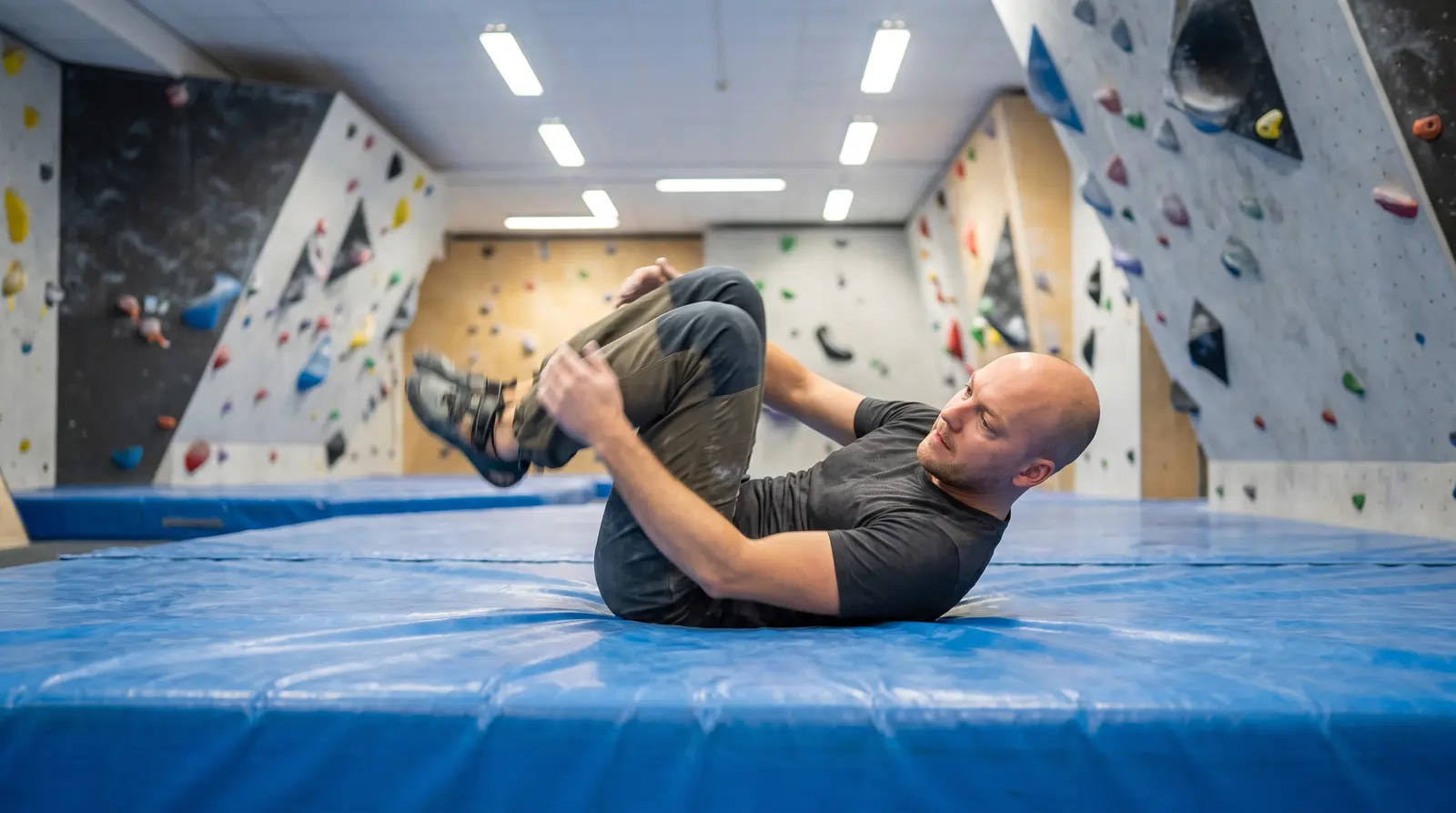
The fall zone is bigger than you think. Climbers swing, jump for holds and fall backwards off overhangs, so give them space on all sides, not just directly below. In practice:
- Wait off the mat, or at its very edge, when someone is on the wall.
- Don't cross the mats behind someone climbing to get to the other side of the gym. Walk around.
- Keep belongings off the mats. Water bottles, bags, shoes and long brushes all turn into ankle-twisting objects when someone lands on them.
- Check before you climb. It's your responsibility as the climber to check the landing too, and to politely ask anyone standing too close to move.
Falls are a real injury risk on their own. A 2025 survey of 245 people injured in bouldering falls found that two-thirds of injuries were to the lower limbs, mostly ankle sprains (Beurienne et al.). Only one of the 245 injured respondents reported bumping into someone on landing, and a survey of injured climbers can't tell you how common collisions are in general, but it only takes one person in the wrong place to turn a routine fall into an injury for two. Learning to land well matters as much as clear mats; our guide to how to fall when bouldering covers it.
2. Taking turns and reading the queue
Bouldering gyms don't have formal queues, which is where most friction happens. The unwritten system works like this:
- One go, then step back. After an attempt, step off the mat and look around. If someone's waiting, they're next.
- Read body language. Someone standing at the edge of the mat, chalked up and looking at a problem, is waiting for it. A quick "Are you on this one?" clears up any doubt.
- Freshly brushed problems: Boulderkeskus notes that "the one who has brushed the holds has the next turn on the problem", and Gripped agrees: let them have the first go.
- Training laps: if you want to repeat a problem over and over for training, ask others first, and don't do it at peak times.
Groups need extra awareness. Six friends taking turns on one problem can block it for an hour. Rotate across a few problems, or let others jump in between your group's attempts.
3. Crossing problems and one climber per section
Gyms set problems close together, and they often cross or share a landing. Before you start, look at where your problem goes. Gripped's advice: "Don't just jump on a boulder before looking at where it ends."
If someone else has already started a problem that crosses or comes near yours, wait. Boulderkeskus spells it out: if someone started first and their problem crosses yours, "you are obliged to give way!" A good default is one climber per section of wall. Two people on neighbouring problems that drift together is how climbers end up falling onto each other.
New to the language? Words like problem, send, beta, flash and topout are all in our bouldering terms glossary.
4. Beta: only when asked
Beta means information on how to climb a problem. Unasked-for beta ("spraying beta") is one of the most common complaints in gyms. Many climbers enjoy working moves out for themselves, and being told the answer spoils that.
- Talking about problems is fine. Gyms are social, and chatting between attempts is part of the fun; just do it off the mats, clear of the fall zones.
- Ask before advising: "Do you want beta?" Accept a no without sulking.
- When you get unwanted beta, a friendly "Thanks, I want to figure it out myself" is all it takes.
- Keep the vibe positive. Gripped suggests keeping negative talk about problems or grades to your friends, not the whole gym.
5. Brushing holds and chalk
Chalk and skin grease build up on holds, especially on popular problems, and make them slippery. Brushing is everyone's job.
Need a brush? Compare the best climbing brushes, including sandstone-friendly bristles.
- Brush holds you've been using, especially before handing the problem over after a long session on it.
- Use the gym's long-handled brushes for holds you can't reach, and put them back off the mats.
- Close your chalk bag and keep it off the landing zone. Spilled chalk on mats is slippery and gets everywhere.
- Found a spinning or loose hold? Don't climb on it. Tell staff, as Gripped recommends, so it can be fixed.
6. Phones, filming and children
Filming yourself is a useful way to check your technique, but check your gym's filming policy first. A few courtesy rules:
- Set up the phone off the mat and out of other climbers' fall lines. A tripod in the landing zone is a trip hazard.
- Don't film strangers without asking, and don't post others prominently without their OK. Check whether your gym has its own filming rules.
- Calls and loud videos belong in the lobby, not under the walls.
Children love bouldering, but mats are not playgrounds. Gym rules typically make parents responsible for keeping kids from running or hanging around on the mats except while they climb. Keep young children within arm's reach, teach them to look up before stepping onto a mat, and follow your gym's age and supervision rules.
7. Spotting etiquette
Spotting means standing behind a climber with your hands up, ready to guide their fall so they land feet first and their head and back are protected. Indoors, spotting is less common on padded floors, but you'll see it on tall or awkward problems. Follow your gym's rules (some discourage or restrict it), and only spot if you know how; a poorly placed spotter can make a fall worse.
- Always ask first. Gripped: "be sure to ask a fellow climber before spotting them." An unexpected spotter can be more dangerous than none.
- Spotting is not catching. You guide the hips and upper body towards the mat; you don't try to hold someone's full weight.
- Stay focused. Once you've agreed to spot, keep your eyes on the climber, not your phone.
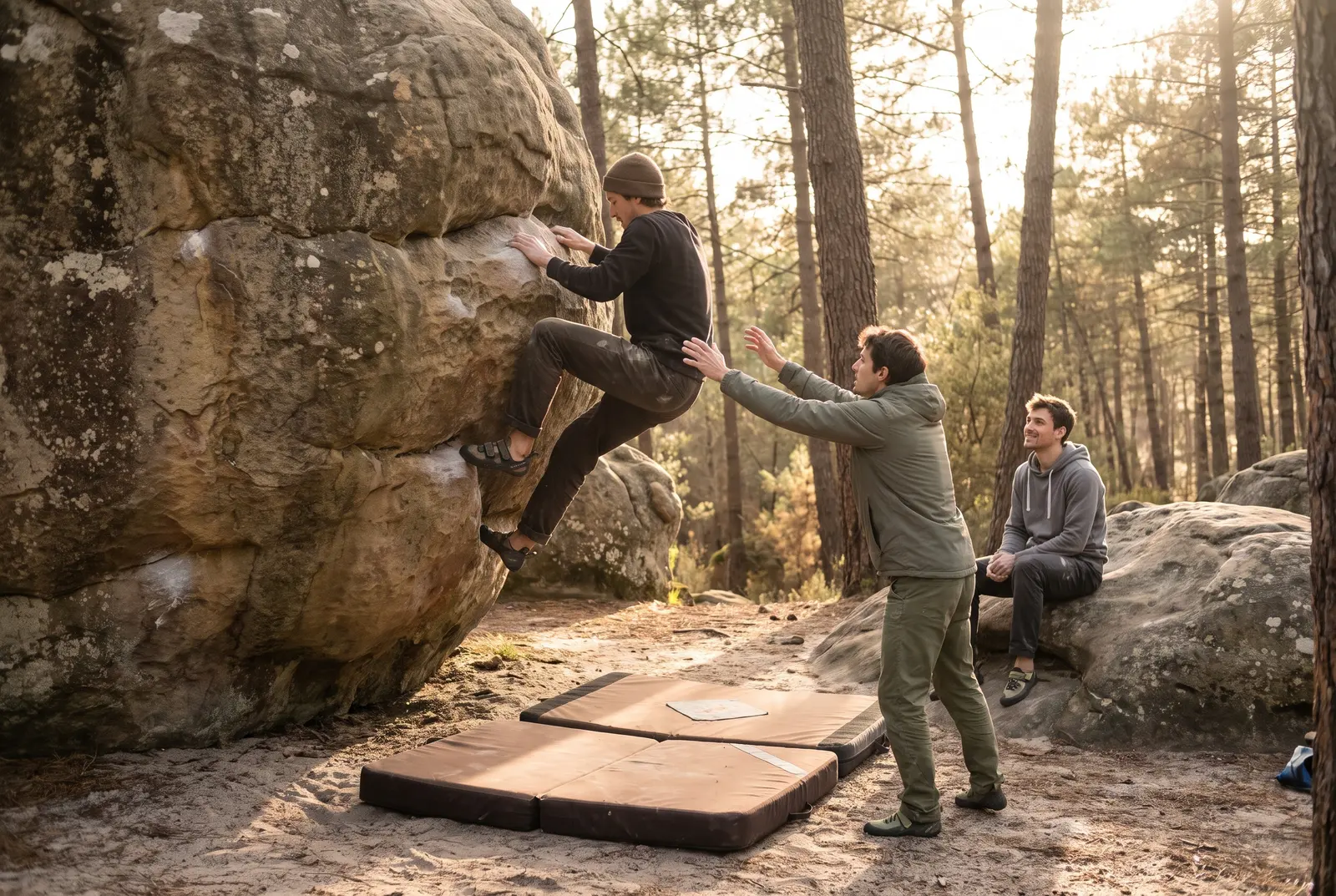
Outdoors, spotting and moving crash pads are core skills, and patient spotting is part of the etiquette. Bleau.info asks climbers to "spot your friends and other climbers patiently".
8. Outdoor bouldering: different rules
Outdoors, etiquette expands from "be nice to people" to "be nice to the rock, the landscape and the people who live nearby". Climbing access often depends on climbers behaving well. Before you go, check current access rules, closures and local restrictions with the land manager or the local climbing organisation. Our outdoor bouldering for beginners guide covers the practical side; here are the ethics.
Leave no trace
The Access Fund's four low-impact bouldering strategies are a good baseline:
- Use existing parking and trails. Park only in designated areas.
- Pack out everything you bring in, including food waste and tape.
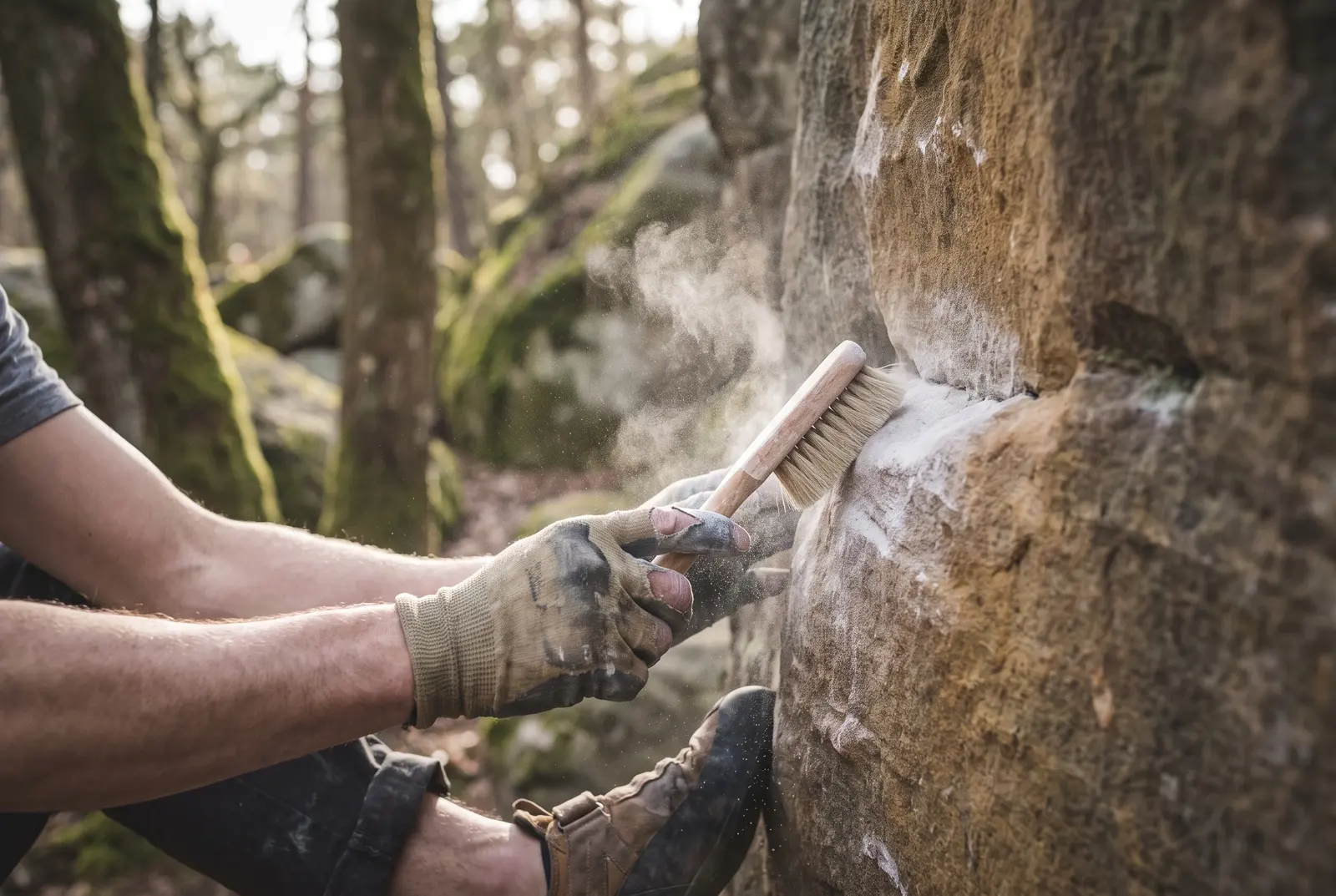
- "Chalk it up, brush it off." Clean your chalk off the boulder before you leave.
- Watch where you put your pad. If a landing would mean putting your pad on vegetation, consider a different boulder.
Tick marks
Tick marks are small chalk lines climbers draw to mark hard-to-see holds. Indoors nobody minds much. Outdoors they're an eyesore to hikers and other climbers. Use as few as possible and brush them all off at the end of your session. Some areas, especially on sandstone, ask you not to make them at all; the BMC advises avoiding tick marks in Fontainebleau.
Sandstone and wet rock
Sandstone needs extra care. Bleau.info, the main database for Fontainebleau, asks climbers: "Do not climb wet problems (damp sandstone is very weak)." The BMC adds that drying can take 24 hours or more, so judge by whether the rock is thoroughly dry and follow local guidance, rather than counting hours. Other rules from Bleau.info's ethics page:
- Brush holds with a soft brush; vigorous brushing has destroyed holds.
- Use chalk sparingly and brush it off before you leave.
- Clean your shoe soles before you climb; sand on rubber polishes the rock.
- Carry your crash pad, don't drag it; stay on existing paths.
- Take all rubbish home, don't make fires, and avoid screaming or playing music.
Planning a trip? Our Fontainebleau bouldering guide has the details on circuits, areas and conditions.
Sharing boulders and pads
Popular boulders get busy. Don't spread a dozen pads over a landing that others want to use, ask before climbing on someone else's pads, and offer to share yours. How many pads you need depends on the landings you'll climb over; see how many crash pads you need.
Gym rules come first
Every gym has its own posted rules: where you can wait, whether you can climb in socks, minimum ages, filming policies. These override anything general, including this guide. Read the posters, listen during your intro, and if in doubt, ask the staff.
The short version: keep the landing clear, take turns, look before you start, ask before you advise or spot, and clean up after yourself. Outdoors, add: don't climb wet sandstone, brush off your chalk and ticks, and leave nothing behind.
FAQ
What is the most important rule in a bouldering gym?
Never be underneath someone who is climbing. Gyms put it first because a falling climber can land on you, and you can't predict where they'll come off. Wait at the edge of the mats, not on them, and keep your bags and bottles off the landing area too.
Is it rude to give beta in bouldering?
Unasked-for beta (advice on how to do a problem) is one of the most common complaints in climbing gyms. Talking about problems is fine and part of the fun; just ask before you explain how to do one, and accept a no.
How long should you wait between turns on a boulder problem?
There's no fixed time. A common approach is to have one attempt, step back, and let anyone waiting have a go before you try again. If nobody else is waiting, you can take your time, but keep an eye out for people who want the same problem.
Can you climb Fontainebleau sandstone after rain?
No, not until it's fully dry. Bleau.info, the main Fontainebleau database, asks climbers not to climb wet problems because damp sandstone is very weak, and the BMC notes that drying can take 24 hours or more. Wait until the rock is thoroughly dry and follow local guidance rather than counting hours.
Sources
- Pardy A, Gripped Magazine, 10 Rules for Indoor Bouldering Etiquette (2023)
- Boulderkeskus, Indoor climbing rules
- Beurienne E et al. The art of falling: identifying the falls scenarios associated with bouldering injuries. Front Sports Act Living (2025)
- Bleau.info, Ethics
- Access Fund, Four Simple Strategies for Low-Impact Bouldering (2021)
- BMC, Olympic detox: best practice for bouldering on sandstone in Font