What Muscles Does Bouldering Work?
 Petr Hess, strength & conditioning coach
Updated 2 Nov 2026 · 9 min read
Key takeaways
Best for: Anyone curious what bouldering trains and what it misses
- Bouldering mainly works the finger and forearm flexors, lats, biceps and upper back, with shoulders and core stabilising.
- It trains pushing muscles and leg strength only lightly, so add presses and squats or lunges for balance.
- One small conference study suggested boulderers' extra finger strength may come from neural adaptation, not bigger forearms; treat it as an indication.
- In one study, elite boulderers peaked near 88% of maximum heart rate but recovered within four minutes, so add aerobic activity.
- Sharp, localised pain in a finger, elbow or shoulder isn't muscle soreness; back off and get it checked if it persists.
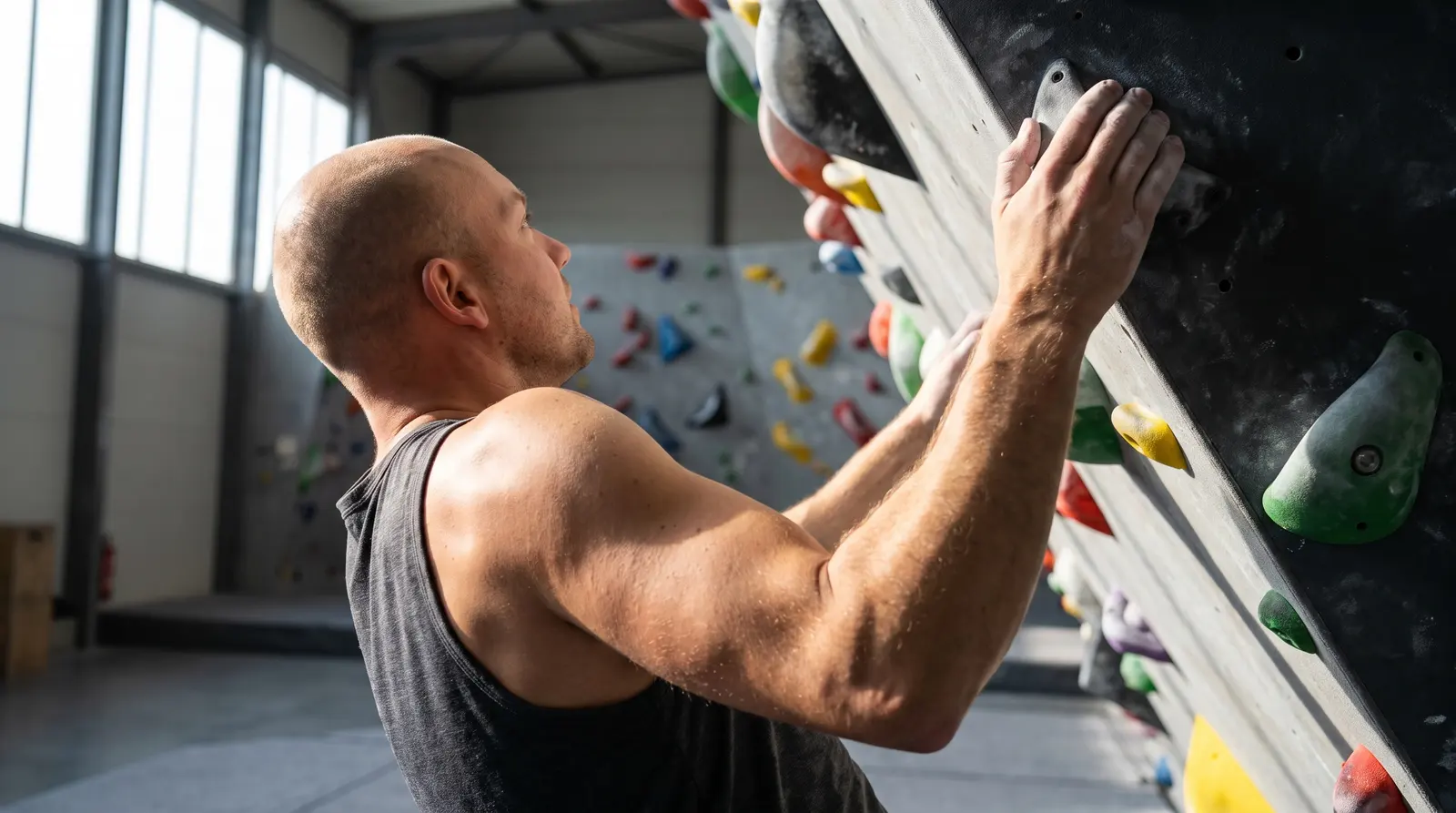
Bouldering works your whole body, but mostly your grip and pulling muscles: the forearm and finger flexors, lats, biceps and the muscles around your shoulder blades. Your rotator cuff and core work hard to keep you stable, and your hips, glutes and calves push you up and hold you on footholds. It builds real strength, especially in the forearms and back, but it trains pushing muscles and leg strength only lightly, so add a little strength work for a balanced body.
I'm a strength and conditioning coach, so this guide looks at bouldering the way I'd look at any sport: which muscles it loads, how hard, and what's left over. If you want to turn that into a weekly plan, see our bouldering training program.
Muscles used in bouldering: overview
| Region | Main muscles | What they do on the wall | How much bouldering trains them |
|---|---|---|---|
| Forearms and hands | Finger flexors (flexor digitorum profundus and superficialis), wrist flexors, small hand muscles; extensors as stabilisers | Grip every hold: crimps, slopers, pinches, pockets | Very high |
| Upper back | Latissimus dorsi, teres major, rhomboids, middle and lower trapezius | Pull your body toward the wall, lock off, keep shoulders set | High |
| Arms | Biceps, brachialis, brachioradialis | Bend the elbow on pulls and lock-offs | High |
| Shoulders | Rotator cuff (supraspinatus, infraspinatus, teres minor, subscapularis), deltoids, serratus anterior | Stabilise the shoulder on reaches, gastons, compression | Moderate to high (mostly as stabilisers) |
| Core | Rectus abdominis, obliques, transverse abdominis, lower back | Keep feet on in overhangs, transfer force between hands and feet | Moderate to high, more on steep walls |
| Hips and glutes | Gluteus maximus and medius, hip flexors, adductors, hamstrings | High steps, heel hooks, keeping hips close to the wall | Moderate (strength), high (mobility) |
| Thighs | Quadriceps | Stand up on footholds, mantles, rock-overs | Low to moderate |
| Calves and feet | Gastrocnemius, soleus, foot muscles | Stand on the tips of your toes on small footholds | Moderate (endurance) |
| Chest and triceps | Pectorals, triceps | Mantles, presses, palming | Low |
Upper body: grip and pull
Forearms and fingers
Your forearms are the limiting factor for most climbers. The muscles that bend your fingers sit in the forearm and pull on long tendons that run through the pulleys in your fingers. Every hold you grip loads them, which is why beginners' forearms "pump" and tire long before their backs do. The forearm extensors, on the back of the forearm, work too: they help stabilise the wrist as you grip.
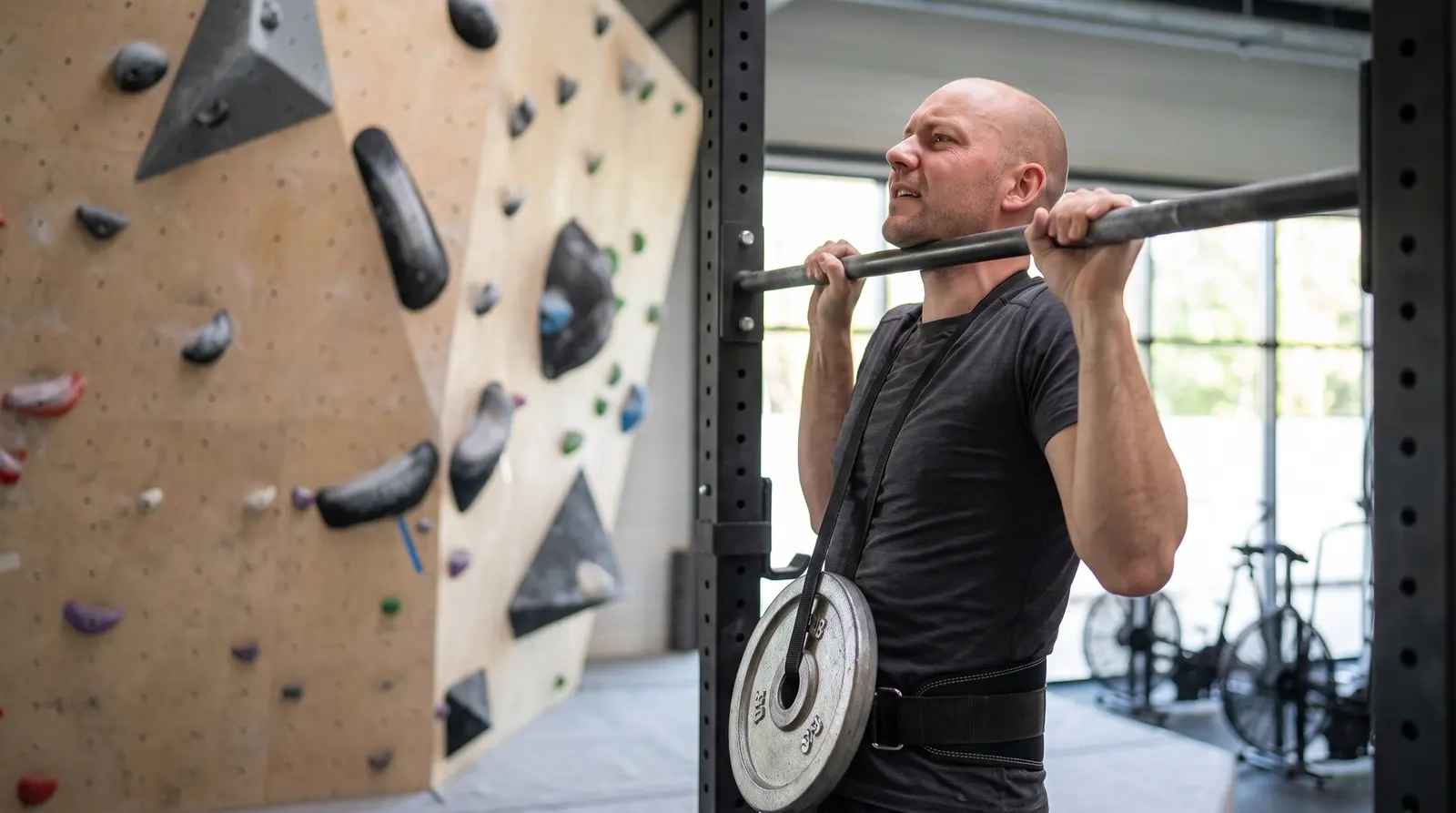
Research backs up how central the fingers are. In a 2023 study of 17 recreational climbers by Exel and colleagues, finger flexor activity during finger hangs stayed similar whether the arms were straight or locked off at different angles, while the biceps, trapezius and latissimus dorsi activity changed with arm position. In other words, the fingers work hard in every position; how much the back and arms work depends on the move.
Lats, upper back and arms
Every pull toward the wall uses the lats, the big muscles of the back, together with the biceps and brachialis at the elbow. Lock-offs (holding a bent arm while you reach with the other) add a lot of biceps and shoulder work. The rhomboids and middle and lower trapezius hold your shoulder blades in place, which is why experienced climbers often have a well-developed upper back.
Shoulders and rotator cuff
Wide reaches, gastons (pushing a hold outward), underclings and compression moves load the shoulder in many directions. The rotator cuff muscles keep the head of the upper arm centred in the socket during these moves. Bouldering trains them, but mostly in their stabilising role, and climbing involves a lot of pulling and internal rotation with little pushing. That imbalance is one reason climbers do antagonist training.
Core, hips and legs
Core
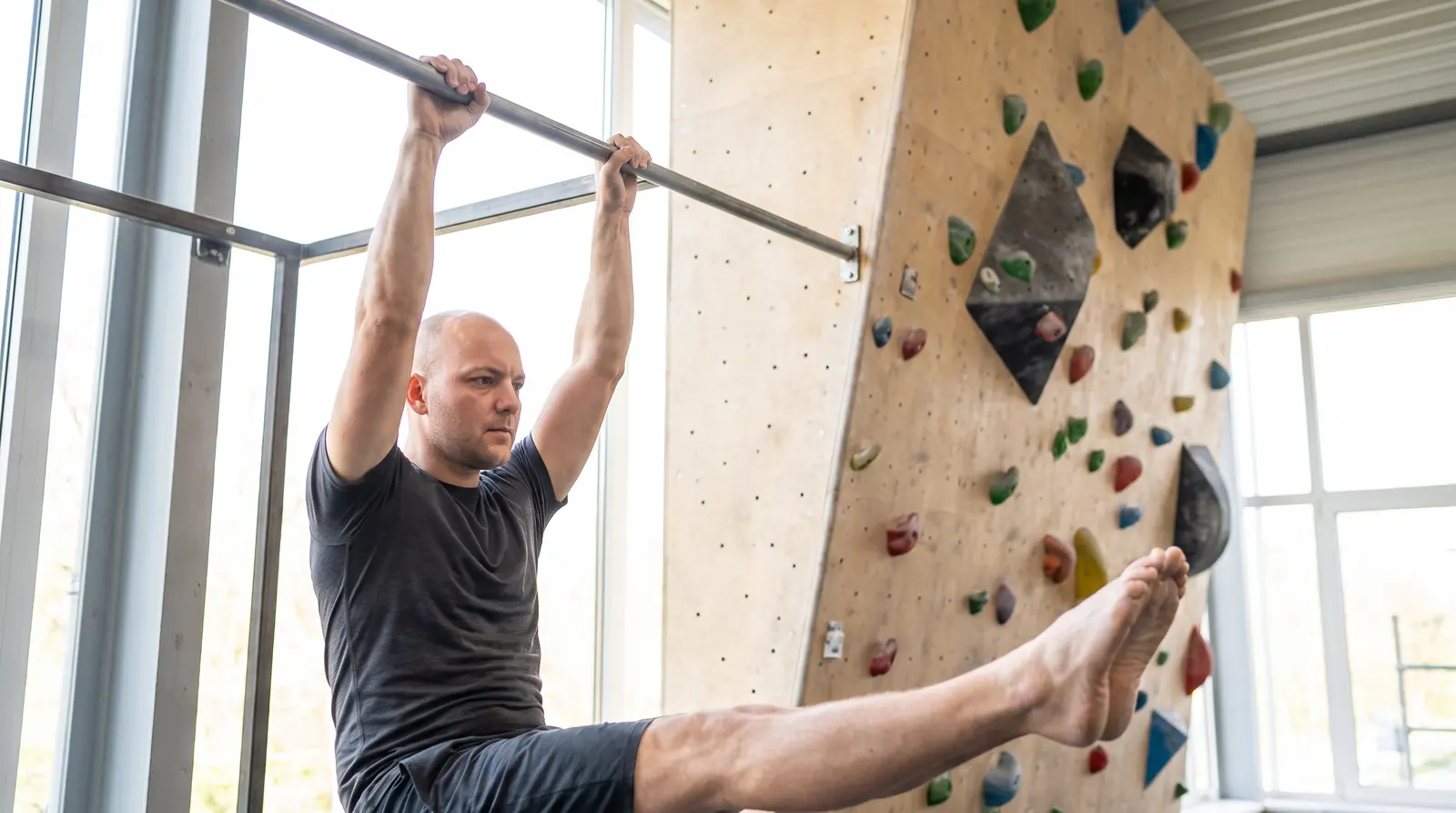
On a vertical wall your core works mostly to hold good posture. On steep walls and roofs, it becomes a main driver: it keeps your feet on the holds when your body wants to swing off, and it transfers force from your legs to your hands. Toe hooks, heel hooks and "core-intensive" overhangs can leave your abs sore for days. Our core exercises for climbing guide focuses on the types of core strength that transfer to the wall.
Hips and glutes
Good climbers keep their hips close to the wall and use their legs to push. High steps, rock-overs and heel hooks rely on the glutes, hamstrings and hip flexors, plus a lot of hip mobility. Bouldering improves hip mobility for many people, but the strength demand is usually moderate compared with a heavy squat or deadlift. Hip and hamstring flexibility often limit high steps and heel hooks; see our stretching for climbers guide.
Quads and calves
Standing up on a foothold, mantling and stepping through all use the quads, and small footholds load the calves as you stand on your toes. These muscles work a lot over a session, mostly at body weight and moderate effort, so for many climbers they build endurance more than maximal strength. Hard high steps, rock-overs and mantles can still be real strength work, especially for beginners.
Where you'll feel it after your first sessions
Soreness is a rough but useful guide to which muscles bouldering is loading, especially when you're new to it. Typical patterns:
| Where it's sore | Usually from | Is it normal? |
|---|---|---|
| Forearms (inner side) | Gripping, especially if you over-grip from nerves | Yes, very common early on |
| Lats and upper back | Pulling on steeper walls | Yes |
| Biceps | Lock-offs and bent-arm climbing | Yes; it often fades as you learn to climb with straighter arms |
| Abs and obliques | Overhangs, keeping feet on | Yes |
| Calves and feet | Standing on small footholds, tight shoes | Yes |
| Finger joints, pulleys or elbows (sharp or localised pain) | Overload of tendons and connective tissue | No: this isn't muscle soreness. Back off, and see a professional if it persists |
Muscle soreness that is general, dull and fades over two or three days is part of adapting. Pain in a specific spot in a finger, at the elbow or deep in the shoulder is different and is worth taking seriously early.
Soreness also tells you something about technique. Very sore biceps and forearms with fresh legs can be a hint that you're pulling with your arms more than pushing with your feet, though soreness alone can't tell you for sure. As technique improves, more of the work shifts to the legs and hips, and you can climb longer with less effort.
Does bouldering build muscle?
Yes, but it's important to separate two things: getting stronger and getting bigger.
- Strength: bouldering is a strength sport. Hard moves often last only a few seconds at near-maximal effort, especially for the fingers. Beginners usually gain grip and pulling strength quickly.
- Muscle size (hypertrophy): climbing does create some muscle growth, particularly in the forearms, back and arms of beginners, but it's not designed to maximise it. Strength gains in climbing come from a mix of better technique, nervous-system adaptations and some muscle growth; how much each contributes isn't well established.
The evidence fits this picture. In a 2016 study presented at the International Rock Climbing Research Congress, Sveen and colleagues measured forearm volume (by water displacement) and finger strength in boulderers, sport climbers and non-climbers. Boulderers had the highest finger strength, but forearm volume didn't differ significantly between the two climbing disciplines. The authors suggested that the extra strength may come from neural adaptations rather than bigger muscles. This was a small study and a conference abstract, so treat it as an indication rather than proof.
For experienced climbers, climbing alone may not be the most effective way to build finger strength. In a 2015 randomised trial by Medernach and colleagues, 23 advanced male boulderers followed either a fingerboard or a bouldering training programme for four weeks. The fingerboard group improved grip strength by about 2.5 kg, a significant change; the bouldering group gained about 1.4 kg, which was not statistically significant. It was a short, small study and doesn't show that climbing stops making you stronger, but experienced climbers who want to get stronger, or bigger, often benefit from targeted training on top of climbing.
| Goal | Is bouldering enough? | What to add |
|---|---|---|
| Grip and finger strength (beginner) | Yes, for the first year or so | Nothing; just climb consistently |
| Grip and finger strength (experienced) | Often not | Structured finger training |
| Bigger back and arms | Partly | Weighted pulls and rows in a hypertrophy rep range |
| Bigger chest, shoulders, triceps | No | Presses, push-ups, dips |
| Leg strength and size | No | Squats, lunges, deadlifts or similar |
Our weight training for climbers guide covers how to add this without hurting your climbing.
Is bouldering a good workout?
For most people, yes. It builds strength, works muscles you'd struggle to train in a normal gym (especially grip and shoulder stabilisers), challenges balance and coordination, and keeps you mentally engaged. Many people simply train more consistently because bouldering is fun.
For cardiovascular fitness, it's more mixed. In a 2021 study by Callender and colleagues, 11 elite boulderers climbed a simulated competition round of five problems with five minutes' rest between them. Oxygen uptake peaked at about 75% of their treadmill maximum and heart rate at about 88% of maximum, and they spent about 23% of their climbing time above their gas exchange threshold. But their breathing and heart rate returned to baseline within four minutes of rest. Bouldering is high-intensity but intermittent: hard bursts separated by long rests.
Calories burned bouldering
You'll see figures like "500 calories an hour" online, but I couldn't find a study that measured energy expenditure across a typical recreational bouldering session. Studies like the one above measure oxygen use during attempts, not over a whole session that includes warm-up, rest, chatting and looking at problems. The honest answer is that it depends mostly on how much time you actually spend climbing. If weight loss is your goal, diet matters far more than the exact calorie count of your climbing.
Bouldering against general fitness guidelines
The CDC recommends that adults get at least 150 minutes of moderate-intensity (or 75 minutes of vigorous) aerobic activity a week, plus at least two days of muscle-strengthening activity working all major muscle groups: legs, hips, back, core, chest, shoulders and arms.
| Guideline component | Does bouldering cover it? |
|---|---|
| Muscle strengthening: back, arms, core | Yes, well |
| Muscle strengthening: legs, hips | Partly |
| Muscle strengthening: chest, pushing | Barely |
| Aerobic activity | Partly; bursts are hard but short, so add walking, cycling, running or similar |
What bouldering doesn't train well, and how to fill the gaps
From an S&C perspective, these are the main gaps, with a minimum dose that fits around 2–4 climbing sessions a week:
| Gap | Why it matters | Minimum effective dose |
|---|---|---|
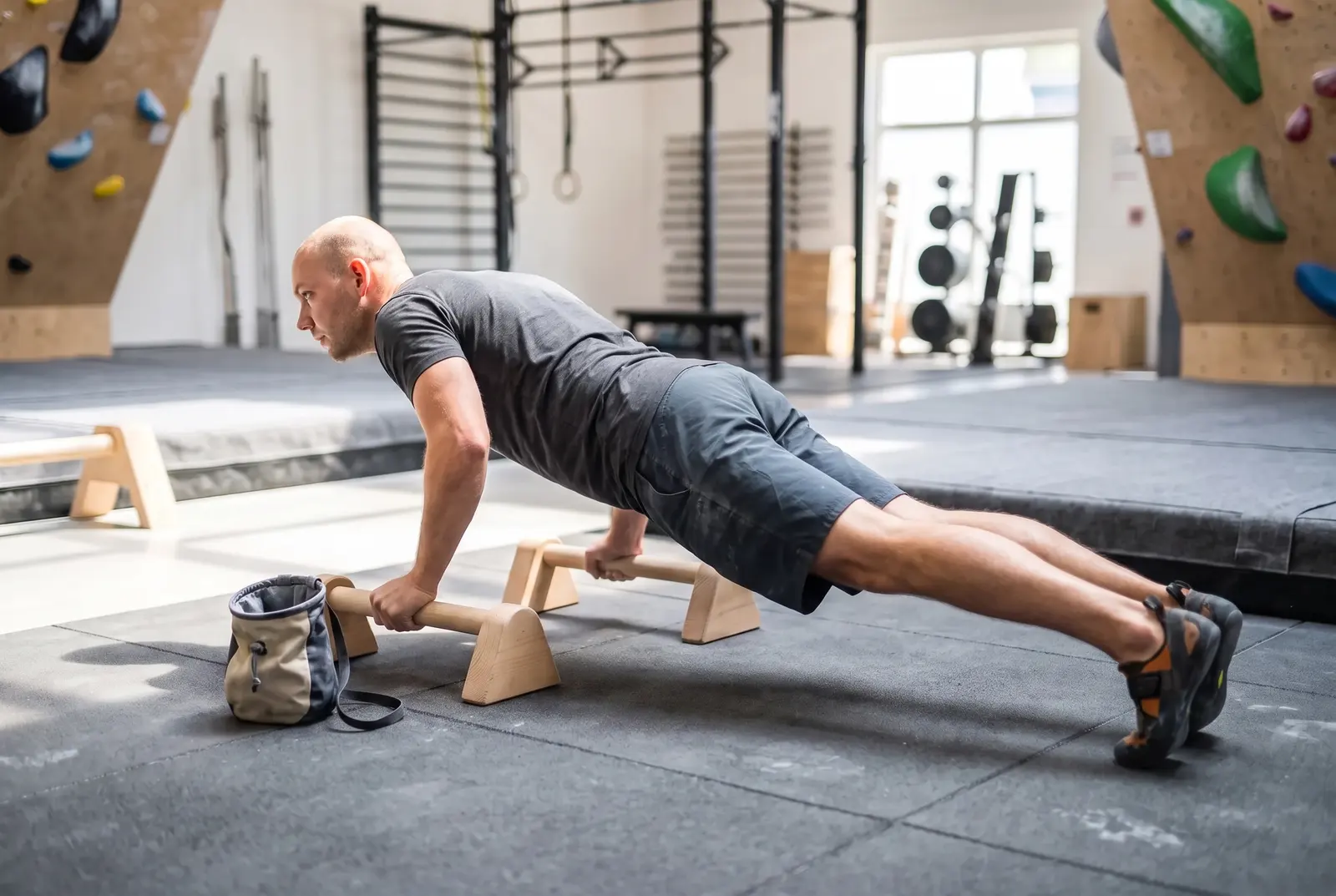
| Pushing (chest, triceps, front of shoulder) | Balance around the shoulder; mantles and presses | 2 sessions a week: 2–3 sets of push-ups, dips or overhead presses, 6–12 reps |
| Shoulder external rotation and lower trapezius | Climbing is pull- and internal-rotation heavy | 2–3 times a week: 2 sets of 12–15 band external rotations and Y-raises |
| Wrist and finger extensors | Balance for the grip muscles | 2–3 times a week: 2 sets of 15–20 reverse wrist curls or band finger extensions |
| Leg strength | Bone and joint health, general athleticism, absorbing landings | 1–2 sessions a week: 2–3 sets of squats, split squats or deadlifts, 5–10 reps |
| Aerobic fitness | Heart health, recovery between attempts and sessions | Total of 150 min a week of moderate cardio, including walking |
| Mobility | High steps, heel hooks, shoulder range | 10 minutes after climbing, 2–3 times a week |
Put these on rest days or after climbing, not before a hard bouldering session. Our guide on how often you should climb explains how to fit climbing and other training into one week without overloading your fingers.
The bottom line
Bouldering is a genuinely good full-body workout with a bias: grip, back, arms, shoulder stabilisers and core get the most work; legs and pushing muscles the least. It builds real strength, especially early on, but much of that strength likely comes from skill and nervous-system adaptation, not just bigger muscles. Build up gradually to 2–4 climbing sessions a week, add two short strength sessions for the gaps and enough aerobic activity to meet the guidelines above, leave time to recover, and you'll cover most of what a balanced fitness programme should.
FAQ
Does bouldering build muscle?
Yes, to a point. Beginners usually gain noticeable strength and some muscle in the forearms, back and shoulders. But part of a climber's strength comes from technique and the nervous system rather than bigger muscles, and climbing isn't designed to make muscles bigger. If you want more muscle, add resistance training.
Is bouldering a full-body workout?
Bouldering uses the whole body, but not evenly. It trains grip, pulling muscles, shoulder stabilisers and core very well, and legs and pushing muscles only lightly. Add some leg and push strength work for a balanced programme.
How many calories does bouldering burn?
There isn't a reliable study-based figure for a typical gym session. Hard bouldering raises heart rate and oxygen use a lot during attempts, but most of a session is rest, so the total depends heavily on how much you actually climb. Treat online calorie numbers as rough guesses.
Is bouldering good exercise for beginners?
Yes. It's a great way to build grip, back and core strength while learning a skill, and it scales to any fitness level. Start with 2–3 sessions a week and climb easy problems so your fingers and shoulders can adapt.
Sources
- Exel J. et al., Neuromechanics of finger hangs with arm lock-offs: analyzing joint moments and muscle activations to improve practice guidelines for climbing, Frontiers in Sports and Active Living (2023)
- Sveen J, Stone KJ, Fryer SM., Strength and forearm volume differences in boulderers and sport climbers, International Rock Climbing Research Congress (2016)
- Medernach JPJ, Kleinöder H, Lötzerich HHH., Fingerboard in Competitive Bouldering: Training Effects on Grip Strength and Endurance, Journal of Strength and Conditioning Research (2015)
- Callender NA, Hayes TN, Tiller NB., Cardiorespiratory demands of competitive rock climbing, Applied Physiology, Nutrition, and Metabolism (2021)
- Centers for Disease Control and Prevention, Adult Activity: An Overview (2023)