Weight Training for Climbing: The Lifts, a 2x/Week Program and How to Schedule It
 Petr Hess, strength & conditioning coach
Updated 2 Nov 2026 · 10 min read
Key takeaways
Best for: Climbers wondering whether and how to add gym lifting
- Pulling strength is one of the strongest correlates of climbing level, though a causal link hasn't been proven.
- Two sessions a week of pull-ups, rows, a hip hinge, a press and single-leg work suit most recreational climbers.
- Lift after climbing or on separate days, and avoid heavy pulling the day before a hard session.
- For strength with less size gain, keep most sets at 3–6 reps and volume modest; that limits growth rather than preventing it.
- Lattice's commercial data suggest weighted pull-ups pay off below about 160–165% of bodyweight for men and 135% for women.
Yes, most climbers should do some weight training. Pulling strength is one of the strongest predictors of climbing level in the research, and stronger shoulders, hips and legs make every move cost a smaller share of what you have. Two short sessions a week built around pull-ups, rows, a hip hinge, a press and single-leg work are enough for most recreational climbers, as long as you lift after climbing or on separate days and keep the reps low enough to build strength rather than bulk.
This is my home turf: I coach strength and conditioning for individuals and sports clubs, and climbing is my favorite complement to that work. I am not a climbing coach, so this guide stays on the strength side. For the full weekly picture, including finger training and climbing sessions, start with our bouldering training program.
Should climbers lift weights? What the evidence says
Strength and climbing level
The best data come from cross-sectional studies, which compare climbers of different levels at one point in time:
- MacKenzie and colleagues (2020) tested 77 climbers, from lower grades to around 8a onsight, on 47 physical and psychological variables. In both men and women, shoulder power and endurance, measured as maximum pull-ups, arm crank power and bent-arm hang, emerged as the main determinants of climbing ability. Finger, hand and arm strength, core endurance, aerobic endurance, flexibility and balance were important secondary factors. In a small proof-of-principle follow-up, raising those main determinants by 42–67% went along with a 2 to 3 grade improvement, but each training group had only three climbers, who kept climbing as usual, so this is a preliminary signal rather than proof of cause and effect.
- Devise, Quaine and Vigouroux (2023) tested 28 advanced to elite male climbers. Maximum pull-up reps and weighted pull-up 1-rep max both correlated with climbing level (r = 0.45 for the 1-rep max), while pure speed of pulling did not.
A 2024 narrative review by Saeterbakken and colleagues brings the evidence together. Upper-body strength programs improved climbing-specific tests in lower and intermediate grade climbers, and the one study that compared high-repetition and high-load programs found both improved dead hangs, pull-up strength and lead performance. The authors are clear, though, that a causal link between specific strength and climbing performance has not been proven, and evidence for advanced and elite climbers is limited.
Injury risk
The same review notes that fingers and shoulders are the most common sites of overuse injuries in climbing, and that resistance training was linked to fewer overuse climbing injuries in two retrospective studies. Its logic is simple: if your strength goes up, each move costs a smaller percentage of your maximum. Using their example, an 80 kg climber who raises their pull-up 1-rep max from 100 kg to 120 kg (bodyweight plus added load) drops a bodyweight pull-up from 80% to 67% of their maximum.
The weight gain fear
Climbers worry that lifting will add bulk they then have to haul up the wall. The review addresses this directly: extra muscle adds mass, but up to a point the added strength should still improve performance. High-level climbers were leaner than age-matched controls, yet body fat was the weakest predictor of performance among the variables studied.
Muscle can grow without a calorie surplus, especially in people new to lifting, so do not assume you are safe from any size gain. Still, a climber doing a handful of heavy sets twice a week, while also climbing several times a week, usually gains size slowly. If you want strength with as little size gain as possible, keep most of your sets heavy, in the 3–6 rep range, and keep weekly volume modest. That limits muscle gain rather than preventing it: the 2026 ACSM position stand found that heavier loads (80% of your 1-rep max or more) built more strength, but muscle growth was similar across light and heavy loads and was greater with higher volumes (10 or more sets a week). The review classifies 1–5 reps as maximal strength work and 8–15 reps as hypertrophy work.
The key lifts and why they matter
For a full breakdown of which muscles climbing uses, see what muscles does bouldering work. In the gym, you need five movement patterns.
| Pattern | Main exercises | Why climbers need it |
|---|---|---|
| Vertical pull | Pull-up, weighted pull-up, chin-up | The movement most closely tied to climbing level in the research |
| Horizontal pull | Dumbbell row, cable row, ring row | Shoulder blade strength and control for steep terrain and roofs |
| Hip hinge | Romanian deadlift, trap bar deadlift, hip thrust | Posterior chain for heel hooks, high steps and body tension |
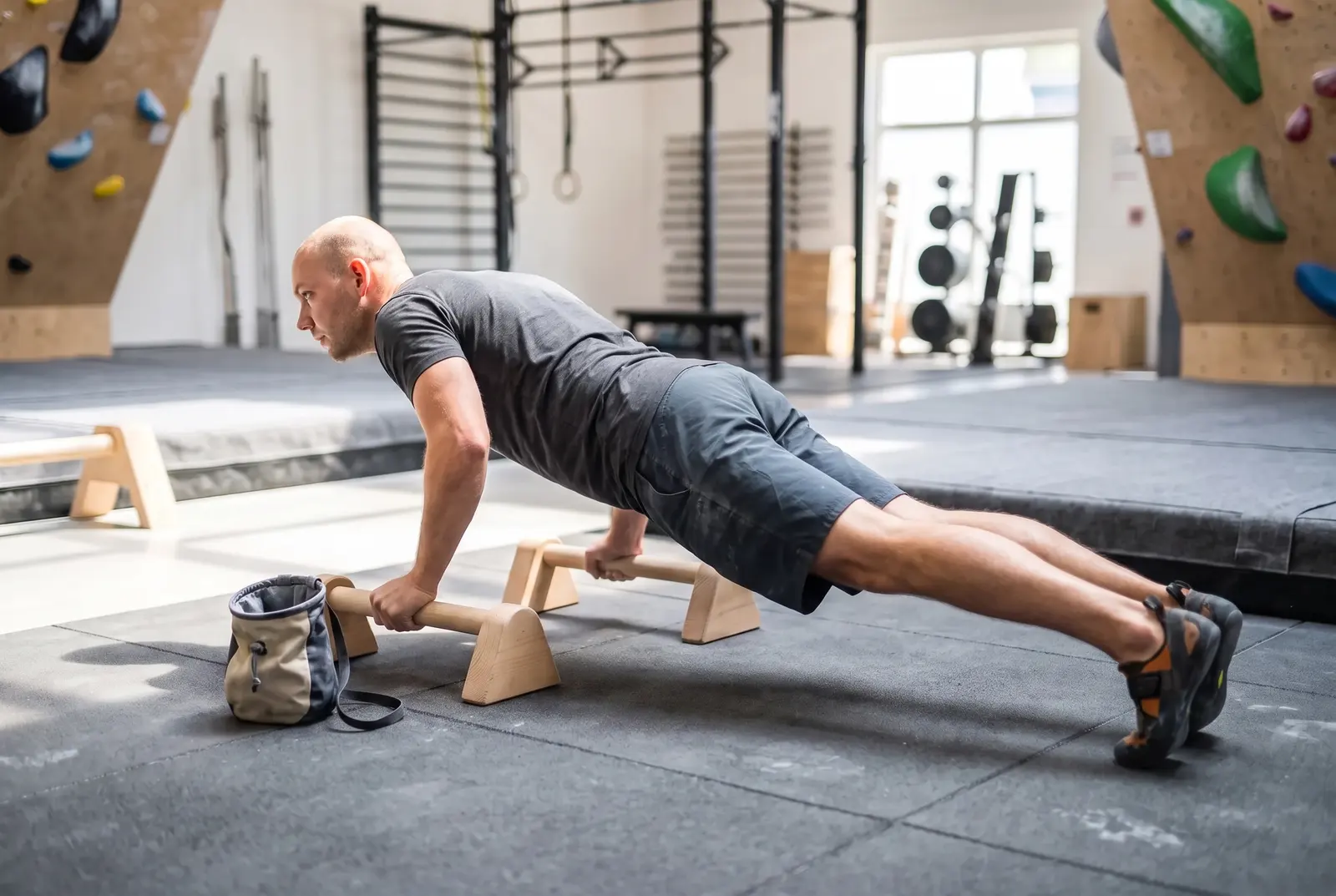
| Push | Overhead press, push-up, dip | Mantles, presses, and balance around the shoulder |
| Single leg | Split squat, step-up, single-leg RDL | Rock-overs, high feet, and landing strength |
Pull-ups and weighted pull-ups
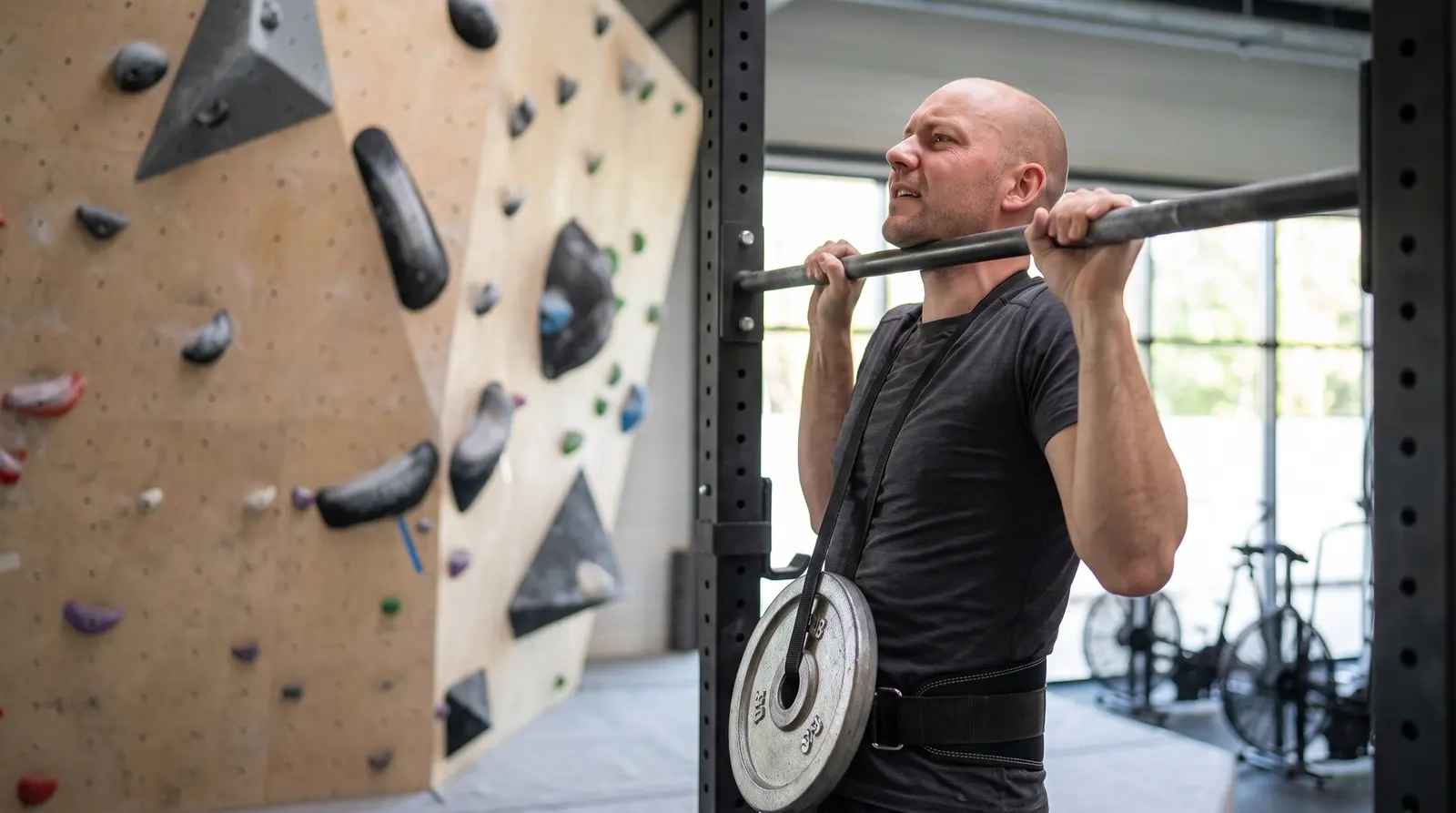
Start every program here. Use a full hang at the bottom and pull until your chin clears the bar, without kicking. Once you can do about 8–10 clean reps, add weight with a belt or vest and work in lower rep ranges. Mix overhand and underhand (chin-up) grips across the week.
Rows
Rows train the muscles that pull your shoulder blades back and down, which is what keeps your shoulders in a stable position on steep ground. They also balance the forward-rounded posture that lots of pulling and crimping can encourage.
Hip hinge
A Romanian deadlift or trap bar deadlift trains your hamstrings, glutes and back extensors. Climbers use these muscles on heel hooks and for keeping hips close to the wall. You do not need heavy max singles; controlled sets of 5–8 are plenty.
Overhead press and push-ups
Pushing keeps your shoulders balanced and helps on mantles and compression moves. This is where weight training overlaps with antagonist training; if you already do that routine, you can keep pushing volume in the gym modest.
Single-leg work
Split squats and step-ups build strength in exactly the position you use on a high step or rock-over, one leg at a time. They are also easier on the lower back than heavy bilateral squats when you are already tired from climbing.
Pull-up benchmarks for climbers
There is no official pull-up standard by grade. Two sources give useful reference points:
| Source | Test | What they found |
|---|---|---|
| Devise et al. (2023), 28 advanced to elite male climbers | Max strict pull-ups | Average 22.5 reps (range 12–40); reps correlated with climbing level |
| Lattice Training (2026), 733 assessments | Weighted pull-up 2-rep max, as % of bodyweight (body plus added load) | Men around V7–V8: about 145%; around V9–V10: about 160% |
| Lattice Training (2026) | Same | Women: average 137%; suggested "gold standard" about 135% for women and 165% for men |
Lattice's interpretation is that below roughly 160–165% of bodyweight (men) or about 135% (women), weighted pull-up training is likely a good use of time; above that, the returns diminish and fingers, mobility, endurance and skill are usually better targets. Keep in mind that this is commercial assessment data with no reported statistics, and the female sample was smaller. Pulling strength is also only half the story; compare your fingers with our finger strength benchmarks before deciding what to train.
Lock-off training
A lock-off is holding yourself with one arm bent while the other hand reaches for the next hold. It needs strength at a specific joint angle, so train it with isometric holds and slow eccentric work:
- Lock-off holds: pull up on two arms and hold at the top, at 90° of elbow bend and at 120° (just above full hang). Hold each position 3–5 seconds, for 3–4 sets of one round of all three angles, with 2 minutes of rest.
- Slow negatives: from the top of a pull-up, lower over 4–5 seconds, pausing briefly at 90°. Do 3–4 sets of 2–4 reps.
- Offset pull-ups: one hand on the bar, the other on a towel or lower handle, so the high arm does more work. Do 3 sets of 3–5 reps per side. Only progress towards one-arm work once your weighted pull-ups are solid and your elbows are consistently pain-free.
Keep your shoulders engaged and controlled rather than hanging passively, but let the shoulder blades move naturally during the dynamic reps instead of forcing them rigidly down and back. Stop any exercise that hurts, especially if you feel pain on the inside or outside of the elbow.
A 2x/week weight training program for climbers
These programs follow general strength training guidelines. The American College of Sports Medicine recommends 8–12 rep loads and 2–3 sessions a week for novices, and for intermediates a wider 1–12 rep range with emphasis on heavier loads, with 3–5 minutes of rest between heavy sets. For climbers who already put a lot of load on their upper body, two sessions a week is a practical fit.

Beginner (new to lifting)
| Exercise | Session A | Session B | Rest |
|---|---|---|---|
| Pull-up (band-assisted or negatives if needed) | 3 × 5–8 | 3 × 5–8 (chin-up grip) | 2 min |
| Dumbbell row | 3 × 8–12 per side | — | 90 s |
| Ring or TRX row | — | 3 × 8–12 | 90 s |
| Romanian deadlift (dumbbells or bar) | 3 × 8–10 | — | 2 min |
| Split squat | — | 3 × 8–10 per side | 90 s |
| Push-up | 3 × 8–15 | — | 90 s |
| Dumbbell overhead press | — | 3 × 8–12 | 90 s |
| Core (see link below) | 2 exercises | 2 exercises | 60 s |
Choose loads you can lift with 2–3 good reps left in the tank. Session time is about 40–50 minutes.
Intermediate (6+ months of consistent lifting)
| Exercise | Session A (heavier) | Session B (moderate) | Rest |
|---|---|---|---|
| Weighted pull-up | 4 × 3–5 | 3 × 6–8 (chin-up grip) | 3 min |
| Lock-off holds or slow negatives | — | 3 sets (see above) | 2 min |
| Row (cable, dumbbell or chest-supported) | 3 × 6–8 | 3 × 8–10 | 2 min |
| Trap bar or Romanian deadlift | 3 × 4–6 | — | 3 min |
| Rear-foot elevated split squat | — | 3 × 6–8 per side | 2 min |
| Overhead press | 3 × 5–6 | — | 2–3 min |
| Dips or push-ups | — | 3 × 8–12 | 90 s |
| Core | 2 exercises | 2 exercises | 60 s |
For the core work in both programs, pick from our core exercises for climbing. Leave 1–2 reps in reserve on the heavy sets; there is no need to grind to failure when your climbing also depends on fresh muscles.
How to schedule lifting with climbing
Climbing is the priority. Lifting should make your climbing better, not leave you too tired to climb well.
Option 1: lift after climbing, same day
Climb first, while your skill and fingers are fresh, then lift. This keeps hard days hard and easy days easy, which gives you more full rest days. The downside is that your pulling will be weaker after a hard session, so expect lower numbers on pull-ups than when fresh.
Option 2: lift on separate days
Lifting on non-climbing days gives you better lifting quality, but it removes rest days. It works best if you climb two or three times a week. Put leg and hinge work first and keep upper-body pulling lighter if the next day is a climbing day.
Rules that apply to both
- Do not do heavy pulling the day before a hard bouldering, board or hangboard session.
- Count weighted pull-ups and lock-offs as part of your total upper-body load, the same as hard climbing.
- If you climb four or more times a week, one lifting session focused on legs, hinge and pushing may be enough.
For how many climbing days to pair with this, see how often should you climb, and for a full week that combines both, see the bouldering training program.
Progression and deloads
The ACSM's 2009 position stand suggests increasing load by 2–10% once you can perform one or two reps beyond your target. Its 2026 update does not give a fixed percentage; it simply says the load needs to keep rising over time for continued progress. In practice, a simple double progression works well:
- Pick a rep range, for example 3 × 5–8.
- Stay at the same weight until you hit the top of the range (8 reps) on all sets with good form.
- Add the smallest available increment, for example 1–2.5 kg on a weighted pull-up, and work back up from 5 reps.
Plan a lighter week every 4–6 weeks, or sooner if your climbing feels flat, your elbows or shoulders ache, or your lifts stall for two sessions in a row. In a deload week, keep the same exercises but cut sets roughly in half and drop the load a little. Also back off lifting before a climbing trip or competition so you arrive fresh.
Common mistakes climbers make in the weight room
- Only training pulling. Climbing already gives you plenty of pulling. A program that is all pull-ups and rows misses the hinge, push and single-leg work that rounds out your strength and balances your shoulders.
- Training to failure every set. Failure sets add fatigue that spills over into your next climbing session. Stopping one or two reps short still builds strength.
- Copying bodybuilding splits. Five-day splits with high volume per muscle group are built for size, not for a climber who also climbs three or four times a week.
- Changing everything at once. Adding a lifting program, a hangboard block and an extra climbing day in the same week is a common route to sore elbows. Add one new stressor at a time.
- Skipping the warm-up. Before heavy pull-ups, do a few easy sets with bodyweight or band assistance, and some light rows and presses to get the shoulders moving.
- Not tracking anything. Write down weights, sets and reps. Without a record, it is hard to tell whether you are progressing or just tired.
The bottom line
Climbers should lift, but only as much as their climbing can absorb. Prioritize pull-ups and rows, add a hip hinge, a press and single-leg work, and train twice a week in low-to-moderate rep ranges, after climbing or on separate days. Use benchmarks to decide whether pulling strength is still your limiter, and once it is not, move your effort to fingers, technique and endurance.
FAQ
Should climbers lift weights?
Most recreational climbers can benefit from some weight training, especially pulling strength, pushing strength and leg and hip work. In a study of 77 climbers, maximum pull-ups, arm crank power and bent-arm hang were the main determinants of climbing level, and a 2024 review linked resistance training with fewer overuse injuries in two retrospective studies. It should support your climbing, not replace it.
Will lifting weights make me too heavy to climb?
Not if you train for strength rather than size. Low-rep, heavy sets with modest total volume build strength with relatively little muscle gain, though low reps still build some muscle, and a 2024 review argued that some added muscle should still help performance up to a point. Body fat was the weakest predictor of performance among the variables in the data the review discussed.
How many pull-ups should a climber be able to do?
There is no official standard. In a 2023 study of 28 advanced to elite male climbers, the average maximum was about 22 strict pull-ups, and both maximum reps and weighted pull-up strength correlated with climbing level. Lattice Training's assessment data put average male V7–V8 boulderers at a weighted pull-up 2-rep max of about 145% of bodyweight, with returns diminishing above about 160–165% for men and about 135% for women.
Should I lift before or after climbing?
After climbing, or on a separate day. Climb first while you are fresh, because climbing skill and finger loading are the priority and fatigue raises the risk of poor movement. Avoid heavy pulling the day before a hard bouldering or hangboard session.
Sources
- Saeterbakken AH et al. The Connection Between Resistance Training, Climbing Performance, and Injury Prevention. Sports Medicine - Open (2024)
- MacKenzie R et al. Physical and Physiological Determinants of Rock Climbing. International Journal of Sports Physiology and Performance (2020)
- Devise M, Quaine F, Vigouroux L. Assessing climbers' pull-up capabilities by differentiating the parameters involved in power production. PeerJ (2023)
- Ollie Torr, Is pull-up training a waste of time for climbers?, Lattice Training (2026)
- American College of Sports Medicine. Progression models in resistance training for healthy adults. Medicine & Science in Sports & Exercise (2009)
- Currier BS et al. ACSM Position Stand: Resistance Training Prescription for Muscle Function, Hypertrophy, and Physical Performance in Healthy Adults: An Overview of Reviews. Medicine & Science in Sports & Exercise (2026)
- Slater GJ et al. Is an Energy Surplus Required to Maximize Skeletal Muscle Hypertrophy Associated With Resistance Training. Frontiers in Nutrition (2019)
- Prinold JAI, Bull AMJ. Scapula kinematics of pull-up techniques: Avoiding impingement risk with training changes. Journal of Science and Medicine in Sport (2016)