Core Exercises for Climbing: 10 Moves and a 20-Minute Routine
 Petr Hess, strength & conditioning coach
Updated 2 Nov 2026 · 8 min read
Key takeaways
Best for: Climbers who struggle to keep their feet on steep terrain
- For climbers, core means body tension: resisting extension and rotation, and pulling the legs up towards the hands.
- Research is limited; one study of 77 climbers rated core endurance a secondary factor behind shoulder power and endurance.
- In one 10-week study of 19 climbers, isometric core training improved a body-lift test by about 30%; grades weren't measured.
- Train core twice a week for 15–20 minutes, mixing holds and dynamic exercises and progressing from floor to hanging work.
- Do it after climbing or on rest days, and count hanging exercises and front levers as upper-body load.
The best core exercises for climbing train your trunk to resist movement and to pull your legs up towards your hands: hollow holds, dead bugs, side planks, Pallof presses, ab wheel rollouts, hanging knee and leg raises, toes-to-bar, windshield wipers and front lever progressions. Two short sessions a week, after climbing or on a rest day, are a practical starting point; nobody has worked out an optimal dose for climbers. Core strength helps most on steep terrain, where it keeps your feet on the wall.
I coach strength and conditioning, and core training is one of the most misunderstood parts of it. Climbers do not need a six-pack routine with hundreds of crunches. They need a trunk that stays stiff when the feet want to cut loose. This guide shows which exercises do that, how to make them easier or harder, and how to fit them around your climbing. Core is one piece of the bigger picture in how to get better at bouldering.
What "core" means for climbers
In strength and conditioning, "core" means more than your abs. It includes the muscles around your spine, pelvis and hips: the rectus abdominis, the obliques, the deep abdominal muscles, the back extensors, and the hip flexors that lift your legs. For a full breakdown, see what muscles does bouldering work.
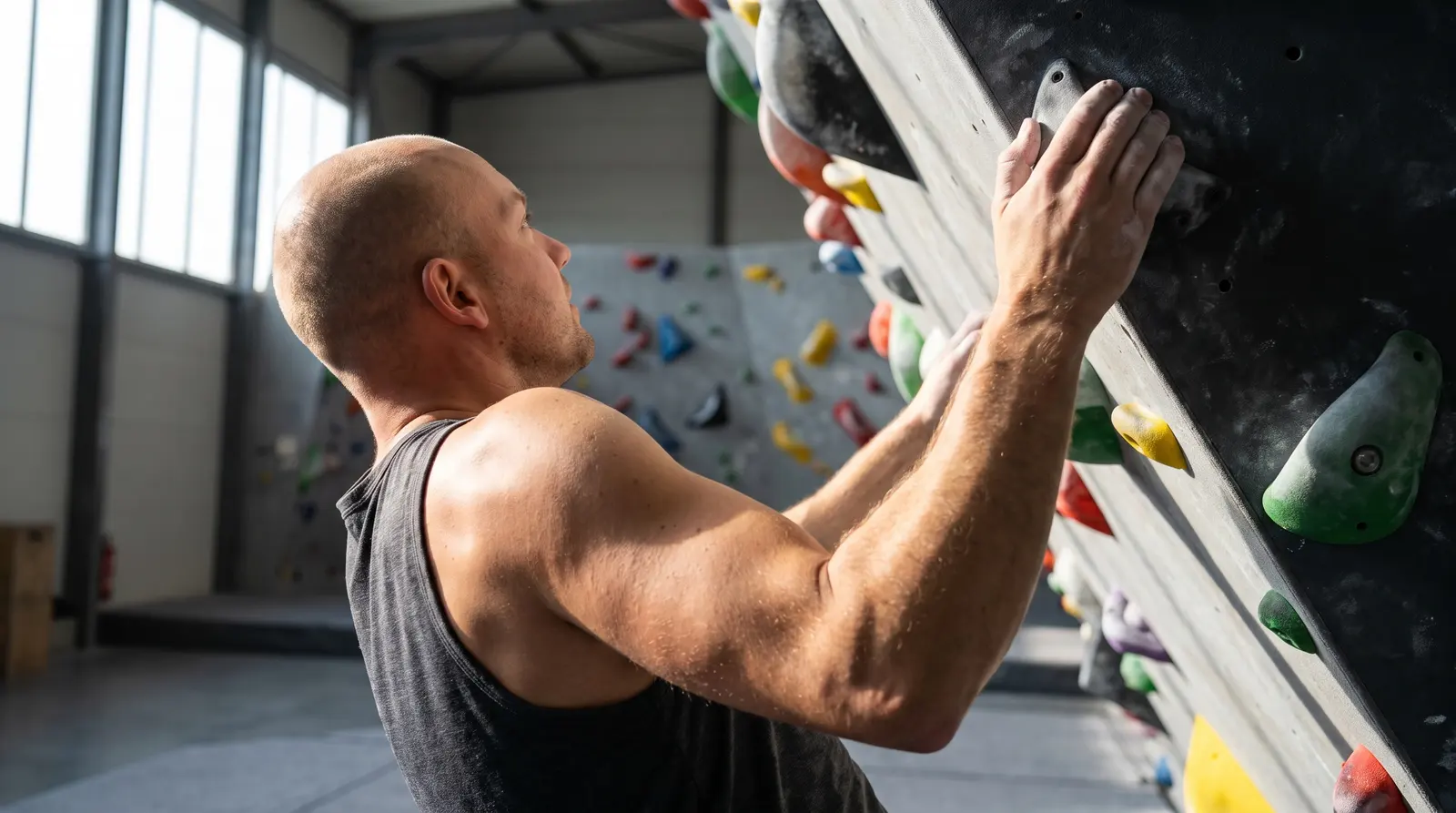
On the wall, your core has three main jobs:
- Anti-extension (body tension). On overhangs your hips want to sag away from the wall. Your abdominal muscles stop your lower back from arching so that pressure stays on your toes.
- Anti-rotation. When you reach with one hand and only have one good foot, your body wants to swing open like a barn door. Your obliques and deep trunk muscles resist that twist.
- Hip flexion strength. Getting your feet back on after they cut, or placing a high foot on a steep wall, means pulling your legs up towards your hands. That is mainly a hip flexor and lower ab job.
Saeterbakken and colleagues (2018) note that on hard routes climbers often have only two points of contact, typically one hand and the opposite foot, and suggest core strength helps maintain positions, reach holds and transfer force from feet to hands. They also point out that this had not been systematically studied.
What the research says
The research on climbers and core training is limited and mixed:
- It is a secondary factor. MacKenzie and colleagues (2020) tested 77 climbers and found shoulder power and endurance were the main determinants of climbing ability. Core-body endurance was one of several important secondary determinants, alongside finger strength, aerobic endurance, flexibility and balance.
- Training it improves climbing-specific tests. In Saeterbakken's 2018 study, 19 advanced and elite climbers did 10 weeks of core training, twice a week, either as dynamic reps or isometric holds. The isometric group improved a body-lift test (lifting the feet to a foothold while hanging) by about 30%, and the dynamic group improved its general core strength tests by 5–15%. Neither approach was clearly better, and neither improved a horizontal body lock-off test. Each session lasted 30–40 minutes. There was no non-training control group, and the study measured core and climbing-specific tests rather than climbing grades, so whether core training improves your actual climbing is still unproven.
- Different exercises hit different muscles. A 2020 systematic review of electromyography (EMG) studies found that unstable and suspended rollouts and planks produced some of the highest abdominal activity, while side planks emphasized the obliques. The studies were small and varied in method, and they measured muscle activity, not training results.
The takeaway: a sensible approach is to train core twice a week, include both holds and dynamic movements, and do not expect it to replace climbing or pulling strength.
10 core exercises for climbing
The list runs from floor-based basics to hanging exercises. Start where you can do every rep with good form, and move on when the progression target feels easy.
1. Hollow body hold
How: Lie on your back, press your lower back into the floor, lift your shoulders and legs slightly off the ground and reach your arms overhead. Hold.
Regression: bend the knees and keep the arms by your sides. Progression: straight legs lower to the floor, then hollow rocks.
Why: It trains anti-extension strength, which may help you keep body tension on overhangs. Real climbing positions vary, so treat it as a foundation, not a copy of the wall.
2. Dead bug
How: On your back, arms pointing at the ceiling and knees bent at 90° above your hips. Slowly lower one arm and the opposite leg towards the floor while keeping your lower back flat, then return and switch.
Regression: move only the legs. Progression: straight leg, or hold a light weight in your hands.
Why: Controlled anti-extension with opposite-arm-and-leg movement, much like reaching with one hand while pushing with the opposite foot.
3. Side plank
How: On one forearm, body in a straight line from head to feet, hips lifted. Hold, then switch sides.
Regression: knees bent and on the floor. Progression: top leg lifted, or feet on a suspension trainer.
Why: Trains the obliques and hip muscles that stop your hips swinging out on side-pulls and flagging moves.
4. Pallof press
How: Stand side-on to a cable or band anchored at chest height. Hold the handle at your chest and press it straight out, resisting the pull to rotate. Hold for 2–3 seconds, return, and repeat.
Regression: lighter band, wider stance. Progression: half-kneeling or split stance, or longer holds.
Why: Pure anti-rotation, the "barn door" problem in a controlled form.
5. Ab wheel rollout
How: Kneel holding an ab wheel. Roll forward as far as you can without your lower back arching, then pull back to the start.
Regression: roll out towards a wall to limit the range. Progression: longer range, then standing rollouts.
Why: One of the hardest anti-extension exercises. Rollout variations were among the highest for abdominal activity in the EMG review.
6. Hanging knee raise and leg raise
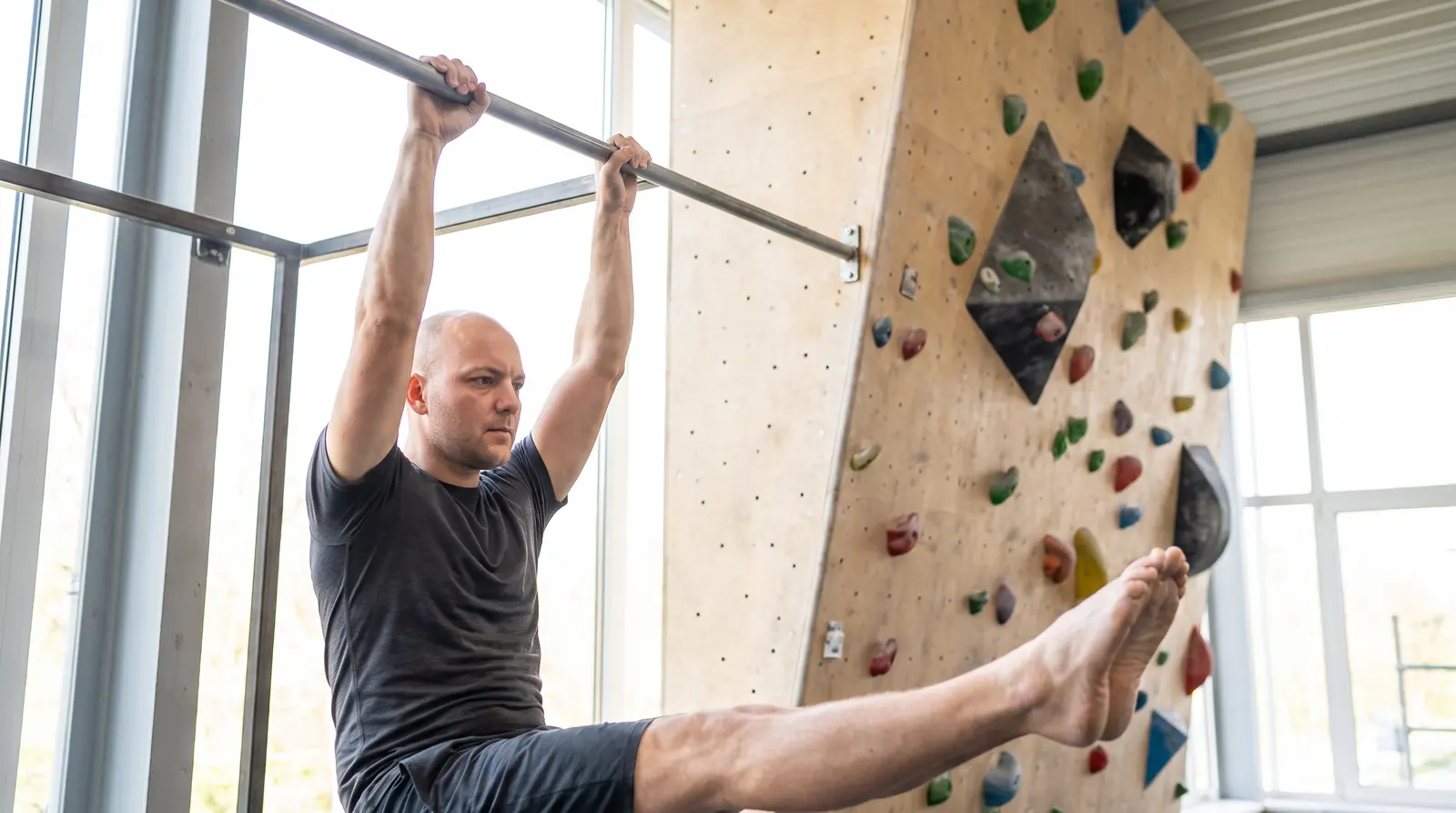
How: Hang from a bar or big jugs with shoulders engaged. Lift your knees towards your chest by curling the pelvis up, then lower slowly without swinging.
Regression: knee raises, or raises on a captain's chair. Progression: straight-leg raises to hip height.
Why: Hip flexion strength while hanging, the closest gym match to getting your feet back on the wall.
7. Toes-to-bar
How: From a dead hang, lift straight legs until your toes touch the bar, then lower with control.
Regression: leg raises to hip height. Progression: slower lowering, pauses at the top.
Why: Full-range compression strength for high feet and toe hooks.
8. Windshield wipers
How: Lying on your back with arms out, lift your legs to vertical and lower them to one side and back, then to the other. The hanging version starts with your toes at the bar and rotates the legs from side to side.
Regression: floor version with bent knees. Progression: straight legs, then the hanging version.
Why: Controlled rotation and anti-rotation under load.
9. Front lever progressions
How: From a hang, pull your shoulder blades down and lean back until your body is horizontal, then hold. Build up through stages:
- Tuck front lever: knees pulled to chest, back flat.
- Advanced tuck: back flat, hips extended so the thighs are at 90° to the torso.
- One-leg front lever: one leg straight, the other tucked.
- Straddle front lever, then full front lever.
Why: It trains the lats and the whole front of the body together, much like keeping your feet on in a steep roof. It is demanding on the shoulders, so add it based on how your shoulders tolerate it and how much pulling strength and control you have on the easier hanging exercises, not after a set number of weeks.
10. Foot lifts on the wall
How: On a steep board or overhang, hang from two good holds and lift your feet to a foothold, place them with control, hold for a second, then lower. This is close to the body-lift test used in Saeterbakken's study, which progressed through more reps, steeper walls and higher hand positions.
Regression: lower foothold, less steep wall. Progression: steeper angle, smaller footholds, straight legs.
Why: It is the most climbing-specific exercise on the list.
A 15–20 minute core routine for climbers
Do this twice a week. In Saeterbakken's study, climbers did 3–4 sets of four exercises at roughly a 4–10 rep max effort, with 2 minutes of rest. The routine below uses a similar structure but in a shorter circuit format to fit after a climbing session.
| Exercise | Level 1 (beginner) | Level 2 (intermediate) | Level 3 (advanced) |
|---|---|---|---|
| A. Anti-extension | Dead bug, 3 × 6–8 per side | Hollow hold, 3 × 20–30 s | Ab wheel rollout, 3 × 6–10 |
| B. Hanging | Hanging knee raise, 3 × 6–10 | Hanging leg raise, 3 × 6–10 | Toes-to-bar, 3 × 5–8 |
| C. Anti-rotation | Side plank, 3 × 20–30 s per side | Pallof press, 3 × 8 per side (2 s hold) | Hanging windshield wipers, 3 × 4–6 per side |
| D. Climbing-specific | Foot lifts on a moderate wall, 3 × 4–6 | Tuck front lever, 3 × 8–12 s | Advanced tuck or one-leg front lever, 4 × 6–10 s |
Format: do A and B as a pair, resting about 60–90 seconds between rounds, then C and D the same way. That takes about 15–20 minutes.
Progression: when you reach the top of the rep or time range on all sets with good form, add reps or seconds the next week. Once you are comfortably above the range, move that exercise to the next level. In the 2018 study, climbers progressed after completing the maximum reps or hold time in their final set, which is a sensible rule.
How to fit core training around climbing
- After climbing is usually best. Your trunk muscles hold you on the wall. Tiring them before a hard session makes body tension worse when you need it.
- Use easy core work as part of a warm-up. A few dead bugs or a short hollow hold are fine before climbing. Save hanging and front lever work for later.
- Count hanging exercises as upper-body load. Toes-to-bar and front levers also load your fingers, shoulders and elbows. On a heavy finger-training day, choose floor-based exercises instead.
- Pair it with your strength sessions. If you lift, add two core exercises to each session, as in our weight training for climbers program.
- Balance the front with the back. Hanging and compression exercises keep your hips flexed. Add hip mobility from our stretching for climbers guide and back and shoulder work from antagonist training.
The bottom line
For climbers, core means body tension: resisting extension and rotation, and pulling the legs up to the hands. Train it twice a week for 15–20 minutes with a mix of holds and dynamic exercises, progress from floor work to hanging work, and do it after climbing or on rest days. It will not replace pulling strength or technique, but it makes steep climbing feel a lot more controlled.
FAQ
Does core strength matter for bouldering?
Yes, but it is a secondary factor rather than the main one. In a study of 77 climbers, core-body endurance was among the secondary determinants of climbing ability, behind shoulder power and endurance. Core strength matters most on steep terrain, where you need body tension to keep your feet on the wall.
How often should climbers train core?
Twice a week is a practical starting point, although an optimal dose is unknown. In a 10-week study, highly trained climbers did core training twice a week in 30–40 minute sessions: the isometric group improved a climbing-specific body-lift test and the dynamic group improved general core strength tests. The study had no non-training control group and did not measure climbing grades.
Are planks good for climbers?
Planks and side planks are a good starting point because they train the trunk to resist unwanted movement. Once you can hold them comfortably, move on to harder anti-extension work like the ab wheel and to hanging exercises, which are closer to what you do on steep climbs.
Should I train core before or after climbing?
Usually after climbing, or on a rest day. A few easy core exercises can be part of a warm-up, but hard core work before climbing tires the muscles you need for body tension on the wall.
Sources
- Saeterbakken AH, Loken E, Scott S, Hermans E, Vereide VA, Andersen V. Effects of ten weeks dynamic or isometric core training on climbing performance among highly trained climbers. PLoS ONE (2018)
- MacKenzie R et al. Physical and Physiological Determinants of Rock Climbing. International Journal of Sports Physiology and Performance (2020)
- Oliva-Lozano JM, Muyor JM. Core Muscle Activity during Physical Fitness Exercises: A Systematic Review. International Journal of Environmental Research and Public Health (2020)