Stretching for Climbers: The Mobility You Need and a 15-Minute Routine
 Petr Hess, strength & conditioning coach
Updated 2 Nov 2026 · 9 min read
Key takeaways
Best for: Climbers whose hips, hamstrings or shoulders limit their moves
- Climbers need usable range in hip turnout and flexion, hamstrings, overhead reach, upper back and wrists, not splits.
- Do dynamic drills before climbing and keep long static holds for after the session or a separate mobility slot.
- One review found static holds of 60 seconds or more cut performance by about 4.6% when tested minutes later.
- Strength training through a full range improved mobility about as much as stretching, so open the range, then load it.
- A 15-minute routine three times a week is a sensible start; stop for sharp, pinching or tingling pain.
Climbers don't need splits or a yoga-teacher back bend. They need usable mobility in a few specific places: hips that open sideways (turnout) and fold high for high steps, hamstrings that let you reach a foothold near your hand, shoulders that reach fully overhead, a mobile upper back and healthy wrists. Do a dynamic warm-up before you climb, keep longer static stretching for after the session or a separate mobility slot, and train flexibility actively so you can use it on the wall. A 15-minute routine three times a week is a sensible starting point; adjust it to your body and your progress.
I'm a strength and conditioning coach, not a climbing coach or physiotherapist. This guide applies general mobility principles and the research cited at the bottom to the positions climbing asks for. Mobility is one piece of the puzzle; for the bigger picture on progressing, see how to get better at bouldering.
What mobility do climbers actually need?
Flexibility in climbing is very specific. In a 2020 study of 60 elite male sport climbers (7b to 9a), simple straddle tests of hip abduction (sitting and standing with legs wide) correlated with climbing level, while several climbing-specific flexibility tests didn't. The authors concluded flexibility is hard to diagnose in climbing "but it should be developed". These are correlations in one group of elite men, so they don't prove that stretching will raise your grade. Which ranges matter most depends on the moves you climb; the table below covers the common ones.
| Area | What it lets you do | Typical sign it's limiting you |
|---|---|---|
| Hip abduction and external rotation (turnout, frog) | Get your hips close to the wall on vertical and slab, stem, bridge wide, frog up | Hips stay far from the wall, you over-grip to stay on |
| Hip flexion (high steps) | Put a foot near your hip and stand up on it | You skip high footholds or "pull" instead of pushing |
| Hamstrings | High steps with a straight-ish leg, heel hooks, toe hooks | Pelvis tucks and the back rounds when you reach a high foot |
| Shoulder flexion (overhead) | Reach high with a straight arm and engaged shoulder | Lower back arches or ribs flare when you reach |
| Thoracic spine (upper back) | Rotate and extend for twisting moves and long reaches | Neck and lower back do all the twisting |
| Wrists and forearms | Slopers, mantels, palming, pressing | Wrist pain on mantels or when pressing down |
If you want to know which muscles do the work in each of these positions, our guide to what muscles bouldering works breaks it down.
Dynamic before climbing, static after: what the evidence says
The old advice to never stretch before sport has been refined. A 2016 systematic review by Behm and colleagues found that, when people were tested a few minutes after stretching, static stretching reduced performance by about 3.7% on average, PNF stretching by about 4.4%, while dynamic stretching improved it by about 1.3%. The dose mattered: holds of 60 seconds or more per muscle group cost about 4.6%, shorter holds about 1.1%. When stretching was followed by dynamic activity, as in a normal warm-up, there was no clear effect on performance.
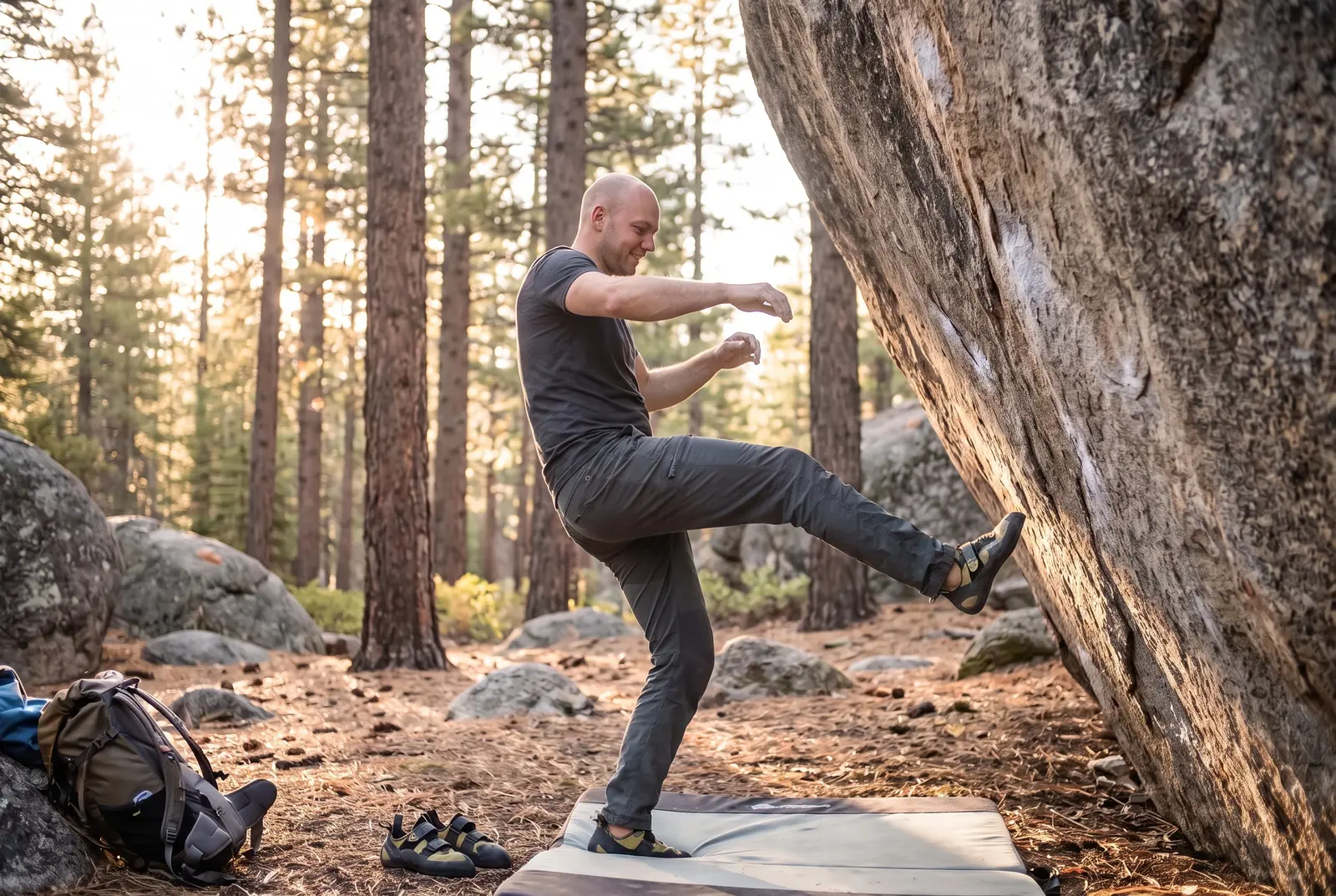
A 2019 review by Chaabene, Behm and colleagues reached the same practical conclusion: short static stretching (60 seconds or less per muscle group) has only trivial effects on strength and power and can sit inside a full warm-up, while longer holds cause meaningful drops. Stretching also didn't clearly prevent all-cause or overuse injuries in the 2016 review, and the immediate range-of-motion gain from one session usually lasted under 30 minutes.
For climbers, that means:
- Before climbing: raise your temperature, move joints through their range with dynamic drills, then climb easy and build up. Short static holds for a tight hip are fine if you follow them with movement. Our climbing warm-up has a full routine, so I won't repeat it here.
- After climbing or on separate days: this is where longer holds belong, when you are warm and no longer need maximal power.
Active vs passive flexibility
Passive flexibility is how far a joint can go with help: gravity, your hands, a partner. Active flexibility is how far you can move it using your own muscles. On the wall, active range usually matters most, although passive range still sets your ceiling, and body weight or momentum can push you into it. Getting a foot up to a hip-high hold, then pressing on it, needs strength at the end of your hip range, not just a loose hamstring.
Two pieces of research help here. A 2024 meta-analysis by Konrad and colleagues (77 studies) found that stretch training produces a moderate increase in range of motion, and that static and PNF stretching beat ballistic and dynamic stretching for long-term gains. Volume, intensity and frequency didn't clearly change the result, which suggests consistency matters more than a perfect protocol. Separately, a 2021 meta-analysis by Afonso and colleagues found that strength training through a full range improved range of motion about as much as stretching, for both active and passive measures.
The S&C takeaway: combine both. Use static holds to open the range, then load it. Deep goblet squats, Cossack squats, Romanian deadlifts and overhead presses all build strength in the ranges climbers use. For trunk control in those positions (keeping feet on in a steep high step, for example), add the work from our core exercises for climbing.
10 stretches and mobility drills for climbers
Doses are starting points for healthy adults. Stretch to a strong but tolerable tension, never sharp pain, tingling or pinching in the joint.
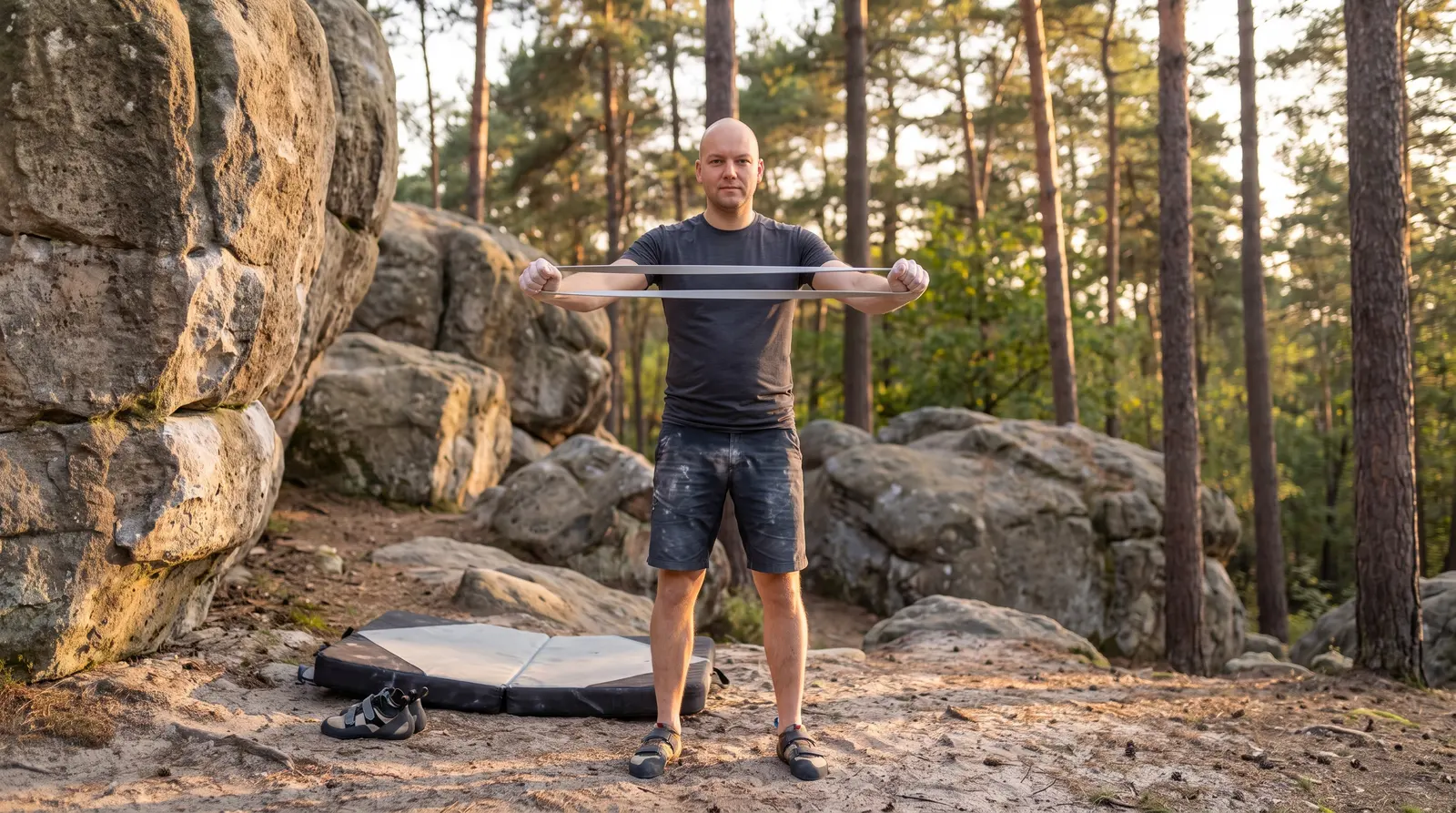
1. Frog stretch (hip abduction and turnout)
Kneel on all fours on a mat, slide your knees wide with feet in line with knees and ankles flexed, then rock your hips slowly back toward your heels. Keep your back long. Dose: 2 × 30–60 s, or 10 slow rocks then a 30 s hold.
2. 90/90 hip switches (hip rotation)
Sit with both knees bent at 90 degrees, one leg in front, one to the side. Sit tall, then rotate both knees to the other side without using your hands if you can. Pause and lean gently over the front shin for a stretch. Dose: 2 × 8 switches, then 20–30 s each side.
3. Cossack squat (active adductors and turnout)
Stand with feet wide, shift into one bent knee while the other leg stays straight with toes up. Keep the heel down. Hold a counterweight in front if balance is hard. Dose: 2 × 5 each side, slow.
4. Deep goblet squat hold (hip flexion and high steps)
Hold a light weight at your chest and sit into a deep squat, using your elbows to push your knees out. Shift side to side. Dose: 3 × 30–45 s.
5. Active high-step lift (active hip flexion)
Stand facing a box or bench at about knee to hip height. Without leaning back or using your hands, lift one foot onto it and press through to stand up slowly. Raise the height as it gets easier. This builds strength in a pattern similar to a high step; balance and positioning still need practice on the wall. Dose: 2 × 5 each side.
6. Hamstring stretch with a strap (hamstrings)
Lie on your back, loop a strap around one foot and raise the straight leg until you feel the back of the thigh. Keep the other leg flat. For an active finish, let go of the strap and try to hold the leg up for 5 s. Dose: 2 × 30–60 s each side, plus 3 active holds.
7. Wall or bench thoracic extension (upper back, overhead)
Kneel in front of a bench, elbows on the edge, hands together behind your head. Sit your hips back and let your chest sink toward the floor while keeping your ribs down. Dose: 5 slow breaths, 3 rounds.
8. Open book (thoracic rotation)
Lie on your side, hips and knees bent to 90 degrees, arms straight in front. Open the top arm across your body toward the floor behind you, following it with your eyes, keeping your knees together. Dose: 8 slow reps each side.
9. Wall slides or overhead reach (shoulder flexion)
Stand with your back against a wall, low back gently pressed in, forearms on the wall. Slide your arms up overhead as far as you can without your back arching off the wall. Dose: 2 × 10 slow reps. Pair this with the pressing and rotator-cuff work in our antagonist training guide so you build strength at the top of the range, not just length.
10. Wrist and forearm flexor/extensor stretch
Kneel and place your palms on the floor, fingers pointing toward your knees. Gently lean back until you feel the forearms. Then turn your hands over (backs of the hands down) and repeat. Dose: 2 × 20–30 s each position, plus 10 slow wrist circles. Keep it gentle: forearm tissues are already loaded heavily by climbing.
The 15-minute routine (3x per week)
Do this after a climbing session, after a strength session, or on its own on a rest day. Don't do the long holds just before a hard bouldering session.
| Block | Drill | Dose | Time |
|---|---|---|---|
| Hips (7 min) | 90/90 hip switches | 2 × 8 + 20 s hold each side | 2 min |
| Frog stretch | 2 × 45 s | 2 min | |
| Cossack squat | 2 × 5 each side | 1.5 min | |
| Deep goblet squat hold | 2 × 40 s | 1.5 min | |
| Hamstrings (2 min) | Strap hamstring stretch + active holds | 45 s + 3 × 5 s each side | 2 min |
| Upper back and shoulders (4 min) | Bench thoracic extension | 3 × 5 breaths | 1.5 min |
| Open book | 8 each side | 1.5 min | |
| Wall slides | 1 × 10 | 1 min | |
| Wrists (2 min) | Wrist flexor/extensor stretch | 2 × 20 s each position | 2 min |
On one of the three days, swap the frog and squat hold for the active high-step lift to train strength at end range. Add the high step to your strength day if you have one.
How to fit mobility into your climbing week
- Little and often is easiest to stick with. Range-of-motion gains come from regular practice over weeks and months, and they fade if you stop.
- Use the wall too. Easy climbing with deliberate high steps, drop knees and wide stems is active mobility training. Pick a few easy problems at the end of a session and climb them while experimenting with hip position, for example getting your hips close to the wall on vertical and slab terrain.
- Prioritise your limiter. If your hips are fine but you can't reach overhead without arching, spend more of your 15 minutes on the shoulder and upper-back block.
- Test every 4–6 weeks. A straddle sit (how close you can lean your chest toward the floor with legs wide), a deep squat and a wall-slide check are simple ways to see progress.
Yoga for climbers
Yoga works well for many climbers because poses like lizard, pigeon, low lunge, wide-legged forward fold and downward dog cover the hip, hamstring and overhead positions in this article. The slow holds are static stretching, so the same timing rule applies: a yoga class fits best on rest days or after climbing, not just before a hard session. If you choose yoga, keep some strength work alongside it so the new range is also controlled range.
When to get help
Stretching should feel like tension in the muscle, not pain in the joint. See a physiotherapist or doctor if a stretch causes sharp, pinching or deep joint pain (common in the hip or shoulder), if you feel tingling or numbness, or if a joint feels unstable or "clicks" with pain. Those are signs to assess, not to stretch harder. Read our medical disclaimer for more.
FAQ
Should climbers stretch before or after climbing?
Before climbing, use a dynamic warm-up: leg swings, arm circles, easy climbing. Short static holds of under about 60 seconds per muscle are fine if dynamic work follows, but long holds right before hard efforts can cost a few percent of strength and power. Longer static stretching fits best after the session or as a separate mobility session.
Is yoga good for climbers?
It can be. Many yoga poses train exactly the ranges climbers use, such as deep hip flexion, hip rotation and overhead reach, and the slow holds count as static stretching. It works best as an extra session or a cool-down, not as a replacement for a proper warm-up or for strength training.
How often should climbers stretch to get more flexible?
Consistency matters most. A 2024 meta-analysis of 77 studies found that stretch training clearly improves range of motion, and that static and PNF stretching beat dynamic stretching for long-term gains. Two to four short sessions a week, kept up for months, is a sensible target.
Does strength training make you less flexible?
No. A 2021 meta-analysis found strength training through a full range of motion improved flexibility about as much as stretching did. Deep squats, Romanian deadlifts and split squats are good mobility work for climbers.
Sources
- Behm DG, Blazevich AJ, Kay AD, McHugh M. Acute effects of muscle stretching on physical performance, range of motion, and injury incidence in healthy active individuals: a systematic review. Appl Physiol Nutr Metab (2016)
- Chaabene H, Behm DG, Negra Y, Granacher U. Acute Effects of Static Stretching on Muscle Strength and Power: An Attempt to Clarify Previous Caveats. Frontiers in Physiology (2019)
- Konrad A, et al. Chronic effects of stretching on range of motion with consideration of potential moderating variables: a systematic review with meta-analysis. J Sport Health Sci (2024)
- Afonso J, et al. Strength Training versus Stretching for Improving Range of Motion: A Systematic Review and Meta-Analysis. Healthcare (2021)
- Draga P, et al. Importance and Diagnosis of Flexibility Preparation of Male Sport Climbers. IJERPH (2020)