Bouldering Terms: A Plain-English Glossary of Climbing Slang
 Petr Hess, strength & conditioning coach
Updated 2 Nov 2026 · 10 min read
Key takeaways
Best for: Newcomers puzzled by bouldering slang and gym jargon
- The glossary explains 88 common bouldering terms in plain English, grouped into moves, holds, grades, gym and training.
- A flash is a first-try send with beta, an onsight is first try with no information; a send covers both.
- A flag holds a leg out for balance and is the simplest cure for a barn door.
- Grades are consensus opinion, not measurement; Mountain Project's chart roughly puts V3 at Font 6A and V6 at 7A.
- Campus, max hangs and full crimp describe some of the highest finger loads, so build finger load gradually.
Bouldering has its own language: you "work your project", "get the beta", "flag" to stop a "barn door" and finally "send". This glossary explains 88 of the most common bouldering terms and pieces of climbing slang in plain English, grouped by theme, with one practical note for each so you know how the word shows up on the wall.
If you're brand new, start with the Grades & ascents and Gym & outdoor sections; they're the words you'll hear in your first session. Our guide on how to start bouldering puts many of them into context. Terms vary a little between countries; where US and UK or European usage differs, I've noted it.
Moves and body positions
| Term | What it means | Practical note |
|---|---|---|
| Barn door | Your body swings open sideways like a door because your points of contact are lined up on one axis. | Fix it with a flag, a drop knee or a different foot. |
| Bicycle | One foot pushes down on a hold while the other toe hooks it from below, like pedals. | Useful on roofs and steep starts to keep feet on. |
| Campus / campusing | Climbing with hands only, feet off the wall. | Hard on fingers and shoulders; not a beginner habit. |
| Compression | Squeezing two features towards each other, "like hugging a fridge". | Engage your core and pull inwards with both arms. |
| Cut loose | Your feet swing off the wall on steep terrain and you hang by your hands. | Brace your core to get your feet back on quickly. |
| Deadpoint | A controlled dynamic move: you grab the next hold at the top of your upward motion, while still in contact with other holds. | Aim to catch the hold at the moment you feel "weightless". |
| Drop knee (Egyptian) | Turning one knee inwards and down so the hip twists into the wall, adding reach. | Great on steep walls, but it twists the knee; ease into it. |
| Dyno | A jump to a hold out of reach, usually with all limbs leaving the wall. | Practise low over good pads: check where you'll fall, clear the landing and learn to land under control before trying bigger ones. |
| Edging | Standing on a small foothold with the edge of your shoe. | Use the inside edge near the big toe for most footholds. |
| Elvis legs | Involuntary shaking of a leg from fatigue or nerves (also "sewing-machine leg"). | Drop your heel and breathe; it often stops. |
| Flag / flagging | Holding a leg out for balance instead of standing on a hold. | The simplest cure for a barn door. |
| Heel hook | Using the back of your heel on a hold to pull or balance. | Pull with the hamstring to take weight off your arms. |
| Knee bar | Pushing a foot against one feature and the knee or lower thigh against another, so you can rest or free your hands. | Common outdoors; some climbers wear knee pads for it. |
| Layback (lieback) | Pulling sideways on an edge or crack with both hands while the feet push the opposite way. | Strenuous; move quickly through it. |
| Lock-off | Holding your body in place with one bent arm while the other reaches. | Strong lock-offs help static climbing on reachy moves. |
| Mantle | Pressing down on a hold or ledge with your palms until you can stand on it. | Essential for topping out outdoors. |
| Match | Bringing both hands (or a hand and a foot) onto the same hold. | Leave room for the second hand when you first grab. |
| Pop | A small, quick jump or fast hand movement to the next hold. | Smaller and more controlled than a full dyno. |
| Rose move | Crossing one arm behind the other so far that your body twists to face away from the wall. | Named after a 1985 route; looks wild, often efficient. |
| Shadow match | Quickly switching hands on a hold that only fits one hand. | Lift fingers one at a time as the other hand slides in. |
| Smear | Pressing your shoe sole flat on the wall where there's no real hold, relying on friction. | Drop your heel and keep your weight over the foot. |
| Static | Moving slowly and in control, without momentum. | Good for technique practice; not always the most efficient. |
| Stem / bridge | Pushing outwards with feet (and hands) on opposite walls of a corner. | A no-hands rest in corners if you find good feet. |
| Toe hook | Pulling with the top of your toes under a hold to keep your body in. | Key on overhangs; pull your toes up towards your shin so the top of the shoe bites. |
Holds
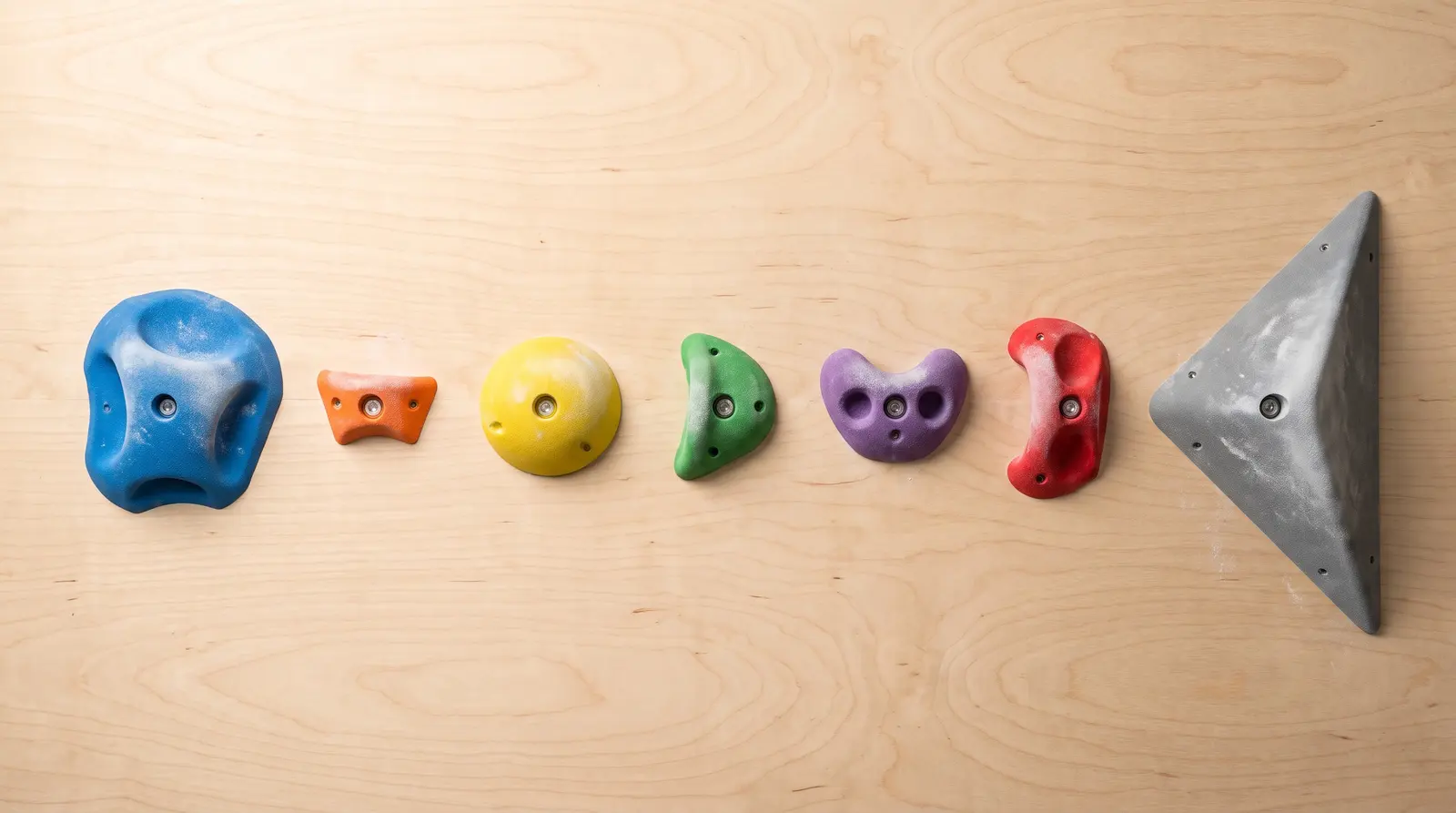
For how to grip each one, see our full guide to types of climbing holds.
| Term | What it means | Practical note |
|---|---|---|
| Arête | An outside corner or ridge of rock or wall. | Squeeze it like a pinch; "arête in" vs "arête off" rules vary per problem. |
| Crimp | A hold just big enough for your fingertips, or the way of gripping it with bent fingers. | Full crimping loads finger pulleys most; half crimp when you can. |
| Edge | A flat ledge, for hands or feet. | Edges vary in size and sharpness; small ones are usually called crimps. |
| Flake | A slab of rock partly detached from the face. | Test it outdoors; some are loose. |
| Gaston | A vertical hold gripped thumb down, elbow out, pushing outward. Named after Gaston Rébuffat. | Needs strong shoulders and good opposing feet. |
| Jug (bucket) | A big, easy hold you can wrap your hand around. | Rest and plan on jugs. |
| Lid | A hold placed to cover part of another, making it worse. | A setter's tool for adjusting difficulty. |
| Mono | A pocket that fits one finger. | High load on one finger; treat with care. |
| Pinch | A hold you squeeze between thumb and fingers. | Thumb strength is often the limiter. |
| A hole that fits one to three fingers. | Use your strongest fingers that fit; keep them neutral. | |
| Sidepull | A vertical hold you pull sideways towards your body. | Lean away and push with the opposite foot. |
| Sloper | A rounded hold without a lip. | Stay low under it with straight arms. |
| Undercling (undercut) | A hold facing downward that you grip palm up. | Get your feet high and stand up. |
| Volume | A large hollow shape bolted to a gym wall, often with holds on it. | Stand on it, palm it, press it. |
Grades and ascents: flash, onsight, send, project, repeat
For how the scales compare, read climbing grades explained.
| Term | What it means | Practical note |
|---|---|---|
| Benchmark | A problem considered typical for its grade. | On training boards, benchmarks are the reliable grades. |
| Crux | The hardest move or section; it usually sets the grade. | Work the crux in isolation, then link into it. |
| Dab | Touching the ground, pad, spotter or an off-route hold during an attempt. | A dab means it wasn't a clean send. |
| Downgrade / upgrade | Lowering or raising a climb's grade after more people have climbed it. | Grades settle over time; first grades are guesses. |
| Eliminate | A problem where some holds are declared off limits. | Agree the rules before you start. |
| FA (first ascent) | The first time anyone climbs a problem. | The first ascensionist usually proposes the grade and name. |
| Flash | Sending first try, but with beta (you watched someone or saw a video). | A good test of whether you've outgrown a grade. |
| Font grade | The European bouldering scale (4, 5, 6A … 9A), from Fontainebleau. | Capital letters (7A) for boulders, lowercase (7a) for routes. |
| Grade | A rating of how hard a climb is. | Consensus opinion, not a measurement. |
| Morpho | A problem whose difficulty depends heavily on body size or reach. | Different body, different beta. |
| Onsight | Sending first try with no prior information at all. | The purest style; rare in gyms where you see others climb. |
| Project | A climb you work over several sessions before sending. | Projecting slightly above your level is a great way to improve. |
| Redpoint | Sending after previous attempts or practice. The term comes from route climbing. | In bouldering people usually just say "send". |
| Repeat | Climbing a problem someone else has already done. | Repeats are how grades reach consensus. |
| Sandbag | A climb that's harder than its grade. | Can come from conservative grading or a hidden trick move. |
| Send | Completing a climb without falling. Also shouted as encouragement. | Covers onsight, flash and redpoint. |
| Soft | A climb that's easier than its grade. | Don't judge your level by one soft tick. |
| V grade | The North American bouldering scale (VB, V0 … V17). | Roughly, Mountain Project's chart puts V3 at Font 6A and V6 at 7A. |
Gym and outdoor terms
| Term | What it means | Practical note |
|---|---|---|
| Allez | French for "go!", shouted to encourage a climber worldwide. | "Gamba!" is the Japanese equivalent. |
| Beta | Information on how to do a problem: sequence, holds, body positions. | Ask for it, or don't; it's your choice. |
| Beta spray | Giving beta nobody asked for. | Ask first. More in our bouldering etiquette guide. |
| Boulder / problem | A short climb without a rope; "problem" is the sequence of moves on it. | Indoors, problems are marked by hold colour or tags. |
| Chalk | Magnesium carbonate powder that dries your hands and improves friction. | Brush off excess chalk and tick marks after you climb. |
| Chipping | Altering rock with tools to create holds. | Strongly condemned by climbers. Don't. |
| Choss | Loose or rotten rock. | Test holds before weighting them outdoors. |
| Circuit | A set of problems sharing a colour and difficulty, indoors or at Fontainebleau. | See Fontainebleau grades and circuits. |
| Comp style | Modern competition-style problems with big volumes and dynamic or coordination moves. | Fun for movement skills, less about finger strength. |
| Crash pad | A portable foam mat placed under a boulder to cushion falls. | Move it as the climber moves; cover the gaps. |
| Downclimb | Climbing back down instead of jumping or falling. | Downclimbing from the top saves your knees and ankles. |
| Highball | A tall boulder where a fall is serious; sources put it at roughly 5 m (16 ft) and up. | Pads and spotters don't make a bad fall safe. Check the landing, the way down and what every fall would mean, not just the grade. |
| Landing | The ground below a boulder. | Check it for rocks and roots before the first attempt. |
| Overhang / roof | A wall steeper than vertical; a roof is close to horizontal. | Keep your feet on with toe hooks and core tension. |
| Reset / setting | Stripping a gym wall section and setting new problems on it. | Finish your projects before the reset date. |
| Sit start (SDS) | A problem that starts sitting on the ground or pad. | Common outdoors; makes the first move harder. |
| Slab | A wall less steep than vertical; it's about balance, footwork and smearing. | Trust your feet and keep your hips out. |
| Spot / spotter | A partner who guides your fall onto the pad, protecting head and back. | Mostly needed outdoors. Learn how to fall bouldering too. |
| Spray wall | A wall covered in holds where climbers make up their own problems. | Great for training specific weaknesses. |
| Top / top out | Top: the finish hold, usually controlled with both hands. Top out: climbing over the top of the boulder. | Many gym problems end on a top hold; outdoor ones usually top out. |
| Topo | A guidebook drawing or photo showing where the problems go. | Apps and printed guides both count. |
| Traverse | Climbing sideways rather than up. | Easy traverses are a classic warm-up. |
| Zone | In comps, a hold partway up that earns points; in some gyms, a wall section on the reset cycle. | Context tells you which one is meant. |
Training terms
| Term | What it means | Practical note |
|---|---|---|
| Antagonist training | Strengthening the muscles that oppose climbing's pulling, such as chest, triceps and shoulder rotators. | A strength coach's favourite: cheap, quick, balancing. |
| Board climbing | Training on a standardised, app-linked wall such as the Kilter, Moon or Tension board. | Compare them in Kilter vs MoonBoard vs Tension. |
| Campus board | A board of wooden rungs climbed without feet to build finger and lock-off strength. | Advanced tool; not for beginners. |
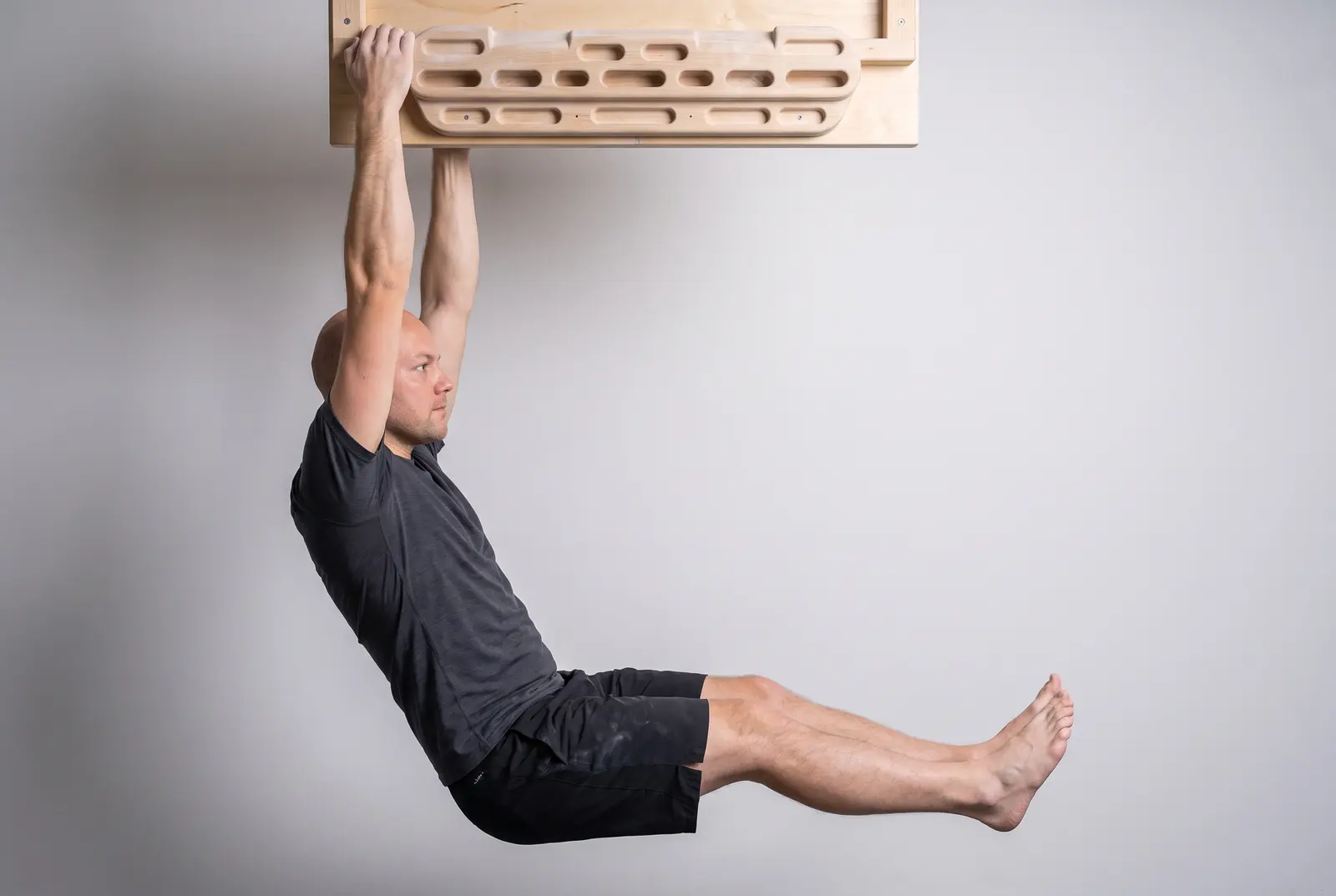
| Dead hang | Hanging still with straight arms: your fingers grip actively and your shoulders stay lightly engaged, but you don't pull up. | The base position for most hangboard exercises. |
| Hangboard (fingerboard) | A board with edges and pockets you hang from to train finger strength. | Follow a structured hangboard program. |
| Max hangs | Short hangs on an edge with near-maximal load, often with added weight. | Built for strength. See max hangs vs repeaters. |
| Pump / pumped | Forearms so fatigued you can barely hold on. | Shake out on good holds; rest more between attempts. |
| Repeaters | Intermittent hangs: short on-off cycles repeated in sets. | In one small 8-week study of advanced sport climbers, intermittent hangs gave larger average endurance gains than max hangs, but the difference between groups was not statistically significant. |
| Training board | Any adjustable or fixed wall built for finger strength and technique training. | Fixed hold layouts let you repeat and compare problems exactly. |
A few terms in context
Here's how the vocabulary sounds in real gym conversation:
- "I flashed the blue, but the purple is my project. The crux is a deadpoint off a sloper." Translation: first-try send on one problem (with beta); working a harder one where the hardest move is a dynamic catch on a rounded hold.
- "Flag your left leg or you'll barn door." Translation: hold your left leg out for balance or your body will swing open.
- "That V4 is a sandbag, it climbs like a V5." Translation: it's graded too easy.
- "No beta please, I want to onsight it." Translation: don't tell me how to do it.
Once these words feel natural, the next step is using them on the wall: read the problem, plan your beta, and project something just above your level.
FAQ
What does beta mean in bouldering?
Beta is information on how to climb a problem: the sequence of moves, which holds to use and how to position your body. Giving beta nobody asked for is called spraying beta.
What is the difference between a flash and an onsight?
Both mean climbing something first try. A flash means you had beta beforehand, for example from watching someone else or a video. An onsight means you had no prior information at all.
What does send mean in climbing?
To send is to complete a climb from start to finish without falling. Climbers also shout it as encouragement. A send can be an onsight, a flash or a redpoint after practice.
Why are boulders called problems?
A boulder problem is the sequence of moves needed to get up a particular line on a boulder or wall. Climbers treat it like a puzzle to solve, which is why the word problem stuck.
Sources
- Wikipedia, Glossary of climbing terms
- The Climbing Hangar, Bouldering Glossary: A whole new language
- Lacrux Climbing Magazine, Bouldering lexicon: These terms you should know (2025)
- Danaan Markey, Climbing Moves, Holds, & Technique: The Beginner's Guide, 99Boulders (2022)
- Mountain Project, International Climbing Grade Comparison Chart
- López-Rivera E, González-Badillo JJ. Comparison of the Effects of Three Hangboard Strength and Endurance Training Programs on Grip Endurance in Sport Climbers. J Hum Kinet (2019)