Climbing Grades Explained: V-Scale, Font, YDS and French Grades Compared
 Petr Hess, strength & conditioning coach
Updated 2 Nov 2026 · 9 min read
Key takeaways
Best for: Climbers comparing grades across gyms, crags and countries
- Bouldering mainly uses the V-scale (V0–V17) or Font scale (up to 9A); routes mostly use YDS or French grades.
- Grades are consensus opinions, not measurements, so every conversion between scales is only approximate.
- Font boulder grades use capitals (7A) and French route grades lowercase (7a); they are completely different scales.
- The V-scale is coarser in the middle grades, but above about V8 the two scales line up almost one to one.
- At a new gym or crag, start a grade or two below your usual level until you've calibrated to local grading.
Climbing grades are numbers or letters that describe how hard a climb is. Bouldering mostly uses the V-scale (V0 to V17, common in North America) or the Font scale (4 to 9A, common in Europe). Roped climbs mostly use the American YDS (5.0 to 5.15d) or the French sport scale (1 to 9c), with UIAA and British grades in some countries. All grades are consensus opinions, not measurements, so conversions between scales are only approximate.
Below you'll find how each scale works, a conversion chart built from one published source, how gyms grade, and why the same grade can feel easy in one place and brutal in the next. If you just want a quick lookup, use our climbing grade converter. If you're new to the vocabulary (send, flash, sandbag), keep our bouldering terms glossary open in another tab.
Why climbing grades exist (and why they're subjective)
Grades help you pick climbs that match your level, track progress and talk about difficulty with other climbers. They are not measured by any device. The first person to climb something suggests a grade, and over time it is adjusted to the "consensus view" of later ascents (Wikipedia, Grade).
That makes grades useful but fuzzy. A climb can feel hard for one person and easy for another because of:
- Body size and reach. A long move can be trivial for a tall climber and the crux for a short one.
- Style. Someone strong on crimps may find a "V4" crimp line easy and a "V3" sloper problem desperate.
- Conditions. Friction on rock changes with temperature and humidity.
- Local tradition. Some areas and gyms grade stiffly, others generously.
Even within one grade there's a spread. As 99Boulders puts it, there are "hard" V7s and "soft" V7s. Treat any single grade as a rough band, not a precise value.
Bouldering grades: V-scale and Font
V-scale (Hueco scale)
The V-scale was first published in 1991 by John "Verm" Sherman in his guidebook to Hueco Tanks, Texas; the "V" comes from his nickname (Wikipedia, Grade; 99Boulders). It is open-ended, starts at V0 and currently goes up to V17. An easier "VB" (sometimes written V-easy) is used for beginner problems. You'll also see split grades like V3-4 and plus or minus signs (V5+) when a problem sits between grades.
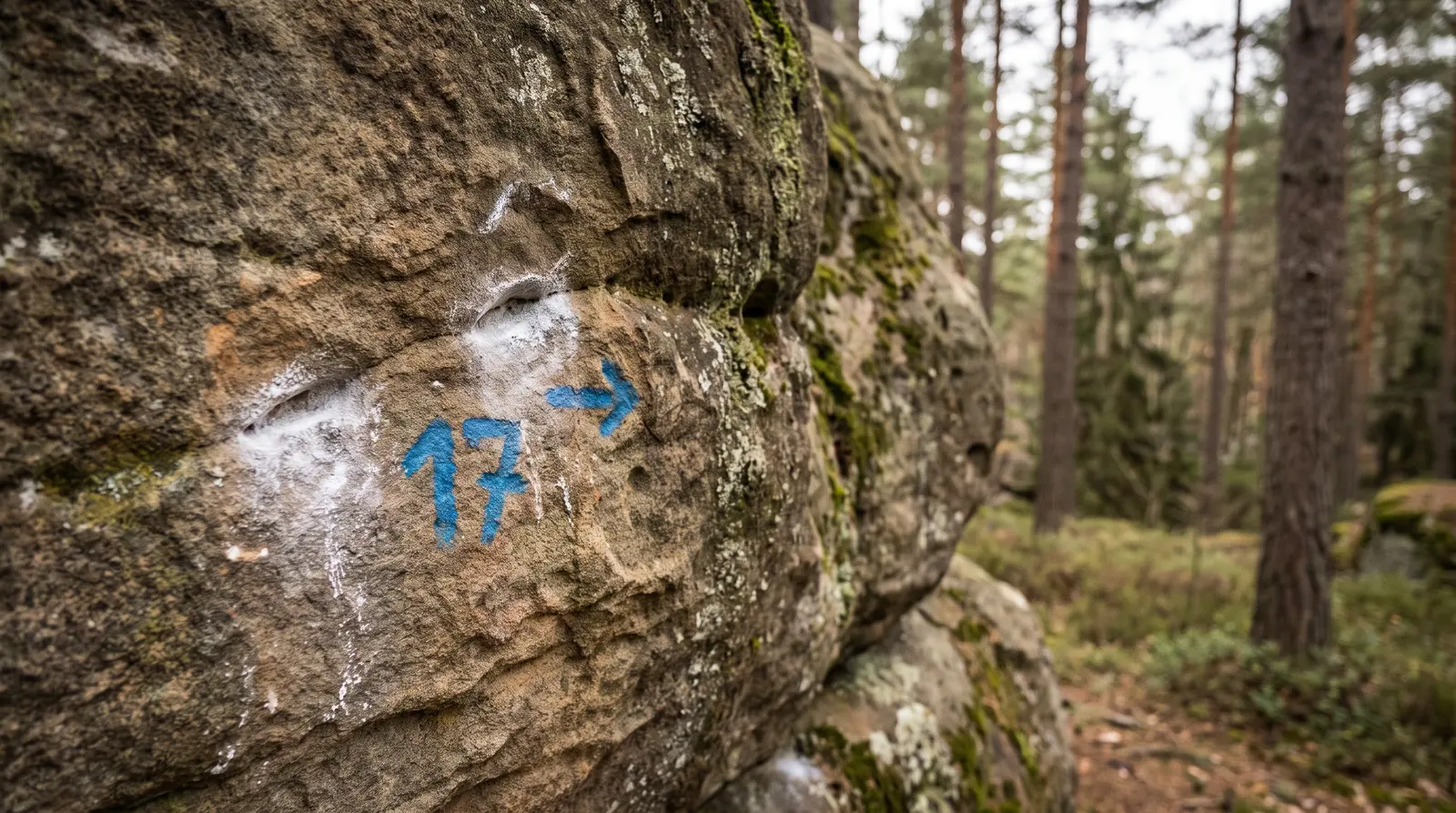
The V-scale is used across North America, and 99Boulders notes it is also popular in South America, Southeast Asia and Oceania.
Font scale (Fontainebleau)
The Font scale comes from the Fontainebleau forest near Paris and dates back to at least 1960 (Wikipedia, Grade). It starts at 1, though problems easier than 3 are rarely found. Up to grade 5 it uses numbers with an optional "+"; from 6 upwards each number splits into A, B and C, each with an optional "+": 6A, 6A+, 6B, 6B+, 6C, 6C+, 7A and so on, up to 9A today.
Font boulder grades are written with capital letters (7A) to separate them from French route grades (7a). They are completely different scales: Wikipedia gives the example that a Font 6C+ boulder is closer in effort to a French 7c route. For more on how the scale feels on its home rock, read Fontainebleau grades and circuits explained.
Route grades: YDS, French, UIAA and British
YDS (Yosemite Decimal System)
The YDS is the North American standard. It grew out of the Sierra Club class system and was adapted by climbers at Tahquitz Peak, California, in the 1950s (Wikipedia, Grade). Classes 1 to 4 describe hiking and scrambling; class 5 is technical roped climbing (Wikipedia, YDS):
| Class | Meaning |
|---|---|
| Class 1 | Hiking or running on a trail |
| Class 2 | Simple scrambling, hands used occasionally |
| Class 3 | Scrambling; a rope could be carried |
| Class 4 | Simple climbing, possibly with exposure; falls could be fatal |
| Class 5 | Technical roped free climbing with a belay |
Within class 5, the number after the decimal point rises with difficulty: 5.6, 5.7, 5.8, 5.9. From 5.10 the letters a, b, c and d split each number (5.10a, 5.10b … 5.15d). Note that 5.10 is harder than 5.9; it's not a decimal number. On trad routes, a suffix can warn about protection: R means inadequate protection with a risk of injury, and X means a fall could be very serious or fatal (Wikipedia, YDS).
French sport grades
The French scale is the dominant route scale in Europe and, together with the YDS, the most widely used worldwide. It was developed from the UIAA scale in the 1980s and uses numbers with a, b, c and "+" (5c, 6a, 6a+, 6b … 9c). It describes the overall difficulty of a route, including how sustained it is, not just the hardest move; it does not rate protection or danger, which is one reason it's also called the sport grade.
UIAA
The UIAA scale uses Roman numerals with "+" and "−" (V+, VI−, VI, VI+ …). It started as a closed I–VI scale, became open-ended in the 1980s, and is still popular in Germany, Austria, Switzerland, the Czech Republic, Slovakia and Hungary (Wikipedia, Grade).
British trad grades (briefly)
British trad routes get two grades, for example E4 6a. The first, adjectival grade (M, D, VD, S, VS, HVS, then E1, E2 …) describes overall seriousness, including protection, exposure and how sustained the route is. The second is a technical grade (4a, 4b, 4c, 5a …) for the hardest single move. British climbers often write French grades with an "f" prefix to tell them apart from British technical grades. A technical grade only describes the hardest move, so it can't reliably predict a French route grade. Australia and New Zealand use the Ewbank scale, plain numbers from 1 upwards.
Climbing grade conversion chart
The charts below are taken from the Mountain Project international grade comparison chart, which itself opens with the warning that "no conversion chart is perfect". Other published charts disagree by a grade or so in places, especially at the easy end, so use these as a guide, not a rulebook.
Route grades: YDS vs French vs UIAA vs British vs Ewbank
| YDS (USA) | French | UIAA | British (UK) | Ewbank (AUS/NZ) |
|---|---|---|---|---|
| 5.6 | 4c | V | S 4b | 14 |
| 5.7 | 5a | V+ | MVS 4b | 15 |
| 5.8 | 5b | VI− | HVS 4c | 16 |
| 5.9 | 5c | VI | HVS 5a | 17 |
| 5.10a | 6a | VI+ | E1 5a | 18 |
| 5.10b | 6a+ | VII− | E2 5b | 19 |
| 5.10c | 6b | VII | E2 5b | 20 |
| 5.10d | 6b+ | VII+ | E3 5b | 21 |
| 5.11a | 6c | VII+ | E3 5c | 22 |
| 5.11b | 6c | VIII− | E3 5c | 23 |
| 5.11c | 6c+ | VIII− | E4 6a | 24 |
| 5.11d | 7a | VIII | E5 6a | 24 |
| 5.12a | 7a+ | VIII+ | E5 6a | 25 |
| 5.12b | 7b | VIII+ | E5 6b | 26 |
| 5.12c | 7b+ | IX− | E6 6b | 27 |
| 5.12d | 7c | IX | E6 6b | 28 |
| 5.13a | 7c+ | IX+ | E6 6c | 29 |
| 5.13b | 8a | IX+ | E7 6c | 29 |
| 5.13c | 8a+ | X− | E7 7a | 30 |
| 5.13d | 8b | X | E8 7a | 31 |
| 5.14a | 8b+ | X+ | E8 7a | 32 |
| 5.14b | 8c | X+ | E9 7b | 33 |
| 5.14c | 8c+ | XI− | E9 7b | 34 |
| 5.14d | 9a | XI | E10 7c | 35 |
| 5.15a | 9a+ | XI+ | E11 7c | 36 |
| 5.15b | 9b | XII− | E11 8a | 37 |
| 5.15c | 9b+ | XII | E11 8a | 38 |
| 5.15d | 9c | XIII− | E11 8c | 39 |
The British column is the most approximate of all, because an E grade depends on protection and seriousness, not just difficulty. A safe route and a dangerous route with the same moves get different E grades.
Bouldering grades: V-scale vs Font
| V-scale | Font | V-scale | Font |
|---|---|---|---|
| VB (V-easy) | 3 | V7 | 7A+ |
| V0− | 4− | V8 | 7B |
| V0 | 4 | V8+ | 7B+ |
| V0+ | 4+ | V9 | 7C |
| V1 | 5 | V10 | 7C+ |
| V2 | 5+ | V11 | 8A |
| V3 | 6A | V12 | 8A+ |
| V3+ | 6A+ | V13 | 8B |
| V4 | 6B | V14 | 8B+ |
| V4+ | 6B+ | V15 | 8C |
| V5 | 6C | V16 | 8C+ |
| V5+ | 6C+ | V17 | 9A |
| V6 | 7A |
Notice the pattern: the V-scale is coarser in the middle grades, so two Font grades often share one V grade (6A and 6A+ are both "V3-ish"). Above about V8 the two scales line up almost one to one.
Can you convert boulder grades to route grades?
Only very loosely. A boulder grade rates a few hard moves; a route grade rates a sequence where endurance and clipping matter too. Wikipedia's comparison table lines V0 up with roughly 5.9 and French 6a/6a+, but you'll find other charts that disagree. One famous illustration: The Wheel of Life in Australia links many boulder problems into one long line and is graded V15 as a boulder but 9a as a route (Wikipedia, Grade). Use boulder and route scales side by side, not as substitutes.
How gyms grade their climbs
Indoor walls don't all follow the outdoor scales. You'll typically see one of three systems:
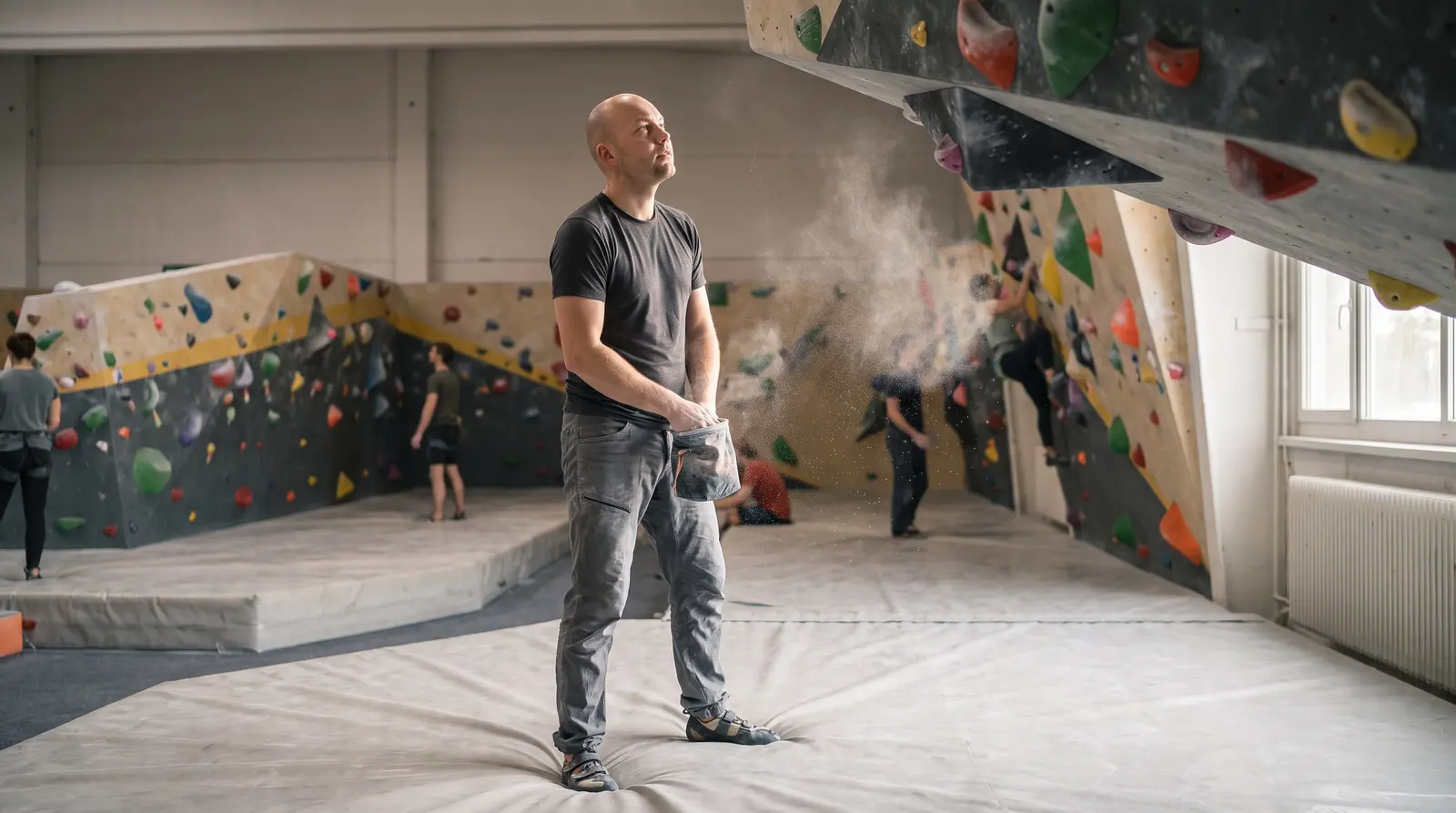
- V or Font grades on a tag. Common in North American gyms (V grades) and in many European gyms (Font grades).
- Colour circuits or ranges. Problems that share a colour form a circuit at a certain difficulty level (The Climbing Hangar). A circuit often covers a range, such as "green = roughly V1–V2", so problems in the same colour can vary quite a bit.
- House scales. Some gyms invent their own system, for example a 0–4 scale (99Boulders).
Grades are usually agreed by the setting team: as 99Boulders describes it, setters "get a consensus around a certain grade" and put it on the wall. That's why a V4 at one gym may feel like a V3 or a V5 at another. Many gyms also don't try to match outdoor difficulty. Wikipedia notes that for people with little outdoor experience, indoor boulder grades tend to feel softer than the same grades outside.
What grade does a beginner climb?
There is no official standard, but two reference points are useful:
- Bouldering (rough guide): 99Boulders groups V0–V2 (Font 4–5+) as beginner, V3–V5 (6A–6C+) as intermediate, V6–V8 (7A–7B) as advanced, V9–V12 as expert, and V13 and above as elite. The same guide notes that the vast majority of boulderers rarely climb V7 or harder indoors.
- Sport climbing (research categories): climbing researchers use the IRCRA scale to group ability levels. In a 2022 study of male sport climbers, "intermediate" was defined as French 5+ to 7a, "advanced" as 7a to 8a and "elite" as 8a+ to 8c, following the IRCRA recommendations (Vereide et al., 2022). The research scale sets different ranges for women.
If you're brand new, the easiest one or two colours at your gym (or VB–V0) are the natural place to start, and how fast you move up depends on how often you climb. If you're just beginning, our guide on how to start bouldering covers your first sessions.
From a strength-coach angle: studies link finger strength with climbing level; in one, elite sport climbers had higher finger peak force and rate of force development than advanced and intermediate climbers (Vereide et al., 2022). If you want to see how your fingers compare with climbers at different grades, look at our finger strength benchmarks. Use them as context, not as a target to chase before your tendons are ready.
Sandbagging and soft grades
A sandbag is a climb that's harder than its grade. It can happen because of overly conservative grading, a hidden "trick" move that is easy once you know it, or local tradition. A soft climb is the opposite: easier than its grade suggests.
Some common reasons grades drift:
- Local reputation. Some areas have a reputation for stiff grading, and Fontainebleau is the classic example; see our Fontainebleau bouldering guide before you go.
- Height and style. A reachy problem can be sandbagged for short climbers and soft for tall ones.
- Rising top grades vs. grade inflation. Wikipedia notes that top grades have risen across all forms of climbing, helped by better technique and equipment. That reflects better performance; grade inflation is something else: giving a higher grade to a climb of the same difficulty.
The healthiest attitude: grades are a shared language, not a verdict on you. If a "V3" feels impossible and a "V5" goes first try, that's normal.
Quick summary
| Scale | Used for | Where | Example |
|---|---|---|---|
| V-scale (Hueco) | Bouldering | North America, many gyms worldwide | V5 |
| Font | Bouldering | Europe, many gyms worldwide | 6C |
| YDS | Routes | North America | 5.11a |
| French | Routes (sport) | Europe and most of the world | 6c |
| UIAA | Routes | Germany, Austria, Switzerland, Central Europe | VII+ |
| British (E + tech) | Trad routes | UK | E3 5c |
| Ewbank | Routes | Australia, New Zealand, South Africa | 22 |
For quick conversions on the go, bookmark our grade converter, and remember that every conversion is an estimate.
FAQ
What is a 5.10 in French grades?
On the Mountain Project comparison chart, 5.10a is French 6a, 5.10b is 6a+, 5.10c is 6b and 5.10d is 6b+. Other charts shift some of these by a step, so treat any conversion as approximate.
Is V0 or VB easier?
VB is easier. It sits below V0 on the V-scale and is used for beginner problems; on the Mountain Project chart it lines up with Font 3, while V0 lines up with Font 4.
Why do gym grades feel easier than outdoor grades?
Gyms grade their own problems, often by setter consensus, and many do not try to match outdoor difficulty. Outdoor problems also demand skills like reading natural rock, finding feet and topping out. Several sources note that indoor boulder grades tend to feel softer than the same grade outside, especially for people with little outdoor experience.
What does sandbagged mean in climbing?
A sandbagged climb is harder than its official grade suggests, whether because of conservative grading, a trick move you only learn with experience, or a local habit of grading stiffly. The opposite is a soft grade.
Sources
- Mountain Project, International Climbing Grade Comparison Chart
- Wikipedia, Grade (climbing)
- Wikipedia, Yosemite Decimal System
- Alex Beale, Bouldering Grades: The Complete Guide, 99Boulders
- Vereide V, Andersen V, Hermans E, Kalland J, Saeterbakken AH, Stien N. Differences in Upper-Body Peak Force and Rate of Force Development in Male Intermediate, Advanced, and Elite Sport Climbers. Front Sports Act Living (2022)
- The Climbing Hangar, Bouldering Glossary: A whole new language