Best Via Ferrata Set: Lanyards, Full Kit and Safety Guide (2026)
 Petr Hess, strength & conditioning coach
Updated 2 Nov 2026 · 15 min read
Key takeaways
Best for: Anyone buying or renting gear for a first or regular via ferrata season
- Only use a certified EN 958 via ferrata set; slings or homemade setups have no energy absorber and can fail or injure your spine in a fall.
- Sets are rated for climbers from 40 kg body weight (without gear) up to 120 kg including gear; anyone under 40 kg body weight, which means most children, also needs a rope belay.
- A swivel and a rest loop make a big difference; the Edelrid Cable Comfort Tri, Petzl Scorpio Eashook SW and CAMP Gyro Rewind Pro lead independent comparisons.
- Replace the whole set once the absorber has deployed, and learn clipping and resting technique from a guide or Alpine Club course.
The best via ferrata set for most people is a current EN 958 lanyard with a compact energy absorber, two elastic arms, a swivel and a rest loop, rated for users from 40 kg body weight up to 120 kg including your gear. In the independent bergsteigen.com 2025 comparison, the Edelrid Cable Comfort Tri scored well in the most categories and the Petzl Scorpio Eashook was the lightest set with a swivel; CAMP's Kinetic Gyro Rewind Pro had the best anti-tangle swivel. A set is only one piece of the kit: you also need a climbing harness, a helmet, gloves and sturdy shoes, plus the skills to use them.
Whether you call it a via ferrata lanyard, a Klettersteigset or a kit ferrata, it's life-saving equipment, and this guide treats it that way. We haven't tested these sets ourselves. The picks come from manufacturer specs, the published comparisons by bergsteigen.com and Bergzeit, and safety guidance from the German Alpine Club (DAV), Edelrid and Petzl. Browse the rest of our climbing gear guides for the harness and helmet, and see our affiliate disclosure for how links work.
Prices and stock change often; the button opens the retailer or brand page so you can check today's price.
What is a via ferrata set?
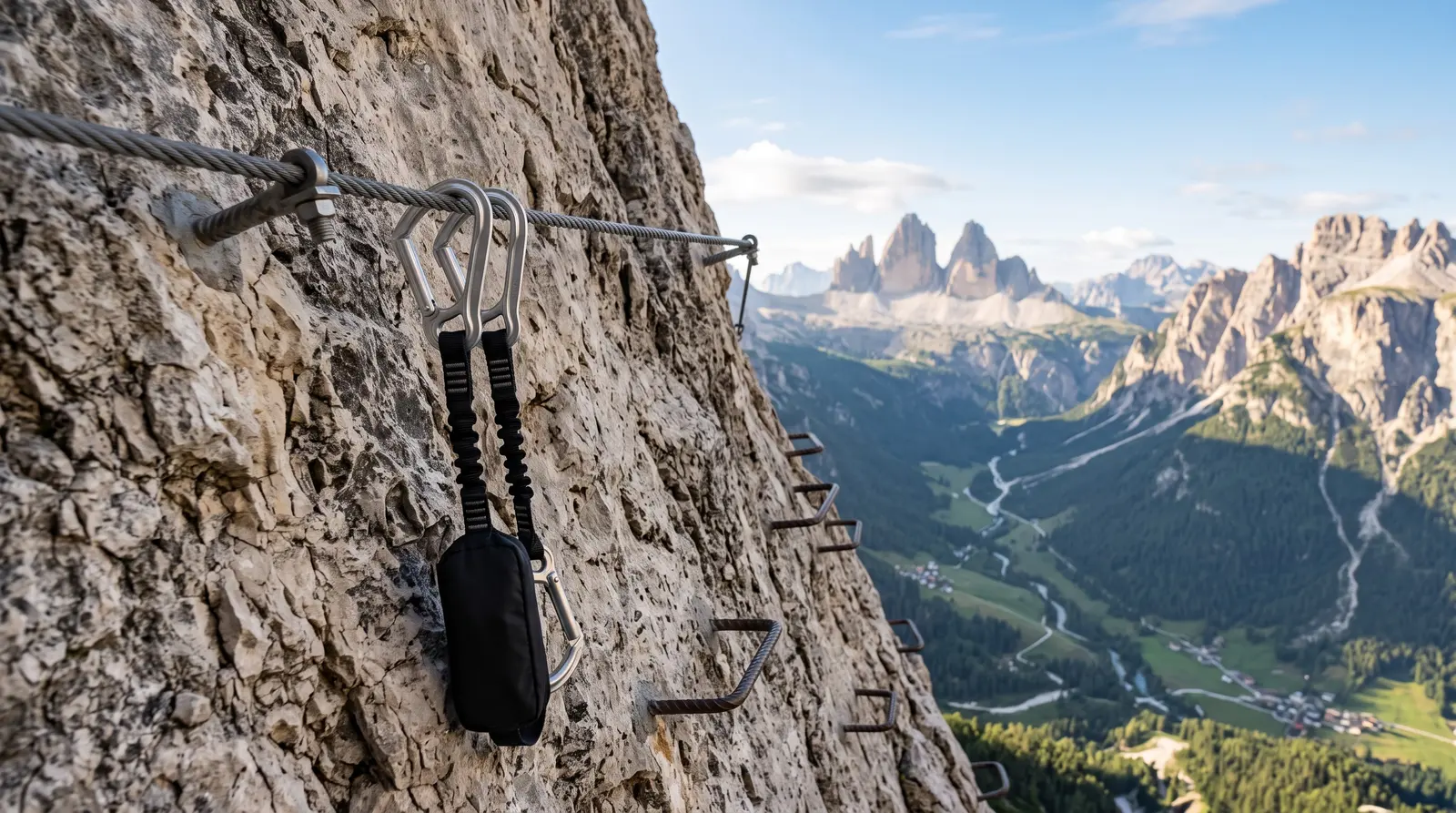
A via ferrata set (also called a via ferrata lanyard, Klettersteigset or kit ferrata) connects your harness to the steel cable that runs along the route. Edelrid's breakdown of a modern set has five parts:
- Two via ferrata carabiners that clip the cable. Both stay clipped except for the moment you pass an anchor, and then you move them one at a time.
- Two elastic arms that keep the carabiners close to your body without loose loops snagging.
- A swivel (on most current sets) that stops the arms twisting around each other as you clip and unclip.
- An energy absorber, usually tear webbing: two webbing strips stitched together that rip apart progressively in a fall, lengthening the braking distance and cutting the force on your body.
- A tie-in loop that you girth-hitch to your harness belay loop or tie-in points, following the instructions for that set.
Many sets add a rest loop or short arm. You clip a separate carabiner to it and hang from a rung or anchor to shake out before a steep section.
Why the energy absorber is everything
On a rope climb the fall is caught by a stretchy rope with a belayer. On a via ferrata you're clipped to a fixed cable, so a fall drops you all the way down to the last anchor below and then some, often several metres onto a short tether. Edelrid explains that routes must be built so the fall height is no more than five metres. Under EN 958, an absorber must not start tearing below 1.3 kN, so resting doesn't trigger it. It must keep the impact force on a 40 kg user under 3.5 kN in that five-metre fall, and stop a 120 kg user within 2.2 m at no more than 6 kN.
The DAV is blunt about what happens without one: it would mean material failure or serious spinal injury. That's also why you must never make your own via ferrata lanyard from slings, cord or a daisy chain. Slings and static cord barely stretch, so in a via ferrata fall they would pass almost all of that force straight to the gear and to your spine. The only acceptable tether between you and the cable is a certified via ferrata set.
The standard: EN 958 and the 40–120 kg range
Via ferrata sets are certified to EN 958, often alongside the UIAA 128 label. According to the DAV, approved sets are designed for a total weight (body plus equipment) of 40 to 120 kg and must meet EN 958:2017. Edelrid explains that the 2017 standard (in force since 1 January 2017) demanded lower impact forces across all weight classes and a braking distance of up to 2.20 m, which at first made absorbers bigger. Newer designs have shrunk them again. A 2024 edition of EN 958 now exists, and Edelrid's current product pages already list absorbers certified to EN 958:2024. Both editions use the same range: at least 40 kg body weight (without equipment) and no more than 120 kg including equipment.
Two practical points:
- Count your gear. The 120 kg upper limit includes your pack, water and clothing. A heavy person with a full pack can go over it. Outside the range, Bergzeit points out, the set's protection is no longer guaranteed.
- Old sets aren't "just as good." Sets made to earlier versions of the standard were tested to different criteria, and some older designs were recalled (see below). If a set is old or you don't know its history, replace it.
A short history of recalls
In August 2012 a climber died in the Austrian Tyrol when both arms of a via ferrata set broke in a fall. Edelrid then recalled seven models, saying the webbing of the elasticated arms "may no longer meet the relevant safety standards" after increased use. Reporting at the time by grough and UKClimbing describes other makers, including Wild Country, following with recalls, initial research pointing to grit abrading the elastic arms, and an emergency UIAA meeting with 16 manufacturers that agreed to revise the UIAA 128 standard to add fatigue testing.
Recalls still happen with modern gear. Petzl recalled SCORPIO EASHOOK lanyards (reference L060BA00) made in 2021 for a carabiner gate problem; the current Eashook models carry different references (L060BB00, L060CB00). In November 2025 Mammut issued a call for self-inspection of the carabiners on its Skywalker Pro and Skywalker Pro Turn sets after finding that the plastic locking arms could bend and the lock could stiffen in the cold. That's why we haven't included the Skywalker in our picks. If you own one, follow Mammut's check-and-return procedure. Whatever you own or rent, search "[brand] [model] recall" before your trip.
Carabiners, swivels and rest loops: what actually matters
Via ferrata carabiners ("K" type)
Via ferrata carabiners are a special category, marked with a K under the EN 12275 connector standard (you'll often see names like Climbing Technology's "K-Advance"). The DAV describes them as having a large gate opening and an automatic lock against accidental unclipping, and they're tested for loading along the spine, across the gate and in bending, the way they can be loaded on a cable. A palm-squeeze lock, which opens when you grip the back of the carabiner, is the most intuitive design. Never replace a set's carabiners with ordinary screwgates; on modern sets they're sewn into the arms anyway.
The bergsteigen.com 2025 test found two clear groups: big palm-squeeze carabiners (Salewa, Edelrid, Rock Empire, Black Diamond) that "catch" the cable easily, and Petzl's smaller Eashook, which still has a 3.5 cm opening and was a favourite for small hands. If you can, try carabiners in a shop, with gloves on.
Swivel
Without a swivel, every clip-and-unclip adds a twist until the arms wrap around each other. Bergsteigen.com only tested sets with swivels, calling them "good standard" today. It rated the triple-joint swivels from CAMP and Edelrid clearly better than the rest. Most brands also sell nearly identical sets without a swivel, typically for a little less money.
Rest loop or positioning lanyard
The DAV recommends sitting back in a rest sling before strenuous passages to spot the crux and collect yourself. The safest designs either have a fixed static rest loop between the arms or an eyelet on the absorber where you add a short sling and carabiner. Either way, the absorber stays in the system. The common alternative, a separate 60 cm sling girth-hitched to the harness belay loop, bypasses the absorber, so it may only be loaded while you're actually resting. Never climb on with a rest sling still clipped from your harness to the route. In a fall it would short-circuit the absorber, which the DAV warns would be disastrous.
Best via ferrata sets at a glance
Weights and features are from the manufacturer or Bergfreunde product pages linked in each section. Brands revise these sets often, so check the current version and its standard before you buy.
| Set | Best for | Weight | Swivel | Rest option | Main drawback |
|---|---|---|---|---|---|
Edelrid Cable Comfort Tri | Best overall | 532 g (19 oz) | Triple-joint | Rest loop at absorber | Premium price tier |
Petzl Scorpio Eashook SW | Light and small hands | 460 g (16 oz) | Yes | Short arm (add carabiner) | Swivel less effective than triple joints |
CAMP Kinetic Gyro Rewind Pro | Arms that never tangle | 655 g (23 oz) | Triple-joint Gyro | Rest sling | Heaviest here |
Edelrid Cable Kit VI | Budget classic | 484 g (17 oz) | No | Rest loop at absorber | Arms can twist |
Black Diamond Easy Rider | Big carabiners, value | 585 g (21 oz) | Steel swivel | Steel loop for carabiner | Arms tend to twist a little |
Salewa Ergo Tex | Long reach, gloved hands | 515 g (18 oz) | Asymmetric swivel | Rest loop | Swivel less effective; stock varies |
Climbing Technology Hook It Compact Twist | Teens and smaller hands | 660 g (23 oz) | Integrated | Loop in one arm | Heavy for a compact set |
All seven are listed for users from 40 to 120 kg (88–265 lb); the 120 kg maximum includes equipment.
The 7 best via ferrata sets in 2026
Edelrid Cable Comfort Tri: best overall
Edelrid's high-end set pairs a triple-jointed swivel with thin, elasticated HMPE arms (84 cm), OneTouch II palm-squeeze carabiners designed to stop your fingers getting pinched between gate and cable, and a rest loop next to the absorber. Edelrid's US page lists the absorber as conforming to EN 958:2024. Bergfreunde lists it at 532 g.
Bergsteigen.com's 2025 test called it the only set that scored well in most categories: big carabiners, thin arms, a small absorber and a very good swivel. It was also among the sets with the smallest absorbers, which makes tying in easier.
- Best for: anyone buying one set for years of regular via ferrata, from easy Alpine routes to steep Dolomites classics.
- Main drawback: it sits in the premium price tier.
- Skip it if: you only go once a year (rent or buy the Cable Kit VI) or you're counting every gram.
Petzl Scorpio Eashook SW: lightest with a swivel
Petzl lists the SW (swivel) version at 460 g, with an ultra-compact absorber, two elastic arms that extend from 74 to 112 cm, and a 26 cm short arm where you add your own carabiner to rest on a rung. The Eashook carabiners have an automatic double-action lock that Petzl says works with gloves and a keylock nose that reduces snagging. The plain Scorpio Eashook (no swivel) is 440 g.
Bergsteigen.com called it the lightest set with a swivel and the smallest absorber on the market, noted it was "surprisingly" easy to use even with small hands, and said the revised set was knocking on the test winner's door. Its one weak point was the swivel, which didn't work quite as well as the triple joints from CAMP or Edelrid. A Bergzeit tester singled out the Eashook SW for its large, grippy carabiner and the rest arm.
- Best for: long Alpine tours where weight and pack size matter, and climbers with small hands.
- Main drawback: the rest carabiner isn't included, and the swivel untangles less well than triple-joint designs.
- Skip it if: you want the largest possible carabiner gate for big cables and chain links.
CAMP Kinetic Gyro Rewind Pro: best anti-tangle swivel
The successor to the Kinetic Rewind Pro adds CAMP's triple-joint Gyro swivel. Bergfreunde lists it at 655 g for users from 40 to 120 kg. Bergsteigen.com called it one of the few sets whose arms really don't twist, and still rated the Gyro the best swivel on the market in 2025. Its slim-nosed carabiners also fit into tight chain links where fat carabiners won't go. Bergzeit's tester called the joint "the most mature solution."
- Best for: routes with lots of clipping, and anyone who hates untwisting arms.
- Main drawback: the heaviest set in this list.
- Skip it if: you mostly do long, easy routes where weight matters more than handling.
Edelrid Cable Kit VI: best budget classic
The no-swivel classic shares the Comfort's compact absorber (EN 958:2024 on Edelrid's US page), OneTouch II carabiners and rest loop, with 92 cm elasticated arms. Bergfreunde lists it at 484 g. Edelrid describes the arms as wear-resistant, and the shared absorber is one of the smallest around, which makes tying in and out easy.
- Best for: occasional users who want a modern, current-standard set without paying for a swivel.
- Main drawback: no swivel, so the arms will twist on routes with lots of anchors.
- Skip it if: you do long, anchor-heavy routes often; the Comfort Tri is worth the step up.
Black Diamond Easy Rider: big carabiners, good value
Black Diamond relaunched the Easy Rider with extra-large, ergonomic carabiners, an ultra-compact absorber and a steel swivel with a steel loop for a resting carabiner. BD's EU page lists it at 585 g, certified to CE EN 958:2017. Bergsteigen.com says it's practically identical to Rock Empire's Siga set except for the colours, praises its very large, easy carabiners and generous tie-in loop, and notes its arms tend to twist a little. It placed the price in the lower range for this category.
- Best for: beginners who want big, easy-to-catch carabiners at a fair price.
- Main drawback: heavier than the Edelrid and Petzl sets, and its swivel is less effective.
- Skip it if: you're in the US. We found it on Black Diamond's EU site but not on the US store, so check availability.
Salewa Ergo Tex: longest reach, best for gloves
Salewa's current Ergo Tex uses Ergotec 3.0 carabiners with an extra-wide gate that Salewa says is easy to work with gloves, an asymmetric swivel, a rest loop and an elasticated tie-in loop. The US page lists 515 g. Bergsteigen.com (testing at 548 g) said the big "nose" carabiners caught the cable best of all, and the Ergo Tex had the longest reach "by a respectable margin," useful at breaks in the cable. It said the set would have been near the top if it had a better-working swivel.
- Best for: tall climbers, long reaches between cable sections, and climbing in gloves.
- Main drawback: the swivel doesn't control twisting as well as the best, and stock differs by country (the US page showed it out of stock).
- Skip it if: you have small hands; the big carabiners can feel bulky.
Climbing Technology Hook It Compact Twist: for teens and smaller hands
Climbing Technology describes this set as compact, with an integrated swivel, a webbing loop in one arm for resting on an anchor, a thin tie-in loop, and double-gate carabiners with an ergonomic grip and large opening. CT says it's "particularly suitable for young mountaineers," and the product page lists 660 g. It's rated for 40 kg (without gear) to 120 kg (with gear), so it only suits teenagers and light adults who are within that range. Bergsteigen.com noted its swivel was decent but not at the level of CAMP or Edelrid.
- Best for: teenagers and light adults over 40 kg who struggle with large carabiners.
- Main drawback: heavier than other compact sets.
- Skip it if: the child is under 40 kg. No set replaces a rope belay below that weight.
How to choose a via ferrata set
| Your situation | What to prioritise | Good fit |
|---|---|---|
First season, a few routes a year | Current standard, easy carabiners; consider renting first | Edelrid Cable Kit VI, Black Diamond Easy Rider |
Regular Alpine and Dolomites trips | Swivel, rest loop, durability | Edelrid Cable Comfort Tri, CAMP Gyro Rewind Pro |
Long tours, fast and light | Weight, small absorber | Petzl Scorpio Eashook SW |
Small hands or teenagers over 40 kg | Ergonomic, smaller carabiners | Petzl Scorpio Eashook SW, CT Hook It Compact Twist |
Tall, or climbing in gloves | Reach, large gate | Salewa Ergo Tex |
Over about 100 kg body weight | Check the 120 kg total includes your pack | Any set above, with a light pack |
Child under 40 kg body weight | Rope belay from a competent adult or guide | A set alone is not enough |
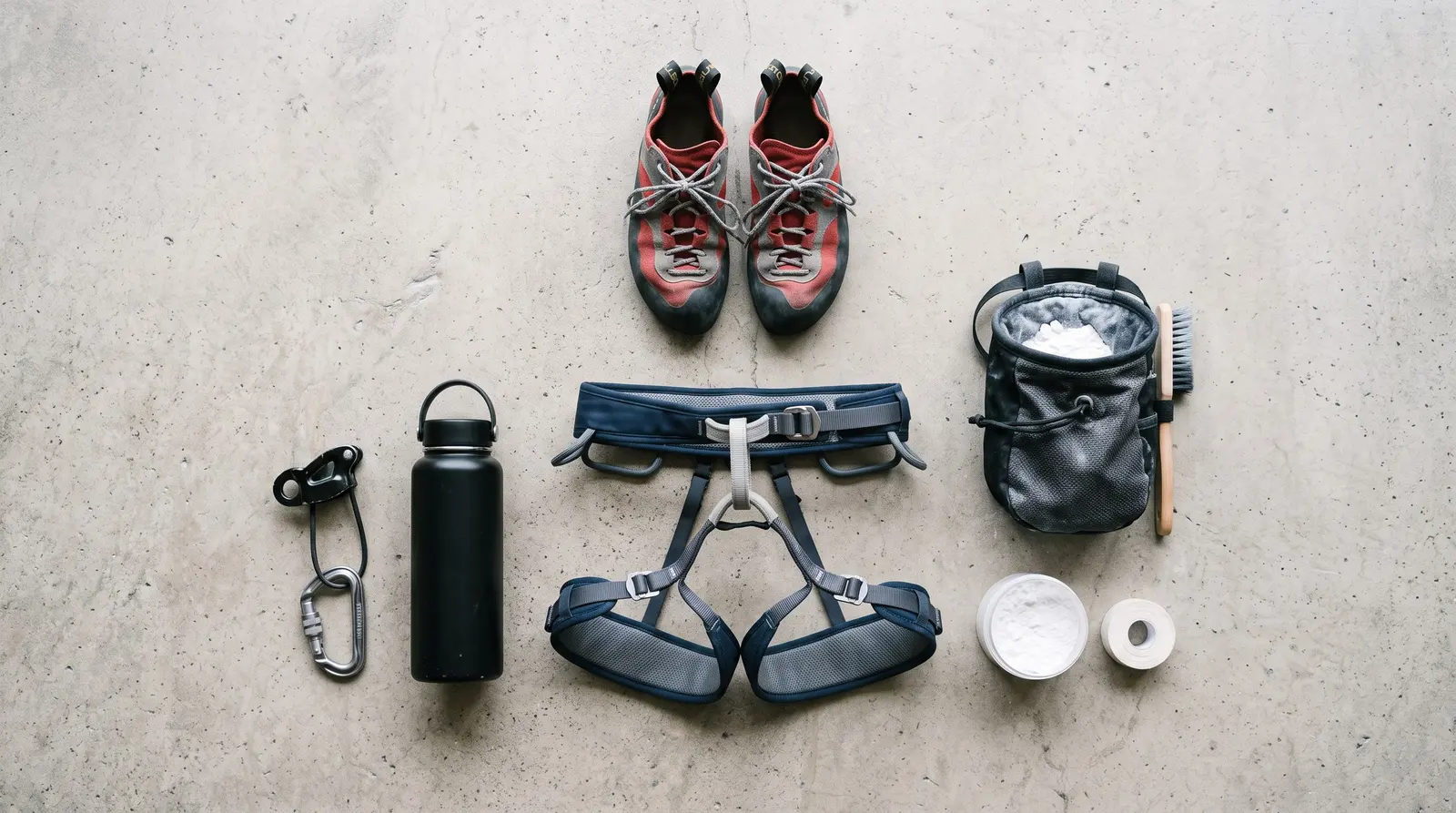
Full via ferrata gear checklist
The DAV notes that emergencies on via ferratas often come down to inadequate equipment. A complete kit:
- Via ferrata set to EN 958, within its weight range, inspected before each trip.
- Harness. The DAV says any sit harness used for sport or alpine climbing works on a via ferrata. Via ferrata-specific harnesses just have simpler padding and fewer gear loops. See our best climbing harness guide. Children, and adults with a high centre of gravity, should add a chest harness.
- Helmet. There's no such thing as a special via ferrata helmet, according to the DAV. Head injuries come mostly from hitting the rock or the route's ironwork, not only from falling stones. Our best climbing helmet guide covers fit and the different types.
- Gloves. Snug gloves with a firm wrist closure protect your hands from frayed cable strands. Full-finger and fingerless versions both work.
- Shoes. Anything from a solid approach shoe to a light mountaineering boot, depending on the route, the approach and the season. The DAV suggests heavier people choose ankle-high boots for stability.
- Rest carabiner if your set has a short arm without one (Petzl Eashook), and a short sling if your set has only an eyelet.
- For children or nervous partners: a 20–30 m single rope and the skills to belay with it.
- Pack basics: weather forecast, water stowed inside the pack (bottles in side pockets can fall on people below), a layer and a phone.
If you're building a climbing kit from scratch, our climbing gear for beginners guide explains which harness and helmet also work for the gym and the crag.
Via ferrata grades in brief
There's no single worldwide scale, but two Austro-German scales dominate guidebooks. The Schall scale runs from A (easy, natural footholds plus pegs and ladders, ideal for beginners and children) through B (the most common grade, steeper and more exposed), C (steep, physically demanding), D (vertical to overhanging, needs strong arms and endurance) to E (extremely difficult). Some guides add F. The Hüsler or K-scale runs from K1 to K6 and roughly matches A to F. French and Italian guides use alpine grades from F to ED. The overall grade also depends on how long and how frequent the hard passages are. As a guide, the DAV suggests children aged 6–9 stay at B/K2 or below and children aged 9–14 at C/K3 or below. For rock-climbing grades, see climbing grades explained.
Via ferrata with kids: weight limits and rope belay
This is where a lot of family trips go wrong. Most children weigh less than 40 kg, which is below the bottom of the EN 958 range, so a standard set may not brake a child's fall correctly. The guidance is consistent:
- The DAV says people under 40 kg must always be belayed with a rope as well, and that a fall into the set should be avoided at all costs for children. It also recommends a rope on long, steep sections from grade C, on exposed terrain without a cable, or when the child is scared.
- Petzl says that because its SCORPIO is designed for 40–120 kg, belaying a child with a dynamic rope is essential, and the rope must stay taut so that the rope, not the lanyard, stops any fall. If you don't have multi-pitch-style belay skills, Petzl says to hire a professional.
- Children need a harness that fits their proportions. The DAV suggests a full-body harness, or a sit harness plus a chest harness, so they can't slip out after a fall.
Specialist via ferrata belay kits make this easier: the DAV describes them as a 15–20 m rope with a stuff sack and a backstop device. They add to the children's sets and lanyards; they don't replace them, and they don't replace the skill to use them.
Rent or buy?
Rent if you're trying via ferrata once or twice, travelling light, or kitting out a child who is still growing. Rental sets are widely available in Alpine valley shops. Buy once you go every season. You then know your set's full history, including whether it has ever taken a fall, and you get carabiners that suit your hands.
When renting, check the set before you leave the shop. The label should show EN 958 (ideally the 2017 or 2024 edition) and the 40–120 kg range. The absorber pouch should be intact with no exposed or torn stitching, the elastic arms free of fraying, and the carabiners should open and lock smoothly. During the 2012 recalls, the BMC told climbers to use caution with personal and hired sets that had elasticated arms. That's a good reminder that a hire set is only as good as its history.
Inspection, falls and retirement
- Before every trip: inspect the webbing, stitching, absorber pouch, swivel and carabiner gates. Edelrid says to check the set is fully functional before every use.
- After a fall: Edelrid says that once the absorber has deployed, the entire lanyard must be replaced. Its absorbers show red indicator threads inside the pouch after a fall or critical load. Bergzeit's advice is to replace a set even after a light fall. Petzl's tear-webbing absorbers can't be opened by the user (bergsteigen.com notes this), so follow Petzl's own inspection procedure.
- Lifespan: retire the set when it reaches the lifespan in its instructions, sooner with heavy use, UV exposure or contact with chemicals, and immediately if it's subject to a recall.
- Storage: dry, out of sunlight, away from chemicals. Mammut's 2025 notice is a reminder that even carabiners can be affected by how sets are stored and transported.
Common mistakes
- Clipping the second arm back to your harness. The DAV warns that this short-circuits the absorber. Keep both arms clipped to the cable.
- Climbing with the rest sling clipped in. A separate sling from your belay loop bypasses the absorber. Unclip it before you move.
- Using slings or a homemade setup. Without a tested energy absorber, a via ferrata fall can break gear or your spine.
- Ignoring the weight range. Under 40 kg needs a rope; over 120 kg including your pack is outside what the set was tested for.
- Climbing too close together. The DAV warns of a domino effect: if one person falls, they can take the next one with them. Keep a clear gap to the climber ahead.
- Going out in a storm. The steel cable is a lightning conductor. Check the forecast and turn back early.
- Choosing a route beyond your arms. The DAV suggests heavier people with relatively weak arms pick shorter routes without athletic sections. Strength training helps; see weight training for climbers.
Prices and stock change often; the button opens the retailer or brand page so you can check today's price.
FAQ
Can I use my normal climbing harness for via ferrata?
Yes. The German Alpine Club (DAV) says any sit harness made for sport or alpine climbing works on a via ferrata. Dedicated via ferrata harnesses are simply lighter and simpler. Children and adults with a high centre of gravity should add a chest harness.
Can a child under 40 kg use a via ferrata set?
Not on its own. EN 958 sets are designed for users of at least 40 kg body weight (without gear) up to 120 kg including gear, so the DAV says anyone under 40 kg must also be belayed with a rope, and Petzl calls a dynamic rope belay essential for children on its SCORPIO lanyards. The adult must know how to belay from anchors, or hire a guide.
Do I have to replace my via ferrata set after a fall?
Yes, once the energy absorber has deployed. Edelrid says the entire lanyard must then be replaced, and its absorbers show red indicator threads after a fall or critical load. Bergzeit advises replacing a set even after a light fall. Also retire it when it reaches the lifespan stated in the instructions.
Is it safe to rent a via ferrata set?
It can be, if the set is a current EN 958 model in good condition. Check that the absorber pouch is closed and undamaged, the arms aren't frayed, and the carabiners open and lock smoothly. If the shop can't tell you how old the set is, or it looks worn, ask for another one.
Sources
- Deutscher Alpenverein (DAV), Ausrüstung für den Klettersteig
- Deutscher Alpenverein (DAV), Mit Kindern und Jugendlichen am Klettersteig
- Edelrid, In-depth knowledge about via ferrata sets
- Edelrid, Via ferrata sets and equipment (inspection after a fall)
- Petzl, Via ferrata with a child (Tech Tip)
- Bergsteigen.com, Klettersteigset Test 2025
- Bergzeit Magazin, Testsieger: Die besten Klettersteigsets
- grough, UIAA warns owners of all via ferrata sets to check their safety (2012)
- UKClimbing, Via ferrata death prompts emergency UIAA meeting (2012)
- Bergsteigen.com, Rückruf Mammut Skywalker Pro Via Ferrata Sets (2025)
- Climber, Petzl is recalling its SCORPIO EASHOOK via ferrata lanyards
- Climbers Paradise, Via ferrata tutorial 05: Types and difficulties
- OpenStreetMap Wiki, Key:via_ferrata_scale
- Petzl, SCORPIO EASHOOK SW (manufacturer specs)
- Edelrid, CABLE COMFORT TRI (manufacturer specs)
- Black Diamond, Easy Rider Via Ferrata Set (manufacturer specs)