No-Drill Hangboard Mount: Door Frame Mounts, Stands and Portable Boards
 Petr Hess, strength & conditioning coach
Updated 2 Nov 2026 · 9 min read
Key takeaways
Best for: Renters who want to hangboard without drilling
- The CLEVO Door is the most fully specified door mount found; the YY Vertical SandwichBase suits narrower doors with solid trim.
- Measure your door against the maker's width and depth ranges, and note CLEVO says doors in drywall aren't suitable.
- Respect published load limits and leave a margin, because jerky or weighted hangs load the mount more than smooth ones.
- Use every safety feature each session; YY now says its VerticalBase must not be installed without safety clamps.
- DIY pull-up bar adapters and frames have no load rating; if you can't hang anything, the Tension Block needs no anchor.
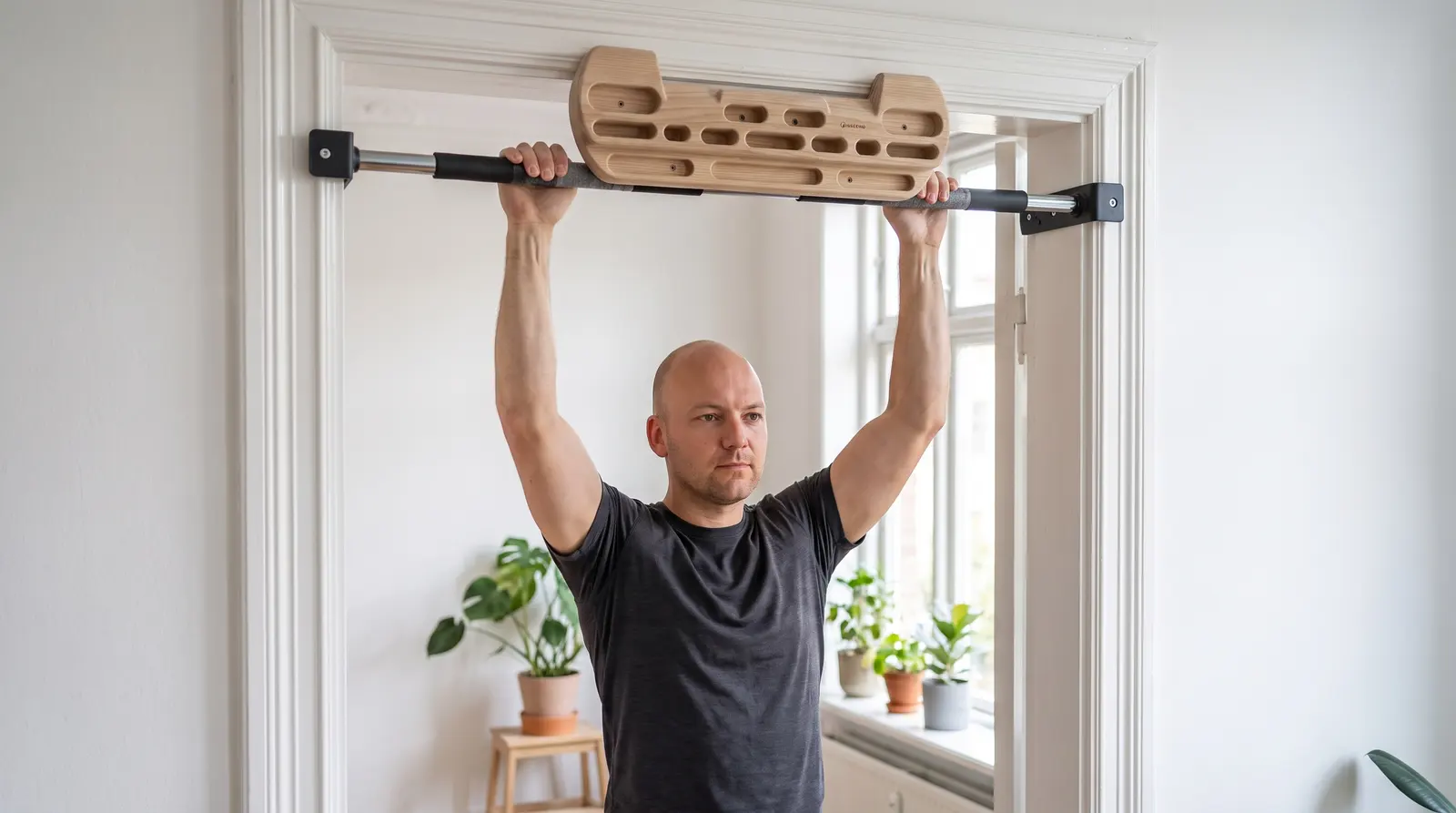
You can train on a hangboard without drilling in four ways: a purpose-built door frame mount such as the CLEVO Door, a doorway pull-up bar adapted to hold a board, a freestanding wooden frame, or a portable board that hangs from a bar or is loaded from the floor. For most renters, a dedicated door mount is the most purpose-built option, as long as your door frame meets the maker's fit rules; we have not tested or compared how stable each one is. If you can't hang anything at all, a no-hang block like the Tension Block is the simplest answer.
I'm a strength and conditioning coach, and my first question with any home setup is the same one I ask about a squat rack: will it hold the load safely, every time? This guide focuses on the mount. To pick the board itself, see our best hangboards guide.
Prices and stock change often; the button opens the retailer or brand page so you can check today's price.
No-drill hangboard options at a glance
Specs and limits come from each maker's product page, checked in November 2026. A blank load limit means the maker doesn't publish one.
| Option | Best for | Fit and load (per maker) | Main drawback |
|---|---|---|---|
| CLEVO Door | Most fully specified door mount | Doors 70–92 cm wide, 11–28 cm deep; 130 kg; not for drywall | Heavy (8.6 kg) and pricey; board not included |
| YY Vertical SandwichBase | Narrower doors, quick set-up | Doors 63–84 cm wide, frame depth 6–14 cm; load limit not listed | Needs solid, structural trim |
| Pull-up bar + plywood (DIY) | Budget, if you already own a bar | No rating for the modified build | Needs DIY skill; the bar's rating doesn't cover your build |
| Freestanding wood frame (DIY) | Garages, gardens, no door | Depends on your build | Takes floor space and a day to build |
| Tension Flash Board | Portable hanging and warm-ups | 8, 10, 15 and 20mm edges | Few grip types |
| Lattice Mini Bar | Lightest travel option | 150 g; 10 and 20mm edges; 130 kg max load | One hand at a time, cord adjustments |
| Tension Block | No anchor at all | 20, 10, 8 and 6mm edges, pockets, pinches; under 200 lb | Mainly lifting; needs weights or bands |
Before you buy: door frame and load safety
A no-drill mount is only as strong as the thing it presses against. Check these points before you spend money, and follow your mount's fitting instructions to the letter.
1. Measure your door
Every door mount has a width range and a depth range. CLEVO needs a door 70–92 cm (27–36 in) wide and 11–28 cm (4.3–11 in) deep, with at least 1 cm of support surface on the frame and a frame no taller than 11 cm. YY Vertical's SandwichBase fits doors 63–84 cm wide with a frame depth of 6–14 cm. If you're outside the range, don't improvise.
2. Check what the wall is made of
CLEVO lists concrete and brick walls as suitable and says doors in drywall (plasterboard) are not, because the wall may dent or push in. Older and rental buildings vary a lot, and knocking on the wall can't tell you whether it will take the load. Find out how the wall and frame are built before you order (ask your landlord or building manager), and get a qualified person to look at it if you're unsure.
3. Check the trim
Clamp-style mounts load the door trim. YY Vertical says the SandwichBase works by bracing ("arc-boutement") in the door frame, and a sponsored write-up noted that it needs solid, structural trim, not purely decorative molding.
4. Respect the load limit, and remember dynamic loads
CLEVO rates the Door at 130 kg (286 lb). Lattice gives a 130 kg max load for the Mini Bar, and Tension says the Block is intended for loads under 200 lb. Hangboard training can add weight on top of your bodyweight, and a dropped or jerky hang briefly loads the mount more than a smooth hang. Leave a margin, and only do dynamic or weighted work if the maker says the mount supports it.
5. Use every safety feature, every time
This is the lesson of YY Vertical's October 2026 safety notice. Its VerticalBase instructions originally allowed set-ups without the safety clamps in some frames. YY now says "any installation of the VerticalBase without safety clamps must be stopped", because without them "the pressure may no longer be sufficient, even in static conditions" and the product could come loose and cause a fall. The notice covers all units sold after September 1, 2025. If you own one, read the notice; the clamps need a frame no thicker than 1.6 cm and between 1 and 6.5 cm wide.
Practical habits that apply to every mount:
- Check the fit before each session. YY recommends a quick tightness check every time.
- Load it gradually: feet on the floor first, then partial weight, then a full hang.
- Keep the board level and vertical. Ellis Brigham's fingerboard guide points out that even a few degrees of overhang make the holds harder.
- Clear the floor below and keep a landing mat or soft surface underneath.
Renting?
Ellis Brigham notes that renters' options are limited unless the landlord agrees to holes in the wall, which is why door mounts, frames and portable boards exist. Even a no-drill mount can mark paint or soft trim, so read your lease, and keep the mount's compatibility guide in case you need to show it.
Our picks, explained
We have not tested these mounts. The picks are based on maker specs, fitting instructions, published safety notices and climber consensus.
CLEVO Door: best door frame mount
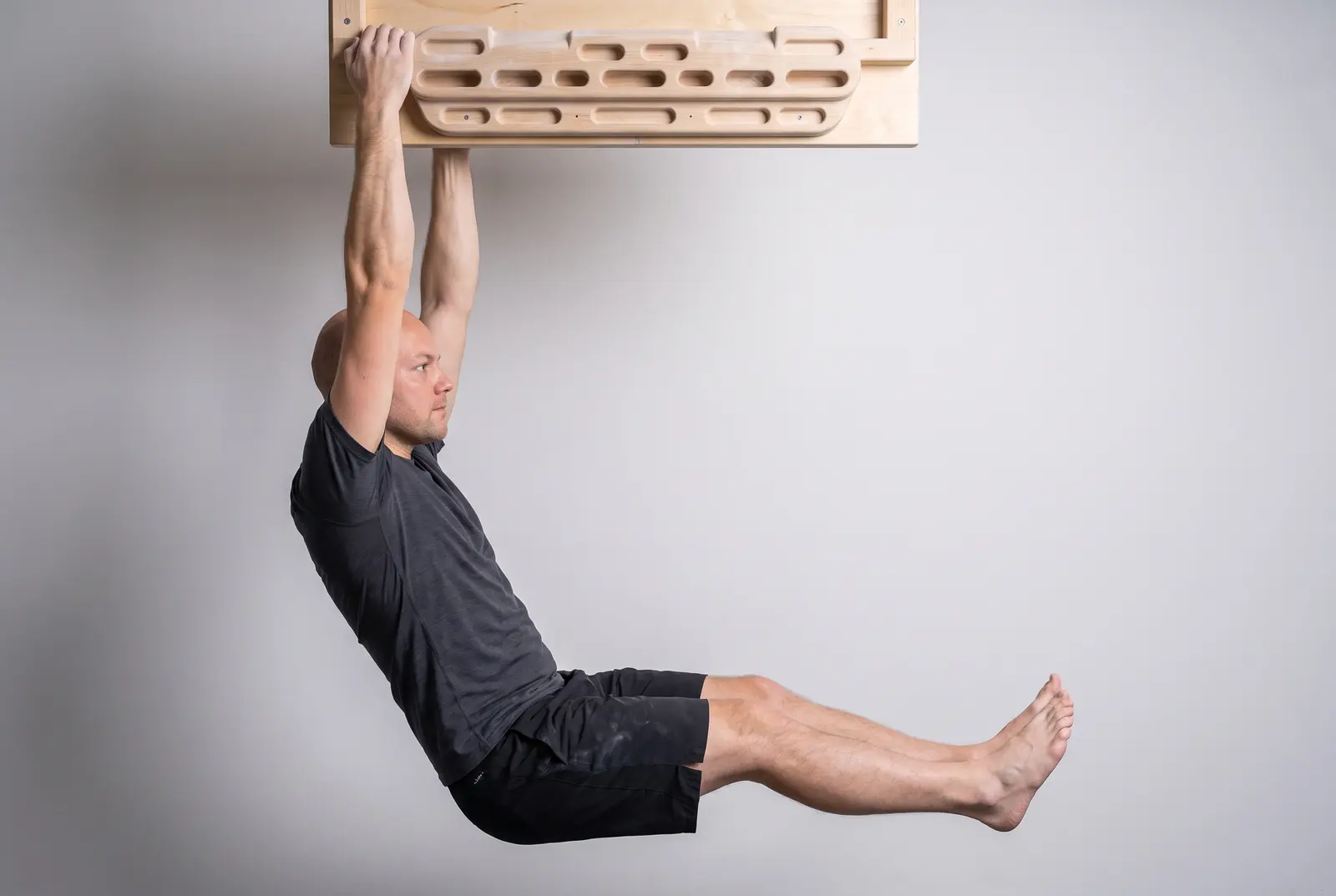
The CLEVO Door is a beech-and-steel frame, developed in Germany, that hooks into a door frame without screws and carries a hangboard plate and a 4 cm wooden pull-up bar. CLEVO says it spreads the load through several contact surfaces and uses safety pins to keep it anchored. It has the most complete published spec we found: door widths, depths, a 130 kg load rating, an 8.6 kg product weight, a downloadable manual and a five-year warranty. It was listed at €229 without a board, or €299 bundled with CLEVO's hangboard, with worldwide shipping from Germany.
- Best for: renters with a standard door in a masonry wall who want a stable, everyday set-up.
- Main drawback: heavy, expensive, and not suitable for drywall.
- Skip it if: your door is outside the 70–92 cm width range or set in plasterboard.
YY Vertical SandwichBase: best for narrower doors
The SandwichBase clamps into the door frame with interlocking steel parts and a wooden board, installs in about 30 seconds without tools, and stores flat. It fits doors 63–84 cm wide, gives a 90 cm wide mounting surface, and comes with a manual covering compatibility and safety. It's designed around YY's VerticalBoard hangboard but YY says it's compatible with other boards. It was listed at €189.
- Best for: narrower doors and small flats where the mount has to disappear after each session.
- Main drawback: YY doesn't publish a load limit on the product page, and it relies on structural trim.
- Skip it if: your trim is thin or decorative, or you want a published weight rating before you buy.
Tension Flash Board: best portable hangboard
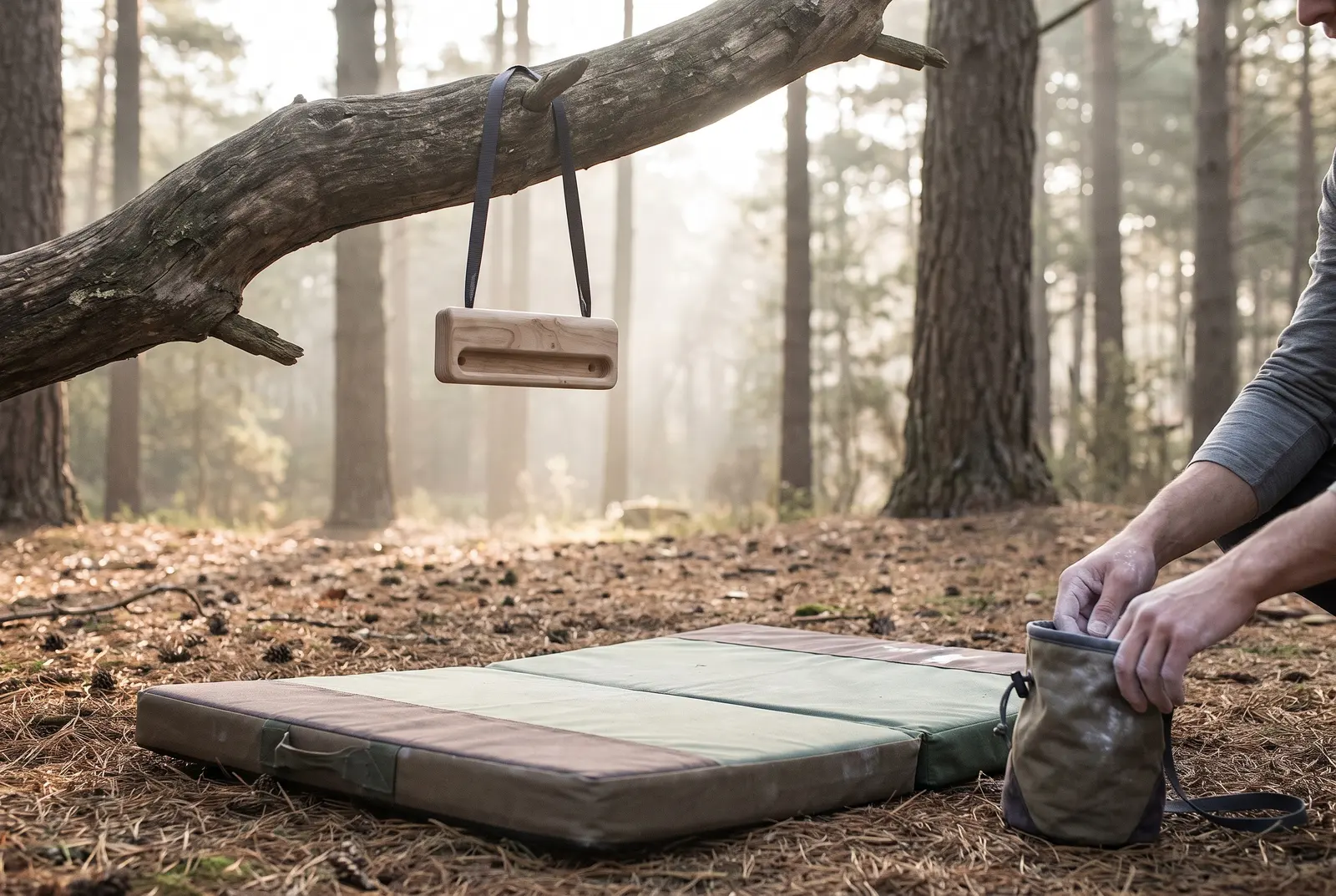
The Flash Board is a compact wooden cylinder with 8, 10, 15 and 20mm edges. Tension says you can hang it from a pull-up bar, a sturdy tree or a bolt, or pull it against a solid object or your own foot. That makes it a natural partner for a screw-free doorway pull-up bar. It was $99 on Tension's store.
- Best for: renters who already own a pull-up bar, and climbers who travel.
- Main drawback: edges only, no jugs, slopers or pockets.
- Skip it if: you're a beginner who needs big holds; start with our hangboard for beginners guide first.
Lattice Mini Bar: lightest travel option
Lattice's Mini Bar weighs 150 g, is 15.5 cm long, and has a 10mm edge, a 20mm edge, a jug and a mini pinch. At that size it takes one hand at a time, so for a normal two-handed hang you'd need two or a full-size board. Lattice lists a 130 kg max load and, in reply to a customer review, advises loading the edge progressively and adjusting the angle if the cord slips. It was about €50 on Lattice's store.
- Best for: warming up at the crag and keeping a routine on the road.
- Main drawback: switching edges means adjusting the cord.
- Skip it if: you want a full-size board at home.
Tension Block: best if you can't hang anything
The Block is a no-hang tool: you lift it from the floor with a weight or band attached. It's machined from maple with 20, 10, 8 and 6mm edges, two- and one-finger pockets and three pinches. Tension says it is intended for loads under 200 lb and should be inspected before each use. It was $59.
- Best for: anyone with no door, beam or bar, and anyone who wants fine control over load.
- Main drawback: for floor lifting you need weights or bands. Tension also allows free-hanging set-ups, still within the under-200 lb limit.
- Skip it if: you mainly want to hang and do pull-ups.
Not on our list: YY Vertical VerticalBase
The VerticalBase is a double-sided, telescoping door mount for doors 70–95 cm wide. Because of the October 2026 safety notice above, we'd only consider it if your frame can take the safety clamps and you follow YY's updated instructions.
DIY options
Doorway pull-up bar adapter
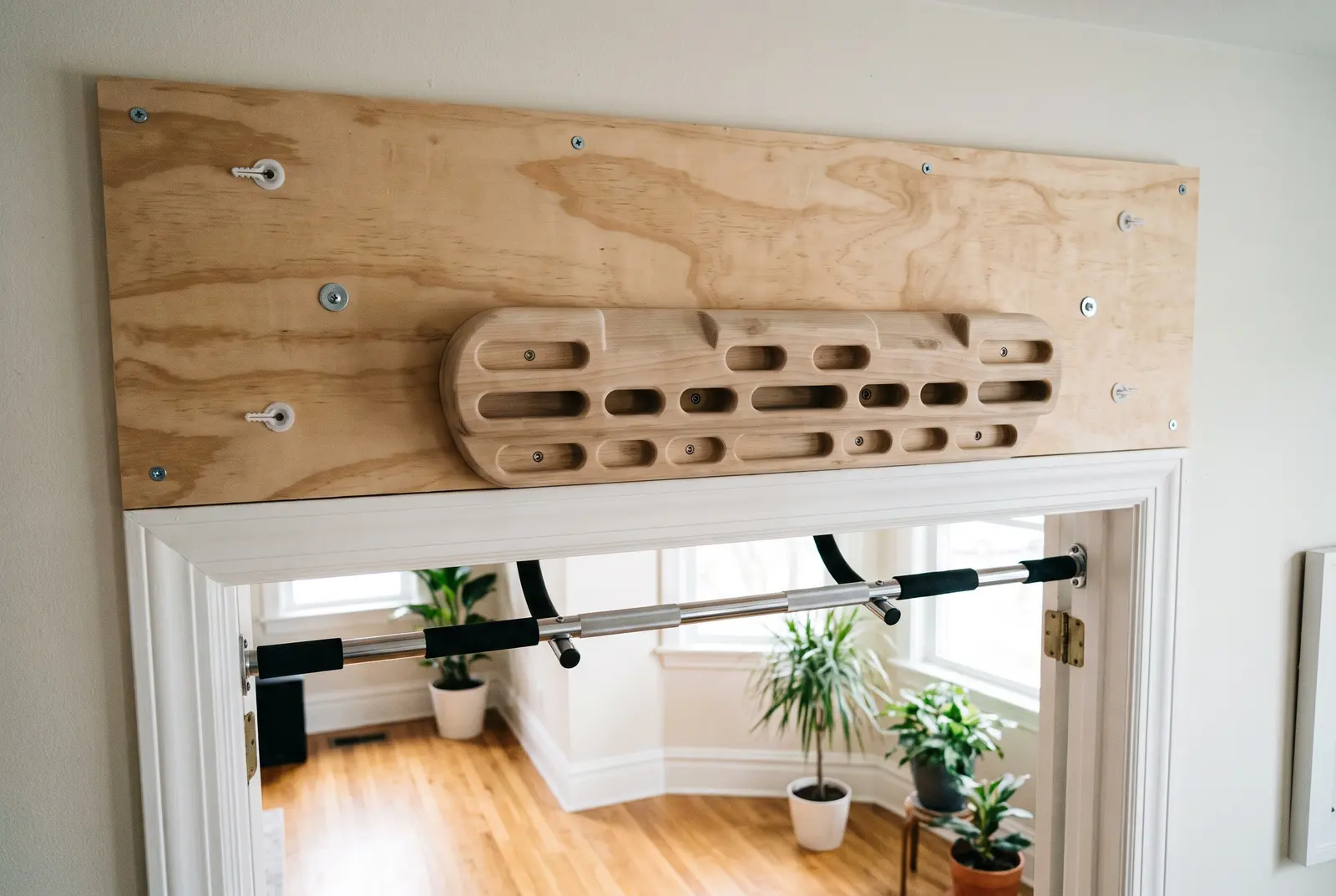
Ellis Brigham describes a simple no-drill build: a doorway pull-up bar that hooks over the frame with two handles pointing away from the door, two 2½ in x 4 in galvanised pipe nipples, two matching floor flanges, and a plywood plate for the board. The nipples attach to the flanges, the flanges are screwed to the plywood, and the nipples slot into the bar's handles once the end caps are off. The adapter, the fasteners, the bar and the door frame can all fail. The bar's rating was set for pull-ups, not for a board hanging out in front, so it gives you no safe load for this modified build. Treat it as unrated and load it very gradually.
Freestanding hangboard stand
We didn't find a dedicated hangboard stand from a major climbing brand, so for a true stand most people build one. Sports Basement published a one-day build using two 8 ft 4x4 posts, five 8 ft 2x4s, ½ in bolts and triangle supports at the base, with the board on a three-slat panel near the top. The author, at 6 ft 4 in, kept the posts at full 8 ft height. It's a good garage or garden option, but it's your build, so it has no load rating: over-build it, check it isn't racking or tipping, and load it gradually.
Training on a no-drill set-up
A no-drill mount is a good reason to train conservatively. Start with your feet on a chair or the floor to take weight off, keep sessions short, and progress in small steps. Our hangboard program lays out progressions by level, and the beginner guide explains when you're ready. If you want to measure your pulls instead of hanging, a force gauge with a block or portable edge works without any mount; our Tindeq Progressor buyer's guide covers whether it's worth it.
Bottom line
If your door sits in a masonry wall and fits the range, the CLEVO Door is the most fully specified no-drill mount we found. The YY Vertical SandwichBase suits narrower doors with solid trim. If you already own a pull-up bar, a Tension Flash Board or Lattice Mini Bar gets you training for much less, and the Tension Block needs no anchor at all. Whatever you choose, measure first, follow the maker's instructions and load limits exactly, and use every safety feature every session.
FAQ
Can you use a hangboard without drilling?
Yes. The main options are a purpose-built door frame mount such as the CLEVO Door or YY Vertical SandwichBase, a doorway pull-up bar adapted to hold a board, a freestanding wooden frame, or a portable board hung from a pull-up bar or loaded from the floor. Each one has fit rules and load limits you need to check first.
Is a door frame hangboard mount safe?
It can be if your door frame suits the mount and you follow the maker's instructions exactly. CLEVO, for example, lists a 130 kg load limit, specific door widths and depths, and says doors in drywall are not suitable. YY Vertical issued a safety notice in October 2026 telling VerticalBase owners to stop using it without its safety clamps.
Will a hangboard door mount damage my door frame?
Makers design them to spread load across the frame, and CLEVO says its mount avoids damage through force distribution. Damage is still possible on soft or decorative trim and drywall, which is why the makers list unsuitable frames. If you rent, check with your landlord and the mount's compatibility guide first.
What is the best hangboard if I can't mount anything?
A portable board you load from the floor, such as the Tension Block or Lattice Mini Bar with a weight or your own foot, needs no anchor at all. It's also a sensible way for beginners to control load.
Sources
- CLEVO Climbing, CLEVO Door: Doorway Hangboard Pull-up Bar (product page)
- YY Vertical, SandwichBase (product page)
- YY Vertical, Safety Corrective Action: VerticalBase (Oct 2026)
- Esme Bonney, Ellis Brigham, How to Set Up a Climbing Fingerboard
- Sports Basement, DIY Freestanding Hangboard Setup
- Lattice Training, Mini Bar (product page)