Best Belay Device: GriGri vs ATC, Device Types and the Right Pick for You
 Petr Hess, strength & conditioning coach
Updated 2 Nov 2026 · 13 min read
Key takeaways
Best for: Choosing your first or next belay device for gym, sport or multipitch climbing
- For gym and single-pitch sport climbing, an assisted-braking device like the Petzl GRIGRI (8.5–11 mm single ropes) is the default choice.
- For multipitch, trad and rappelling you need a tube or guide device such as the Black Diamond ATC-Guide or Petzl Reverso, which handle two strands.
- Assisted braking is not hands-free: keep your brake hand on the rope at all times, and learn your device from a qualified instructor.
- Check the official rope diameter range: the Edelrid Giga Jul tops out at 10.0 mm, so it won't take thicker gym ropes.
The best belay device for most people who climb in gyms and on single-pitch sport routes is an assisted-braking device, and the Petzl GRIGRI is the default choice: it fits 8.5–11 mm single ropes and won top marks in OutdoorGearLab's 17-device test. If you climb multipitch or trad, you also need a tube or guide device such as the Black Diamond ATC-Guide, because it handles two rope strands, rappels and belays a second from the anchor. Whatever you buy, it only works if you have learned to use it properly. Assisted braking is not hands-free.
We haven't tested these devices ourselves. This guide is built from manufacturer specifications (linked in each section), published independent tests from OutdoorGearLab and Treeline Review, and safety research from the German Alpine Club (DAV). Rope diameters come straight from the official product pages, checked in November 2026. More guides live in our climbing gear section, and our affiliate disclosure explains how links work.
Prices and stock change often; the button opens the retailer or brand page so you can check today's price.
The four types of belay device
Many buyer's guides split devices into just "ATC" and "GriGri". That hides the most important middle ground. There are really four families, and the type matters more than the brand.
| Type | How it brakes | Examples | Ropes | Best for | Main limitation |
|---|---|---|---|---|---|
Tube (manual) | Friction only. Your brake hand does all the holding. | Black Diamond ATC-XP, Petzl Reverso | Single, half and twin | Rappelling, double ropes, soft catches, light weight | No safety reserve if the brake hand lets go |
Guide / plaquette (tube with guide mode) | Friction when belaying a leader; auto-blocks when belaying one or two seconds from an anchor | Black Diamond ATC-Guide, Petzl Reverso, Edelrid Giga Jul | Single, half and twin | Multipitch, trad, alpine | Lowering a second in guide mode needs extra technique |
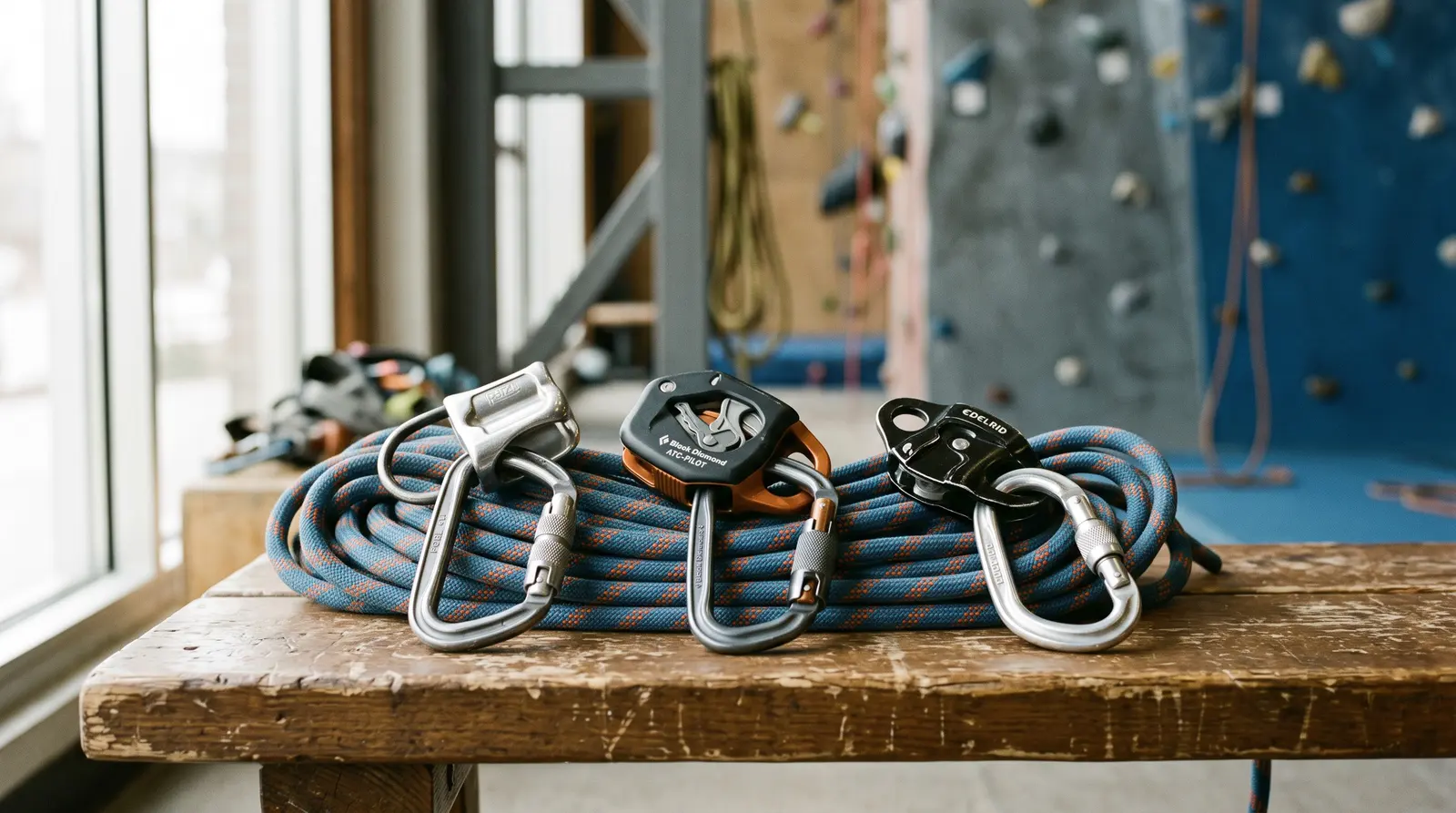
Passive assisted braking ("autotube") | No moving parts. The rope pinches against the carabiner when loaded, if the brake hand is low. | Mammut Smart 2.0, Edelrid Jul 2, Climbing Technology Click Up+, BD ATC Pilot | Single rope only (most models) | Gym and sport climbing on a budget, light weight | Braking depends on brake-hand position and carabiner |
Active assisted braking (cam) | A spring-loaded cam pivots and pinches the rope when it is loaded | Petzl GRIGRI, GRIGRI+, NEOX | Single rope only | Gym, sport, projecting, beginners after instruction | Heavier, pricier, no two-strand rappel |
The DAV's safety research team draws the same line between the two assisted types. Cam devices (EN 15151-1) lock regardless of where your brake hand is, once a sharp pull triggers the cam. Autotubes (EN 15151-2) only lock when the brake strand is held in the right position, and their performance depends on the carabiner. In German you'll see both called a Sicherungsgerät Halbautomat (semi-automatic belay device). That name is a little misleading, because neither type is automatic.
Belay devices compared: official specs
All figures come from the manufacturer pages linked in the sources. Weights are for the device alone, without a carabiner.
| Device | Type | Rope diameter (official) | Weight | Price tier | Main drawback |
|---|---|---|---|---|---|
Petzl GRIGRI | Active cam | 8.5–11 mm single (optimized 8.9–10.5 mm) | 175 g / 6.2 oz | Premium | Feeding slack fast takes practice |
Petzl GRIGRI+ | Active cam, anti-panic | 8.5–11 mm single (optimized 8.9–10.5 mm) | 200 g / 7.1 oz | Premium | Heavier; mode selector is easy to forget |
Petzl NEOX | Active cam with wheel | 8.5–11 mm single (optimized 8.9–10.5 mm) | 235 g / 8.3 oz | Premium (top) | Heaviest and most expensive |
Black Diamond ATC-Guide | Guide / tube | 8.1–11 mm | 80 g / 2.8 oz | Budget–mid | No braking assist in normal belay mode |
Black Diamond ATC-XP | Tube | 7.7–11 mm | 64 g / 2.3 oz | Budget | No guide mode, no assist |
Mammut Smart 2.0 | Passive assisted | 8.7–10.5 mm single | 80 g / 2.8 oz | Budget–mid | Different feeding technique; carabiner-dependent |
Edelrid Giga Jul | Guide + passive assisted | 7.1–10.0 mm | about 120 g / 4.3 oz (OutdoorGearLab) | Mid | Max 10 mm rules out many thick gym ropes |
Climbing Technology Click Up+ | Passive assisted | 8.5–11 mm single | 110 g / 3.9 oz | Budget–mid | Scored lowest in OutdoorGearLab's test |
GriGri vs ATC: which should you buy?
"GriGri vs ATC" is really "active assisted braking vs tube". Each wins in different places, and many climbers end up owning both.
| Question | GriGri (active cam) | ATC (tube / guide) |
|---|---|---|
If my brake hand slips? | The cam usually locks when the rope is loaded. That's a safety reserve, not a guarantee. | Nothing stops the rope. The brake hand is the only thing holding the climber. |
Holding a climber who hangs a lot | Much less tiring. The cam holds most of the load. | Your hand holds the brake strand the whole time. |
Feeding slack to a leader | Needs a specific technique to override the cam. Done badly, it can short-rope the climber. | Easy and intuitive. |
Soft catches | Possible, but you give the softness with your body movement. | Some rope slips through naturally, so catches tend to be softer. |
Ropes | One single rope, 8.5–11 mm | Single, half or twin ropes |
Rappelling | Single strand only | Two strands, the standard way to rappel |
Belaying a second from an anchor | Possible (Petzl publishes a technique note) | ATC-Guide in guide mode handles one or two seconds |
Weight | 175 g / 6.2 oz | 64–80 g / 2.3–2.8 oz |
Price | Premium | Budget |
Choose a GriGri if you mostly climb in the gym or on single-pitch sport routes, you belay a partner who works routes and hangs a lot, or you are newer to belaying and have been taught to use it. Choose an ATC-Guide if you climb multipitch, trad or alpine, use double ropes, or need to rappel. Own both if you do both. Many sport climbers keep a GriGri for cragging and clip an ATC-Guide to the harness for rappels and longer routes.
The German Alpine Club takes a clear position for indoor and crag sport climbing. Its belay device recommendation favors assisted-braking devices for beginners, lighter belayers and less experienced belayers. It keeps tube and Munter hitch as the standard for multipitch, and it notes that the softer, dynamic catch of a tube or Munter hitch matters most when a light leader is belayed by a much heavier partner.
Which belay device for your situation
Gym climbing
An active cam device (GRIGRI or GRIGRI+) or a passive assisted device (Smart 2.0, Click Up+, ATC Pilot). Check your gym's rules first, because belay checks and rental devices vary from gym to gym. Also check the house rope diameter against your device's range.
Sport climbing outdoors
A GRIGRI is the usual choice, especially for projecting. If you belay lead a lot and want the smoothest slack, the NEOX is worth its weight. Add a light tube if you'll ever need to rappel.
Multipitch and trad
A guide device: the ATC-Guide, Petzl Reverso or Edelrid Giga Jul. They take half and twin ropes, rappel on two strands and auto-block a second from the anchor. Some climbers also carry a GRIGRI on single-rope multipitch sport routes, but that's a technique to learn from an instructor, not from a product page.
Complete beginners
The GRIGRI+ was designed with you in mind: the anti-panic handle stops the descent if you pull the lever too hard, and its top-rope mode makes taking in slack easier. OutdoorGearLab named it the best device for new climbers. Pair it with a proper belay course. If you're still putting your first kit together, start with our climbing gear for beginners guide, and choose your climbing harness before your device, since the belay loop is where it all connects.
Tight budget
The Black Diamond ATC-XP is a budget-tier tube that does the basics well. The Mammut Smart 2.0 adds passive braking assist for a modest extra cost and is popular in Europe.
Safety: what assisted braking does and doesn't do
This is the section to read twice. Belay devices protect lives, and most belay accidents are caused by the belayer, not the hardware.
- Assisted braking is not hands-free. Petzl's GRIGRI page states that feeding slack and catching falls are done "always keeping a hand on the brake side of the rope." The DAV puts it the same way: the brake hand principle applies to every device, at all times.
- A cam needs a sharp pull to lock. The DAV found that cam devices lock after a trigger jerk. Holding the cam open while feeding slack, or gripping the device wrongly, can stop it from locking.
- Passive devices depend on your brake hand and carabiner. Autotubes only lock if the brake strand is held low and the right carabiner is used. In the DAV's tests, some combinations of carabiner and device could disable blocking, and some devices had small safety reserves with thin ropes when the brake hand let go.
- Lowering is where many accidents happen. The DAV's 2015 analysis found that about one in five gym ground falls needing an ambulance happened during lowering. A panicked full pull on a lever leaves only your brake hand holding the climber.
- Learn from a qualified instructor. Take a belay course at your gym or with a certified guide. Learn the specific device you will use, including how to thread it, feed slack, catch and lower. Practise lowering with an instructor before you belay unsupervised.
- Read the manufacturer's instructions. Every device on this list ships with an instruction manual, and Petzl, Edelrid and Climbing Technology publish theirs and their inspection procedures online.
- Check the rope diameter range for your device and the rope you are using, every time you switch ropes.
- Look for certification. Belay devices sold in Europe are certified to EN 15151-1 (cam devices) or EN 15151-2 (manual and passive devices). Petzl's and Mammut's devices also list UIAA certification.
- Partner check every time: harness buckles, knot, device threaded in the right direction, locking carabiner locked, end of the rope knotted. Wear a climbing helmet outdoors.
From an S&C coaching perspective, belaying is a motor skill like any other. It becomes reliable through supervised repetition, and it degrades under fatigue and distraction. A safety reserve in the device does not replace attention.
The shortlist: 8 current belay devices
Every model below is listed on its maker's official site as of November 2026. Verdicts are drawn from the cited independent tests and manufacturer specs, not hands-on testing.
Petzl GRIGRI: best overall
The current GRIGRI is Petzl's lightest and most compact cam device at 175 g (6.2 oz). It is certified for 8.5–11 mm single ropes, optimized for 8.9–10.5 mm, and its handle gives a 3:1 mechanical advantage for smooth lowering. OutdoorGearLab named it the best overall belay device for experienced climbers. Testers singled out how well it holds a climber who is hanging all over a project. Treeline Review also recommends it, while noting the steeper learning curve compared with a tube and the risk of threading it the wrong way. Petzl engraves a threading diagram on the side plate for that reason.
Best for: gym and single-pitch sport climbing, belaying partners who work routes. Main drawback: feeding slack quickly to a leader needs a specific technique, and it can't do two-strand rappels. Skip it if you climb mostly multipitch on double ropes.
Petzl GRIGRI+: best for beginners
The GRIGRI+ adds two features for people learning to belay. The anti-panic handle stops the descent if you pull the lever too far, and Petzl's ASSIST+ top-rope mode pre-activates the cam to make taking in slack easier. It weighs 200 g (7.1 oz) and takes the same 8.5–11 mm single ropes. OutdoorGearLab named it the best device for new climbers. It also warned that it's easy to forget to switch from top-rope to lead mode, and Treeline noted that the selector needs a small tool to lock it.
Best for: beginners, gyms and anyone who mostly top-ropes. Main drawback: heavier and more expensive than the standard GRIGRI. Skip it if you're an experienced lead belayer who finds the anti-panic feature gets in the way.
Petzl NEOX: best for lead belaying
The NEOX is a cam device with a built-in wheel that lets the rope run out smoothly when you pay out slack to a leader. Petzl describes it as optimized for lead climbing. It takes 8.5–11 mm single ropes and weighs 235 g (8.3 oz). OutdoorGearLab gave it a Top Pick for lead belaying and a perfect score for feeding slack. Its testers called it their preferred lead device, but rated it weak for belaying from above.
Best for: frequent lead belayers, especially fast clipping on steep sport routes. Main drawback: the heaviest and priciest device here. Skip it if you mostly top-rope, or you're still learning, since the GRIGRI+ is designed for that.
Black Diamond ATC-Guide: best for multipitch
The ATC-Guide is a tube with a guide mode that belays one or two seconds from an anchor and locks if they fall. Black Diamond lists it at 80 g (2.8 oz) for ropes from 8.1 to 11 mm, with multiple friction modes for lowering and rappelling. OutdoorGearLab gave it its Best Buy award, and Treeline named it the best for multipitch. Both point out the trade-off: in normal belay mode it gives no braking assist. When we checked, Black Diamond's US store listed it as temporarily out of stock, but it is still a current model and widely available from retailers.
Best for: multipitch, trad, alpine routes, double ropes and rappelling. Main drawback: no safety reserve when belaying a leader. Skip it if you only climb in the gym. An assisted device suits that better.
Black Diamond ATC-XP: best budget tube
The ATC-XP is a simple tube with a high-friction side. Black Diamond says it gives three times the holding power of regular friction mode, for ropes from 7.7 to 11 mm. At 64 g (2.3 oz) it's one of the lightest devices you can buy. OutdoorGearLab rated it lightweight and inexpensive, but it can't belay a second from an anchor.
Best for: a cheap first tube, a rappel and backup device, or carrying alongside a GRIGRI. Main drawback: no guide mode and no braking assist. Skip it if you plan to start multipitch climbing soon. Spend a little more on the ATC-Guide.
Mammut Smart 2.0: best passive assisted device
The Smart 2.0 is a light, passive assisted-braking device with no moving parts: when a climber falls, a brake insert pinches the rope against the carabiner. Mammut lists it at 80 g (2.8 oz) for single ropes from 8.7 to 10.5 mm and recommends its Smart HMS carabiner. Treeline Review notes it's popular in Europe. Independent testers were less enthusiastic. Treeline's reviewer found it not smooth enough for constant use and flagged the design of the bundled carabiner's gate, and it scored near the bottom of OutdoorGearLab's test.
Best for: budget gym and sport belaying with some braking assist. Main drawback: it needs its own feeding technique, and braking depends on brake-hand position and carabiner. Skip it if you can afford a GRIGRI and climb mostly single-pitch.
Edelrid Giga Jul: most versatile
The Giga Jul combines a guide-style tube with a passive assisted-braking mode, chosen with a slider. Edelrid lists it for 7.1–10.0 mm ropes, certified to EN 15151-2, with a guide mode for belaying seconds and rappelling on two strands. OutdoorGearLab gave it a Top Pick for versatility. It found lowering in assisted mode clunky and the mode slider confusing at first.
Best for: climbers who want one device for multipitch and some braking assist when belaying a leader. Main drawback: the 10.0 mm maximum rules out many thick gym ropes. Skip it if you climb mostly in a gym with fat house ropes.
Climbing Technology Click Up+: passive device with a threading safeguard
The Click Up+ is a passive assisted device from Italian brand Climbing Technology, designed for gym and crag climbing with 8.5–11 mm single ropes. It weighs 110 g (3.9 oz) and is certified to EN 15151-2. The brand says its V-shaped notches still give braking if the rope is threaded backwards, and its V-Proof design reduces handling errors. It is also the weakest-rated device on this list: OutdoorGearLab gave it the lowest score in its test and called it "a curiously innovative device that simply doesn't work as well as the competition."
Best for: climbers whose gym or club teaches on it. Main drawback: independent testers preferred almost everything else. Skip it if you are choosing freely. A GRIGRI or Smart 2.0 is the safer bet on reviews.
Also worth knowing: the Petzl Reverso (57 g; single 8.5–10.5 mm, half 7.1–9.2 mm, twin 6.9–9.2 mm) is a direct rival to the ATC-Guide. Black Diamond's ATC Pilot (92 g, 8.7–10.5 mm) was Treeline's pick for gym climbing. Edelrid's Jul 2 (8.9–11 mm) is a passive device built for thicker single ropes.
Common belay device mistakes
- Buying a GriGri as a shortcut instead of learning to belay. The device gives you a reserve, not a skill.
- Threading the device backwards. A reversed GRIGRI won't lock. Check the engraved diagram and do a test pull before every climb.
- Holding the cam open to feed slack. Learn the manufacturer's feeding technique, and let go of the device as soon as the leader has clipped.
- Using the wrong carabiner. This matters most for passive devices. Use the model or shape the manufacturer recommends, and always lock it.
- Ignoring the rope diameter range. A thin, slick rope in a device near its lower limit brakes less. A thick gym rope can jam a narrow device.
- Standing far from the wall. Stay close, especially for the first clips, so a fall doesn't pull you off balance. If your partner is much heavier than you, ask an instructor about a ground anchor or a resistor, and don't improvise.
- Panicking on the lever when lowering. Lower slowly, with the brake hand in control. The GRIGRI+ anti-panic handle exists for this reason.
- Forgetting to switch modes. On the GRIGRI+ or Giga Jul, check the mode before each climb.
- Using a worn device. Retire it if you see deep grooves, sharp edges, cracks or a sticky cam, and follow the maker's inspection procedure.
Do you need a belay device if you only boulder?
No. Bouldering uses no ropes, so you only need a belay device when you start top-roping or lead climbing. If you're deciding between the two disciplines, our comparison of bouldering vs rock climbing covers the gear and skills each one needs.
Prices and stock change often; the button opens the retailer or brand page so you can check today's price.
The bottom line
For gym and sport climbing, the GRIGRI is the default, and the GRIGRI+ suits new belayers. For multipitch and trad, a guide device like the ATC-Guide or Reverso is essential. Match the device to your rope diameter, learn it from a qualified instructor, and never take your brake hand off the rope.
FAQ
Is a GriGri safer than an ATC?
An assisted-braking device such as the GriGri gives you a safety reserve if you make a mistake, which is why the German Alpine Club (DAV) recommends assisted-braking devices for beginners and for sport climbing in gyms and at crags. It does not make belaying automatic. Petzl's own instructions say to keep a hand on the brake side of the rope at all times, and the DAV points out that most accidents come from human error, not the device.
Can you rappel with a GriGri?
Yes, on a single strand. Petzl publishes technique notes on rappelling with the GRIGRI and NEOX. Because these devices take only one single rope, you can't make a standard two-strand rappel with them, so climbers who rappel multipitch routes carry a tube or guide device as well.
Do I need a special carabiner for my belay device?
Use a locking belay carabiner the manufacturer recommends. It matters most for passive assisted-braking devices, because their braking comes from the rope pinching against the carabiner. Mammut recommends its Smart HMS carabiner for the Smart 2.0, and OutdoorGearLab found performance differences of up to 35% depending on the carabiner used.
How long does a belay device last?
It depends on use, not a fixed date. Retire a device if it has deep rope grooves, sharp edges, cracks or deformation, or if a cam-type device no longer moves freely. Treeline Review suggests many devices last around five years. Petzl and other brands publish inspection procedures for their devices, so follow the one for yours.
Sources
- Jeff Dobronyi et al. / OutdoorGearLab, The 6 Best Belay Devices (2025)
- Mary Beth Skylis / Treeline Review, Best Belay Devices (2025)
- DAV Sicherheitsforschung, Halbautomaten: Stärken, Schwächen, Unterschiede (2015, updated 2023)
- Deutscher Alpenverein, Sicherungsgeräte: Empfehlung (2020, updated 2023)
- Petzl, GRIGRI (manufacturer specs)
- Petzl, GRIGRI + (manufacturer specs)
- Petzl, NEOX (manufacturer specs)
- Petzl, REVERSO (manufacturer specs)
- Black Diamond, ATC-Guide Belay Device (manufacturer specs)
- Black Diamond, ATC-XP Belay Device (manufacturer specs)
- Black Diamond, ATC Pilot (manufacturer specs)
- Mammut, Smart 2.0 (manufacturer specs)
- Edelrid, Giga Jul (manufacturer specs)
- Edelrid, Jul 2 (manufacturer specs)
- Edelrid, Mega Jul (manufacturer specs)
- Climbing Technology, Click Up+ (manufacturer specs)