Climbing Rope Length and the Best Climbing Ropes: Buyer's Guide (2026)
 Petr Hess, strength & conditioning coach
Updated 2 Nov 2026 · 15 min read
Key takeaways
Best for: Choosing the length, diameter and type of your first or next climbing rope
- Your rope must be more than twice the height of the tallest route you lower off, with some to spare: 30–40 m for most gyms, 60 m for short-route crags, 70 m for most modern sport climbing, 80 m for the longest single pitches.
- For a first outdoor rope, choose a 9.5–9.8 mm single rope (symbol 1 in a circle) with a middle mark, and check it fits your belay device's printed range.
- Dry treatment is optional in the gym but essential for ice and alpine; only the UIAA Water Repellent label guarantees under 5% water uptake.
- Tie a knot in the end of the rope every time, inspect it before each use, and retire it after chemical contact, core damage or a very hard fall (Petzl's maximum lifetime for textiles is 10 years).
The right climbing rope length is at least twice the height of the tallest route you'll lower off: 30–40 m for most gyms, 60 m for areas with short routes, 70 m for most modern sport climbing, and 80 m only for destinations with 40 m pitches. For a first outdoor rope, the best climbing rope for most people is a single rope around 9.5–9.8 mm with a middle mark, such as the Mammut 9.5 Crag Classic or Sterling VR9 9.8. Whatever you buy, tie a knot in the end of the rope every time.
This guide is for climbers moving from bouldering or top-roping to their own rope. If you're still deciding whether ropes are for you, read bouldering vs rock climbing first. We haven't tested these ropes ourselves. The advice and shortlist come from the UIAA and EN standards, manufacturer specs and guidance, and published independent tests, mainly OutdoorGearLab, Treeline Review and GearJunkie. More guides live in our climbing gear section, and our affiliate disclosure explains how links work.
Prices and stock change often; the button opens the retailer or brand page so you can check today's price.
Best climbing ropes at a glance
Specs come from each manufacturer's product page (linked in the sections below). Lengths are the ones listed on the official site in November 2026; availability varies by country.
| Rope | Best for | Diameter / weight | Type and treatment | Main drawback | |
|---|---|---|---|---|---|
Mammut 9.5 Crag Classic | All-round sport and trad | 9.5 mm / 58 g/m | Single; untreated; centre mark | No dry treatment; middle mark fades | Check price at Amazon |
Mammut 9.5 Crag We Care Classic | Budget, eco-minded climbers | 9.5 mm / 58 g/m | Single; untreated; centre mark | Kinks; you can't choose the colour | Check price at Amazon |
Sterling VR9 9.8 | First outdoor rope, top-roping | 9.8 mm / 62 g/m | Single; dry-treated core only; middle mark | Heavier; sheath not dry-treated | Check price at Amazon |
Black Diamond 9.9 (40 m) | Gym lead and top-rope | 9.9 mm / 66.9 g/m | Single; untreated; middle mark | Heavy; mixed durability reports | Check price at Amazon |
Edelrid Tommy Caldwell Eco Dry CT 9.3 | Bicolour all-rounder | 9.3 mm / 57 g/m | Single; PFC-free Eco Dry; bicolour | Premium price | Check price at Amazon |
Petzl Volta 9.2 | Lightweight sport and multi-pitch | 9.2 mm / 55 g/m | Single, half and twin; Duratec Dry | Expensive; sheath wears faster | Check price at Amazon |
Beal Joker 9.1 Unicore | Multi-pitch and alpine | 9.1 mm / 52 g/m | Single, half and twin; Dry Cover | Slippery in belay devices | Check price at Amazon |
Climbing rope length: which length do you need?
Length is the decision that most affects safety, so start here. On a single-pitch route you climb to an anchor and get lowered back to the ground, which means the rope has to reach up and back down. The rule Treeline Review gives is simple: the rope must be at least twice the length of the pitch. A 35 m route needs a 70 m rope, with no spare. Take guidebook heights seriously, because a few metres of stretch, a high first bolt or a belayer standing back from the wall all eat into that margin.
| Where you climb | Rope length | Why |
|---|---|---|
Gym with walls around 15 m (common in North America) | 30–40 m (98–131 ft) | Treeline recommends 30–40 m because most gym walls are about 15 m tall; OutdoorGearLab calls 40 m ropes gym ropes |
Gym with taller walls (many German and Central European halls) | 50–60 m (164–197 ft) | Bergzeit says 50–60 m is usually enough indoors. Ask your gym for its tallest lead route |
Crags with short routes (Frankenjura, the Gunks, Rumney) | 60 m (197 ft) | Bergzeit and Treeline both name these as 60 m areas; OutdoorGearLab calls 60 m the US standard |
Modern sport crags with routes around 35 m, including the Alpine foothills | 70 m (230 ft) | OutdoorGearLab recommends 70 m where anchors sit around 35 m up; Bergzeit notes routes up to about 40 m in the Alpine foothills and calls 70–80 m often the better choice |
Destinations with 40 m pitches (Kalymnos, Siurana, Indian Creek) | 80 m (262 ft) | OutdoorGearLab names these as 80 m destinations; GearJunkie calls 80 m a specialist length |
Multi-pitch and alpine with two ropes | 2 × 50–60 m half or twin ropes | Two ropes let you rappel the full length; Bergzeit says 50 or 60 m is usually enough, and OutdoorGearLab notes 50 m is common for European multi-pitch |
60 m vs 70 m vs 80 m: the trade-offs
The sources disagree a little on the default. GearJunkie and Treeline treat 70 m as the new standard because so many modern routes are around 35 m. OutdoorGearLab still calls 60 m the US standard. For Europe, Bergzeit's answer to the common German question "Kletterseil 60 m oder 70 m?" is regional: 60 m works in short-route areas like the Frankenjura, while 70–80 m suits longer crags and climbing trips. Spanish climbers searching for how many metres of rope they need (cuerda de escalada: ¿cuántos metros?) face the same split; Siurana is one of the places OutdoorGearLab lists as an 80 m destination.
Extra length costs weight and money. At 58 g/m, a 9.5 mm rope weighs about 3.5 kg (7.7 lb) at 60 m, 4.1 kg (8.9 lb) at 70 m and 4.6 kg (10.2 lb) at 80 m. That's roughly 0.6 kg (1.3 lb) for every 10 m. From a strength and conditioning point of view, that extra kilo matters most on long approaches; at the crag, flaking and pulling more rope is the bigger daily cost. If you climb in several regions, 70 m is the most flexible single choice. A 70 m rope also leaves more room to cut off worn ends later; a 60 m rope cut to 55 m is already short for many crags.
Rope types: single, half, twin and static
Every dynamic climbing rope sold in Europe is certified to EN 892, and ropes carrying the UIAA Safety Label meet EN 892 plus the UIAA's extra requirements in UIAA 101. The rope end is marked with a symbol showing what it is certified for. Here's how to read it.
| Type | Symbol on the rope end | How it's used | EN 892 test (summary) | Typical diameter |
|---|---|---|---|---|
Single | 1 inside a circle | One strand, clipped into every quickdraw. Gym, sport, most trad and top-rope | 80 kg (176 lb) mass; at least 5 falls; first-fall impact force max 12 kN | About 8.5–10.5 mm |
Half (double) | ½ inside a circle | Two strands, clipped alternately to reduce rope drag on wandering trad, alpine and ice routes | 55 kg (121 lb) on one strand; at least 5 falls; max 8 kN | About 8–9 mm |
Twin | Two overlapping circles | Two strands always clipped together, like one rope | 80 kg on both strands together; at least 12 falls; max 12 kN | Thinnest, roughly 7–9 mm |
Static / low-stretch | No dynamic symbol; certified to EN 1891 instead | Hauling, fixed lines, rope access, rigging. Some are sold for gym top-rope systems | Not tested for leader falls | Varies |
Some ropes carry two or all three dynamic symbols. The Petzl Volta and Beal Joker are "triple-rated": you can use them as a single rope at the crag and as a half or twin pair in the mountains. That flexibility is useful, but a skinny triple-rated rope is not a beginner's rope.
Rope diameter: weight, durability and belay-device fit
Diameter is a trade-off between handling, durability and weight. Thicker ropes are easier for a new belayer to hold and last longer; thinner ropes are lighter and run faster through quickdraws, but wear sooner and stretch more. Weight also depends on construction, so compare grams per metre rather than diameter alone.
| Diameter | Typical weight | Durability | Belay-device fit and handling | Best for |
|---|---|---|---|---|
9.8–10.5 mm (workhorse) | About 62–70 g/m | Highest; thick sheath shrugs off top-rope and gym wear | Easiest to grip and catch; above about 10.5 mm, check the device range | Gym, top-roping, projecting, beginners |
9.2–9.7 mm (all-round) | About 55–60 g/m | Good | Bergzeit reports no problems with tubes or assisted-braking devices in roughly 9.2–9.8 mm | Outdoor sport and trad, most climbers' one rope |
8.5–9.1 mm (skinny) | About 48–53 g/m | Lowest; wears faster under hard use | Runs fast and can slip in some devices; Bergzeit says check the device below 9.2 mm | Redpoint attempts, multi-pitch, alpine |
Always check the rope range printed on your belay device. Petzl lists the GRIGRI as compatible with 8.5–11 mm single ropes and optimised for 8.9–10.5 mm. GearJunkie notes that ropes can vary by up to about 0.3 mm from the nominal size, so two "9.5s" can feel different in the same device. Our best belay device guide lists the official ranges for popular devices. Bergzeit recommends 9.5–10.5 mm for beginners, which matches what most reviewers suggest.
Impact force and fall rating, explained simply
Two numbers on every spec sheet confuse new buyers. Both come from the same lab drop test.
- The test. EDELRID's summary of EN 892 describes a guided 4.8 m drop: an 80 kg mass for single and twin ropes, 55 kg for half ropes, at a fall factor of about 1.7. Fall factor is the fall length divided by the rope paid out. A fall of 1.7 is far harsher than a typical sport fall, where lots of rope is out.
- Impact force is the peak force on the falling mass in the first drop, in kilonewtons (kN). EN 892 allows a maximum of 12 kN (about 2,700 lbf) for single ropes. Lower means a softer catch for you and less load on the top piece of protection, which OutdoorGearLab says matters most on questionable trad gear or ice. Our picks range from 7.4 kN (Beal Joker) to 9.0 kN (Edelrid 9.3). OutdoorGearLab also points out that the belayer's weight and technique can matter more than the rope.
- Fall rating (UIAA falls) is how many of those brutal drops the rope survived before breaking; the minimum is 5. It is not a count of real falls you're allowed. OutdoorGearLab calls the number of little importance once a rope passes the minimum, and Treeline stresses that it's a lab result, not a retirement count.
- Elongation. Dynamic elongation (stretch in the first test fall, max 40% under EN 892) tells you how soft the catch is. Static elongation (stretch with a body weight hanging) tells you how much you'll sag when top-roping or resting, which matters near ledges and the ground.
Dry treatment: when is it worth paying for?
"Dry" on a label can mean many things. The only independent benchmark is the UIAA Water Repellent label. Under UIAA 101, the rope sample is lightly abraded, soaked for 15 minutes, and must take up less than 5% of its weight in water. When the UIAA introduced the test in 2014, it said untreated rope absorbs about 50% and ropes marketed as "dry" without adequate treatment absorb 20–40%. Mammut's own spec sheet for the untreated 9.5 Crag Classic lists a UIAA dry test result of 46%, which shows what "untreated" means in practice.
- Gym only: skip it. Ropes rarely get wet indoors.
- Outdoor sport and trad: nice to have. GearJunkie and OutdoorGearLab both note that dry treatment also repels dirt and grit, which extends rope life even in dry climates.
- Ice, snow, alpine and multi-pitch in changeable weather: essential. A soaked rope gets heavy, and the UIAA notes it can freeze and become unusable.
- Core vs sheath: some ropes treat only the core (the Sterling VR9's DryCore) or only the sheath. Fully treated ropes treat both. If wet performance matters, look for the UIAA Water Repellent label rather than a brand name.
- Chemistry: older treatments used PFCs. Edelrid describes its Eco Dry finish as PFC- and PFAS-free, and Petzl says its Duratec Dry is free from intentionally added PFAS.
Middle mark, bicolour ropes and end marks
A middle mark tells you when half the rope is out, so you know whether a route is too long to lower off, and it helps you centre the rope for a rappel. UIAA 101 says that if a rope has a middle marker, it must be within 1% of the published length from the true middle. Ink or dye marks fade, though: OutdoorGearLab flags fading middle marks on the Crag Classic and Black Diamond 9.4, and Treeline notes the same issue on other ropes.
Bicolour (or bi-pattern) ropes change weave or colour at the middle, so the mark never wears off and is easy to see in poor light. OutdoorGearLab highly recommends them for multi-pitch climbing. They cost more; Treeline found the bicolour Sterling IonR around $65 more than the single-colour version at 70 m. Some ropes also have warning marks near the ends, such as the coloured last 5 m on Trango's Agility Duo Dry described by GearJunkie. Treat all marks as a backup. The knot in the end is the safety system.
If you cut a damaged end off, the old middle mark is no longer in the middle. Mammut's advice is to re-measure and mark the new middle with an Edding 3000 pen, and to write the new length on the tape at the end.
How to choose: match the rope to your climbing
- Gym only: a 9.8–10 mm single rope in 30–40 m, or the length your gym states. No dry treatment needed. Pick: Black Diamond 9.9 in 40 m.
- Beginner moving outdoors: a 9.5–9.8 mm single rope in 60 or 70 m (by region), with a middle mark. Picks: Sterling VR9 9.8, Mammut 9.5 Crag Classic.
- Tight budget: an untreated 9.5–9.8 mm rope from a major brand. Picks: Mammut 9.5 Crag We Care Classic, Sterling VR9.
- Experienced sport climber who travels: a 9.2–9.4 mm dry-treated rope in 70 or 80 m. Picks: Edelrid Tommy Caldwell 9.3, Petzl Volta 9.2.
- Multi-pitch and alpine: a triple-rated rope or a pair of half ropes, ideally UIAA Water Repellent. Pick: Beal Joker 9.1.
A rope is only one part of the system. If you're putting together your first kit, see our climbing gear for beginners checklist, and our best climbing harness guide for the other piece every roped climber needs.
The shortlist: 7 current climbing ropes
Mammut 9.5 Crag Classic: best all-round rope
OutdoorGearLab names the 9.5 Crag Classic its best overall climbing rope in 2026, praising its durability, handling, versatility and price. Mammut lists 9.5 mm, 58 g/m, a 7.7 kN impact force, 6 UIAA falls and a 42% sheath, with an abrasion-resistant centre mark. It comes in 50, 60, 70 and 80 m. It isn't dry-treated (Mammut's spec sheet gives a 46% UIAA dry test result), and Mammut describes it as PFC-free. A Duodess bicolour version is listed too.
- Best for: a first or only rope for sport and trad cragging.
- Main drawback: OutdoorGearLab found the middle mark fades quickly; no dry treatment.
- Skip it if: you climb in wet conditions or on ice, or want the lightest rope possible.
Sterling VR9 9.8: best first outdoor rope
Sterling describes the VR9 as a single rope for budget-minded climbers, made in the USA. Its page lists 9.8 mm, 62 g/m, 8.6 kN, 6 UIAA falls, a 35% sheath and DryCore treatment, with 60 and 70 m as available lengths (the 40 m option has no middle mark). OutdoorGearLab names it the best workhorse cragging rope for durability, price and handling, and GearJunkie picks it as its best daily driver.
- Best for: new leaders, top-roping and climbers who want one durable rope at a mid price.
- Main drawback: heavy for long days; GearJunkie notes only the core is dry-treated, and Treeline mentions some owner complaints about durability.
- Skip it if: you mostly climb multi-pitch or carry your rope a long way.
Black Diamond 9.9: best gym rope (in 40 m)
Black Diamond sells the 9.9 in 40, 60 and 70 m. Its page lists 66.9 g/m, an 8.9 kN impact force, 33% dynamic elongation, a 34% sheath, a middle mark and no dry treatment. Treeline names it the best rope for frequent cragging and expects its test rope to last years, while OutdoorGearLab calls it a good entry-level and gym rope with a clear middle mark. The 40 m length is the one to buy for the gym, if your gym's walls allow it.
- Best for: gym lead and top-rope sessions with a thick, easy-to-hold rope.
- Main drawback: heavy and untreated; OutdoorGearLab rated its durability lower than Treeline did.
- Skip it if: you plan to take the 40 m rope outdoors. It's too short for many outdoor routes.
Mammut 9.5 Crag We Care Classic: best budget rope
This is the budget pick of OutdoorGearLab (Best Buy) and GearJunkie (Best Budget), and Treeline's best eco-friendly rope. Mammut lists the same core numbers as the Crag Classic (9.5 mm, 58 g/m, 7.7 kN, 6 UIAA falls), but the sheath is made from 100% residual yarn left over from colour changes, so every rope looks different. Lengths run from 40 to 80 m.
- Best for: climbers who want a proven 9.5 mm rope for less money.
- Main drawback: Treeline found it one of the kinkiest ropes in its test; no dry treatment, no colour choice.
- Skip it if: you want a bicolour middle or a dry rope.
Edelrid Tommy Caldwell Eco Dry CT 9.3: best bicolour all-rounder
Edelrid's ColorTec weave changes the rope's colour at the middle, giving a permanent centre mark. The official page lists 9.3 mm, 57 g/m, a 9.0 kN impact force, 7 falls and a 39% sheath, plus a PFC- and PFAS-free Eco Dry finish that Edelrid says absorbs significantly less water in the UIAA test than untreated ropes. Lengths: 60, 70 and 80 m. OutdoorGearLab lists it as a top pick for its clear bi-pattern, versatility and handling.
- Best for: experienced sport and trad climbers who want one rope with a middle you can't miss.
- Main drawback: expensive; OutdoorGearLab found it slippery at first.
- Skip it if: you're a new belayer or mostly climb in the gym.
Petzl Volta 9.2: best lightweight rope
Petzl's Volta is a 9.2 mm, 55 g/m rope certified as a single, half and twin rope. Petzl lists 6 single-rope falls, an 8.6 kN single impact force, a 42% sheath, Duratec Dry treatment, a middle mark and ends bonded with an ultrasonic process to stop fraying. It's sold from 30 m up to 100 m, including 70 and 80 m. OutdoorGearLab describes it as light, soft, supple and versatile.
- Best for: experienced climbers who want a light rope for long sport routes, travel and multi-pitch.
- Main drawback: expensive; OutdoorGearLab found the sheath wears quickly.
- Skip it if: it would be your first rope, or you top-rope a lot.
Beal Joker 9.1 Unicore: best for multi-pitch
Beal calls the Joker the first rope to meet all three dynamic rope standards. The current Dry Cover version lists 9.1 mm, 52 g/m and a 35% sheath, with a guaranteed 7.4 kN and 5 falls as a single rope and 5.7 kN with 15 falls as a half rope. Its Unicore construction bonds the core and sheath, and Beal lists 0 mm sheath slippage. Lengths include 50 to 80 m. OutdoorGearLab names it the best rope for multi-pitch.
- Best for: multi-pitch, alpine rock and climbers who want one rope for single or double-rope systems.
- Main drawback: OutdoorGearLab found it slippery in belay devices and not built for heavy use.
- Skip it if: you mostly climb in the gym or work routes with lots of falls and lowering.
Rope bags, care and storage
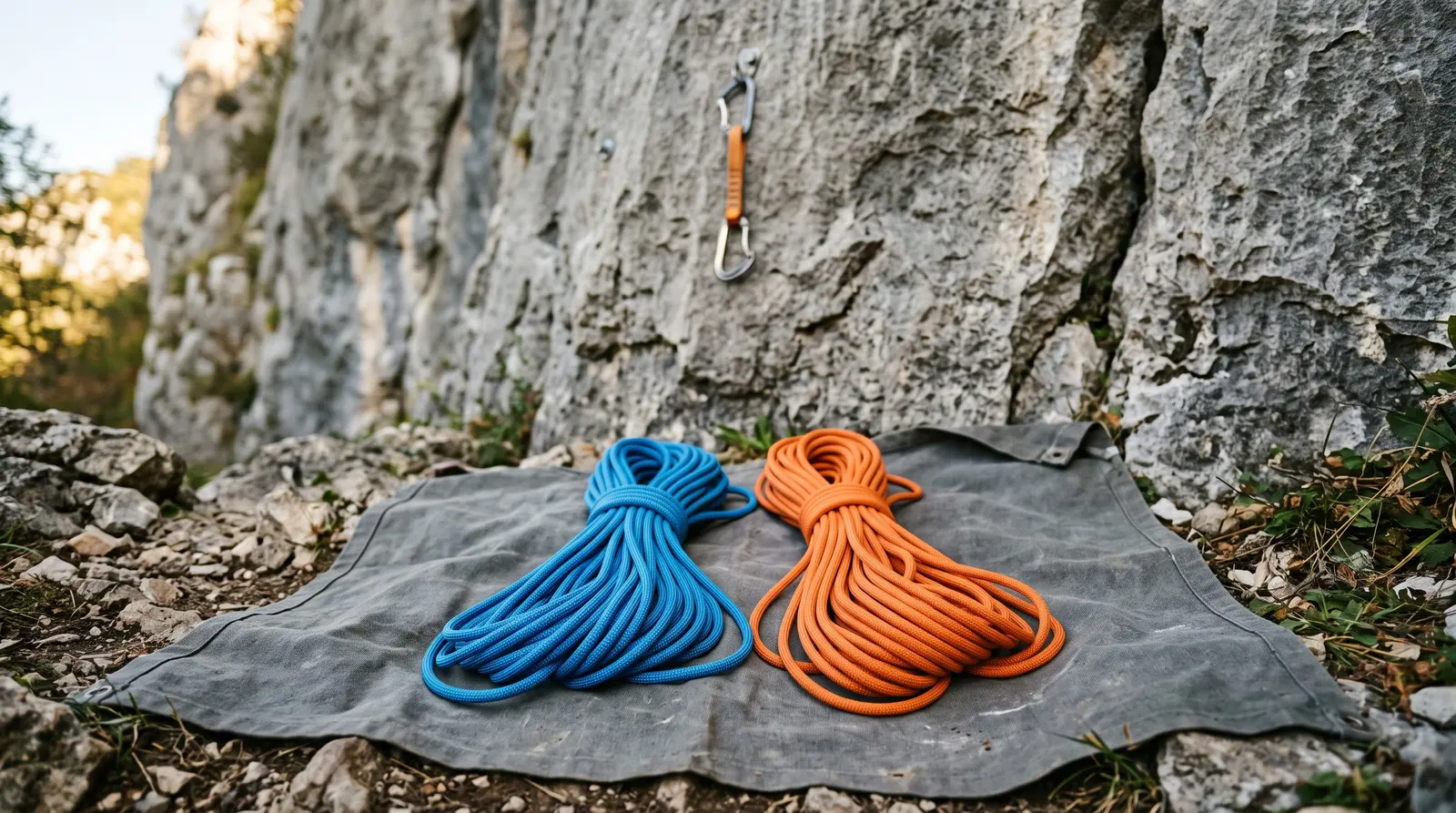
A rope bag (a bag with a built-in tarp) is the cheapest way to extend a rope's life. Mammut says ropes should always be stored in a rope bag to protect them from chemicals, moisture and sharp objects, and recommends laying a tarp under the rope at the crag. Treeline gives the same advice: pile the rope on a tarp or into a bag rather than on the dirt.
- Store it dry, cool and dark. If the rope is wet, leave the bag open until it dries. Keep it away from UV and heat.
- Not in the car. Mammut calls this the main storage mistake: temperatures swing, and contact with battery acid is a reason to replace a rope because the damage is invisible.
- Wash when dirty. Mammut's method: run the rope through your hands to remove dirt, then machine wash at 30 °C (cold) with a mild detergent on a wool programme. Lay it flat to dry in a cool place. Never tumble dry, hang it in the sun or put it on a heater.
- Swap ends. GearJunkie suggests switching which end you tie into, so the same section doesn't take every fall and lower.
- Avoid sharp edges. Mammut calls them the quickest way to end a rope. Extend quickdraws so the rope runs smoothly.
When to retire a climbing rope
There's no fixed number of falls. Follow the manufacturer's guidance and inspect the rope before every use. Mammut's checklist is to pull the whole rope through your hands, looking and feeling for:
- obvious cuts;
- sections much thicker than normal;
- spots that feel stiff or very soft (Treeline and GearJunkie also flag flat spots that may mean core damage);
- discolouration;
- a damaged sheath with the core showing.
Mammut also suggests a loop test: bend a small loop and press it. If it springs back, fine; if the loop collapses, the rope is too damaged to use. If the damage is near an end, you can cut it off; if it's near the middle, retire the rope.
Retire it straight away after contact with acid or other chemicals. Mammut considers a fall above factor 1.0 to compromise a rope, and OutdoorGearLab suggests considering retirement after a very hard fall. Age matters too: Petzl sets a maximum lifetime of ten years from the date of manufacture for textile products, used or not. The production year is printed on the rope end; Mammut suggests writing down your purchase date as well, because the print fades.
Common mistakes when buying a rope
- Buying the gym rope for outdoors. A 30–40 m rope is too short for many outdoor routes. The Rumney accident above involved exactly this.
- Going too skinny too soon. A 9.0 mm rope is light, but it's harder for new belayers to hold and wears faster. Start around 9.5–9.8 mm.
- Ignoring the belay device range. Check the printed range on your device before you buy.
- Using a static rope for lead or top-rope falls. Static ropes are for hauling and fixed lines. Lead only on an EN 892 dynamic rope.
- Trusting the middle mark to decide whether you can lower. Marks fade and move when a rope is cut. Check route length and knot the end.
- Paying for dry treatment you won't use, or skipping it for ice and alpine climbing where it matters.
- Buying used ropes of unknown history. You can't see chemical damage or the falls a rope has taken.
Safety basics before your first rope day
- Knot the end of the rope every time you belay or lower, or have the belayer tie in. This closes the system.
- Check route length against rope length in the guidebook before you climb, and watch the middle mark as you lead.
- Wear a helmet outside. In the Rumney accident, neither climber wore one. See our best climbing helmet guide.
- Learn from a qualified instructor. Tying in, belaying, lead climbing and lowering need hands-on instruction and supervised practice. This guide helps you choose gear; it doesn't teach you to use it.
Prices and stock change often; the button opens the retailer or brand page so you can check today's price.
FAQ
Is a 60 m rope long enough for sport climbing?
For many crags, yes. OutdoorGearLab calls 60 m the US standard, and Bergzeit says 60 m is usually enough in areas with short routes such as the Frankenjura. Many modern sport routes are around 35 m, though, and a rope must be at least twice the height of the lower-off. Check your guidebook, and if you climb on several continents, a 70 m rope covers more routes.
What rope diameter should a beginner buy?
Something around 9.5 to 10 mm. Thicker ropes are easier to hold when belaying, last longer under top-rope and gym wear, and sit in the middle of most belay devices' ranges. Bergzeit recommends 9.5 to 10.5 mm for beginners. Save skinny ropes under 9.2 mm for when you and your belayers have more experience.
Do I need a dry-treated rope for the gym?
No. Gym ropes rarely get wet, and several popular gym and cragging ropes come untreated. Dry treatment is worth it outdoors because it also helps repel dirt, and it's essential for ice, snow and alpine climbing. Look for the 'UIAA Water Repellent' label if you need proven performance in wet conditions.
How long does a climbing rope last?
It depends on use, not a fixed number of falls. Inspect it before every session and retire it if you find core damage, stiff or soft spots, exposed core, chemical contact or a very hard fall. Petzl sets a maximum lifetime of ten years from the date of manufacture for textile products, even if the rope is barely used.
Sources
- UIAA, UIAA 101 Dynamic Ropes, Version 9.1 (2025)
- UIAA, New UIAA standard developed for water repellent ropes (2014)
- EDELRID, EN 892 Dynamic mountaineering ropes: simplified summary of the standard
- Jeff Dobronyi / OutdoorGearLab, How to Choose a Climbing Rope (2024)
- Trish Matheny / OutdoorGearLab, Best Rock Climbing Ropes of 2026 (2026)
- Chris Meehan / Treeline Review, Best Climbing Ropes of 2026 (2026)
- Miya Tsudome and Matt Bento / GearJunkie, The Best Climbing Ropes of 2026 (2026)
- Stefan Rehm / Bergzeit Magazin, Länge & Durchmesser von Kletterseilen (2026)
- Mammut Help Center, Ropes: care, cutting, washing, storage and retirement (2025)
- Petzl, FAQ: What is the lifetime of my Petzl equipment?
- American Alpine Club, Accidents in North American Climbing: Lowering Error at Rumney, Rope Too Short for Climb (2017)
- UIAA Safety Commission, Static rope safety (2022)
- Sterling Rope, Understanding the difference between ropes
- Petzl, GRIGRI (manufacturer specs)