Best Climbing Holds for a Home Wall: Starter Sets, Steep-Wall Holds and Footholds
 Petr Hess, strength & conditioning coach
Updated 2 Nov 2026 · 10 min read
Key takeaways
Best for: Home wall builders choosing holds for their wall angle
- The Metolius PU Mega Pack is the budget starter for vertical walls; MoonBoard School Holds or wooden holds suit 30–45° training walls.
- Match holds to wall angle: a sloper that's fun on a vertical wall can be useless at 40°, where positive holds work.
- Check the hardware on every order: bolts must match the T-nut thread, and Moon sets don't include bolts.
- Buy footholds early, since poor feet on a steep wall make every problem harder; screw-ons fill gaps between T-nuts.
- MoonBoard sets are rated for advanced climbers; keep holds indoors and check for loose, spinning holds before each session.
The best climbing holds for a home wall depend on its angle. For a vertical or slightly overhanging wall, a mixed starter set such as the Metolius PU Mega Pack gives you jugs, edges and feet with all the hardware included. For a 30–45° training wall, you want positive, skin-friendly holds: board-style sets such as the MoonBoard Original School Holds or wooden holds, plus jugs for warm-ups and footholds you can stand on.
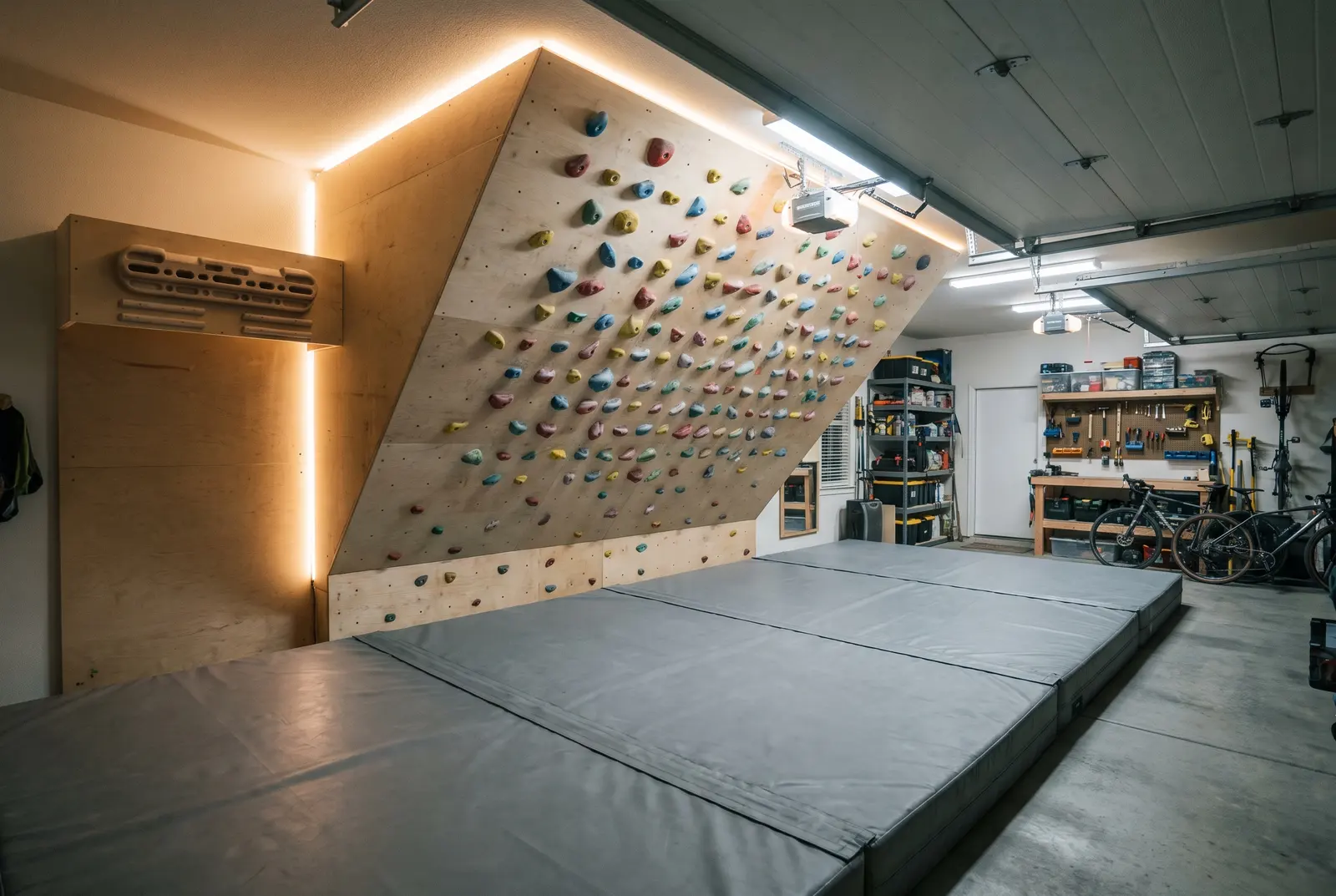
I'm a strength and conditioning coach, and I look at a home wall as a training tool: it should let you set problems you can repeat, progress and recover from. This guide covers the holds; if you haven't built the wall yet, start with our guide on how to build a home climbing wall, which covers angles, plywood and T-nut grids.
Prices and stock change often; the button opens the retailer or brand page so you can check today's price.
Best home wall holds at a glance
Specs and angle guidance come from each maker's product page, checked in November 2026. Where a maker doesn't state an angle, we say so.
| Model | Best for | Key specs (per maker) | Main drawback | Buy |
|---|---|---|---|---|
Metolius PU Mega Pack | Budget starter set, vertical to moderate walls | 30–60 PU holds, random mix, bolts, T-nuts, screws and wrench included | Random shapes, not a training set | Check price at Amazon |
So iLL Bubbies Sampler | Slab, vertical and 15° walls | Sloper family from feet to large, made to order in the USA | Expensive; not listed for walls steeper than 15° | Check price at Amazon |
Metolius Roof Jugs | Warm-ups on steep walls | "Massive jug holds for steep walls and roofs", sets of 2, hardware included | Big holds eat wall space | Check price at Amazon |
MoonBoard Original School Holds | 40° (or 25°) board training | 40 PU hand holds + 10 footholds; bolts not included | Advanced level, unforgiving crimps | Check price at Moon US |
MoonBoard Wood Holds Set A | Skin-friendly steep training | 32 birch-ply holds in 16 mirrored pairs; countersunk bolts required | Expensive, advanced level | Check price at Moon UK |
Metolius Screw-On Handholds | Cheap screw-on feet | 10-packs (40-pack sold out, Nov 2026), self-drilling screws included | Close-out line, so stock may run out | Check price at Amazon |
Beastmaker Resin Footholds | Board footholds | 25mm deep, three profiles (90°, 20° and 30° slope), packs of 4 | Ships from the UK; mounting not stated | Check price at Beastmaker |
How to choose holds for a home wall
1. Match the holds to your wall angle
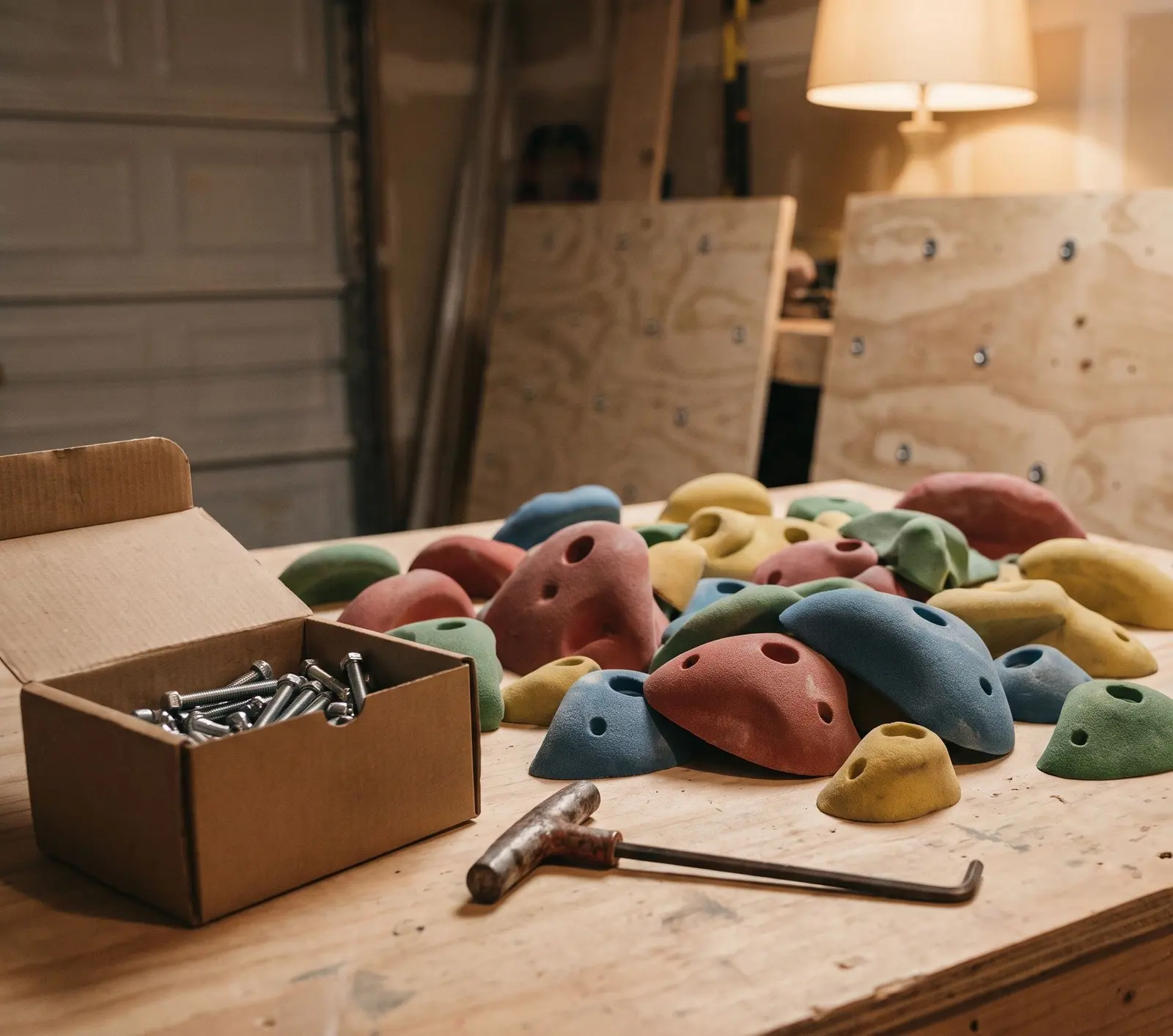
Wall angle changes what a hold feels like more than anything else. A sloper that's fun on a vertical wall can be useless at 40°, and a jug that's a rest at 40° is a ladder rung on a vertical wall. Our guide to types of climbing holds explains jugs, crimps, slopers, pinches and pockets if you need a refresher.
| Wall angle | Hand holds that work | Feet |
|---|---|---|
Vertical to 15° | Small edges, crimps, slopers, pinches; few big jugs | Small screw-ons and smears |
20–30° | Mix of edges, pinches and incut slopers; a few jugs | Small but positive footholds |
35–45° | Positive edges, incut crimps, pinches, jugs for warm-ups; slopers only if well shaped | Positive footholds you can pull on with your toes |
Makers increasingly say which angle a set is for. So iLL describes its Bubbies Sampler as "great for slab, vertical, or 15 degree angles". Moon says its Original School Holds are "designed to complement both the 40-degree and 25-degree MoonBoard setups". Metolius sells its Roof Jugs as "massive jug holds for steep walls and roofs". Look for that line before you buy; if it isn't there, ask the maker.
2. Choose a material: PU, resin or wood
- Polyurethane (PU): the standard for modern holds. It's tough and can be molded into any shape and texture. Metolius Mega Packs and the MoonBoard School Holds are PU. Climbing magazine describes polyurethane holds as sturdier than ceramic-composite alternatives.
- Polyester resin and composites: older-style or textured holds. Beastmaker uses a polyester resin mix (70% fillers, 30% resin) for its footholds and says they won't polish or wear out. Climbing magazine notes that ceramic-composite holds such as Synrock resist spinning and don't polish like plastic but are more fragile than PU.
- Wood: smooth, warm and kind to skin. Moon describes its birch-ply wood holds as "skin-friendly" and resistant to polishing. That's why many steep training boards use wood. The trade-off is fewer shapes and higher prices.
A practical mix for a steep training wall is wood or board-style PU for the hands and grippy PU or resin for the feet.
3. Bolt-on vs screw-on holds
Bolt-on holds attach with a bolt into a T-nut, so you can move them in seconds. Screw-on holds attach directly to the plywood with the screws and mounting holes the maker specifies, which makes them ideal for footholds and for filling gaps between T-nuts. Metolius describes its screw-ons as "low-profile holds that attach to wooden walls with self-drilling screws" that "go where bolt-on holds won't".
Most home walls end up with bolt-on hand holds and a lot of screw-on feet. Many bolt-on holds also have a small hole for a "pinning" screw that stops them spinning; Moon recommends pinning holds that have one.
4. Get the hardware right
Hardware is the most common surprise in a hold order.
- T-nuts: go in the back of the plywood. Metolius sells 3/8 in, 4-prong, zinc-plated T-nuts for 3/8 in bolts.
- Bolts: must match the T-nut thread (M10 and 3/8 in bolts aren't interchangeable), the hold's bolt-head shape and the right length, so the bolt engages the T-nut fully without hitting anything behind the panel. Moon lists M10 bolts on its UK store (for example, 50 M10 x 60mm bolts for the Original School Holds), and its wood holds "must be fixed with countersunk bolts only".
- Included or not: Metolius Mega Packs and Roof Jugs include bolts and T-nuts. Moon and Tension hold sets say bolts are not included.
- Tools: Moon warns not to use an impact driver on its holds. Tighten by hand with the right key.
5. How many holds do you need?
We couldn't find a reliable "holds per square metre" figure, so here's what the sources do say. IndoorClimbing.com's standard layout puts T-nut holes on an 8-inch grid starting 4 inches from the edge, which gives 72 T-nuts per 4 x 8 ft sheet (about 24 per square metre). You don't need a hold on every T-nut. Climbing magazine's sample starter order for a home wall came to 172 holds for about $1,001, at the prices when the list was compiled. Its advice is to favour smaller, versatile holds: they're cheaper and let you use more of the wall, while big holds use up space quickly.
6. Budget by wall size
Prices below are from the makers' own stores, checked in November 2026; they give you a feel for the cost of a first order, not a quote. For the full picture of plywood, framing and mats, see our home climbing wall cost guide.
- One 4 x 8 ft sheet: a Metolius Mega Pack 30 (around $180, November 2026) plus a pack of screw-on feet is a realistic start.
- 8 x 8 to 8 x 12 ft: a 50- or 60-hold pack (around $280–330 from Metolius, November 2026) or a board-style set (the MoonBoard Original School Holds are around $350 on Moon's US store, November 2026), plus extra feet and T-nuts.
- A dedicated training board: wood and board sets cost more per hold; Moon's Wood Holds Set A is around £400 for 32 holds on its UK store (November 2026).
Climbing magazine also suggests cheaper routes: factory seconds sold by weight, used holds from your local gym, and hold subscriptions.
7. Or buy a board system
If you mainly want to train and you have a steep wall, a standardised board (Kilter, MoonBoard or Tension) gives you a fixed layout and a shared problem database in an app. Our comparison of Kilter vs MoonBoard vs Tension explains the trade-offs. The picks below are for climbers setting their own problems, or mixing board holds into a custom wall.
Our top picks, explained
We haven't climbed on these sets ourselves. The picks are based on maker specs and angle guidance and Climbing magazine's home-wall advice.
Metolius PU Mega Pack: best budget starter set
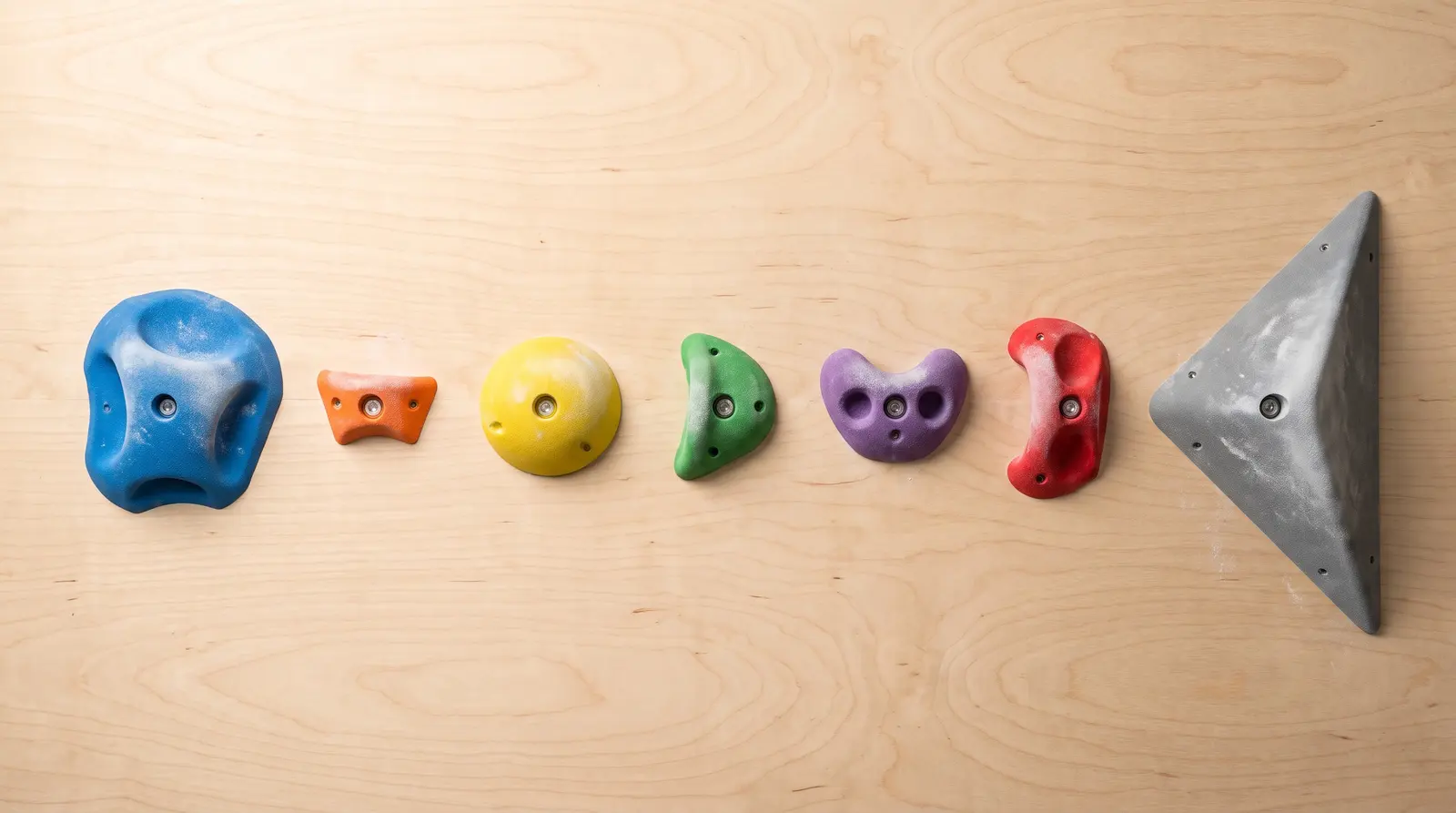
Metolius says its Mega Packs contain "a random mix of various sizes of footholds, screw-on hand holds, modular holds, mini-jugs, macro or roof jugs" in polyurethane, and calls them "the ideal starter kit for your home climbing wall". You choose 30, 40, 50 or 60 holds, and bolts, T-nuts, self-drilling screws and a multi-wrench are included, which removes most of the hardware headache. Metolius's US store listed them at around $180 (30) to around $330 (60) (November 2026).
- Best for: a first wall, vertical to moderately overhanging, especially for a family.
- Main drawback: the mix is random, and the shapes are general-purpose rather than training-specific.
- Skip it if: you're building a 40° board and want precise, repeatable training holds.
So iLL Bubbies Sampler: best for vertical and slab walls
So iLL describes the Bubbies Sampler as a moderate set that's "great for slab, vertical, or 15 degree angles", made up of holds from the Bubbies family "from feet to large, for all your slopey needs". So iLL says its holds are made to order by hand in the USA, with a lead time of about 15 days, and that holds are final sale. It was around $658–662 depending on colour (November 2026).
- Best for: lower-angle walls where you want to practise slopers, footwork and body position.
- Main drawback: it's a premium set, and slopers get much harder on steep walls.
- Skip it if: your wall is steeper than the 15° So iLL lists for this set.
Metolius Roof Jugs: best jugs for a steep wall
Every steep wall needs a few big holds for warm-ups, downclimbing and beginners. Metolius calls its Roof Jugs "massive jug holds for steep walls and roofs". They attach with 3/8 in socket-head bolts, bolts and T-nuts are included, and they come in pairs (around $30, November 2026) or a bulk six-pack.
- Best for: warming up on a 30–45° wall and making it usable for guests.
- Main drawback: big holds take a lot of space on a small wall.
- Skip it if: your wall is vertical and space is tight; there, big jugs mostly serve beginners, warm-ups and downclimbing.
MoonBoard Original School Holds: best for a 40° training wall
Moon's Original School Holds are the first set made for the MoonBoard: 40 polyurethane hand holds and 10 footholds that Moon says are "designed to complement both the 40-degree and 25-degree MoonBoard setups". Moon describes them as "unforgiving crimps and pinches" and rates them for advanced climbers. Bolts and T-nuts aren't included. They were around $350 on Moon's US store (November 2026).
- Best for: strong climbers who want steep, crimpy board training on a custom wall.
- Main drawback: unforgiving holds that will be too hard for many climbers at 40°.
- Skip it if: you climb below the advanced level Moon recommends, or your fingers are recovering from injury.
MoonBoard Wood Holds Set A: best wooden holds
Moon's Wood Holds Set A is 32 bolt-on holds in 16 mirrored pairs, made from birch plywood. Moon calls them skin-friendly and says they would be "perfect for creating your own unique system board style training setup". They must be mounted with countersunk bolts and pinned with 5mm wood screws, none of which are included. The set was around £400 on Moon's UK store (November 2026).
Tension's Wooden Hold Packs are the main alternative, sold as foot, small, medium, large and spraywall packs with the required screws or bolts listed on the page. Every pack was still sold out in November 2026, and Tension doesn't state a recommended angle.
- Best for: skin-friendly, mirrored training on a steep wall.
- Main drawback: expensive per hold, and Moon rates it for advanced climbers.
- Skip it if: you need lots of holds on a small budget.
Metolius Screw-On Handholds: best budget screw-on footholds
Metolius sells Screw-On Handholds in 10-packs (around $30, November 2026), with self-drilling screws included; the Greatest Chips 40-pack was sold out in November 2026. They're low profile, so they work as footholds and as small hand holds between T-nuts. Metolius still marked the line as a 25%-off close-out in November 2026, so stock may not last.
- Best for: filling a wall with cheap, varied feet.
- Main drawback: it's a close-out line, so specific shapes may disappear, and Metolius doesn't publish sizes for each hold.
- Skip it if: you want matching board-style feet.
Beastmaker Resin Footholds: best footholds for a board
Beastmaker's Resin Footholds are designed for board climbing and come in three difficulties: blue with a 90° edge, purple with a 20° slope and black with a 30° slope, all 25mm deep. Beastmaker says the resin mix won't polish and that the bright colours make feet easy to spot against wooden hand holds. They were around £17 per pack of 4 (November 2026).
- Best for: a steep training wall where you want feet of known difficulty.
- Main drawback: Beastmaker doesn't state the mounting method on the page, and the easiest (blue) pack was low on stock in November 2026.
- Skip it if: you need a lot of cheap feet fast.
Setting tips for a small wall
- Start with fewer holds than T-nuts. Leave space to add holds as you find gaps in your setting.
- Buy feet early. On a steep wall, poor feet make every problem harder and teach you to cut loose.
- Mirror where you can. Mirrored pairs let you train both hands equally.
- Keep holds indoors. Metolius says its holds can't be used outside: the material may fade or get damaged, and the hardware will rust.
- Check holds before each session. A loose hold that spins can throw you off without warning.
- Sort the landing first. Even a short wall needs proper matting; our crash pad guide covers pads that work under a home wall.
Bottom line
For a first, lower-angle wall, a Metolius PU Mega Pack with extra screw-on feet is the easiest start, and So iLL's Bubbies suit a vertical wall if your budget allows. For a 30–45° training wall, buy holds that the maker designs for steep terrain: MoonBoard School Holds or wooden holds for your hands, Metolius Roof Jugs for warm-ups and Beastmaker or Metolius feet. Check the hardware line on every order, and add holds slowly as you learn what your wall needs.
FAQ
How many climbing holds do I need for a home wall?
There is no fixed rule. A common T-nut layout gives about 72 T-nuts per 4 x 8 ft sheet, but you don't need a hold on every one. Climbing magazine's sample starter list came to 172 holds for a larger home wall. A 30-hold starter pack plus some screw-on feet is enough to start setting on a single sheet, and you can add holds as you find gaps.
What holds are best for a 40 degree home wall?
Positive holds: incut edges, jugs, pinches and well-shaped crimps, with footholds you can actually stand on. Slopers and tiny feet get much harder as the wall steepens. Moon says its Original School Holds are designed for its 40-degree and 25-degree MoonBoard, and Metolius sells its Roof Jugs for steep walls and roofs.
Are wooden climbing holds better than plastic?
Wood is kinder to skin and resists polishing, so many climbers prefer it for steep training boards. Polyurethane holds can be molded into more shapes and textures and are usually tougher, which suits general setting and footholds. Many home walls use both.
Do climbing holds come with bolts?
Some do and some don't. Metolius Mega Packs and Roof Jugs include bolts and T-nuts, while Moon and Tension hold sets list bolts as sold separately. Always check the hardware line on the product page, and use the bolt type the maker specifies.
Sources
- Climbing magazine, Home Wall Primer, Part 2: Choosing Holds (2022)
- Steve Lage, IndoorClimbing.com, How to Install T-Nuts
- Metolius Climbing, Mega Packs (product page)
- Moon Climbing, MoonBoard Original School Holds (product page)
- So iLL, Bubbies Sampler (product page)
- Beastmaker, Resin Footholds (product page)