Forearm Pump in Climbing: Why It Happens and How to Beat It
 Petr Hess, strength & conditioning coach
Updated 2 Nov 2026 · 11 min read
Key takeaways
Best for: Climbers whose forearms give out on long problems or routes
- Pump comes from hard gripping raising forearm pressure and restricting blood flow; calling it lactic acid is an oversimplification.
- Grip only as hard as the hold needs, and keep your arms straight while getting weight onto your feet.
- In one small lab study, shaking out with the arm hanging low gave about 22% longer endurance than resting on the hold.
- Build aerobic capacity first with ARC and 1-minute on/off intervals, then add power endurance with 4x4s.
- The sample 6-week block combines Lattice and Gripped protocols but hasn't been tested as a whole; adjust it and retest.
Forearm pump is the tight, swollen, burning feeling in your forearms that makes your grip fail on long boulders and routes. It happens because hard gripping squeezes the blood vessels inside your forearm muscles, so oxygen gets in and waste products get out more slowly. You can delay it on the wall by gripping more lightly, keeping your arms straight and shaking out with your arm hanging low, and you can reduce it over weeks with structured endurance training.
I am a strength and conditioning coach, not a climbing coach or physio, and climbing is my favorite complement to my own training. Pump is a good example of where general exercise physiology and climbing meet. This guide explains what is going on in your forearm, what you can do about it in the middle of a climb, and how to train it, with a sample 6-week block. It fits alongside the rest of our climbing training guides.
What is forearm pump?
Your fingers are moved mostly by muscles in your forearm, the finger flexors, which pull on long tendons that run through your palm and fingers. When you hold on to a climbing hold, those muscles contract hard and often for many seconds at a time.
A contracting muscle gets firmer and the pressure inside it rises. In a 2004 study, Schoeffl and colleagues put a pressure catheter into the deep finger flexor compartment of ten high-level climbers and had them climb on a rotating wall until their forearms gave out. Pressure in the compartment rose as the effort got harder, and forearm exhaustion ended the test for every climber. In seven of the ten, pressure returned to normal within three minutes of stopping.
Higher pressure inside the muscle makes it harder for blood to flow through it. When the grip is long and hard, blood flow is restricted (partial occlusion). The muscle runs short of oxygen, relies more on fast, oxygen-independent energy, and byproducts of that work build up. Fluid also shifts into the working muscle, which adds to the swollen, tight feeling. That combination is what climbers call pump.
Why short rests matter so much
The key detail is what happens between grips. When you let go, even for a second or two, blood rushes back in. Research on climbers keeps pointing at this recovery as a big part of endurance:
- MacLeod and colleagues (2007) found that recovery of forearm oxygenation during the rest phases of an intermittent grip test explained 41% of the variation in climbers' endurance performance. They concluded that muscle re-oxygenation during rests predicts endurance.
- Baláš and colleagues (2016) found that sport climbers did better on intermittent tests compared with continuous ones than boulderers and lower-grade climbers did, which they linked to specific aerobic adaptations in the forearm.
In plain terms: you do not get less pumped only by being stronger. You also get less pumped by getting better at refilling your forearms with oxygen in the brief moments you are not squeezing.
The lactic acid myth
Many climbers still say pump is "lactic acid building up". That is an oversimplification at best.
In an influential 2004 review, Robergs, Ghiasvand and Parker argued that there is no biochemical support for lactate production causing acidosis. In their analysis, the acidity during intense exercise comes from the breakdown of energy molecules (ATP) by non-mitochondrial pathways, which releases hydrogen ions. Lactate production actually slows acidosis rather than causing it. They still described rising lactate as a useful indirect marker, because it happens at the same time as the acidity.
Two caveats keep this honest:
- The review is not the final word. Several published letters disputed parts of it, and muscle fatigue has several causes that researchers still argue about.
- Lactate in the blood during climbing is often modest. In the Schoeffl study, mean blood lactate at the end of the climbing test was 3.48 mmol/l, even though every climber was stopped by forearm exhaustion.
The practical takeaway: stop thinking of pump as a poison you need to "flush". Think of it as a blood flow and recovery problem. Everything that lets blood back into the forearm, more often and for longer, helps.
How to avoid getting pumped on the wall
These fixes all work through the same mechanism: lower the grip force you need, or increase the time and quality of blood flow between grips.
1. Grip only as hard as the hold needs
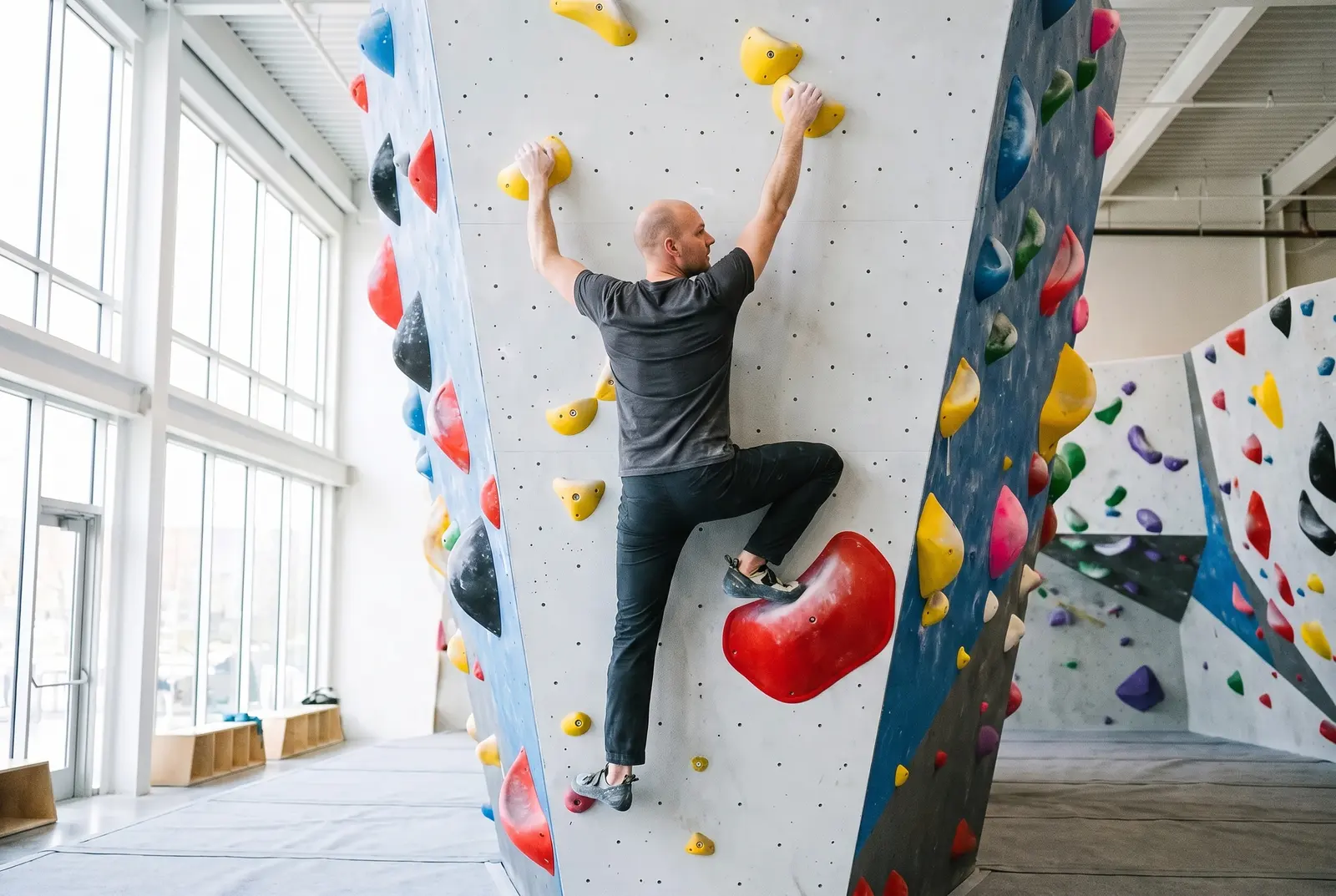
Gripping harder than the hold needs is a common way to get pumped early. Since forearm pressure rises with effort, squeezing harder than necessary restricts blood flow for no benefit. On easy terrain, practice holding each hold as lightly as you can without slipping. On jugs, try relaxing until you feel your fingers just start to open, then add a little back.
2. Keep your arms straight when you can
Hanging on straight arms takes work off your biceps and shoulders. It does not make your fingers work less, though: in a 2023 study of finger hangs, finger flexor activity stayed about the same with straight or bent arms. So pair straight arms with positions that put as much weight as possible on your feet. Bend your arms to move, then straighten them again. Turning your hips into the wall and using your feet well helps here; our bouldering training program covers the technique side.
3. Shake out with your arm hanging low
This is the on-the-wall fix with the most direct evidence, though that evidence is one small lab study, not proof that it beats every other technique. In the Baláš 2016 study, 22 climbers did intermittent grip tests at 60% of their maximum. When they shook the forearm beside the body during the rest phases, compared with resting the hand relaxed over the hold, they lasted about 22% longer, produced about 28% more total force over the test and re-oxygenated their forearm muscles about 32% faster.
How to do it:
- Find a position where you can hang on one straight arm with your feet taking weight.
- Drop the other arm fully below your shoulder, relax your hand and shake it loosely.
- Swap hands before the holding arm gets too pumped, and alternate a few times.
Many climbers also briefly raise the arm above the head between shakes. I could not find a study that tested that specific technique, so treat it as optional. The arm-down shake is the part with data behind it.
4. Breathe steadily
Climbers often hold their breath on hard sequences. Breathing out on hard moves and keeping a steady rhythm at rests helps you stay relaxed, which feeds back into a lighter grip. Use rests to take a few slow, full breaths before you set off again.
5. Pace the climb
- Climb steadily through hard sections. Hanging around on a bad hold, chalking and re-reading the sequence, costs blood flow every second.
- Rest on good holds, not mediocre ones. A rest on a poor hold can pump you more than it recovers you.
- Read the route from the ground. Knowing where the rests and clips are lets you move more decisively.
6. Warm up gradually
Jumping on a hard route or boulder with cold forearms is a classic way to get a fast "flash pump" that lingers for the rest of the session. A gradual warm-up, starting with easy climbing and building towards harder moves, gives the forearms time to get blood flowing before you ask for big efforts. Our climbing warm-up guide has a full routine.
How to train climbing endurance
Short-term fixes only go so far. To get pumped less, you need to train both sides of the problem: your aerobic capacity (how well your forearms use oxygen and recover between grips) and your power endurance (how long you can keep making hard moves). Lattice Training recommends building aerobic capacity first in a training cycle, then adding harder work on top.
ARC (continuous easy climbing)
ARC stands for Aerobic Restoration and Capillarity. Lattice describes it as 20 to 45 minutes of continuous climbing at an intensity where you barely feel pumped, well below your onsight level. On a busy gym wall, traversing or climbing up and down easy routes works.
- Keep the pump at a low, steady level. If it rises, move to easier terrain.
- Use the time to practice light grips, straight arms and quiet feet.
- Lattice also lists a "regeneration" session (Continuity 5x3): three bouts of 5 minutes of climbing, with 3 minutes of rest, at least four grades below onsight, easy enough to hold a conversation.
Aerobic capacity intervals
Lattice's aerobic capacity session is one set of ten 1-minute climbing bouts with 1 minute of rest after each (1:1 work to rest), on terrain about two grades below your onsight level. The pump should only become high near the end of the session. If you are pumped out by rep four, the grade is too hard.
4x4s for power endurance
4x4s are the classic bouldering power endurance workout. As described by Gripped:
- Choose four boulder problems, ideally steep ones with no rests, that feel hard to complete when you are tired.
- Climb all four back to back with as little rest as possible. Newer climbers can start with rest equal to the time the problem took.
- Rest about 4 minutes, then repeat for four sets in total. Start with about 2:1 rest to work between sets and move towards 1:1 as you progress.
- Expect a high pump by the third and fourth sets. If you are falling off regularly, lower the grades next time.
- Progress by raising grades, shortening rests or adding sets, not by climbing faster.
- Leave 48 to 72 hours between sessions, and do no more than two per week.
Gripped also recommends doing 4x4s after a full warm-up and at least 20 minutes of hard bouldering, then resting 10 minutes before starting.
Repeaters on the hangboard
Hangboard repeaters, such as 7 seconds on and 3 seconds off, are a controlled way to train finger strength endurance without route access. They suit climbers who already hangboard safely; if you are new to it, start with our hangboard program. For how repeaters compare with short, heavy hangs, and what the research says about each, read max hangs vs repeaters. If you want to set intensities from your actual pulling force rather than by feel, a force gauge helps; see our Tindeq Progressor buyer's guide.
Sample 6-week endurance block
This block is an illustrative combination of the Lattice and Gripped protocols above. The combination itself has not been tested in a study, so adjust the starting volume and progression to your training history and how well you recover. It assumes you climb about three times a week and want to get pumped less on long boulders or routes. Each line is one session; keep your other climbing day for normal bouldering or projecting. Grades refer to your current onsight level.
| Week | Session A (aerobic) | Session B (harder) | Notes |
|---|---|---|---|
| 1 | ARC: 2 × 15 min, 5 min rest, barely pumped | Aerobic capacity: 6 × 1 min on / 1 min off, 2 grades below onsight | Learn the pacing; finish feeling you could do more |
| 2 | ARC: 2 × 20 min | Aerobic capacity: 8 × 1 min on / 1 min off | Practice arm-down shakes during every rest on the wall |
| 3 | ARC: 30 min continuous | Aerobic capacity: 10 × 1 min on / 1 min off | The full Lattice dose; pump only high at the end |
| 4 | Aerobic capacity: 10 × 1 min on / 1 min off | 4x4: four moderate problems, 1:1 rest within sets, about 4 min between sets | 4x4 problems should feel steady, not limit |
| 5 | ARC: 30–40 min, or Continuity 5x3 | 4x4: same problems, shorter rest within sets or one harder problem | Change only one thing at a time |
| 6 | ARC: 20 min easy | Retest: repeat your week 1 benchmark (see below) | Lighter week to absorb the training |
Before week 1, pick a benchmark you can repeat in week 6: for example, the number of laps you can do on a set circuit, or how far you get on a pumpy route at your limit. Use the same wall angle, holds and rest. If you also hangboard, keep it to your usual routine; do not add a new hangboard block on top of this one.
How much endurance you need depends on what you climb. Lattice suggests at least two endurance sessions a week for route climbers, and at least one for boulderers, with boulderers needing roughly 25–50% of a route climber's endurance volume. For fitting this into your week, see how often you should climb.
Recovery between burns
When you are working a route or a long boulder, the rest between attempts matters as much as the attempt itself.
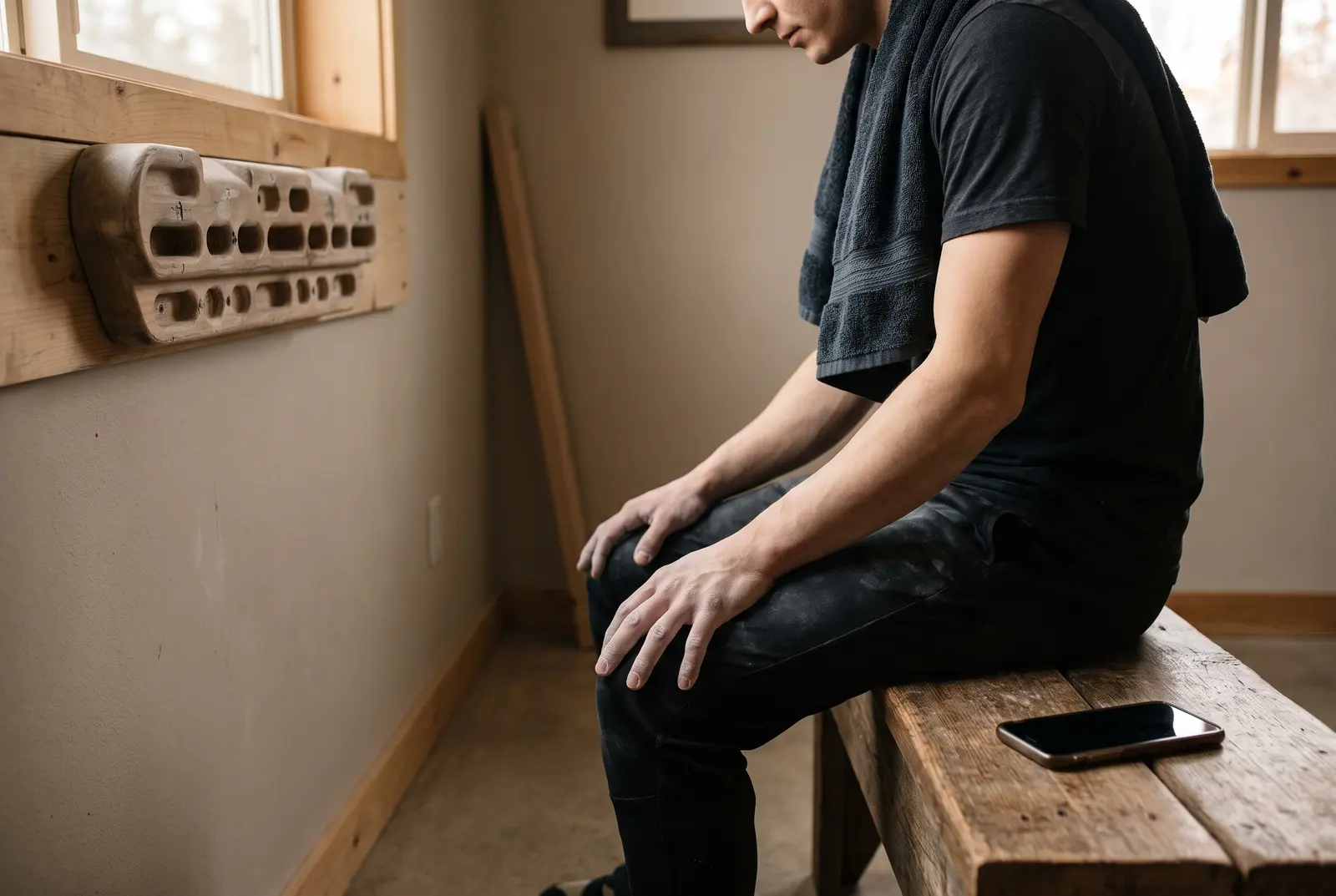
- Rest until your forearms feel normal again. There is no validated rest time that works for everyone. In Schoeffl's study most climbers' forearm pressure returned to normal within three minutes, but that is not the same as being ready for another maximal effort. On a hard project, many climbers wait considerably longer.
- Keep moving lightly. Gentle hand opening and closing, loose arm shakes and walking around keep blood flowing better than sitting still with your arms crossed.
- Do not try again while still pumped. Going back up with heavy forearms tends to make each attempt shorter than the last and adds fatigue without much learning.
- Know when to stop. If each attempt gets noticeably worse, call it a day and save the project for when you are fresh.
For training sessions, follow the rest periods in the protocols above. They are part of the workout, not a break from it.
The bottom line
Forearm pump is mainly a blood flow problem, not a lactic acid problem. In the moment, grip lighter, keep your arms straight, shake out with your arm hanging low and keep moving through hard sections. Over weeks, build an aerobic base with ARC and 1:1 intervals, then add power endurance with 4x4s or hangboard repeaters. Retest after six weeks, and keep doing whatever moved the needle.
FAQ
Is forearm pump caused by lactic acid?
Not in the simple way most climbers think. Lactate is produced when you climb hard, but a well-known 2004 review by Robergs and colleagues argued that lactate production does not cause the acidity linked to fatigue and actually slows it down. Pump is better explained by restricted blood flow through the working forearm muscles and the build-up of metabolic byproducts, including hydrogen ions. The topic is still debated in the scientific literature.
What is the fastest way to recover from a pump?
On the wall, let your arm hang straight down beside your body and shake it gently while the other hand holds on. In a 2016 study, shaking with the arm beside the body led to about 22% longer intermittent grip performance and about 32% faster muscle re-oxygenation than resting the hand over the hold, although this was one small lab study. Off the wall, rest until your forearms feel normal again before the next hard attempt.
How long does it take to build climbing endurance?
Lattice Training suggests at least two endurance sessions a week for route climbers and at least one for boulderers. Most structured endurance blocks run for several weeks, and a 6-week block is a sensible minimum to judge whether you are getting pumped less. Progress depends on your starting level, so retest the same circuit or route at the start and end of the block.
Does a warm-up reduce forearm pump?
Yes, a gradual warm-up is one of the most common pieces of advice for avoiding a fast, early pump, often called a flash pump. Start on easy terrain and build up gradually to harder moves before you try anything near your limit.
Sources
- Schoeffl V, Klee S, Strecker W. Evaluation of physiological standard pressures of the forearm flexor muscles during sport specific ergometry in sport climbers. British Journal of Sports Medicine (2004)
- Robergs RA, Ghiasvand F, Parker D. Biochemistry of exercise-induced metabolic acidosis. American Journal of Physiology (2004)
- MacLeod D et al. Physiological determinants of climbing-specific finger endurance and sport rock climbing performance. Journal of Sports Sciences (2007)
- Baláš J, Michailov M, Giles D, Kodejška J, Panáčková M, Fryer S. Active recovery of the finger flexors enhances intermittent handgrip performance in rock climbers. European Journal of Sport Science (2016)
- Tom Randall, How to Train Climbing Endurance, Lattice Training (2019)
- Aaron Pardy, Boost Your Power Endurance with Bouldering 4x4s, Gripped (2023)
- Exel J et al. Neuromechanics of finger hangs with arm lock-offs: analyzing joint moments and muscle activations to improve practice guidelines for climbing. Frontiers in Sports and Active Living (2023)
- NHS, Compartment syndrome