Best Drill for Building a Climbing Wall: Drill, Impact Driver or Hammer Drill?
 Petr Hess, strength & conditioning coach
Updated 2 Nov 2026 · 12 min read
Key takeaways
Best for: DIY builders choosing power tools for a home climbing wall
- A brushless 18V/20V drill/driver with a clutch and a 1/2 in. (13 mm) chuck is the one essential tool; it drills T-nut holes and sets holds.
- Match the bit to your T-nuts: 7/16 in. for standard 3/8 in. T-nuts, 1/2 in. for industrial ones, 12–13 mm for most M10 T-nuts; test on scrap first.
- Add an impact driver for frame screws, and an SDS-plus rotary hammer only if the wall is anchored to concrete or brick, with anchors specified by a qualified person.
- Wear eye protection and a dust mask, use two hands on big bits, and start hold bolts by hand to avoid overtightening.
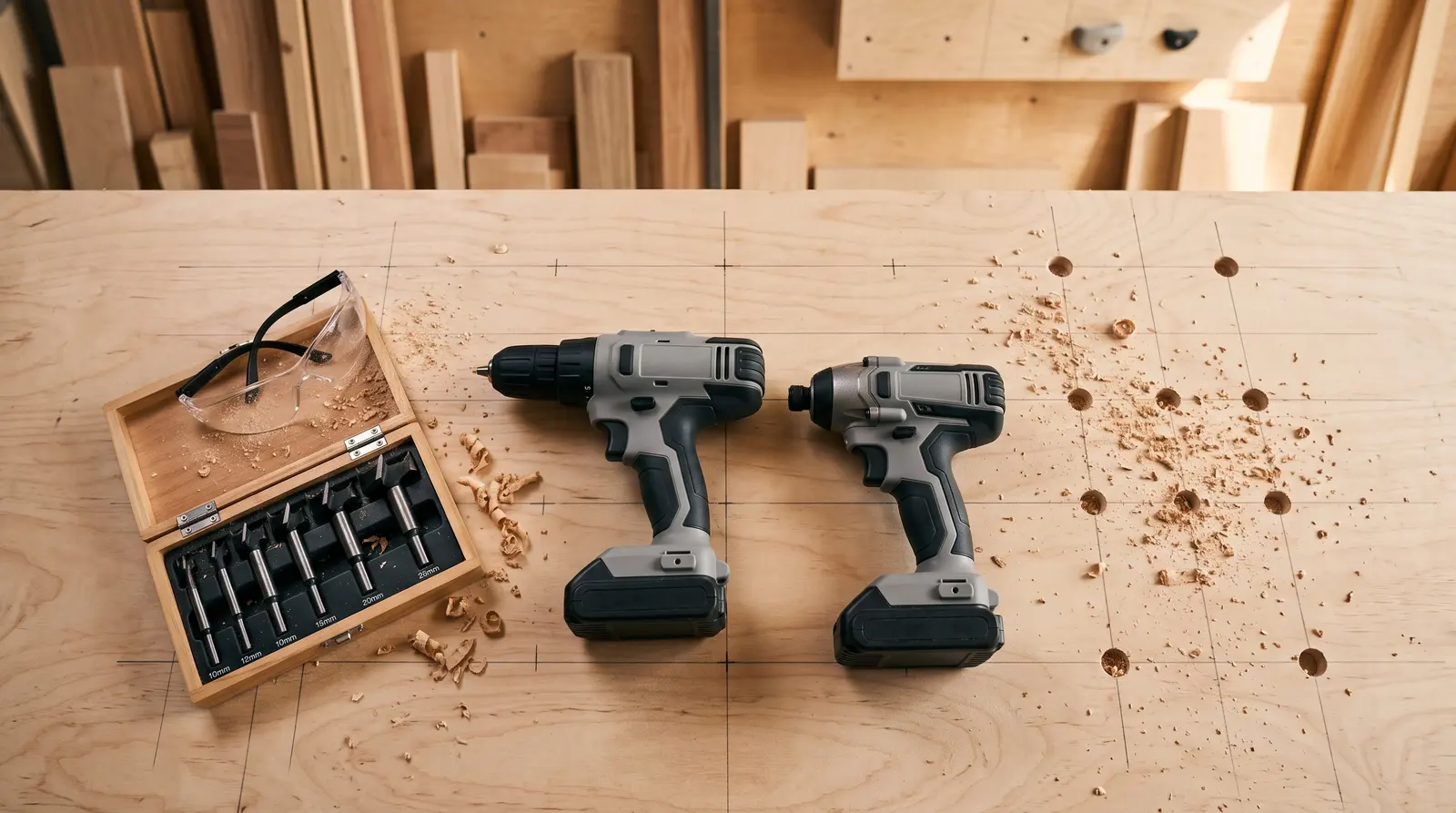
The best drill for building a climbing wall is a brushless 18V/20V drill/driver with a 1/2 in. (13 mm) metal chuck, an adjustable clutch, two speeds and at least two batteries. That one tool bores the T-nut holes and drives most screws. Add an impact driver if you are building the frame yourself, and a hammer drill or SDS-plus rotary hammer only if the wall gets anchored to concrete or brick.
Most home walls need hundreds of identical holes, so comfort, battery life and the right bit matter more than headline torque. We haven't tested these tools ourselves. The shortlist below is built from manufacturer specifications (linked in each section), home-wall build guides from Atomik, IndoorClimbing.com, Moon Climbing and Treeline Review, and route-setter discussion. For the full build process, from framing to holds, see our guide on how to build a home climbing wall. Read how our links work in the affiliate disclosure.
Prices and stock change often; the button opens the retailer or brand page so you can check today's price.
Quick comparison
Torque figures are the makers' own numbers. They are measured differently by each brand (DeWalt doesn't publish a torque figure for the US version of the DCD800 at all), so treat them as a rough guide, not a ranking.
| Model | Type | Voltage | Key specs (official) | Best for | Main drawback |
|---|---|---|---|---|---|
DeWalt DCD800 | Drill/driver, brushless | 20V MAX (US) / 18V XR (EU) | 0–650/0–2,000 rpm; up to 90 Nm (UK spec); 15 clutch settings; 1/2 in. chuck | Most home-wall builders | No hammer mode |
Makita XFD131 kit | Drill/driver, brushless | 18V LXT | 440 in-lbs (50 Nm); 0–500/0–1,900 rpm; 3.8 lb with battery | Makita users, lighter work | Lowest torque here for stacked-panel drilling |
Milwaukee M18 3601-20 | Compact drill/driver, brushless | 18V | 550 in-lbs; 0–550/0–1,700 rpm; 5.7 in. long; 2.3 lb bare | Small hands, overhead work | Bare tool; battery extra |
Bosch GSR 18V-55 | Drill/driver, brushless | 18V | 55 Nm; 0–460/0–1,800 rpm; 20+1 torque settings; wood up to 35 mm | Builders in Europe and the UK | US model codes and availability differ |
DeWalt DCK240C2 | Drill/driver + impact driver kit | 20V MAX | DCD771 drill 0–450/0–1,500 rpm, 300 UWO; DCF885 impact; two 1.3Ah batteries | Tight budgets, US | Small batteries for hundreds of holes |
Milwaukee M18 FUEL 2904-20 | Hammer drill/driver | 18V | 1,400 in-lbs; up to 2,100 rpm; AutoStop control mode | Big builds, some masonry | Far more power than T-nut holes need |
Milwaukee M18 FUEL 2953-20 | Impact driver | 18V | 2,000 in-lbs; 3,900 rpm; 4-mode drive control | Framing screws and lag screws | Not for drilling T-nut holes |
Bosch GBH 18V-22 | SDS-plus rotary hammer | 18V | 1.9 J; concrete 4–22 mm (optimal 4–12 mm); KickBack Control | Anchoring frames to concrete | Single-purpose; 2.3 kg bare |
How many holes will you drill?
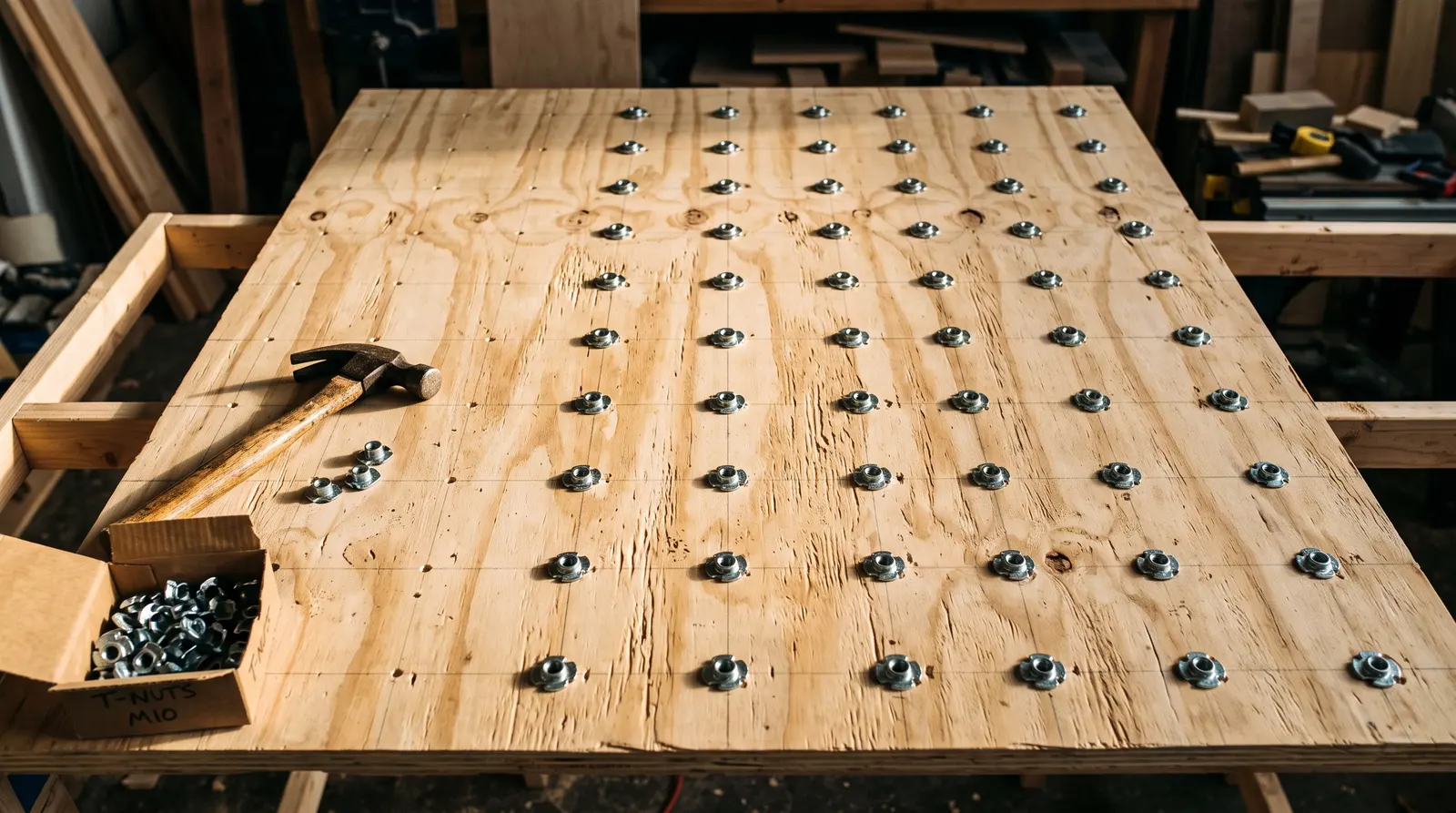
This is what decides how much drill and battery you need. IndoorClimbing.com's classic layout puts T-nuts every 8 in. (20 cm), starting 4 in. from the edges, which gives about 72 holes per 4 x 8 ft sheet. Atomik's drilling guide shows a denser panel with 8 columns and 16 rows, or 128 T-nuts per panel. So a modest three-sheet wall means roughly 216 to 384 T-nut holes, before you count framing screws, pilot holes and screw-on footholds. Plywood grades, grid spacing and T-nut types are covered in our guide to climbing wall plywood and T-nuts.
Hundreds of 7/16 in. holes in 3/4 in. plywood is moderate work for any modern 18V drill. The bigger load comes if you follow Atomik's tip and stack several panels, clamped together, to drill them all in one pass with a long bit. That needs more torque, a long bit and steady pressure, and that's where a 2 Ah battery runs flat quickly.
Drill/driver vs impact driver vs hammer drill
| Tool | What it does on a wall build | Do you need it? |
|---|---|---|
Drill/driver (Akkuschrauber) | Bores T-nut holes, pilot holes, drives screws with a clutch that stops at a set torque | Yes. This is the one essential power tool |
Impact driver | Drives long wood screws and lag screws into the frame quickly; also sets and strips hold bolts | Very useful if you build the frame; optional for a pre-built frame or kit |
Combi / hammer drill | A drill/driver with a hammer mode for small holes in brick and block | Only if you also drill masonry occasionally; it works as a normal drill too |
SDS-plus rotary hammer | Drills concrete and hard masonry for anchors much faster and with less effort | Only if the wall is anchored to concrete or brick, and ideally by the person who designs that fixing |
Combo kit (drill + impact) | Two tools sharing one battery platform | Often the best value if you have no cordless tools yet |
Why a drill/driver comes first
A drill/driver takes round drill bits, spade bits and Forstner bits in a three-jaw chuck, and its clutch lets you set a torque limit so screws stop at the surface. That makes it the right tool for both boring T-nut holes and the delicate job of bolting on holds. In German-speaking countries this is what people mean by an Akkuschrauber for a Boulderwand. Look for a 1/2 in. (13 mm) metal chuck, two speeds, a brushless motor and an LED.
Where an impact driver earns its place
An impact driver hammers in short rotational bursts once a screw resists. That makes it much faster and less tiring for the long structural screws that hold a frame together. Route setters argue about it for holds. In a UKClimbing thread, one gym said its 14V Hilti impact drivers work well because you can start a bolt slowly before the impacts kick in. Others in the same thread blamed impact drivers fired in carelessly for cross-threaded and damaged T-nuts. For a home wall, start each hold bolt by hand or on low speed, and stop as soon as the hold stops spinning. Overtightening cracks holds and spins T-nuts loose.
When you need a hammer drill
Plywood and timber never need hammer action. You only need it if a ledger, wall bracket or frame foot goes into concrete, brick or block. Bosch lists its GSB 18V-55 combi drill for masonry holes up to 10 mm, which suits small plugs and fixings. For structural anchors in concrete, an SDS-plus rotary hammer such as the Bosch GBH 18V-22 is the proper tool. Bosch gives it an optimal range of 4–12 mm in concrete.
T-nut hole sizes and the right bit
Treeline Review's authors bought a bit that didn't match their T-nuts and had to go back over every hole. Check the size before you drill:
| T-nut type | Hole size given by | Size |
|---|---|---|
Standard 3/8 in.-16 pronged T-nut | Atomik, IndoorClimbing.com | 7/16 in. (about 11.1 mm) |
Industrial 3/8 in. T-nut | Atomik | 1/2 in. (12.7 mm) |
M10 hammer-in T-nut | Oliunìd | 12 mm |
Moon Climbing T-nuts (M10 or 3/8 in.) | Moon Climbing | 13 mm / 1/2 in. |
M10 round-base T-nut with screw holes | Anatomic (Slovakia) | about 13 mm |
If a guide says "11 mm", that is the metric near-equivalent of 7/16 in. For metric M10 T-nuts, the sellers we checked specify 12 or 13 mm, so measure the sleeve of your actual T-nut and drill a test hole in scrap. The T-nut should need a firm tap with a hammer, not fall through and not split the wood.
- Spade bit: cheap and fast. Atomik says a spade bit is fine for drilling one panel at a time.
- Long general-purpose or auger-style bit: Atomik used a 12 in. long bit, with a jig, to drill stacked panels.
- Forstner or brad-point bit: the cleanest holes, but slower and pricier. Worth it on a visible face, not needed on a grid hidden behind holds.
- Drilling guide block: Atomik suggests a square offcut of 2x4 with a 7/16 in. hole drilled through it to keep the bit perpendicular.
Both Atomik and IndoorClimbing.com drill from the climbing face so that splinters blow out on the back, where the T-nut flange covers them. Atomik also puts a pallet under the stack so the bit doesn't hit the floor. Our full list of saws, clamps and hand tools is in tools to build a climbing wall.
Batteries and platforms
The battery is a long-term choice: once you own two batteries and a charger, every later tool from that brand is cheaper as a bare unit. DeWalt, Makita, Milwaukee, Bosch, Ryobi and Metabo all have large 18V (20V MAX in the US) families. DeWalt states that its 20V MAX label is the maximum no-load voltage and that the nominal voltage is 18V, which is why the same drill is sold as 18V XR in Europe. Compare tools on torque, speed, weight and battery capacity, not the voltage label.
- Two batteries minimum. One drills while the other charges. Makita says the 3.0 Ah battery in the XFD131 kit charges fully in about 30 minutes.
- Bigger batteries for stacked drilling. Small 1.3–2 Ah packs keep the drill light for overhead hold setting but drain faster on long bits. A 4–5 Ah pack suits a drilling day.
- Stay on one platform. If someone in your home already owns a brand, buy into that one.
- EU vs US. Model codes and kits can differ between markets, so check your local brand site before you buy. DeWalt sells the DCD800 under the same code in the US (20V MAX XR) and the UK (18V XR).
The shortlist
DeWalt DCD800: best overall drill/driver
The DCD800 is DeWalt's brushless 1/2 in. drill/driver. DeWalt's US page lists two speeds (0–650 and 0–2,000 rpm), a 1/2 in. metal ratcheting chuck and a 3-mode LED. The UK 18V XR version is rated at up to 90 Nm, with 15 torque settings. The US kit (DCD800D2) includes two 2 Ah batteries, a charger and a bag; larger-battery kits exist. It has enough power to drill stacked panels with a long bit and a clutch fine enough for bolting on holds.
- Best for: anyone who wants one drill for the whole build and years of hold setting.
- Main drawback: no hammer mode (that's the DCD805), and the 2 Ah kit batteries are small for a long drilling day.
- Skip it if: you already own batteries from another brand.
Makita XFD131: best kit for Makita users
Makita's XFD131 kit lists 440 in-lbs (50 Nm) of maximum torque, two speeds (0–500 and 0–1,900 rpm), a 1/2 in. chuck, 3.8 lb with battery, and a rated wood capacity of 1-1/2 in. The kit includes a 3.0 Ah LXT battery that Makita says charges in 30 minutes. A 7/16 in. hole is well within its capacity; for heavy stacked-panel drilling, Makita's own XFD12 is rated at 530 in-lbs.
- Best for: single-sheet drilling and hold setting on the Makita LXT platform.
- Main drawback: the lowest torque on this list.
- Skip it if: you plan to drill three or four stacked panels at once.
Milwaukee M18 compact brushless 3601-20: best compact drill
Milwaukee lists 550 in-lbs, 0–550 and 0–1,700 rpm, a 5.7 in. length and 2.3 lb as a bare tool, with an all-metal gear case and 1/2 in. metal chuck. Short and light matters when you reach overhead under a 40-degree board to bolt on holds.
- Best for: hold setting, overhead work and smaller hands.
- Main drawback: the -20 is a bare tool, so you'll need M18 batteries and a charger (kits exist).
- Skip it if: you need one drill for stacked-panel drilling and masonry.
Bosch Professional GSR 18V-55: best pick in Europe
Bosch rates the GSR 18V-55 at 55 Nm and up to 1,800 rpm, with 20+1 torque settings, a 13 mm Röhm metal chuck, a brushless motor and 1 kg weight without battery. Bosch lists drilling in wood up to 35 mm. The GSB 18V-55 is the same drill with an impact (hammer) mode for masonry up to 10 mm, if you also need small wall plugs.
- Best for: builders in the UK and EU, and anyone on the Bosch Professional blue 18V platform.
- Main drawback: this model code is from Bosch's European range; in North America check Bosch's local lineup.
- Skip it if: you are in the US. The DCD800 is easier to find there.
DeWalt DCK240C2: best budget combo kit
DeWalt's DCK240C2 pairs the DCD771 drill/driver (0–450 and 0–1,500 rpm, 300 UWO, 1/2 in. chuck) with the DCF885 impact driver (2.8 lb, 1/4 in. hex), plus two 1.3 Ah batteries and a charger. That covers drilling, frame screws and hold setting at an entry-level price tier.
- Best for: first-time builders in the US who own no cordless tools.
- Main drawback: 1.3 Ah batteries are small for hundreds of holes; plan on a bigger battery or patient breaks.
- Skip it if: you want to drill stacked panels or expect to keep building and resetting for years.
Milwaukee M18 FUEL 2904-20: best heavy-duty hammer drill
Milwaukee calls the 2904-20 its most powerful hammer drill: 1,400 in-lbs of torque, up to 2,100 rpm and a 6.9 in. length. It also has AutoStop control mode, which Milwaukee says protects against over-rotation when a bit binds. That is a real safety feature when a long spade or auger bit snags in a stack of plywood.
- Best for: large walls, stacked-panel drilling and occasional small masonry holes on one tool.
- Main drawback: far more torque than T-nut holes or hold bolts need; use a low clutch setting near holds.
- Skip it if: you are building a single 8 x 8 ft board.
Milwaukee M18 FUEL 2953-20: best impact driver for the frame
Milwaukee lists 2,000 in-lbs, 3,900 rpm, a 4.47 in. length and 2.2 lb, with 4-mode drive control for adjusting output speed and power. A low mode helps when you use it on hold bolts; higher modes drive long frame screws quickly.
- Best for: building a timber frame, kicker and bracing.
- Main drawback: hex-shank only, no clutch; not a T-nut drilling tool.
- Skip it if: you buy a pre-built frame or a freestanding kit.
Bosch Professional GBH 18V-22: best for concrete anchors
The GBH 18V-22 is an 18V SDS-plus rotary hammer. Bosch lists 1.9 J of impact energy, a concrete drilling range of 4–22 mm (optimal 4–12 mm), 2.3 kg without battery, and KickBack Control for "enhanced safety against accidental jams". It also lists a vibration emission of 14 m/s² when hammer drilling concrete, so take breaks on longer jobs.
- Best for: fixing a wall frame, ledger or brackets to a concrete or brick wall, after a builder or engineer has specified the anchors.
- Main drawback: single-purpose; it's not the tool for T-nut holes.
- Skip it if: your wall is freestanding or fixed only into timber. You can also hire one for a day.
Which setup should you buy?
| Your situation | Buy |
|---|---|
Pre-built frame or kit panels, just setting holds | A compact drill/driver with a clutch |
Building a timber frame and drilling your own panels | Drill/driver + impact driver (a combo kit is usually best value) |
Drilling stacked panels in one pass | A full-size brushless drill (DCD800 class or above) with 4–5 Ah batteries and a long bit |
Frame anchored into concrete or brick | Above, plus an SDS-plus rotary hammer (buy or hire), with anchors specified by a qualified person |
Already own cordless tools | Stay on your platform; buy bare tools |
Budget-wise, the tools are a small slice of the build next to plywood, T-nuts and holds. See our home climbing wall cost breakdown before you upgrade to the premium tier.
Safety when drilling a climbing wall
- Eye protection, always. Spade bits throw chips, and you'll often drill at face height or overhead.
- Dust mask and extraction. OSHA notes that airborne wood dust may cause allergic and non-allergic respiratory symptoms and cancer. Drilling concrete and brick releases crystalline silica, which OSHA links to silicosis and lung cancer. Use at least a good-fitting dust mask, a vacuum, and work in a ventilated space.
- Hearing protection for hammer drilling and long drilling sessions.
- Two hands and a stable stance. Use the side handle where the tool has one, start large bits on low speed, and clamp the work. A bit that binds can twist the drill hard. Features like Milwaukee AutoStop and Bosch KickBack Control help, but they don't replace a firm grip.
- Secure ladders and scaffolding when you work on the upper part of an overhang.
- Check behind the surface for cables and pipes before drilling any building wall.
- No loose clothing or gloves near a spinning bit, and remove the battery before changing bits.
Common mistakes
- Wrong bit size. Too small and the T-nut splits the ply or won't seat; too big and it spins. Test on scrap with your actual T-nuts.
- Drilling from the back. Drill from the climbing face so the tear-out sits under the T-nut flange.
- Drilling after the wall is up. Drill and fit T-nuts with panels flat on trestles; hammering T-nuts into a mounted overhang is hard work.
- Driving hold bolts on full power. Start bolts by hand or on low speed. Overtightening cracks holds and loosens T-nuts.
- Buying a hammer drill you don't need. Timber and plywood never need hammer action.
- One small battery. Running out halfway through a sheet costs more time than a second battery costs money.
Once the panels are drilled, choose your holds with our guide to the best climbing holds for a home wall, and plan problems with spray wall setting. More build guides are in our home wall section.
Prices and stock change often; the button opens the retailer or brand page so you can check today's price.
FAQ
What size drill bit do I need for climbing wall T-nuts?
For standard 3/8 in.-16 T-nuts, Atomik and IndoorClimbing.com use a 7/16 in. bit (about 11 mm); Atomik says industrial T-nuts need 1/2 in. For metric M10 T-nuts, Oliunìd recommends 12 mm and Moon Climbing specifies 13 mm for its own T-nuts. Always check the spec of the exact T-nuts you bought, and test one hole in scrap first.
Can I build a climbing wall with an impact driver only?
Not really. An impact driver is great for driving long screws and lag screws into the frame, but it takes hex-shank bits and has no clutch, so it is a poor tool for boring hundreds of clean T-nut holes and easy to overtighten hold bolts with. Buy a drill/driver first and add an impact driver if your budget allows.
Do I need a hammer drill for a home climbing wall?
Only if the wall or its frame is fixed to concrete, brick or block. Plywood and timber need a normal drill/driver. A combi hammer drill handles small masonry holes; for larger or many anchor holes in concrete, an SDS-plus rotary hammer is the better tool. Anchoring to masonry should be designed or checked by a qualified builder or structural engineer.
Is 18V the same as 20V for drills?
Usually yes. DeWalt states that its 20V MAX batteries are 20 volts at maximum initial voltage with no load and 18 volts nominal, which is why the same platform is sold as 18V XR in Europe. Compare torque, speed and battery capacity rather than the voltage label.
Sources
- Atomik Climbing Holds, How to Drill a Climbing Wall Panel for T-Nuts
- Steve Lage, IndoorClimbing.com, How to Install T-Nuts
- Moon Climbing, How to Build Your MoonBoard (build guide and FAQ)
- Oliunìd, T-Nuts for Climbing Holds (M10, product page)
- Jocelyn Crawford, Treeline Review, How to Build a Home Climbing Wall
- UKClimbing forums, Drill-driver or impact driver for route setting? (2015)
- Anatomic, Round Base T-nut M10 with holes (product page)
- OSHA, Wood Dust
- OSHA, Silica, Crystalline
- DeWalt, DCD800 20V MAX XR Brushless 1/2 in. Drill/Driver (US) and DCD800 18V XR (UK)
- Makita, XFD131 18V LXT Brushless 1/2 in. Driver-Drill Kit
- Milwaukee Tool, M18 FUEL 1/2 in. Hammer Drill/Driver 2904-20
- Milwaukee Tool, M18 Compact Brushless 1/2 in. Drill/Driver 3601-20
- Bosch Professional, GSR 18V-55 Cordless Drill/Driver
- Bosch Professional, GBH 18V-22 Cordless Rotary Hammer with SDS plus