Freestanding Climbing Wall: DIY Frames, Ready-Made Kits and How to Keep It From Tipping
 Petr Hess, strength & conditioning coach
Updated 2 Nov 2026 · 11 min read
Key takeaways
Best for: Renters and anyone who can't or won't fix a climbing wall to the house structure
- A freestanding wall needs far more floor: Moon's freestanding MoonBoard needs 4,865 mm of depth at 40°, against 2,353 mm for the wall-mounted version.
- Overhanging frames try to tip forward, sway sideways and kick out at the legs; a wide base, floor anchors or calculated ballast plus diagonal bracing deal with it.
- Have a structural engineer or qualified builder check any DIY freestanding frame, and ask your landlord and check the floor before you bring one into a flat.
- Ready-made frames are premium: Moon's freestanding kits list at £8,250–£10,000 in the UK, while Kilter and EverActive adjustable frames are sold by quote.
A freestanding climbing wall is a wall or training board that stands on its own frame and doesn't screw into your walls, studs or ceiling joists. You can build one yourself (an A-frame or a panel held up by a rear "backstay" frame) or buy a ready-made frame such as the freestanding MoonBoard kit, a Kilter adjustable frame or Essential's EverActive wall. They suit renters and rooms with weak or unreachable ceilings. The price is more floor space, more material, and a frame that has to be designed so it can't tip, sway or have its legs kicked out.
This guide compares the four main options, explains where the tipping risk comes from, and shows how much room and money each route takes. It is written by a strength and conditioning coach, not an engineer or carpenter, so it covers what to plan and ask, not a structural design. For the full build process (plywood, T-nuts, holds), start with our pillar guide on how to build a home climbing wall. This page covers the frame question.
Prices and stock change often; the button opens the retailer or brand page so you can check today's price.
Who needs a freestanding wall?
- Renters. Atomik points out that you may need a self-supporting structure if you rent or live somewhere permits are required. In Japan, renters usually have to restore the flat to its original condition when they move out. The rules are set by your contract, and the Ministry of Land, Infrastructure, Transport and Tourism publishes guidelines on restoration disputes. In Germany people search for a Boulderwand freistehend for the same reason. Wherever you live, read your lease and ask the landlord before you bring a heavy structure in.
- Weak or unknown structure. In old houses, garages with light trusses, or rooms where you can't find solid joists, a frame that carries its own load avoids hanging a heavy wall off something you can't trust.
- People who might move. A bolted-together frame can be taken apart and moved. Commercial steel frames are designed for that.
- Outdoor and garden walls. With no building to lean on, an outdoor wall has to be freestanding anyway. Weatherproofing is a separate job (see below).
If you own the house and have sound joists or concrete walls, a wall-mounted build is usually cheaper and takes less floor. Our build guide compares the two side by side.
The four options compared
| Option | How it stands | Best for | Space | Cost tier | Main drawback |
|---|---|---|---|---|---|
DIY A-frame | Two panels (or a panel and a brace) lean against each other in an "A"; the triangle carries the load | Vertical to slightly overhanging walls, kids, two-sided walls | Moderate; both sides of the A take floor | Budget | Hard to make steep; the top of an A-frame is a fall hazard if climbed over |
DIY backstay frame | An overhanging panel held by rear legs, a top beam and a base, braced diagonally, anchored or ballasted | Steep training walls and DIY boards (25–45°) | Large: the frame extends well beyond the panel | Budget to mid | Must be designed for tipping, racking and kick-out; get it checked |
Commercial frame kit (e.g. freestanding MoonBoard) | Engineered steel frame, bolted together, fixed angle set at assembly | A standard board with no carpentry, people who may move | Large and fixed: 2,440 × 4,865 mm footprint for the MoonBoard | Premium | Price, availability and delivery logistics |
Adjustable frame (e.g. EverActive, Kilter adjustable) | Steel frame with crank or electric actuators; floor-anchored or freestanding version | Households with mixed levels, long-term training | Largest; reach changes with angle | Premium plus | Cost, quote-only buying, often needs professional install |
DIY options
A-frame
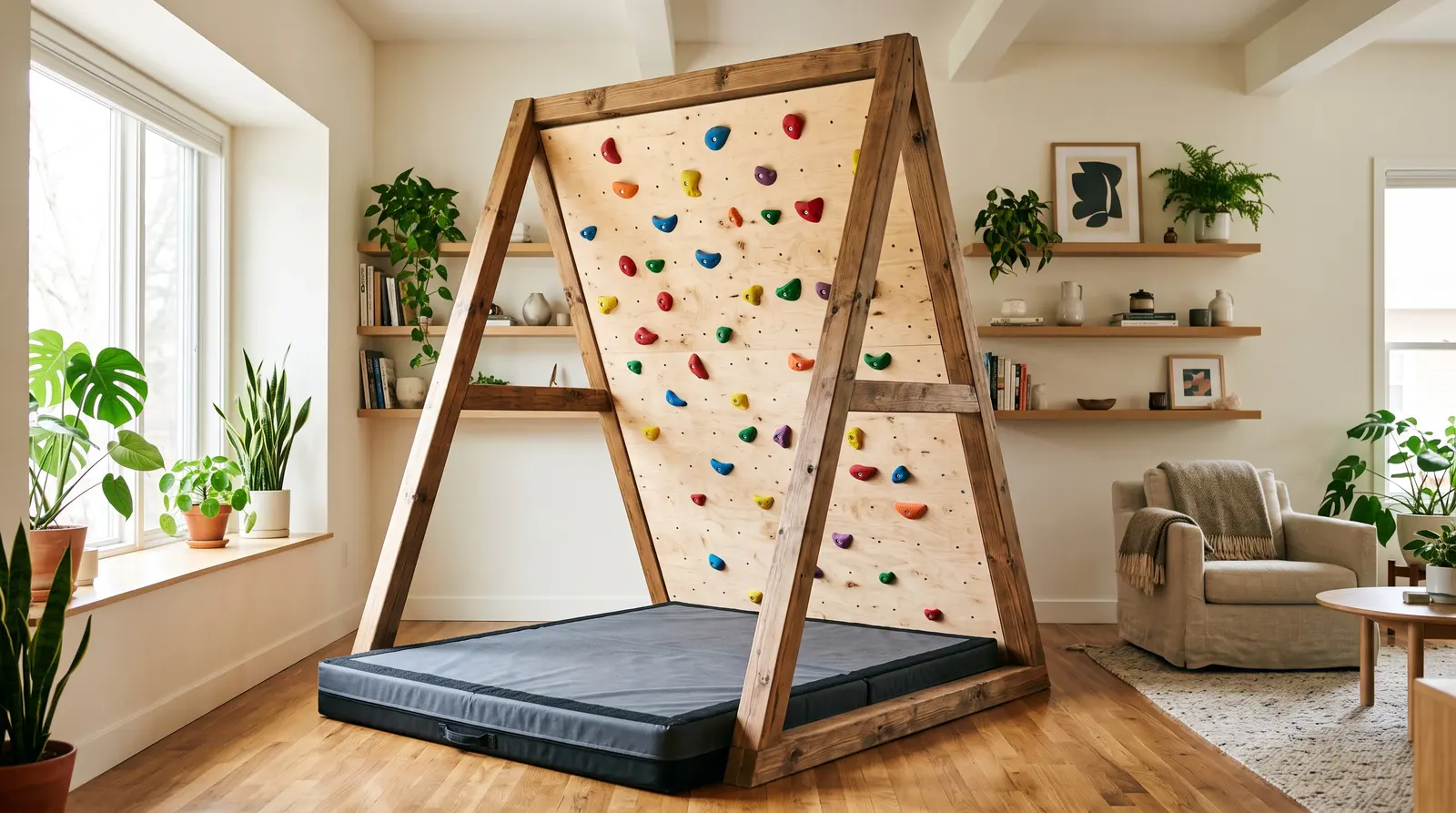
The simplest freestanding design: two faces lean against each other and the floor forms the third side of a triangle. Triangles don't rack, which is why A-frames feel solid at gentle angles. They work well for vertical or slabby walls, kids' walls and two-sided walls you can climb from both sides. Their weakness is steepness. To get a 30–40° overhang, one face has to lean far out, and the A turns into a long, lopsided triangle that needs a lot of floor and a strong tie at the base. For small children, see our kids climbing wall guide, which covers the separate safety standards.
Backstay (self-supporting) frame
Most freestanding adult training walls are this type: the climbing panel is the front face, rear legs or posts hold up the top, and a base of beams on the floor ties everything together. Diagonal braces stop the frame swaying side to side when someone swings or jumps. Atomik's advice for freestanding overhangs is that the wall needs at least 2x6 supports on each end, secured to the ground, and that the posts must not be able to be kicked out: either attach them to the floor or run an attachment plate back to a wall. It prefers a beefier post made from two 2x6s sistered together.
This is the design where the details matter most, so treat any plan you find online as a starting point for a professional to check, not as a proven design.
Ready-made frames and board kits
Freestanding MoonBoard kit (Moon Climbing)
Moon describes the freestanding MoonBoard as a self-assembly, laser-cut, powder-coated steel frame that two people can put together in half a day. The kit includes the frame, painted pre-drilled and T-nutted panels, the LED system and all hold sets for the chosen setup (2016, 2017, 2019 or 2024). You choose 40° or 25° during assembly. Moon lists the tools as a 6 mm hex socket, a 30 mm spanner and socket, and a small scaffold tower.
- Footprint (Moon's figures): 40°: 2,440 mm wide × 4,865 mm deep × 3,554 mm high (8 ft × 15 ft 9 in × 11 ft 7 in). 25°: same width and depth, 4,010 mm high. With the MoonBoard Pad System the width grows to 5,455 mm.
- Logistics: Moon gives the shipping box as about 880 kg. Parts are made to order, and the shipping quote is shown in your cart.
- Availability (3 Nov 2026): sold on Moon's global store; the US store shows it as out of stock and points buyers to the global store.
- Outdoors: Moon says some people set it up outside, but the control box then needs full weatherproofing and the marine-ply panels will delaminate if they stay wet.
- Main drawback: price, an 880 kg delivery, and a fixed angle (you pick 40° or 25° at assembly, not session by session).
- Skip it if: your ceiling is under about 3.6 m (11 ft 7 in) or you can't give up nearly 5 m of floor depth.
EverActive Pro Freestanding (Essential Climbing / Kumiki)
Essential's EverActive Pro is an adjustable wall with electric actuators and a touchscreen controller, sold in 8 × 12, 12 × 12 and 12 × 16 ft sizes, with a 2 ft kicker on the 8 × 12. Tension features it as its adjustable-wall partner. There are two mounting options. The floor-mount version uses specialised concrete anchors and needs 4 in (about 10 cm) of sound concrete. The freestanding version is for when you have no floor to anchor to: the frame connects to beams that Essential lists as 10 ft × 7 in × 5 in. Angles range from 0° to 65°, and the wall can be set up with T-nut patterns for Tension, Moon, Kilter, Grasshopper or a spray layout.
- What's included: powder-coated frame, channel feet, T-nutted panels, the actuators and controls, and assembly hardware. Holds and flooring are extra.
- Install: Essential says professional installation is included with every EverActive Pro. It also notes that a forklift is needed to unload it from the truck.
- Main drawback: pricing is by quote only, and it is a US product. International buyers have to ask about shipping.
- Skip it if: you want a fixed-angle board on a budget. A DIY frame with board holds costs a fraction of the price.
Essential also sells a cheaper, manually cranked EverActive Wall (15–55°, 8 × 10 or 12 × 12 ft, no kicker). Essential's page doesn't say whether it has a freestanding version, so ask before you plan a rental install around it.
Kilter Board frames (Kilter / Setter Closet)
Kilter's frames page doesn't list fixed frame prices. Setter Closet (Kilter's own store, and the US distributor for Lemur frames) quotes frames, panels and mats on request, usually bundled with the holds and LED kit. For DIY frames it will send grid and drilling patterns, but it "encourage[s] you to seek the help of a qualified contractor". The Homewall (HW Fullride) layouts are the home-sized ones: 7 × 10 and 10 × 10 ft boards need no kickboard and list an optimal clearance height of 8–11 ft, while 8 × 12 and 10 × 12 ft boards list 11–14 ft. Kilter's FAQ gives a guide of about $14,000 to $75,000+ for bundles with pads and an adjustable frame, and says those prices vary a lot by size and options.
- Main drawback: quote-only and expensive once you add a frame. White-glove installation is offered in North America at extra cost.
- Skip it if: you only need a fixed angle. Build or buy a simpler frame and add the hold kit.
MoonBoard DIY kit on your own frame
The middle route: build (or have a builder make) a freestanding timber frame, and bolt on Moon's DIY kit, which comes with pre-drilled, pre-T-nutted panels, the holds and the LEDs. Moon says the DIY kit is "designed to be mounted on an existing wall or frame". The build guide asks for four upright supports set 813 mm (2 ft 8 in) apart and a 370 mm kickboard, at exactly 40° or 25°. Wall-mounted at 40°, it needs 2,440 mm of width, 2,353 mm of depth and 3,174 mm of height, plus matting and fall zone. A freestanding frame adds its own depth on top of that.
- Main drawback: you are now designing the freestanding structure yourself, and it needs a professional check.
- Skip it if: you don't want to build. Buy the steel-frame kit instead.
For how the three board systems compare as training tools, see Kilter vs MoonBoard vs Tension.
Stability and safety: why freestanding walls tip
A wall fixed to a building borrows the building's mass and stiffness. A freestanding frame has only itself. Three things try to move it:
- Tipping forward. On an overhang, the panel and the climber lean out past the base of the wall. If the frame's base doesn't reach far enough under that load, or isn't anchored or weighed down, the whole structure can rotate forward over its front feet. Notice how much bigger the freestanding MoonBoard's footprint is than the wall-mounted one: 4,865 mm against 2,353 mm of depth at 40°. The frame needs that room.
- Racking (side sway). Swinging, cutting feet and dynos push the frame sideways. Without diagonal bracing, a rectangle of timber turns into a parallelogram.
- Kick-out and sliding. Legs on a smooth floor can slide, and a leg that gets kicked or knocked can drop the structure. That is why Atomik insists the posts must not be able to be kicked out.
How designers deal with it
- A wider, longer base (feet or rails that extend under the landing zone, as commercial frames do).
- Anchoring to the floor. Concrete anchors in a garage slab, as EverActive's floor-mount version does. On a rental, that may itself need permission.
- Ballast or counterweight on the base. This works only if the weight is sized and fixed in place by someone who has done the calculation. Loose sandbags that can shift don't count.
- Triangulation: diagonal braces in every bay you can reach without blocking the climbing.
The floor matters too
A freestanding wall puts all its weight, plus the climber and the mats, onto a few feet or rails. A concrete garage slab is the easy case. On a suspended timber floor or an upper floor of an apartment building, ask the building owner or an engineer whether the floor can take it. In a flat, think about noise and vibration for the neighbours below as well.
Mats and fall zone
Atomik's guidance: pad every obstacle you could hit, use continuous flooring rather than one crash pad, and plan roughly 1 in (2.5 cm) of foam for every foot (30 cm) of wall height. It notes that gyms pad about 6–8 ft (1.8–2.4 m) out from the wall. On a freestanding frame, the frame members themselves are obstacles: pad the rear legs and any base rails that stick out into the landing zone. Moon's pad system for the freestanding MoonBoard more than doubles the width it needs, which shows how much room good padding takes. See our guide to home climbing wall mats, and learn to fall safely.
Other safety points
- Wear eye and ear protection when cutting and drilling, and a dust mask when cutting plywood or MDF. Our tools guide covers the kit.
- Check bolts, joints and anchors regularly. Timber shrinks and bolts loosen.
- Keep children from climbing the back of the frame or the top of an A-frame.
- Outdoors, plan for rain: Moon warns that its marine-ply panels delaminate if they stay wet.
Space and angle
Two numbers decide whether a freestanding wall fits: height at your chosen angle and total depth (panel overhang + frame + fall zone). Commercial examples:
| Wall | Angle | Width | Depth | Height |
|---|---|---|---|---|
Freestanding MoonBoard | 40° | 2,440 mm (8 ft) | 4,865 mm (15 ft 9 in) | 3,554 mm (11 ft 7 in) |
Freestanding MoonBoard | 25° | 2,440 mm (8 ft) | 4,865 mm (15 ft 9 in) | 4,010 mm |
DIY MoonBoard, wall-mounted (for comparison) | 40° | 2,440 mm (8 ft) | 2,353 mm (7 ft 8 in) | 3,174 mm |
EverActive Wall 8 × 10 (manual) | 40° | 9 ft overall | 7 ft 0 in horizontal reach | 8 ft 2 15/16 in |
Kilter HW Fullride 7 × 10 / 10 × 10 | Adjustable | 7 or 10 ft board | Ask Kilter | 8–11 ft clearance |
Footprints exclude mats and fall zone unless stated. Figures are from Moon, Essential and Setter Closet, checked 3 November 2026.
The steeper the angle, the lower the wall but the further it reaches out. For a mixed-level household, Tension recommends 30 or 40° on its TB2 for V2–V5 climbers and 45° for V6–V10, and says its boards are best on an adjustable wall. Our article on the best home climbing wall angle has the footprint formula and a table for your ceiling.
What a freestanding wall costs
| Tier | What you get | Typical cost |
|---|---|---|
Budget | DIY A-frame or small backstay frame, plywood, T-nuts, starter holds, second-hand mats | Materials at local prices plus an engineer's or builder's check. See our cost breakdown for line items |
Mid | Professionally built or checked timber frame plus a board hold kit (e.g. MoonBoard DIY kit, TB2 sets) | Frame and labour quoted locally, plus the kit. The MoonBoard 2024 DIY kit lists at $5,790 on Moon's US store |
Premium | Steel freestanding board kit | Freestanding MoonBoard kits £8,250–£10,000 (UK store); US listing $11,000–$13,350 but shown as sold out. Plus shipping and mats |
Premium plus | Adjustable steel wall with board holds and flooring | Kilter bundles with pads and adjustable frame about $14,000–$75,000+; EverActive by quote |
Prices are as listed on the makers' sites on 3 November 2026, and they change. Delivery of a steel frame can be a large extra cost.
Common mistakes
- Copying a plan without a check. A frame that looks solid with nobody on it can move under a swinging climber.
- Forgetting the frame's own footprint. People measure the panel's overhang and forget the legs, base and mats around it.
- Leaving frame members unpadded in the fall zone.
- No diagonal bracing, so the wall sways sideways.
- Loose ballast that shifts, instead of a fixed, calculated counterweight or anchors.
- Ignoring the lease and the floor, especially in upstairs flats.
- Too steep for the users. A 45° wall in a family of beginners gets little use.
Not ready for a whole wall?
If you rent and only want finger training, a hangboard on a portable stand or door-frame mount is a much smaller project. See our no-drill hangboard mounts and best hangboards. Once you have a wall, our guide to spray walls and setting and our list of the best climbing holds for a home wall help you get the most out of it.
Prices and stock change often; the button opens the retailer or brand page so you can check today's price.
FAQ
Can I build a climbing wall without attaching it to the wall?
Yes. A freestanding climbing wall carries its own weight and the climber's weight through its own frame to the floor, so nothing is screwed into the walls or ceiling. The trade-off is that the frame needs more floor space and more material, and it must be designed so it cannot tip, rack sideways or have its legs kicked out. Atomik notes you may need a self-supporting structure if you rent.
Will a freestanding climbing wall tip over?
It can if it is badly designed. On an overhanging wall the panel and the climber lean out past the base, so the frame needs a base that reaches far enough, floor anchors, or properly sized ballast to stay put. Commercial frames solve this with engineered steel frames and feet; a DIY frame should be checked by a structural engineer or qualified builder before anyone climbs on it.
How much space does a freestanding board need?
Much more than a wall-mounted one. Moon Climbing lists the freestanding MoonBoard at 2,440 mm wide, 4,865 mm deep and 3,554 mm high at 40 degrees, against 2,353 mm of depth for the wall-mounted DIY MoonBoard at the same angle. Add matting around the sides on top of that.
How much does a freestanding climbing wall cost?
A DIY frame costs the price of lumber, plywood, hardware, holds and mats at your local prices. Ready-made frames are a different league: as of November 2026 Moon lists its freestanding MoonBoard kits at £8,250 to £10,000 in the UK, and Kilter quotes board bundles with pads and an adjustable frame at roughly $14,000 to $75,000 and up. Essential's EverActive walls are sold by quote.
Sources
- Moon Climbing, Freestanding MoonBoard Kit 2024 (product page, 2026)
- Moon Climbing, Choose Your MoonBoard (2026)
- Essential Climbing, EverActive Pro Climbing Wall 8'x12' Freestanding (2026)
- Setter Closet / Kilter, Kilter Board Frame and Mat Options and Board Sizes (2026)
- Tension Climbing, FAQs: choosing a wall angle (2026)
- Atomik Climbing Holds, Common Mistakes Made When Building a Climbing Wall