Spray Wall Guide: What It Is, How to Set It and How to Train on It
 Petr Hess, strength & conditioning coach
Updated 2 Nov 2026 · 11 min read
Key takeaways
Best for: Home wall owners who want to set better spray wall problems and train on them with structure
- A spray wall works best dense: install more T-nuts than you think and fill gaps with screw-on holds.
- Scatter small screw-on jibs through the lower third instead of wasting handholds as feet.
- Give every problem one purpose and agree on foot rules (open, open jibs, tracking) so grades stay consistent.
- Log problems in a spray wall app such as Stōkt or Boardsesh and progress one variable at a time: hold quality, distance, volume, rest or angle.
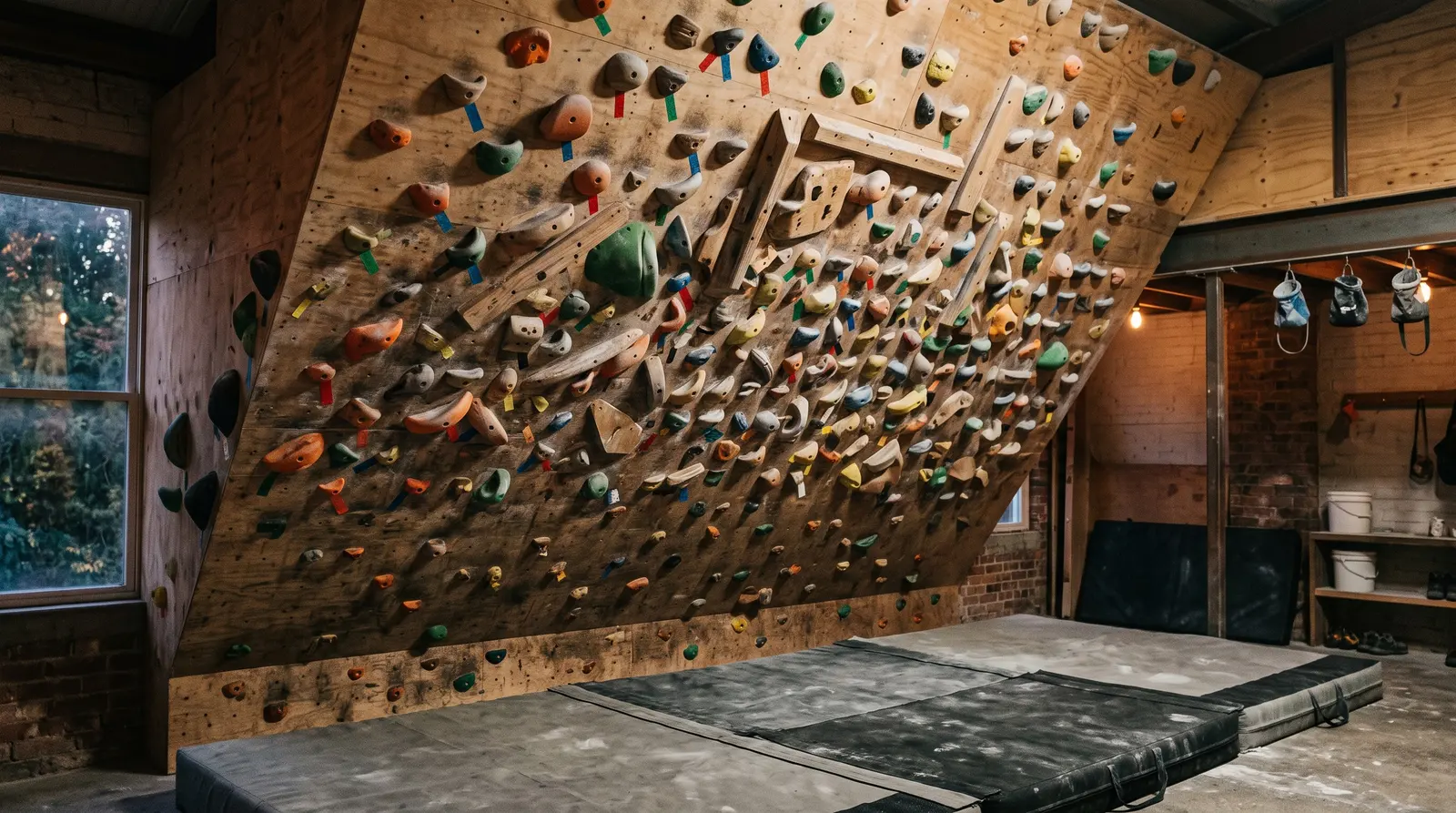
A spray wall is a steep home or gym wall covered in a dense, random-looking spread of holds, with no fixed routes. You invent problems by choosing which holds are "on", so one 8 x 10 ft panel can hold hundreds of climbs. To set one well, fill the wall with a varied mix of holds, scatter small screw-on footholds across the lower third, and give every problem a clear purpose.
I am a strength and conditioning coach, not a professional route setter. So the setting advice below comes from setters and hold makers, cited by name. The training section is where my own background comes in: how to turn a spray wall into a training tool with structure, progression and enough variety to keep you climbing for years. If you are still at the planning stage, start with our guide on how to build a home climbing wall.
Prices and stock change often; the button opens the retailer or brand page so you can check today's price.
What is a spray wall?
Treeline Review describes a spray wall as a training tool that lets you make up routes in the moment. Unlike a gym wall, where each problem has its own coloured holds, a spray wall uses every hold for many problems. You mark a problem with coloured tape, a photo, or an app, and you can change it in seconds without touching a spanner.
Most spray walls are overhanging. A route setter quoted by Treeline Review, Cody Hanson of Movement Climbing Gym in San Francisco, said most experienced boulderers he knows prefer 30 to 60 degrees overhanging, and that you should train at the angle of your goals. For how to pick the angle for your space and level, see our guide to the best home climbing wall angle.
Spray wall vs system board vs LED board
These three wall types overlap, and many home walls mix them. The difference is how the holds are chosen and how problems are shared.
| Spray wall | System board | LED board (Kilter, Moon, Tension) | |
|---|---|---|---|
Hold layout | Dense, varied, chosen by you | Symmetrical, repeated hold types in a grid | Fixed, standard layout from the maker |
Problems | Set by you and your friends | Usually set as drills (same move, both sides) | Shared global database with grades |
Best for | Variety, creativity, training your own weaknesses | Isolating one grip or movement, left-right balance | Benchmarks, comparable grades, structured progression |
Cost | Lowest; buy holds over time | Low to mid | Highest (hold set plus LEDs) |
Main drawback | Grades are guesses; problems can feel contrived | Repetitive movement | Expensive; you cannot change the layout |
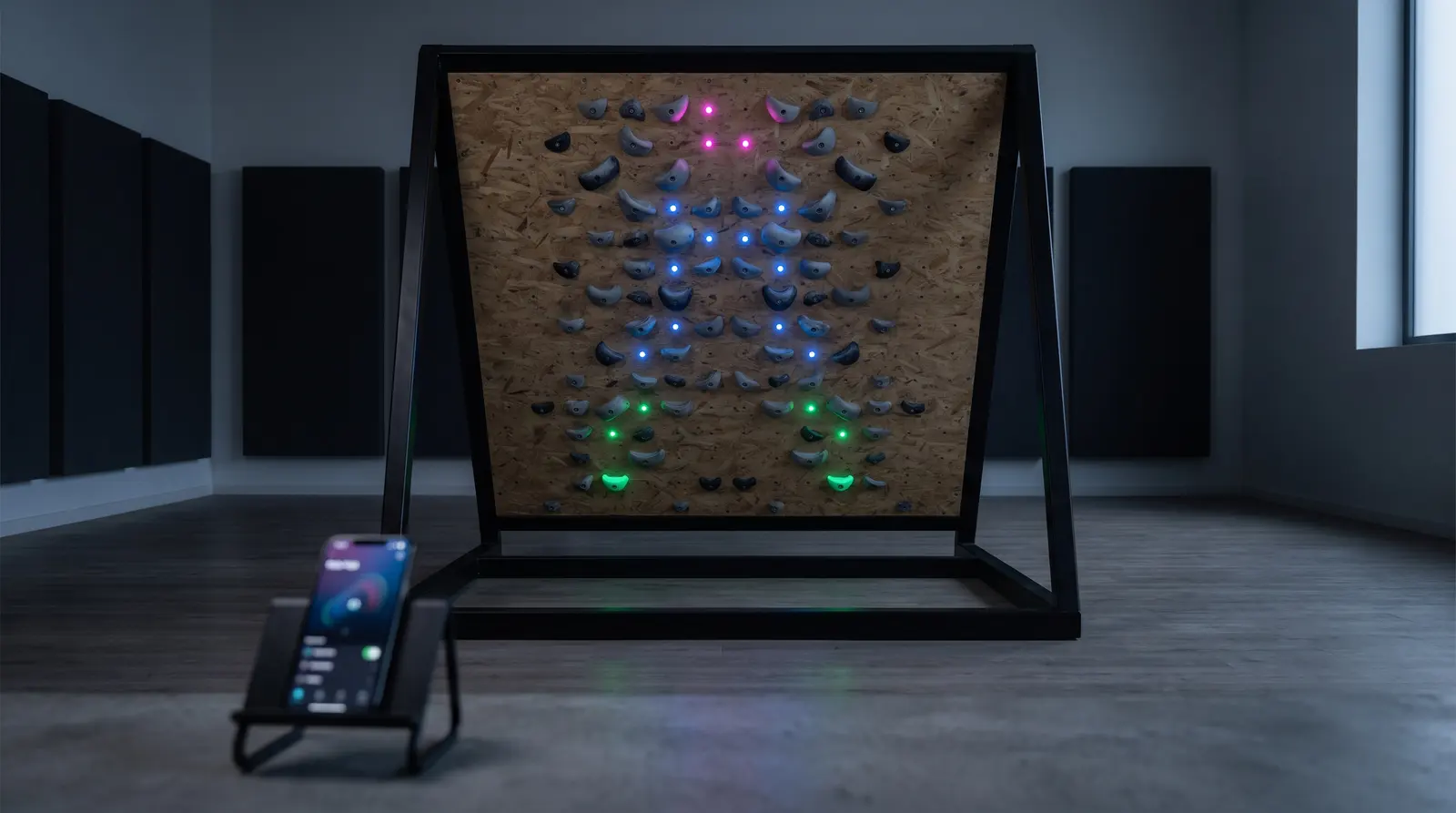
The lines are blurring. Tension sells its Tension Board 2 with a choice of mirror or spray layout from one hold set, and calls the spray layout an "out-of-the-box spray wall". Kilter's Homewall layout is also built for dense home walls. We compare those boards in detail in Kilter vs MoonBoard vs Tension.
How dense should a spray wall be?
Denser than you think. Atomik Climbing Holds says most home wall builders don't install enough T-nuts, and that even 120 T-nuts per panel can leave gaps once big holds cover their neighbours. Their point: the more holds on the wall, the more problems, and the more ways to link problems for power-endurance training.
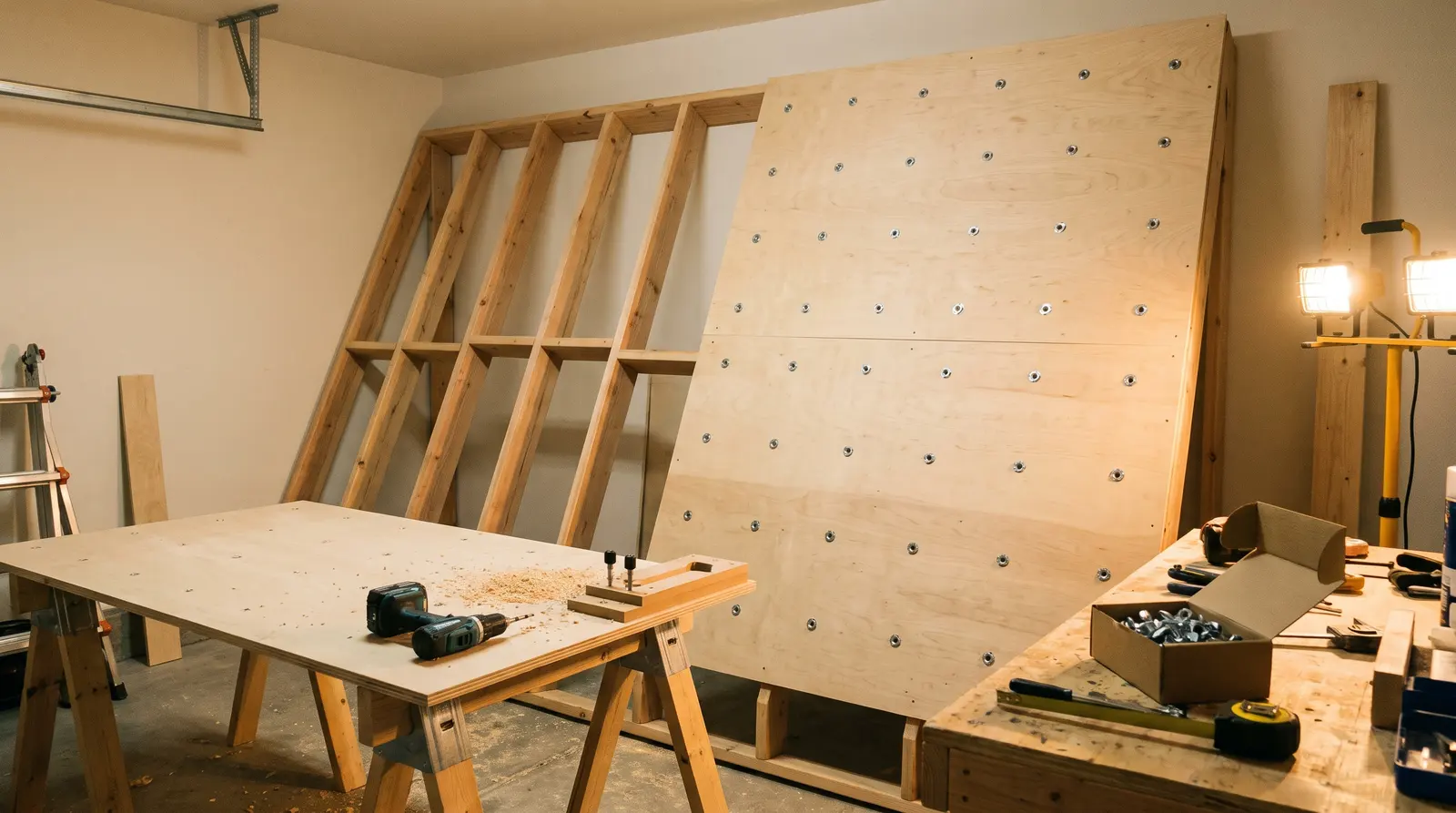
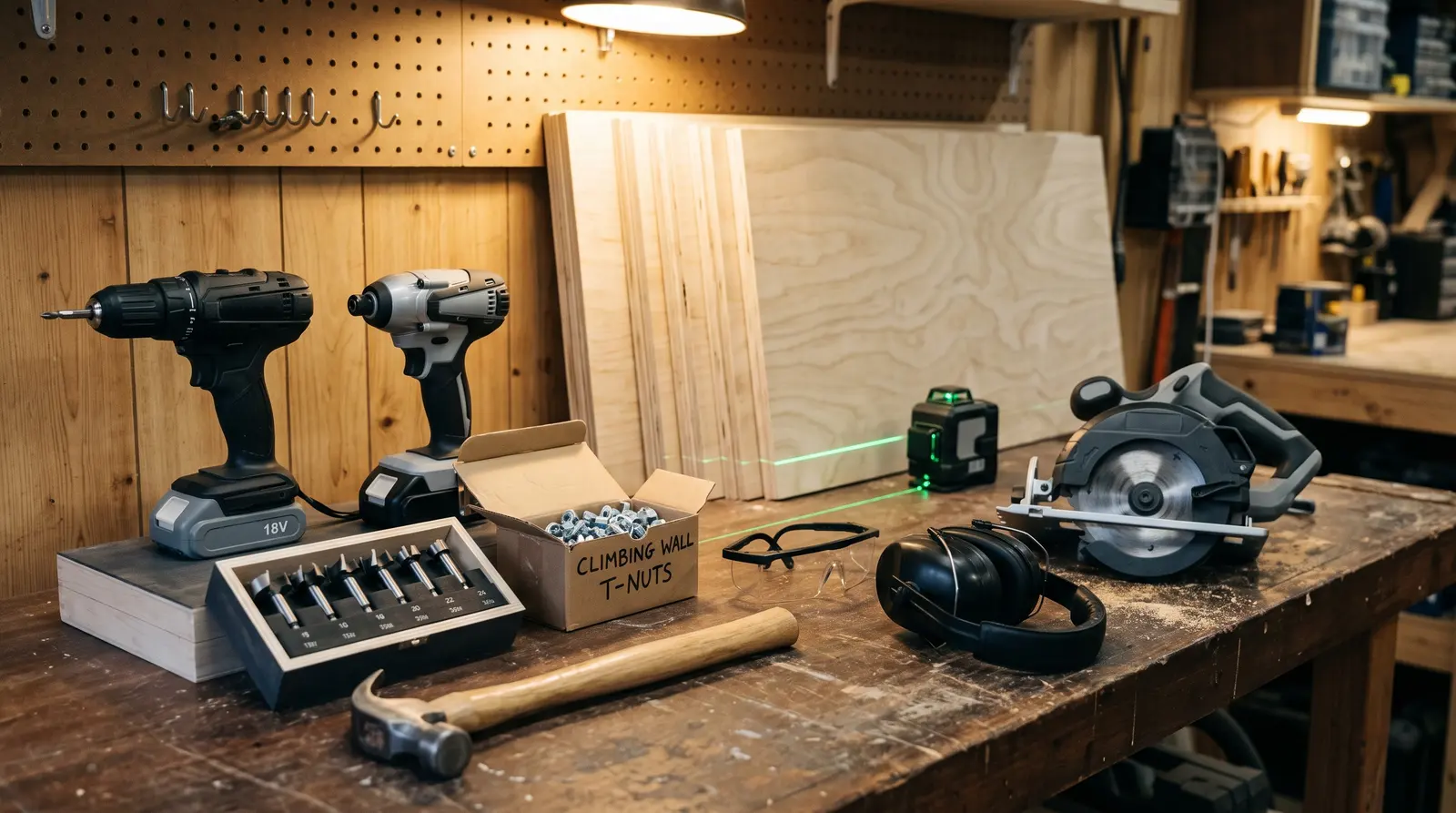
- T-nut grid: a common layout is an 8 in (about 20 cm) grid, which gives about 72 T-nuts per 4 x 8 ft sheet. Denser grids, down to about 4 in (10 cm), give more freedom for a spray wall. See climbing wall plywood and T-nuts for the details.
- Holds per area: Atomik's layout guide, written mainly for family and kids' walls, recommends about one hold per square foot (roughly 10 per m²) when you want variety of routes. Treat that as a floor, not a target: a mature training spray wall usually ends up denser, because screw-on footholds go in between the T-nuts.
- Start smaller: Treeline Review suggests setting a few problems first and then filling the rest of the wall, rather than trying to set a whole spray wall at once.
The hold mix: what to put on a spray wall
We could not find a reliable published percentage split for spray wall holds, so the table below is qualitative. It combines the advice of Climbing magazine's home wall primer, Treeline Review and Atomik. For the names of each hold type, see types of climbing holds.
| Hold type | How many | Where | Why |
|---|---|---|---|
Jugs and mini-jugs | Plenty | Spread across the whole wall, including the top | Warm-ups, easy circuits, start and finish holds. Climbing magazine: "You can never have too many jugs." |
Incut edges and crimps | The core of the wall | Middle and upper wall | Most training problems on steep walls use positive edges |
Pinches | A good handful | Middle wall, varied orientations | Thumb strength and compression moves |
Slopers | Fewer, choose carefully | Where the wall is least steep, or as big features | Flat holds get much harder as the wall steepens (Hanson, via Treeline) |
Pockets and multi-grip holds | Some | Anywhere | One hold, several grips: more problems per T-nut |
Footholds and jibs | Lots, small | Lower third and kicker | Feet everywhere without using up handholds |
Volumes | Optional | High to make it feel steeper, low to make it easier | Change how an old wall climbs without a rebuild |
Climbing magazine's hold primer gives four useful selection criteria: comfort (you want long sessions several days a week), versatility (holds with several grips you can rotate), footprint (big holds eat wall space) and cost. Atomik points out that hold prices follow the amount of resin, so a very cheap big pack usually means small holds. Our best climbing holds for a home wall guide covers specific sets by wall angle.
Jibs and footholds
This is where most home walls go wrong. Climbing magazine's setting primer argues that you shouldn't waste handholds as footholds on a home wall. Home problems involve a lot of traversing, and a handhold placed below waist height is a handhold you can't use on other problems. Instead:
- Buy a couple of dozen screw-on jibs (tiny footholds), ask your gym for old foot chips, or make your own from wood.
- Scatter them permanently and evenly through the lower section of the wall. Treeline suggests the lower third.
- Use screw-ons rather than bolt-ons here: Treeline notes that screw-on foot chips are a cheap way to fill a spray wall, while bolt-on holds are usually too big for foot chips and get expensive across a whole kicker.
- Screw-ons are not for frequent swapping. Treeline notes they can go almost anywhere, but you shouldn't move them often, because each move leaves new screw holes in the plywood.
How to set boulder problems on a spray wall
Start with structure
Climbing magazine's setting primer offers a simple way to beat the blank-wall problem: put a large "X" of jugs from the top corners to the bottom corners. This spreads the big holds across the wall and gives you natural lines in and out of the X. A circular jug traverse of about 25 moves, starting and finishing on the same hold, makes an easy, tendon-friendly warm-up.
Give each problem one purpose
Not every problem has to be a masterpiece. The primer suggests giving each problem one job: an open-hand warm-up, a crimp problem, a toe-hook problem, a footwork problem, a lock-off problem. Hanson's advice via Treeline is to set for your own strengths and weaknesses, and not to keep everything inside your comfort zone. Atomik's founder Kenny Matys adds a setter's rule: a route should teach a lesson or test a skill, have flow, and be fair for different heights. He tends to put the key move in the middle of a problem, not right off the ground or at the very top.
Control difficulty
- Keep it sustained. Home problems are short, so the primer recommends consistent difficulty rather than one defined crux.
- Make holds worse, not moves weirder. Hanson suggests taking a problem inside your comfort zone and simply making all the holds a bit worse. For harder problems, he suggests making every move close to your limit.
- Force the sequence. Rotate holds to force a hand, or use foot rules to keep the hips where you want them.
- Forerun. Climb it again after it is "done", let others try it, and tweak or rotate holds if it doesn't flow.
Agree on foot rules
Most spray wall arguments are about feet. Climbing magazine lists four common rules, and Stōkt lets you attach similar rules to each problem in the app:
- Open feet: any hold on the wall can be used for feet.
- Open jibs: hands follow the problem, feet can also use the small jibs.
- Natural tracking: feet follow the problem, but stemming and heel hooks on the wall are allowed.
- Tracking: feet may use only the marked holds, exactly like the hands.
Write your house rules on a whiteboard near the wall, along with the problem names. If you need a refresher on terms like flagging or tracking, see bouldering terms.
Spray wall setting checklist
- Every hold tight, and checked for spinning before each setting session.
- Jug "X" or a jug circuit in place for warm-ups.
- Small footholds scattered evenly through the lower third and on the kicker.
- Each problem has one stated purpose (grip type, movement or energy system).
- Hard moves in the middle of the problem, not on the first or last move.
- Foot rule chosen and recorded for each problem.
- Reaches checked for shorter climbers (add an intermediate if needed).
- Problem forerun, tweaked and saved (photo, tape or app).
- Landing zone covered, with mats under the whole fall zone. See home climbing wall mats.
- Stale area? Strip it and reset. Climbing's primer recommends stripping the whole wall when everything feels old.
Logging problems: spray wall apps
Tape works, but on a dense wall it gets confusing fast. Apps solve two problems: knowing which holds are on, and keeping a record of what you climbed.
- Stōkt calls itself an app for spray walls, on iPhone and Android. You photograph your wall, and the app maps the holds so you can set climbs. Its features page lists ascent stats (sends, flashes and attempts), crowd grading in Hueco, Font or Dankyu grades, foot-only holds, custom foot rules, circuits with numbered holds, mirror versions on symmetrical walls and partial resets that keep existing climbs. Home walls can start free. Stōkt Pro, aimed mainly at gyms, adds adjustable-angle walls, LED connection and competitions; its page lists it at $20 per month (as of November 2026) with a free 30-day trial. Stōkt also sells its own spray wall LEDs, available in Europe.
- Boardsesh is an app for Kilter, Tension and MoonBoard that also lets you photograph any spray wall and set and log climbs on it. Useful if you train on a board at the gym and a spray wall at home and want one logbook.
- KAYA is a strong app for outdoor guidebooks, beta videos, ascent tracking and gym features, but its homepage doesn't mention home walls or spray walls. Use it for the crag and the gym, not as your spray wall database.
- Crimpd is a training app with structured workouts, timers and workload tracking. It doesn't store spray wall problems, but it is handy for logging the training side of your sessions.
Whatever you use, log three things for each problem: the grade feel, the purpose and whether you sent it. That turns a pile of problems into training data.
Training on a spray wall: an S&C coach's view
A spray wall's strength is also its weakness. Infinite variety is great for movement skill, but with no structure many people climb the same favourite problems at the same effort every session. Training needs two things: progressive overload (the work gets gradually harder) and planned variety (the stimulus changes enough to keep adapting without new injury risk).
How to progress on a spray wall
Change one variable at a time, and only when the current level feels controlled:
- Hold quality: swap one hold in a problem for a worse one.
- Move distance: skip an intermediate or move a hold further away.
- Volume: add moves, link two problems, or repeat a circuit.
- Rest: shorten rest between attempts for power-endurance work, but keep full rest for maximal moves.
- Angle: if your wall adjusts, go steeper only after the lower angle feels solid.
Finger tissues adapt more slowly than muscles. Don't make holds smaller and the wall steeper in the same week, and back off if your fingers feel sore the day after. Our climbing finger injuries guide lists the warning signs.
Sample spray wall sessions
These are general templates, not a personal programme. Always start with a proper climbing warm-up, and fit them into a full bouldering training program rather than adding them on top of a full week.
| Session | Main block | Rest | Stop when |
|---|---|---|---|
Limit bouldering (strength and power) | 2–4 hard problems, a few attempts each, near your max | Full rest, a few minutes between attempts | Movement quality or power drops |
Volume and technique | Many moderate problems with one purpose each (footwork, flagging, heel hooks), tracking feet | Short, as needed | Feet get sloppy |
Power endurance | Link two or three problems into a circuit, or climb a long numbered circuit; repeat a few times | Rest roughly equal to or longer than the work | You can't complete the circuit |
Weakness session | Problems built only on your weak grip or style (pinches, slopers, left side) | Full rest | Fingers or shoulders feel tweaky |
Games day (deload or social) | Add-on game, laser pointer, no-thumbs climbing | Easy | Fun stops |
For most recreational climbers, one or two hard spray wall sessions a week plus easier volume is plenty. How often to climb depends on your level and recovery; see how often should you climb. If you also hangboard, count both towards the same weekly finger load.
Common spray wall mistakes
- Too few T-nuts and holds. A half-empty spray wall gives you a handful of problems, not hundreds.
- Using good handholds as feet. Use jibs and foot chips in the lower third instead.
- Too many slopers on a steep wall. They get much harder as the angle increases.
- No foot rules. The same problem becomes three different grades.
- Climbing favourites forever. Without logging and progression, sessions stop driving improvement.
- Loose holds. A spinning hold is a fall risk. Check and tighten regularly.
- Thin padding. Falls on an overhang go outwards and often happen awkwardly. Pad the whole fall zone.
What to buy for a spray wall
None of these were tested by us. The picks are based on manufacturer specs and on what Climbing magazine, Treeline Review and hold makers recommend for home walls: a cheap mixed base, lots of small feet, and some quality holds for the main training area.
Metolius PU Mega Pack
A mixed starter pack in 30, 40, 50 or 60 holds. Metolius says each pack is a random mix of footholds, screw-on holds, modular holds, mini-jugs and roof jugs, with bolts, T-nuts, self-drilling screws and a wrench included. Best for: filling an empty wall quickly. Main drawback: the mix is random, so you get little control over shapes. Skip it if you already have a base set and need specific grips.
Metolius Greatest Chips (screw-on)
Part of Metolius's screw-on handhold range, sold as a 40-hold pack with self-drilling screws. Low-profile screw-ons go where bolt-on holds won't, which is exactly what you want for foot chips between T-nuts. At the time of writing, Metolius lists the screw-on range as a close-out, so stock may be limited. Best for: scattering jibs across the lower third. Main drawback: screw-ons shouldn't be moved often. Skip it if your plywood is already full of old screw holes.
Atomik 10 Angled Feet (screw-on)
Ten screw-on footholds, 3/4 to 1 in (about 19–25 mm) deep, with optional wood or concrete screws. Atomik is based in Utah and offers a large colour range. Best for: footholds a little more positive than tiny chips, useful on steeper walls. Main drawback: hardware is an extra option, so remember to add it. Skip it if you want only very small feet; Atomik also sells smaller tech feet.
Tension Wooden Hold Packs (Spraywall Pack)
Tension sells wooden hold packs as foot, small, medium, large and spraywall packs. Hardware is not included; the product page lists the exact screws or bolts each pack needs. Wood is kind to skin, which matters on a wall you climb several times a week. Best for: a high-quality wood core for a steep spray wall. Main drawback: premium price and separate hardware, and packs are sometimes sold out. Skip it if you are on a tight budget or your wall is near vertical, where plastic holds give more grip options.
Beastmaker Resin Footholds
Board footholds sold in packs of four in three difficulty levels (blue easy, purple medium, black hard). Best for: a tidy kicker row with consistent feet. Main drawback: small packs, so filling a whole wall adds up. Skip it if you want a random, natural-looking spread of jibs.
The bottom line
A good spray wall is dense, full of small feet, and set with intention. Start with jugs, add positive edges and pinches, scatter jibs in the lower third, agree on foot rules, and log your problems in an app such as Stōkt. Then treat it like any training tool: progress one variable at a time, plan your hard sessions and rest days, and reset the wall when it stops inspiring you.
FAQ
What is a spray wall?
A spray wall is a steep wall covered densely in a random mix of holds, with no fixed routes. You make up problems by choosing which holds are on, usually marking them with tape or saving them in an app. It is the most common layout for home walls because one wall can hold hundreds of problems.
How many holds does a spray wall need?
There is no official number. Atomik's layout guide uses about one hold per square foot for family walls when you want route variety, and says most builders install too few T-nuts, while Climbing magazine's sample starter set was 172 holds. For a spray wall, aim to fill most T-nuts over time and add screw-on foot chips in the lower third.
What is the best app for a spray wall?
Stōkt is built specifically for spray walls: you photograph the wall, it maps the holds, and you set, grade and log problems on it. Boardsesh supports Kilter, Tension and MoonBoard and also lets you photograph a spray wall to set and log climbs. General apps such as KAYA focus on outdoor guides, beta videos and gym logging rather than home spray walls.
Is a spray wall better than a Kilter or MoonBoard?
Not better, different. A spray wall is cheaper, fully customisable and lets you set for your own weaknesses. An LED board gives you a shared database of graded benchmark problems and a standard you can compare across gyms. Many climbers train on both.
Sources
- Climbing magazine, Home Wall Primer, Part 3: Route Setting (2022)
- Climbing magazine, Home Wall Primer, Part 2: Choosing Holds (2022)
- Jocelyn Crawford, Treeline Review, How to Build a Home Climbing Wall (2025)
- Atomik Climbing Holds, How to Fill in the Gaps on Your Home Climbing Wall
- Atomik Climbing Holds, Climbing Hold Layouts
- Stōkt, Features and Stōkt Pro (2026)
- Boardsesh, Climbing app for Kilter, Tension and MoonBoard (2026)
- Tension Climbing, Tension Board 2 product page (2026)