Home Climbing Wall Mats: How Thick, How Big and Which Type to Buy
 Petr Hess, strength & conditioning coach
Updated 2 Nov 2026 · 13 min read
Key takeaways
Best for: Padding a home or garage climbing wall safely on any budget
- Plan about 1/2 to 1 inch of foam per foot of wall height (4–8 in or 10–20 cm for an 8 ft wall), with a firm top layer over softer foam.
- Cover from the base of the wall to well past the point below the top edge, plus the sides; gym landing zones typically reach 6–8 ft (1.8–2.4 m) out.
- Seams and edges cause rolled ankles: strap pads together, use hook-and-loop joins or lay one continuous rug or cover on top.
- Several large crash pads over a base of folding gym mats or foam tiles is the most flexible budget setup; one pad on its own is not enough.
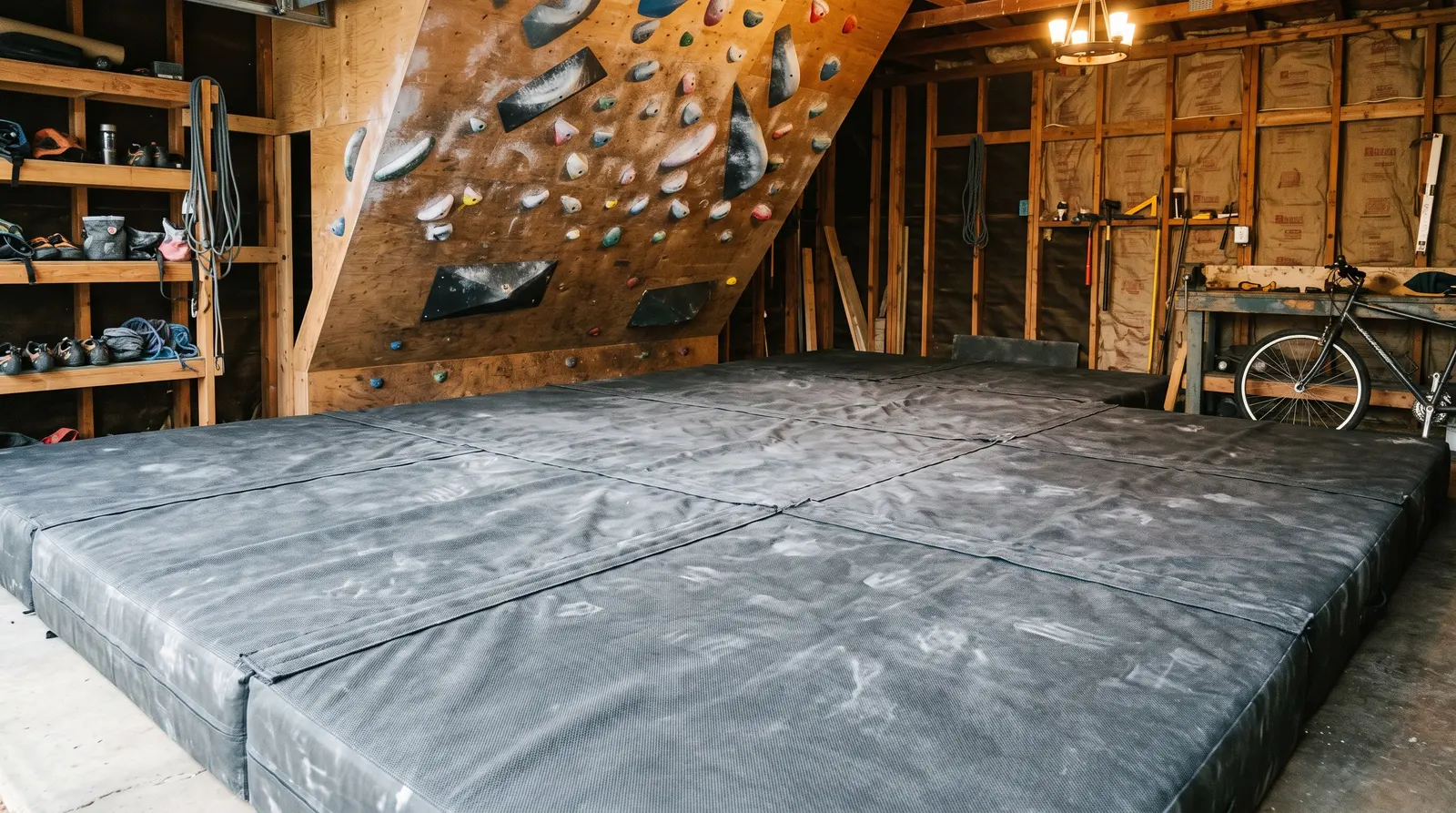
The right home climbing wall mats cover the whole fall zone in one continuous, gap-free surface, from the base of the wall to well past the point where the top edge sits. Plan on about 1/2 to 1 inch of foam per foot of wall height (roughly 4–8 in or 10–20 cm for an 8 ft wall), with a firm top layer over softer foam. Most people either push several crash pads together and cover the seams, or buy a purpose-built home-wall pad system.
Matting is the part of a home wall that people skip, and it is the part that protects your ankles, wrists and head. This guide compares the four realistic options, shows how to size the landing zone and how thick to go, and covers seams, layering and cleaning. If you are still planning the build, start with our guide on how to build a home climbing wall, because the mat zone changes how much floor you need.
A note on how this was made: I'm a strength and conditioning coach, not a flooring engineer or gear tester, and we have not tested these mats. Thickness and sizing figures come from manufacturers and the standards body, and I name the source each time. Some links may be affiliate links; see our affiliate disclosure.
Prices and stock change often; the button opens the retailer or brand page so you can check today's price.
Home climbing wall mat options compared
There are four ways to pad a home wall. Most real setups combine two of them.
| Option | Typical thickness | Best for | Main drawback |
|---|---|---|---|
Bouldering crash pads (several, pushed together) | 4–5.5 in (10–14 cm) | Small walls, renters, people who also boulder outside | Gaps and edges between pads; you need several |
Home-wall pad systems (Moon, Flashed) | 4.25–15.7 in (11–40 cm) | Board walls and serious training setups | Expensive, made to order, limited availability by region |
Folding gymnastics mats | 1.5–2.4 in (4–6 cm) | Base layer, kids walls, very low walls | Too thin on their own for most adult walls |
DIY foam (blocks, mattresses) with a cover or rugs | Whatever you build | Big areas on a tight budget | Quality varies; seams and covers take work |
Thickness ranges come from the products named below: Metolius pads at 4 in, Moon's Saturn at 14 cm, Flashed's Homewall Training Pad at 4.25 in, the MoonBoard Pad System at 400 mm, and Greatmats folding mats at 1.5 in to 2-3/8 in.
How thick should home climbing wall mats be?
There is no single legal number for a private home wall. Atomik Climbing Holds, a US hold maker that publishes wall-building guides, says plainly that "there are no formal standards" for home walls, then gives two rules of thumb in its common mistakes guide:
- 4 in (10 cm) mats or crash pads "may work for short walls", but it is best to plan 1 inch of foam for every foot of wall height.
- For gymnastics-style pads, the general rule is 1/2 to 1 inch per foot, so an 8 ft wall should have 4 to 8 in of padding, and you should never go below 2 in of industrial-grade pad.
Here is what that rule gives you, measured from the top of the mat to the highest hold you can fall from. If you climb right to the top of the wall, use the wall height.
| Wall height | Minimum (1/2 in per ft) | Recommended (1 in per ft) |
|---|---|---|
7 ft (2.1 m) | 3.5 in (9 cm) | 7 in (18 cm) |
8 ft (2.4 m) | 4 in (10 cm) | 8 in (20 cm) |
10 ft (3.0 m) | 5 in (13 cm) | 10 in (25 cm) |
12 ft (3.7 m) | 6 in (15 cm) | 12 in (30 cm) |
For comparison, Moon Climbing's own MoonBoard Pad System for the freestanding MoonBoard is 400 mm (15.7 in) thick, which shows what a board maker considers appropriate for a full-height training board.
What about EN 12572-2?
In Europe, public bouldering walls are covered by EN 12572-2:2017, "Artificial climbing structures: Safety requirements and test methods for bouldering walls". According to BSI's summary, it specifies safety requirements "including the safety zone", and the 2017 edition added a table on shock absorbing, a table on the size of the impact area and a test for shock-absorbing surfaces. The full text is a paid document and I haven't read it, so I won't quote its numbers. If you are building a wall for a club, school, rental or anything other people pay to use, buy the standard or hire a wall builder who works to it. For a private garage wall, it is the reason gym floors look the way they do, not a rule you are bound by.
How big should the landing zone be?
The mats have to catch you wherever you come off, and on an overhang that is not straight below the base.
- Depth: start at the base of the wall (or the kicker) and go past the point on the floor directly below the top edge of the wall. On a steep wall that point is already well out into the room; our guide to the best home climbing wall angle has a footprint table for 30°, 40° and 45°. Then add a margin for swinging falls. Atomik says gym landing zones generally extend 6–8 ft (1.8–2.4 m) out from the wall to protect a big swinging fall from the top.
- Width: go beyond both sides of the wall. Moon's MoonBoard guide says that with the MoonBoard Pad System the freestanding board's space requirement increases to a width of 5,455 mm. For a 2,440 mm-wide board, that is about 1.5 m (5 ft) of padding on each side.
- Obstacles: anything you could hit on the way down counts. Atomik's list includes workbenches, furniture, cars, garage door openers and ceiling joists: move them, wrap them in foam or cover them with a pad.
As a worked example, Moon's pad system for the freestanding MoonBoard measures 5,455 mm wide x 4,865 mm deep (about 17.9 x 16 ft). That is a full board setup; a small 8 ft wide garage wall at a gentle angle will need much less, but the proportions are a good reminder that the mat zone is often bigger than the wall.
Crash pads vs gym matting at home
Crash pads
Bouldering pads are the most common starting point because you may already own one and they go outside with you. They are built for falls onto rough ground, with a stiff top layer and a durable shell. The problem at home is coverage: a standard 3 x 4 ft pad covers 12 sq ft (about 1.1 m²), so a home wall needs several, and the joins between them are, in Atomik's words, "notoriously hard on ankles and wrists". Atomik also says one old crash pad "is not enough". Larger pads help: the Metolius Magnum is 4 x 6 ft (1.2 x 1.8 m), which means fewer seams for the same area. For help counting pads, see how many crash pads you need and our best crash pads guide.
Home-wall pad systems
These are made for indoor use: big, flat sections that join into one continuous surface.
- MoonBoard Pad System (Moon Climbing): a two-foam system "designed specifically to protect the landing under your Freestanding MoonBoard", 400 mm thick, with a firm high-density base and a softer top foam. The pads overlap and fasten with industrial-grade Velcro, and the front is chamfered for sit starts. It is made to order, ships on three pallets at about 805 kg, and no standalone price is listed; shipping and delivery are quoted after you order a MoonBoard.
- Flashed Modular Pro Pad and Homewall Training Pad: Canadian-made modules that connect with hook-and-loop strips. The Modular Pro Pad is 80 x 54 x 8 in (203 x 137 x 20 cm); the Homewall Training Pad is 66 x 42 x 4.25 in with PU and PE foam. As of November 2026, Flashed's site says it is not currently shipping to the US.
- Kilter: Kilter's board prices exclude mats, and its help page says that if you are also installing frames, panels and padding, installation takes an extra 2 to 3 days. Padding is handled through a quote, not an online product.
Folding gymnastics mats
Folding panel mats are cheap per square foot, easy to clean and join edge to edge with hook-and-loop strips. They are thin, though. Greatmats' folding mats run from 1-3/8 in to 2 in in their folding mat guide, and its combo mat is 2-3/8 in (1-3/8 in polyethylene base plus 1 in polyurethane top). By Atomik's rule that is fine as a minimum layer, or as the base under crash pads, but not as the only padding under an adult wall of normal height. Greatmats itself says most of its mats "are not designed for falls of significant height" and suggests 12–18 in polyurethane landing mats for indoor climbing; it also says its interlocking puzzle mats are rated for fall heights of up to 4 ft only in the 1.5 in version, which makes them a kids-wall option, not an adult one.
Foam types: open-cell vs closed-cell
Almost every good climbing pad uses layers of different foams, and the same idea works for a home wall.
- Closed-cell foam (usually polyethylene, PE) is firm and does not absorb water. Metolius uses a stiff closed-cell top sheet to minimise "bottoming out" and a closed-cell base so sharp objects cannot push up through the pad.
- Open-cell foam (usually polyurethane, PU) is softer and absorbs the impact. Metolius puts a thicker open-cell layer in the middle. The Magnum uses 1 in (25 mm) closed-cell on top, 2.5 in (60 mm) open-cell in the centre and a thin closed-cell base; Moon's Saturn uses 30 mm closed-cell over 110 mm open-cell.
Climbing House's DIY crash pad guide describes the same structure (a thick, softer PU core sandwiched by thinner, firmer layers) and warns that homemade pads built from ordinary cushion foam are "probably better than nothing" but won't protect you like dedicated gear. Moon's pad system flips the order for a fixed indoor floor: firm high-density base for stability, softer impact-absorbing top.
DIY mats on a budget
You can get a reasonable landing for much less than a commercial system if you take seams seriously. Atomik quotes one home-wall builder who found 16 toddler mattresses, 200 sq ft of interlocking 1/2 in foam squares for underneath and several area rugs for the top, spending about $200 for a short garage wall. Atomik's advice for this kind of setup:
- Old mattresses are a good budget choice, but falling into the crack between two of them "can break your ankle".
- Lay thick, large rugs over the top to spread your weight and keep feet out of the cracks.
- Look at the gymnastics industry, which mass-produces pads, and stick to the 1/2 to 1 in per foot rule.
A sensible DIY build, combining those points:
- Base: interlocking foam tiles or folding gym mats over the whole zone, so the floor is never exposed.
- Core: the thick layer: crash pads, gym crash mats or foam blocks, pushed tight with no gaps. Stagger the joins so they don't line up with the base layer's joins.
- Top: one continuous cover over everything: large rugs, a carpet offcut, or a sewn or bought fabric cover. This is what turns a pile of pads into a single landing.
If you cut your own foam, buy layered densities rather than one soft block, as described above. Climbing House suggests taking a piece of foam from a commercial pad to the supplier so you match the density.
Covering seams
Seams are the most common weak point in home matting. Ways to deal with them, in rising order of cost:
- Push pads tight and strap them: cinch straps or ratchet straps around a group of pads stop them drifting apart during a session.
- Rug or carpet over the top: Atomik's recommended fix for mattress and pad gaps.
- Hook-and-loop joins: folding gym mats, the Flashed modules and the MoonBoard Pad System all fasten together with Velcro.
- Overlap: Moon's system overlaps the sections rather than butting them.
- Fewer, bigger pieces: one 4 x 6 ft pad has fewer joins than two 3 x 4 ft pads.
Check seams before every session, especially after a hard fall; pads walk apart.
Budget: what full coverage costs
Using prices listed on the makers' own sites as of November 2026, here is what an 80 sq ft (about 7.4 m²) landing zone, for example 10 x 8 ft, costs with each option. These are list prices only, before shipping, and the comparison ignores thickness differences.
| Approach | Units for 80 sq ft | Thickness | Approx. cost |
|---|---|---|---|
Metolius Session II (36 x 48 in, around $200 each) | 7 | 4 in | around $1,400 |
Metolius Magnum (4 x 6 ft, around $400 each) | 3 (84 sq ft) | 4 in | around $1,200 |
Greatmats folding combo mat (4 x 8 ft, around $493 each) | 3 (96 sq ft) | 2-3/8 in | around $1,480 |
DIY mattresses, foam tiles and rugs (Atomik example) | One short garage wall | Varies | about $200 in that builder's case |
Two things stand out. Large crash pads are surprisingly competitive per square foot, with fewer seams. And at 4 in, both crash-pad options only meet the minimum rule for an 8 ft wall, so for taller walls you either stack (base layer plus pads) or go to a thicker system. For the full build budget, see our home climbing wall cost breakdown.
Cleaning and care
- Vinyl-covered gym mats: Greatmats says to sweep or lightly vacuum, wipe with diluted mild soap on a damp cloth, then dry. Don't soak them, don't use abrasive cleaners or brushes, and make sure they are completely dry before folding or stacking. Gym mats are not waterproof.
- Fabric crash pads: Moon's care instruction for its pads is simply to wipe the outer shell to remove surface dirt. Moon also sells replacement shells and foam for its pads, so a tired pad can sometimes be refreshed rather than replaced.
- Chalk: a carpet or rug top layer holds chalk; vacuum it regularly. Wipe shoes before climbing so grit doesn't grind into the cover.
- Damp garages: foam that gets wet takes a long time to dry. Keep mats off a damp concrete floor (a base layer of closed-cell tiles helps) and lift them occasionally to air the underside.
- Retire soft foam: if you can feel the floor through the mat on a normal drop, it is no longer doing its job.
The picks
These picks come from manufacturer specs and the sizing guidance above, not from hands-on testing.
Metolius Magnum: best crash pad for a home wall
A 4 x 6 ft (120 x 178 cm) tri-fold pad with 4 in (10 cm) of sandwich foam: closed-cell top, open-cell centre, closed-cell base. Its size means fewer seams per square foot than standard pads, and it goes outside with you. Best for: walls up to about 8 ft, or as the main layer over a base mat. Drawback: 4 in is only the minimum for an 8 ft wall, and at 18.7 lb (8.5 kg) it is heavy to carry. Skip it if your wall is tall and steep and you never boulder outdoors; a thicker indoor system makes more sense.
Metolius Session II: best budget building block
The classic 36 x 48 x 4 in (91 x 122 x 10 cm) pad with an angled hinge and 9 lb (4 kg) weight. Several of them make a flexible landing you can rearrange or take to the crag. Best for: renters and anyone growing their setup over time. Drawback: many seams; you need to strap them together and cover the joins. Skip it if you want a single continuous surface.
Moon Saturn: best large pad in the UK and EU
Moon's largest crash pad: 160 x 120 x 14 cm (63 x 47 x 5.5 in), 30 mm closed-cell over 110 mm open-cell foam, with a reverse fold for a seamless landing. Best for: European home walls that need thicker pads than the 4 in standard. Drawback: at about 8 kg (17 lb) it is heavy, and at 5.5 in it still only covers the minimum rule for walls up to about 11 ft. Skip it if you are in the US and can get the Magnum more easily.
MoonBoard Pad System: best complete system
A 400 mm-thick, two-foam, Velcro-joined landing built for the freestanding MoonBoard, measuring 5,455 x 4,865 mm. Best for: anyone buying a freestanding MoonBoard. Drawback: made to order, about 805 kg on three pallets, and only listed for the freestanding board, not wall-mounted builds. Skip it if you have a DIY wall of a different size.
Flashed Modular Pro Pad: best modular home-wall pad
An 80 x 54 x 8 in (203 x 137 x 20 cm) indoor module, made in Canada, that joins to others with hook-and-loop strips. At 8 in it meets the full 1 in per foot rule for an 8 ft wall. Best for: Canadian builders who want gym-thickness modules. Drawback: made to order with a lead time of a few weeks, and Flashed says it is currently not shipping to the US. Skip it if you are outside Canada.
Greatmats folding combo mat: best base layer
A 4 x 8 ft folding mat, 2-3/8 in thick, with a polyethylene base and polyurethane top, an 18.5 oz vinyl cover and hook-and-loop fasteners on all four sides. Best for: a wipe-clean, seam-joined base under crash pads, or a low kids wall. Drawback: too thin on its own for an adult wall; custom order, not returnable. Skip it if you want one product that does the whole job.
Common mistakes
- One crash pad under a whole wall. Atomik's verdict: not adequate for most walls.
- Mats that stop at the base of an overhang. On a steep wall you land well out in the room.
- Open seams. The classic ankle trap. Strap, overlap or cover.
- Uneven height or softness. A step from a thick pad to a thin one is a rolled ankle waiting to happen.
- Soft foam only. Without a firm top layer, feet sink and roll.
- Burying the start holds. Plan mat thickness together with the kicker.
- Forgetting the room. Pad or move workbenches, cars and anything else you could hit.
Good matting also works best with good technique: practise how to fall bouldering so you land on flexed knees and roll instead of locking your legs, and keep the highest holds within reach of a controlled drop. For the rest of the build, see our guides to freestanding climbing walls, kids climbing walls and spray walls and setting.
Prices and stock change often; the button opens the retailer or brand page so you can check today's price.
FAQ
How thick should a home climbing wall mat be?
Atomik Climbing Holds gives a rule of thumb of 1/2 to 1 inch of padding per foot of wall height, so 4 to 8 in (10 to 20 cm) for an 8 ft wall, and says it is best to plan for the full 1 in per foot. There is no formal standard for private home walls; EN 12572-2 covers public bouldering walls.
Can I use crash pads instead of gym matting at home?
Yes, many home walls start with several crash pads pushed together. The weak points are the gaps and edges between pads, which are hard on ankles and wrists, so cover the joins or use pads that fasten together. One crash pad on its own is not enough for most walls.
How far out from the wall should the mats go?
Past the point where the top of the wall sits, plus a margin for swinging falls. Atomik says gym landing zones generally extend 6 to 8 ft (1.8 to 2.4 m) out, and Moon's pad system for the freestanding MoonBoard is 4.87 m deep and about 1.5 m wider than the board on each side.
Are folding gymnastics mats good enough for a home wall?
On their own, usually not for adults: common folding mats are about 1.5 to 2.4 in (4 to 6 cm) thick. They work well as a base layer under crash pads or thicker foam, and they connect with hook-and-loop strips, which helps with seams.
Sources
- Atomik Climbing Holds, Common Mistakes Made When Building a Climbing Wall
- Moon Climbing, MoonBoard Pad System
- BSI, BS EN 12572-2:2017 Artificial climbing structures: Safety requirements and test methods for bouldering walls
- Metolius Climbing, Magnum Crash Pad (specs)
- Greatmats, Are Gymnastics Mats Waterproof? (care and cleaning)
- Climbing House, DIY Bouldering Crash Pad
- Greatmats, What Are the Best Climbing Wall Crash Mats?