Kids Climbing Wall: How to Choose, Build and Pad One Safely
 Petr Hess, strength & conditioning coach
Updated 2 Nov 2026 · 15 min read
Key takeaways
Best for: Parents choosing, building or padding a climbing wall or climbing triangle for young children
- Go wide and low: the CPSC recommends a maximum fall height of 32 in. (81 cm) for toddler climbers, and no standard sets a 'safe' height for home kids walls.
- Carpet and thin mats are not enough; cover at least the area under and around the wall with thick gym mats or crash pads, with no gaps.
- Fix the panel into studs or solid masonry with suitable fixings, never drywall alone, and get a qualified builder if you're unsure.
- Pick big jugs and plenty of low footholds, check holds and bolts regularly, and always supervise: one climber at a time, nobody underneath.
A good kids climbing wall is low, well padded and properly fixed. For toddlers, keep the climbing height tiny: the US Consumer Product Safety Commission (CPSC) recommends a maximum fall height of 32 in. (81 cm) for toddler climbers. For older kids, a wide, low traverse wall is safer and more fun than a tall one. Whatever you build or buy, fix it into studs or solid masonry (never drywall alone), cover the whole fall zone with thick mats, and stay in the room while they climb.
This page helps you choose between the four common options (a DIY plywood panel, a ready-made kit, a set of holds for your own panel, or a Pikler-style climbing triangle) and shows what the real safety standards say, so you can set height, mats and anchoring with sources instead of guesswork. If you want a steep training wall for adults, start with our home climbing wall hub instead: an adult board and a kids wall are different projects.
Prices and stock change often; the button opens the retailer or brand page so you can check today's price.
I write as a strength and conditioning coach in Prague, not a carpenter, engineer or child-safety inspector. Climbing is my favourite complement to the training I do, and it is a brilliant way for kids to build grip, coordination and confidence. The safety numbers below come only from the sources linked at the end. We have not tested the products listed; picks are based on manufacturer specs and how well each fits a kids wall.
Quick answer: which kids climbing wall suits your child?
| Child | Best first option | Height guide | Must-haves |
|---|---|---|---|
Toddler (about 6–23 months) | Low climbing triangle or a ground-level activity panel | CPSC: maximum fall height 32 in. (81 cm) for toddler climbers | Soft mats, an adult within arm's reach |
Preschool (2–5 years) | Pikler-style triangle, or a low traverse panel with big jugs | Feet close to the floor; raise holds only as climbing down improves | Thick mats, no gaps, close supervision |
School age (5–12 years) | Wider traverse wall or a short bouldering panel with bolt-on holds | No home-wall number exists; keep falls short and fully padded | Crash pads or gym mats covering the fall zone, rules for one climber at a time |
Teens and adults | A real home bouldering wall | See our full home wall build guide | Structural check, deep matting |
The age groups match the ones the CPSC uses for playgrounds: toddlers are 6 months through 23 months, preschool-age is 2 through 5 years, and school-age is 5 through 12 years. The CPSC notes that young preschoolers may struggle on some climbers because balance, coordination and upper-body strength are still developing, while 4- and 5-year-olds are starting to use arch climbers and similar equipment. Every child is different, so treat these ranges as a starting point, not a rule.
Which safety standards apply to a kids climbing wall?
Short version: none was written for a climbing panel in a child's bedroom. But several standards and handbooks cover the closest things, and they are the best reference points you have.
| Standard or guide | What it covers | Useful for a home kids wall? |
|---|---|---|
EN 12572-1, -2, -3 | European standard for artificial climbing structures: Part 1 walls with protection points (rope climbing), Part 2 bouldering walls (current edition 2017), Part 3 climbing holds | Yes, as a reference for bouldering-wall landing zones and hold safety. Written for climbing walls, not toys. |
EN 1176 / EN 1177 | European playground equipment standard, and the test method for impact-attenuating playground surfacing | Yes, for playground-style climbers and outdoor surfacing |
ASTM F1487 | US standard for public playground equipment | Indirectly; the CPSC public handbook points to it for technical detail |
ASTM F1148 | US standard for home playground equipment | Yes, for backyard play sets with a rock-wall section |
ASTM F1292 | US test for impact attenuation of playground surfacing | Yes, when you buy rubber tiles or mats for outdoor equipment |
CPSC handbooks (Pub. 325 public, Pub. 324 home) | Plain-language guidance on fall height, use zones, surfacing, entrapment and supervision | Yes, the most practical reference for parents |
German Wikipedia's summary of the standards puts the line clearly: climbing walls open to all ages fall under EN 12572, while playground equipment falls under EN 1176. A small panel for young children sits somewhere between the two. In practice, borrow the strictest sensible rule from each: playground thinking for height, surfacing and entrapment, and climbing-wall thinking for holds, bolts and landing zones.
How high should a kids climbing wall be?
Height is the biggest safety decision, because falls are the main injury pattern. The CPSC's home playground handbook says about 80% of home playground injuries happen when children fall from equipment.
What the CPSC says
- Fall height for a climber is the distance from the highest part of the climbing component to the surfacing below. If a climber is part of a larger structure, it is measured from the highest part intended for foot support.
- Toddlers: the maximum fall height for free-standing and composite climbing structures should be 32 in. (81 cm).
- Use zone: surfacing should extend at least 6 ft (1.8 m) in all directions around a climber.
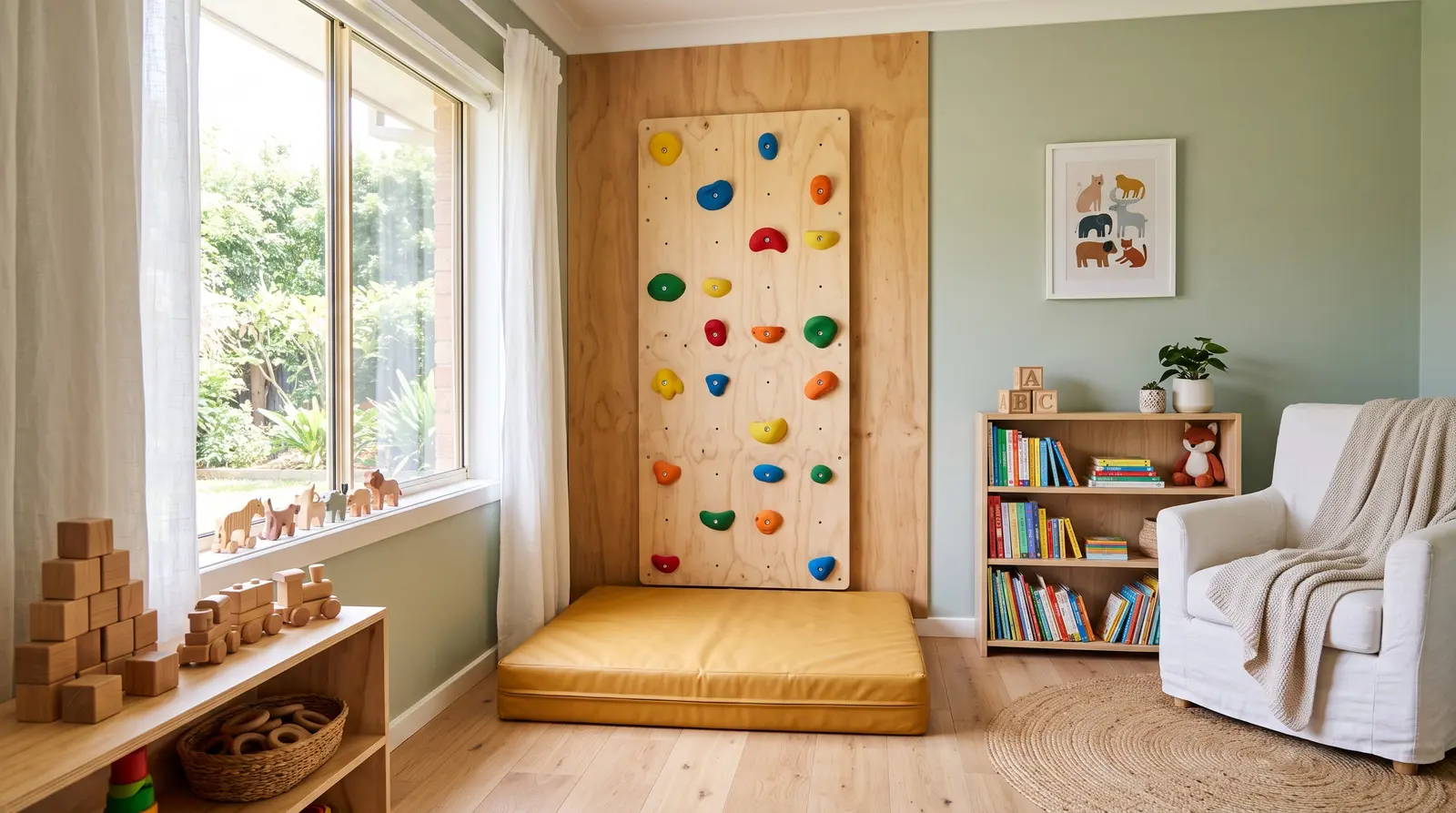
- Ground-level equipment, such as activity walls where the child's feet stay on the ground, does not need protective surfacing. As soon as the feet leave the floor, it is a climber and needs a padded fall zone.
What EN 12572-2 says about bouldering walls
According to the German Wikipedia summary of EN 12572-2 (which describes the 2008 edition), a public bouldering wall may be up to 4.5 m (about 14.8 ft) high, or 4.0 m (about 13.1 ft) if you can stand on top, with an impact area that extends roughly 2–2.5 m (6.6–8.2 ft) beyond the wall's footprint. Those numbers are for public walls used by people of all ages, with purpose-made landing surfaces. They are an upper limit for climbing gyms, not a target for a child's bedroom.
Practical height rules for a home wall
- Go wide, not tall. A traverse wall (one you climb sideways) gives a lot of climbing while the feet stay low.
- Set the lowest footholds just off the floor so small children can start without a jump.
- Raise top holds in stages. Add higher holds only when your child climbs down calmly instead of jumping or dropping.
- Check headroom. This Old House reminds builders to make sure the ceiling is high enough to prevent head injuries. Watch for beams, shelves, light fittings and window sills next to the wall.
- Angle: vertical or slightly off-vertical suits kids best. Overhangs are hard and they push falls outward. Our guide to home climbing wall angles explains the trade-offs.
Mats and fall zone: what counts as "padded"?
This is where most competitor guides go vague. The CPSC is not vague:
- Carpet and thin mats are not enough. The home handbook says carpeting and thin mats are generally not adequate protective surfacing. The public handbook says carpet and mats are not appropriate unless they are tested to and comply with ASTM F1292.
- Never over hard floors without padding. The CPSC lists concrete, asphalt, grass and dirt as inappropriate surfacing.
- Cover the use zone, not just the strip under the wall: the CPSC uses at least 6 ft (1.8 m) around a climber.
- Outdoors with loose fill, the home handbook recommends at least 9 in. (23 cm) of wood mulch, wood chips, engineered wood fibre or shredded rubber for equipment up to 8 ft high, or 9 in. of sand or pea gravel for equipment up to 5 ft high. It notes that 12 in. of fresh fill compresses to about 9 in. over time. Loose fill should not go directly on concrete or asphalt.
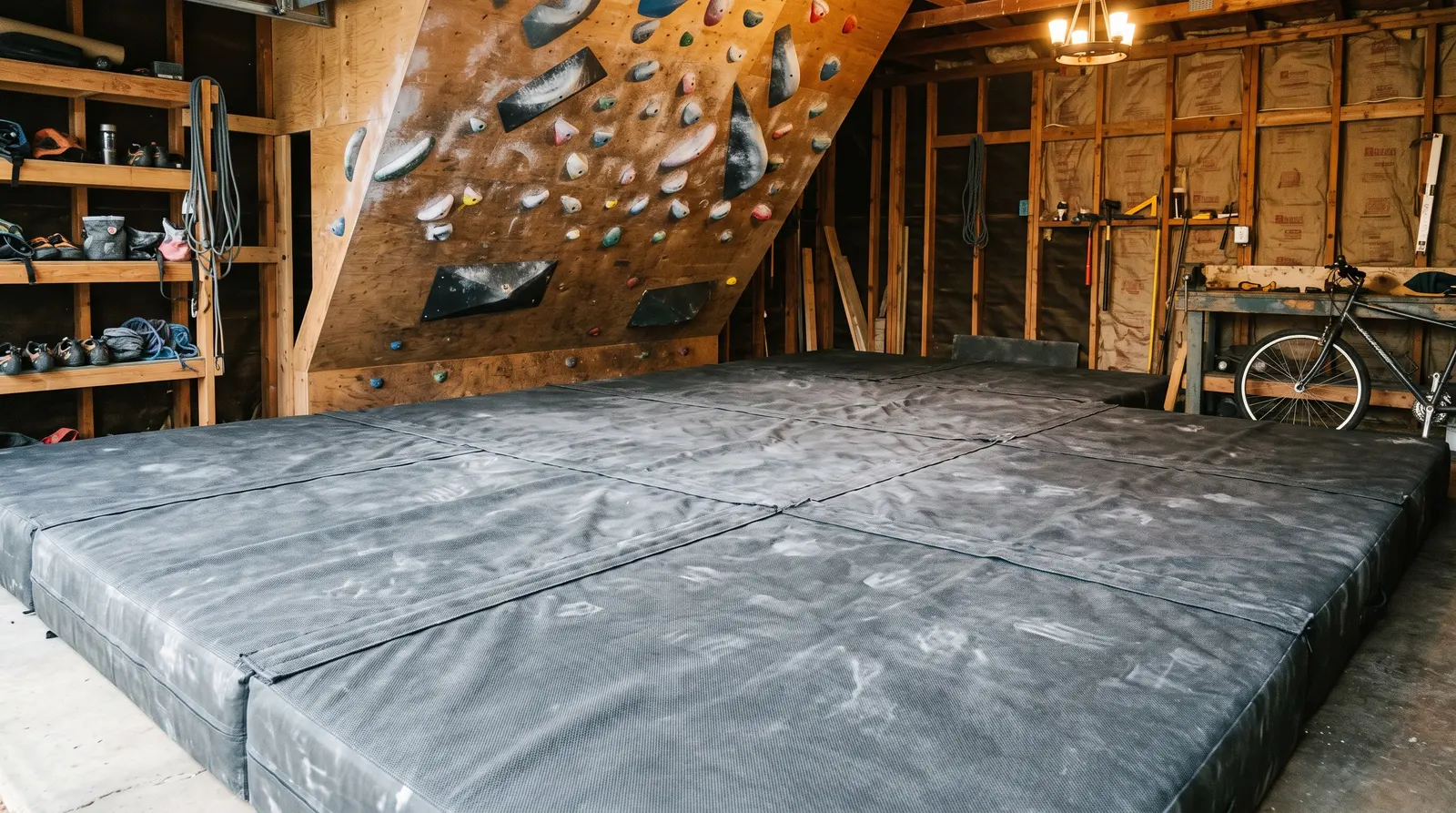
Indoors, the usual answer is a set of thick folding gym mats or bouldering crash pads pushed tight together, so there are no gaps for an ankle to drop into. Mats with hook-and-loop edges help them stay joined. Keep the landing clear of toys and furniture. For thickness, foam types and layouts, see our guide to home climbing wall mats, and if you are using bouldering pads, our crash pad guide.
Anchoring: studs, masonry and when to call a pro
A climbing wall loads its fixings every time a child pulls outward on a hold, and kids also swing, hang and jump. That is why the fixing matters more than the panel.
- Timber stud walls: screw the panel or its battens into the studs, not just into drywall or plasterboard. This Old House advises triple-checking stud positions and using screws long enough to go through into the studs.
- Brick, block or concrete walls (common across Europe): use masonry fixings suited to that wall type. Hollow blocks, old soft brick and plaster need different fixings from solid concrete.
- Battens behind the panel: most DIY walls fix horizontal timber battens to the wall first, then screw the plywood to the battens. This leaves space behind the panel for T-nuts and bolt ends.
- Freestanding frames: outdoors, the CPSC says to follow the maker's anchoring instructions and bury or cover anchors so they don't become trip hazards. The Family Handyman A-frame project uses ground stakes and tells readers to keep kids off until the frame is staked.
Buying options compared
| Option | Best for | What you get | Main drawback | Cost tier |
|---|---|---|---|---|
DIY plywood panel + hold set | Ages about 3+, families who can do basic carpentry | Custom size, any shape; holds can move as kids grow | You are responsible for fixings, T-nuts and design | Budget to mid |
Ready-made kit or pre-drilled panels | Parents who want matched hardware and instructions | Panels, holds and bolts, sometimes a frame | Fixed size; still needs correct wall anchoring | Mid to premium |
Screw-on holds on an existing panel | Very low traverse panels, footholds | Holds fixed with wood screws anywhere | Not easy to move; leaves screw holes | Budget |
Pikler-style climbing triangle | Toddlers and young preschoolers | Foldable wooden frame with rungs, often with a ramp | Outgrown quickly; not real "climbing holds" | Budget to mid |
Backyard play set with rock-wall section | Outdoor play | Built-in climbing ramp or wall on a play structure | Needs outdoor surfacing, anchoring and maintenance | Mid to premium |
Not sure what a whole build costs? Our home climbing wall cost guide breaks down plywood, T-nuts and holds.
Pikler triangle vs climbing wall
The Pikler triangle is named after Emmi Pikler, the Hungarian paediatrician known for letting infants move freely and develop at their own pace. Today the name is used for wooden climbing triangles with rungs, sold by many brands.
| Pikler-style triangle | Kids climbing wall | |
|---|---|---|
Typical age | Toddlers and young preschoolers | Preschool and up |
Movement | Stepping and gripping round rungs, climbing over | Gripping shaped holds, stepping on small footholds, traversing |
Installation | None: freestanding, folds away | Fixed to studs or masonry, or a stable frame |
Grows with the child | Limited | Yes: move holds, make it harder |
Safety points | Rung spacing, stability, mats around it | Anchoring, hold tightness, fall zone, headroom |
Two CPSC points are worth checking on any triangle or climbing frame. First, round rungs for young hands should be about 1 to 1.5 in. (2.5–3.8 cm) in diameter, with the smaller size better for small or weaker children. Second, openings between rungs or bars should be either smaller than 3.5 in. (9 cm) or larger than 9 in. (23 cm), so a child's head can't get trapped. Gaps between those two sizes are an entrapment risk.
Many families start with a triangle and move to a low wall later. That works well: the triangle teaches stepping up and climbing down, which is the skill that makes a wall safe.
Choosing holds for kids
Kids need bigger, friendlier holds than adults. For names like jug, crimp and sloper, see our guide to types of climbing holds.
- Mostly jugs and big incut holds. Small hands can wrap them, and they are easy to hold while climbing down.
- Plenty of footholds. Footholds low on the wall let small climbers stand and rest instead of hanging.
- Bolt-on holds go into T-nuts, so you can move them as your child grows. Screw-on holds fix anywhere with wood screws, which suits very low traverse panels and permanent footholds.
- Check bolt length. A bolt that sticks out of the back of the panel, or a protruding screw tip, can tear skin or clothes. The CPSC's home playground handbook asks for exposed bolt ends to be capped and to stick out past the nut by no more than the bolt's diameter.
- Tighten and inspect. A spinning hold is a classic cause of unexpected falls. The CPSC recommends checking nuts and bolts on home play equipment twice a month; This Old House suggests checking a climbing wall weekly for loose holds, damaged plywood and worn padding.
For more on sets and sizes, read our best climbing holds for a home wall.
DIY kids climbing wall: the short version
A kids wall is a much simpler build than an overhanging adult board. The basic steps:
- Pick the wall. Choose a wall with studs or solid masonry, enough space for mats in front and to the sides, and no windows, radiators or shelves in the fall zone.
- Plan the size. Wide and low beats tall. Sketch where the mats will go before you cut anything.
- Cut and drill the plywood. Most builders use 3/4 in. (18 mm) plywood with a good face. Drill the T-nut grid before mounting. Our guide to climbing wall plywood and T-nuts covers grades, hole sizes and grid spacing.
- Fit T-nuts from the back, then sand all edges smooth. The Family Handyman project reminds builders to sand off rough or splintered edges and check that no screw heads stick up.
- Fix battens and panel into studs or masonry with suitable fixings.
- Lay mats first, then add holds. Start with a few jugs low down and set easy traverses.
- Test every hold with your own weight before children use the wall.
Wear eye and ear protection when drilling, and a dust mask when cutting or sanding plywood. Our list of tools to build a climbing wall covers what you need. If you can't fix into the wall, a freestanding climbing wall may suit you better.
Supervision and house rules
The CPSC's checklist starts with one line: always supervise children on play equipment. Its public handbook adds that toddlers and preschoolers need more attentive supervision than older children, and that supervision alone should not be relied on to prevent injuries. Good design and padding come first.
Simple rules that fit a home wall:
- One climber at a time, and nobody walks or plays under a climber. This Old House gives similar advice: never walk under a climber, and don't share a hold with another climber.
- Climb down, don't jump. Teach children to climb down to the mats. When they do fall, they should land on their feet and roll back, not reach out with straight arms. Our guide on how to fall safely when bouldering explains the technique.
- No bike helmets, cords or drawstrings. The CPSC warns that children wearing bike helmets have been trapped in gaps on play equipment, and that drawstrings, cords and ropes are strangulation hazards. Never tie skipping ropes, leashes or cords to the wall.
- Grippy shoes or bare feet, not slippery socks on plastic holds.
- Close the wall when no adult is around, for example by removing the lowest holds or keeping the room shut.
Common mistakes
- Building tall first. A tall wall with poor padding is the worst combination. Start low and wide.
- Using a rug or yoga mat as the landing. The CPSC says carpet and thin mats are not adequate.
- Fixing into drywall or with the wrong plugs. Find studs or use fixings made for your masonry.
- Mats that stop at the wall's edges. Kids fall sideways and backwards; pad around the wall, not just under it.
- Adult holds on a kids wall. Small crimps and slopers frustrate children and make them drop off.
- Never re-checking. Holds spin, screws loosen and mats creep apart. Put a check on the calendar.
Our research picks for a kids climbing wall
These are research-based picks, not tested products. Each is chosen from the maker's own specs for how well it fits a low, padded kids wall.
Metolius PU Mega Pack
A random mix of polyurethane holds, including footholds, screw-on holds, mini-jugs and big roof jugs, in packs of 30, 40, 50 or 60. Metolius says each set comes with the mounting hardware: bolts, T-nuts, self-drilling screws and its Multi-Wrench. That makes it a simple "everything in one box" start for a DIY panel.
Best for: families building their first DIY plywood wall. Main drawback: the mix is random, so you will get some small holds that are too hard for young kids. Skip it if you only want a tiny toddler panel; a few jugs will do.
Metolius Screw-on Handholds and Mini Jugs
Low-profile holds that fix to a wooden wall with self-drilling screws, which Metolius says "go where bolt-on holds won't". They come in 10-packs of handholds, a 40-pack of Greatest Chips footholds and a 5-pack of screw-on mini jugs. Metolius currently lists the screw-on handholds as a close-out, so check stock.
Best for: very low traverse panels and permanent footholds. Main drawback: moving them leaves screw holes in the panel. Skip it if you want to reset problems often; choose bolt-on holds instead.
Metolius T-Nuts
Standard 3/8 in., four-prong, zinc-plated T-nuts in bags of 25 or 100, for building your own bolt-on grid. Metolius doesn't state a drill size on the product page, so match the bit to the T-nut you buy.
Best for: DIY panels where you buy holds separately. Main drawback: four-prong T-nuts can spin or pop out if not seated well. Skip it if your hold set already includes T-nuts.
Greatmats Safety Folding Gym Mat Combo Foam (4 x 8 ft)
A 4 x 8 ft (1.2 x 2.4 m) folding mat, 2-3/8 in. (6 cm) thick, with a polyethylene base layer and a polyurethane top layer under an 18.5 oz vinyl cover. Hook-and-loop fasteners on all four sides let you join several mats into one continuous landing.
Best for: indoor kids walls, especially low traverse walls. Main drawback: it is a gym mat, not a bouldering pad, so it is thinner than a crash pad. Skip it if your wall is tall enough for real bouldering falls; use thick crash pads instead.
Metolius Session II Crash Pad
A 36 x 48 x 4 in. (91 x 122 x 10 cm) bouldering pad with sandwich foam, folding to carry, at 9 lb (4 kg). Several pads side by side make a thicker landing than gym mats for older kids on a taller panel.
Best for: school-age kids on a bouldering-style panel. Main drawback: a single pad is small; you will need several for a full fall zone. Skip it if you only have a toddler panel; a gym mat is easier to live with.
Pikler-style climbing triangle
Many brands sell foldable wooden climbing triangles. We are not naming one model because we could not verify current specs on the makers' sites. When you compare listings, check the age range and maximum load the maker states, the rung diameter (the CPSC suggests about 1–1.5 in. for young hands), the gaps between rungs (under 3.5 in. or over 9 in.), a stable base that can't fold while in use, and a smooth, splinter-free finish.
Best for: toddlers and young preschoolers. Main drawback: children outgrow it. Skip it if your child is already climbing confidently; go straight to a low wall.
From kids wall to climbing gym
A home wall is a great way in, but a climbing gym with a kids' session teaches movement and falling from qualified instructors. If your child is hooked, read our beginner guide on how to start bouldering. And if the grown-ups want their own wall later, our spray wall and setting guide is the next step.
FAQ
How high should a kids climbing wall be?
There is no single legal number for a home wall. The closest reference is the US CPSC Public Playground Safety Handbook, which recommends a maximum fall height of 32 inches (81 cm) for climbers used by toddlers. For older children, keep the wall low enough that the feet stay close to the floor, cover the whole fall zone with proper padding, and only raise the top holds when the child climbs down confidently.
Is a carpet or a yoga mat enough under a kids climbing wall?
No. The CPSC says carpeting and thin mats are generally not adequate protective surfacing for home play equipment. Use thick foam gym mats or bouldering crash pads that cover the area under and around the wall, with no gaps between them.
Can I screw a kids climbing wall into drywall?
No. Drywall or plasterboard alone cannot hold a climbing wall. The panel has to be fixed into the wall studs or into solid masonry with fixings suited to that wall. If you are not sure what your wall is made of or which fixings to use, have a qualified builder or carpenter install it.
Pikler triangle or climbing wall: which is better for a toddler?
For most toddlers, a low climbing triangle or a very low traverse panel is the better first step, because the climbing height is small and the child can get on and off easily. A wall with bolt-on holds makes more sense from preschool age, when children can grip, step and climb down with more control. Both need padding and supervision.
Sources
- U.S. Consumer Product Safety Commission, Public Playground Safety Handbook, Pub. 325 (2010 edition, PDF reissued December 2015)
- U.S. Consumer Product Safety Commission, Outdoor Home Playground Safety Handbook, Pub. 324 (2005)
- DIN EN 12572-2:2017, Artificial climbing structures, Part 2: Safety requirements and test methods for bouldering walls (catalogue entry)
- Wikipedia (German), Kletterwand: summary of EN 12572 parts 1–3 and EN 1176
- Carol J. Alexander, This Old House, How To Build a DIY Rock Climbing Wall
- Family Handyman, How to Build a Kids Climbing Wall (freestanding A-frame project)