Sardinia Climbing Guide: Best Areas, Season and How to Plan Your Trip
 Petr Hess, strength & conditioning coach
Updated 2 Nov 2026 · 13 min read
Key takeaways
Best for: Sport climbers planning a spring or autumn trip to Sardinian limestone
- Go in spring or autumn; in summer use shady crags like Ulassai and climb early or late, in winter use sunny sectors such as Domusnovas.
- The main areas (Cala Gonone, Ulassai and Jerzu, Isili, Domusnovas) are far apart, so base yourself in one or two and plan on a car.
- Buy the guidebook for your area, because the Cala Gonone, Ogliastra and south-east books are separate titles.
- Check parking signs, bolt condition and local access rules before each crag, and carry offline topos.
Sardinia is a Mediterranean island with limestone sport climbing in several separate areas: Cala Gonone on the east coast, Ulassai and Jerzu in the Ogliastra mountains, Isili in the centre and Domusnovas in the south-west. Plan a trip for spring or autumn, pick a base for the area you want (the areas are far apart, so choose one or two, not all four) and rent a car.
This guide covers when to go, how the main areas differ, how to get there, which guidebook to buy, and the parking and access traps that catch visitors out. If you are still comparing destinations, see our best climbing destinations in Europe or our guide to how to plan a climbing trip. If you are looking for warm-weather options in the cooler months, see our winter sun climbing destinations.
I'm a strength and conditioning coach in Prague, not a local guide or a Sardinia expert. This guide is built from the sources listed at the bottom: crag databases, guidebook listings, climbing-area pages and Italy's official tourism site. Where something is not confirmed, I say so, and for anything safety-critical you should check the current local situation yourself.
Sardinia climbing at a glance
| Topic | Quick answer |
|---|---|
Rock | Mostly limestone at the main sport areas (Cala Gonone, Ulassai/Jerzu, Isili, Domusnovas); granite bouldering and some granite trad exist elsewhere on the island |
Style | Mainly single-pitch sport climbing, plus some multi-pitch routes (Baunei, Supramonte, Domusnovas) |
Size | Mountain Project says nearly 4,000 single-pitch sport routes on the island; counts for individual areas vary a lot by source |
Grades | French grades in local guidebooks; routes from easy to very hard. Sources quote roughly 4 to 9a for Ulassai and Jerzu |
Best months | Spring and autumn; summer is very hot and winter can be windy (see the month table below) |
Main airports | Olbia is the usual choice for Cala Gonone; Cagliari for the south. Alghero is on the north-west coast |
Ferries | From Genoa, Livorno, Piombino and Civitavecchia to Olbia, Golfo Aranci and Porto Torres, among others |
Car | Needed for all but the most basic trip |
Rest days | Beaches and coves, canyons and trekking, nuraghi (Bronze Age stone towers) |
What makes Sardinia different
Sardinia is not one crag area but a set of separate ones. Each has its own character, and you rarely climb in more than one or two on the same trip because of the driving distances. Cala Gonone is a seaside base with sea-level cliffs and canyon crags. Ulassai and Jerzu are inland, mountain-village areas with big limestone walls, and Isili is known for steep roof climbing on large pockets. Domusnovas, in the south-west, has crags clustered around a cave that a road runs through.
Italy's official tourism site describes the island's walls as generally well equipped. Treat that as a general statement, not a guarantee: bolts and anchors wear, especially on busy routes, and corrosion by the sea air can damage hardware without being visible, so judge every bolt and anchor yourself and never rely on a guidebook saying a route is "well bolted". One local description of the Fuili Ferry sector, for example, warns that anchors wear quickly from frequent top-roping and asks visitors to report worn ones.
Grades in local guidebooks are French. Use our grade converter or climbing grades explained if you think in YDS.
When to go: Sardinia month by month
Sources agree on the headline: spring and autumn are best, summer is very hot, winter can be windy, and the island's climate allows climbing in most months if you choose the right aspect. I did not find a source with reliable month-by-month temperature or closure data (Mountain Project's season chart for Sardinia is empty), so use the table as a guide to aspect and heat rather than as a forecast, and check the weather forecast for your dates.
| Season | What sources say | Where to point yourself |
|---|---|---|
Spring and autumn | Best time overall according to Strictly Sardinia and other guides | Any area; the main window for Cala Gonone, Jerzu, Isili and Domusnovas |
Summer | Very hot. La Poltrona (Cala Gonone) is described as too hot to climb roughly 10 am to 4 pm; the Ferry sector at Cala Fuili only gets shade around 5 pm | Early mornings or late afternoons; shady crags such as Ulassai when Jerzu is too hot; shady sectors at Domusnovas. Plan a swim |
Winter | Quite windy according to Strictly Sardinia; the Cala Fuili Ferry page lists it as a winter crag, sheltered from the mistral | Sunny, south-facing crags: at Domusnovas that means sectors such as Chinatown, Arrampicantro and Cartoonia |
At Domusnovas the multi-pitch routes face south, and one area guide says they are not suited to summer. Shade times depend on the month, so check each sector's aspect in the guidebook and plan around the heat.
The main climbing areas compared
Cala Gonone (east coast)
Cala Gonone is a popular base. It is a small seaside town and the crags are close, often within a short walk or drive. The 2025 Segnavia guidebook describes over 700 routes around Cala Gonone with French grades, route lengths, orientation tables and a QR code for each parking area.
- Cala Fuili: a gorge that runs to the sea. A local guide page describes three sectors at the Ferry area, with 23 routes from 4 to 7a: sector 1 by the stairs is the easiest and suits children and beginners, sector 2 is the oldest and has many polished 6a and 6b routes, and sector 3 is the newest and most varied. Approach is about five minutes. Strictly Sardinia also recommends Codula Fuili for easy beginner routes.
- Biddiriscottai: a cliff and cave about a 15 to 20 minute walk from Cala Gonone. Climbing Sardinia says it was re-bolted with titanium from December 2020. Titanium resists corrosion but wears faster from rope friction, so that group asks climbers to add a carabiner at the lower-off, and not to leave quickdraws on titanium hardware, because steel and aluminium corrode in contact with it.
- La Poltrona: described as having 80+ routes, up to six pitches, and facing the sun, so it is a spring, autumn or winter crag.
Cala Gonone suits mixed groups: you can swim after climbing at Cala Fuili, and easy routes sit near harder ones. The road in has hairpin turns, so allow extra time and be careful driving at night.
Ulassai and Jerzu (Ogliastra)
These two villages sit in the mountains inland from the east coast and share a guidebook. Climb Europe lists about 1,300 routes in the 2025 Ulassai and Jerzu guidebook, covering Ulassai, Jerzu, Osini, Ussassai and Gairo. Strictly Sardinia calls Jerzu technical and fingery and gives it roughly 400 to 500 sport routes at about 800 to 900 m, and describes Ulassai, "The Canyon", as mostly shady. That matters in summer: when Jerzu is too hot, Ulassai is the usual answer. Grades are broad, from about F4 to F9a according to Climb Europe, so there is something for most levels, but check the actual sector for your grade before you drive.
Isili (central Sardinia)
Isili is landlocked and known for steep climbing on big pockets, with 13 sectors in one description, ranging from roughly 5.8 to 5.14 on the American scale. Pietra Filosofale is described as the easiest sector, Corvo Spaziale as busy, and Urania as the home of the hardest routes. The Italian tourism site says Isili has over 300 routes in steep rock between narrow, canyon-like gorges. Route counts differ by source, so treat them as rough.
Domusnovas (south-west)
Most sectors cluster around the Grotta di San Giovanni, a natural tunnel about 800 m long. A regional trail site notes that it was once drivable and is now closed to traffic. One area guide lists about 25 sectors, from beginner slabs to steep overhangs. Arrampicantro is described as one of the easiest crags and Bronx and Tana delle Tigri as among the hardest on the island. Access differs by side: the south entrance has Arrampicantro and a church car park that leads to seven other sectors (a walk of around 30 minutes for the farthest), while the north entrance (reachable on foot through the cave, or by driving round the mountain towards the Marganai forest) has Bronx and Tana delle Tigri, and 15 sectors including Animal House and Ruota del Tempo.
Domusnovas offers sunny, south-facing sectors for winter and shady ones for summer. It is about 50 km west of Cagliari, so combine it with a flight into Cagliari.
Other areas
Baunei in northern Ogliastra has single-pitch sport and some multi-pitch routes; Strictly Sardinia mentions Punta Giradili with multi-pitches of up to 15 pitches, and Cala Goloritzè is only reached on foot from the Golgo plateau. Further north, Osilo near Sassari and Capo Caccia near Alghero have limestone sport climbing (Capo Caccia also has deep-water soloing), and there is granite bouldering in the Nuoro area and near Cagliari. These get less attention here because I could not verify detailed current information on them.
Which area for which climber?
| You are… | Start with | Why |
|---|---|---|
A beginner or family | Cala Fuili (Ferry sector 1, Codula Fuili) or Domusnovas slabs | Easy routes near the sea or in a compact area, short approaches |
Intermediate sport climber (6a to 7a) | Cala Gonone, Domusnovas | Many routes and sectors, a choice of aspects |
Steep-climbing fan | Isili, Domusnovas overhangs | Roofs and big pockets |
Hot-weather traveller | Ulassai (shady), Domusnovas shady sectors | Shade at Ulassai; Strictly Sardinia puts Jerzu's crags at 800 to 900 m |
Winter traveller | Domusnovas south-facing sectors, Cala Fuili | Sun and shelter from the mistral |
Getting there and getting around
- By air: Olbia is the usual airport for Cala Gonone, about 106 km by road, and taxi sites estimate around 1.5 hours. Cagliari is the natural airport for Domusnovas (about 50 km west of the city, per Strictly Sardinia) and a long drive to the east coast. Alghero is another option in the north-west.
- By ferry: Operators run to Sardinia from Genoa, Livorno, Piombino and Civitavecchia, among other ports, to Olbia, Golfo Aranci and Porto Torres. One tourism site says crossings take five to 12 hours depending on the route, and some routes, such as Genoa to Olbia, can take longer. Schedules vary by season, so check the operator for your dates. A ferry makes sense if you drive from northern Italy, Switzerland or Germany with a lot of gear, or want your own van.
- Car: A car is the practical choice for anything beyond a single-base trip. Public transport exists (ARST buses via Nuoro to Cala Gonone), but it is slow and timetables change, so check the ARST timetables before you rely on it. Crags are spread out and mountain roads are winding.
Plan your accommodation by area, not by island: Cala Gonone for the east coast, the Ogliastra villages for Ulassai and Jerzu, and the Iglesias and Domusnovas area for the south-west. Types include village apartments, B&Bs and campsites; availability and prices vary by season, so I give no prices here. Book early for spring and autumn, and check that parking is included, because parking fines are a real issue in Cala Gonone (see below).
Access, parking and ethics
- Parking fines are a risk at Cala Gonone. A local topo page for Cala Fuili says police fine cars parked inside the road lines and advises against driving to the end of the road because turning is hard. At Biddiriscottai, parking near the port is paid. Rules change, so follow the posted signs and use designated spaces; if in doubt, walk in from town.
- Anchors and top-roping: A local topo page asks climbers who top-rope at Fuili to add a carabiner of their own to the anchor to save wear, and to report worn anchors. Only top-rope if you know how to build a safe, redundant set-up, or learn it from a qualified instructor.
- Polished starts: At Cala Fuili sector 2, spot the climber until the first quickdraw is clipped.
- Current rules: I did not find any official closure or ban notices for these areas in the sources I read, but that does not mean there are none. Check theCrag, theTopo (27 Crags) and local guidebook websites for current access notes before you go, and respect any local signs.
Gear to bring
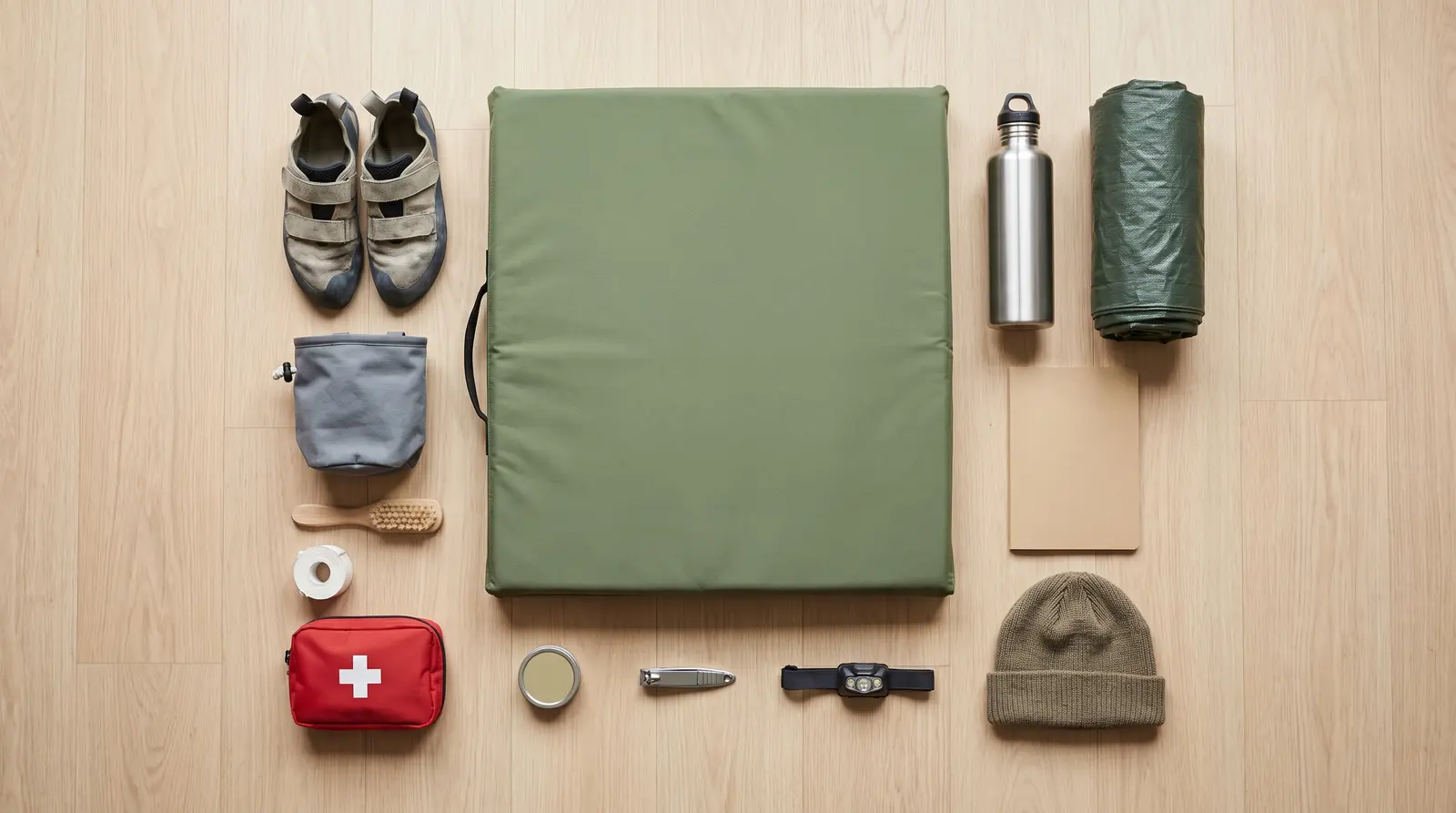
Most sport routes need a single rope and a set of quickdraws; the length depends on the sector, so check the guidebook (Strictly Sardinia says that at Punta Giradili, approached from the top, a single rope works; confirm rope length and retreat options for each route in the guidebook). See our guides to a climbing rope, a harness, a helmet and a belay device. On limestone crags with loose rock or on multi-pitch routes, a helmet is a sensible precaution. In summer bring plenty of water and sun protection, and in winter a windproof layer.
Guidebooks and apps
Sardinia has several guidebooks, and the older ones are out of date, so match the book to your area.
- Cala Gonone: Climbing in Cala Gonone (Sardinia), Corrado Conca, Segnavia, 2025, English, 104 pages, over 700 routes with French grades, orientation tables and QR codes for parking, per the Needle Sports listing.
- Ulassai, Jerzu and the Ogliastra: a revised sixth edition (2025) of the Ulassai and Jerzu Rock Climbing Guidebook, English and Italian, 238 pages, about 1,300 routes, per Climb Europe. It was listed as sold out when I looked, so check current stock.
- Isili and the south-east: Pietra di Luna Sud Sardegna (2025), Maurizio Oviglia and Gianluca Piras, Maurizio Oviglia Edizioni, 232 pages, in Italian and English editions. The publisher says it covers a strip east of the Campidano plain, including Villasimius, the Sarrabus, Isili, Samugheo and Monte Arci. It does not clearly cover Domusnovas, so check coverage with the publisher or a retailer before you buy for the south-west. The older Pietra di Luna sport guide (fifth edition, 2011) covered 3,600+ routes but is dated.
For apps, theTopo (formerly 27 Crags) and theCrag list many Sardinian sectors. Use them for current comments, but remember that route counts differ widely and some pages lack access info.
Rest days and other things to do
Italy's tourism site points to trekking in Baunei and Ogliastra and to the Aguglia obelisk above Goloritzè beach. Both come with rules: the Baunei municipality says Cala Goloritzè has controlled entry (booking, a per-person fee, a daily visitor limit and set trail hours; check the current terms), and describes the Selvaggio Blu as suited only to expert, well-trained hikers, with exposed passages and rope descents, usually split into five or six stages, with group registration and a fee. It is not a casual rest-day walk. Also the island's nuraghi, such as Nuraghe Is Paras near Isili. Near Domusnovas, the Grotta di San Giovanni is worth a look on foot. Sea swimming near the cliffs depends on swell and conditions; check before you jump in, especially outside summer.
Costs, safety and insurance
Carry offline maps or topos and share your plan, because phone reception can be poor in gorges and a rescue can take time. Be careful in gorges and canyon crags in or after heavy rain. Costs depend on season, ferry versus flight and car hire; I do not give figures. The emergency number across the EU, including Sardinia, is 112. Get insurance before you go and check its exclusions for roped climbing, multi-pitch routes, rescue and helicopter costs; our climbing travel insurance guide explains what to look for. Heat is the main hazard in summer: plan around shade, drink enough and stop if you feel unwell. Check that bolts and anchors look sound, wear a helmet where rock is loose, and climb within your ability on unfamiliar crags. If you are new to roped climbing, learn from a qualified instructor first.
A sample 7-day plan
This is a template based on the areas above, not a verified schedule. Adjust it to the season, the weather and your grade.
- Days 1 to 3, Cala Gonone: start at Cala Fuili (Ferry sector or Codula Fuili if you want easy routes), then Biddiriscottai; in winter or spring use La Poltrona.
- Day 4: rest day, swimming and a short coastal trek.
- Days 5 and 6, Ulassai and Jerzu: a day at shady Ulassai in warm weather, or a Jerzu day in cooler weather.
- Day 7: travel day or a half-day near your departure airport.
A south-west week would combine Domusnovas sectors by aspect and time of day, with a rest day on the coast near Masua or Iglesias. For more areas to compare, see our trip guides or the nearby alternatives in Finale Ligure and Kalymnos.
FAQ
When is the best time to climb in Sardinia?
Spring and autumn are the best seasons according to the sources I read. Summer is very hot, so climb early or late on shady crags such as Ulassai, and winter can be windy, so use sunny, sheltered crags such as the south-facing sectors at Domusnovas.
Do you need a car for climbing in Sardinia?
Practically yes. The main areas are far apart and the crags are spread out. Buses (ARST) connect towns such as Olbia, Nuoro and Cala Gonone, but they are slow and timetables change, so a rental car or your own car on the ferry is the usual choice.
Which area is best for beginners in Sardinia?
Cala Gonone has easy routes near the sea, such as sector 1 at the Cala Fuili Ferry area and Codula Fuili. Domusnovas has beginner slabs such as Arrampicantro. Always check the current guidebook for your grade.
Which airport should I fly into for Sardinian climbing?
Olbia is the usual airport for Cala Gonone, about 106 km by road. Cagliari is closer to Domusnovas. Alghero serves the north-west.
Sources
- Mountain Project, Sardinia rock climbing
- Italia.it, Free climbing in Sardinia
- Climb Europe, Rock climbing in Sardinia
- Strictly Sardinia, Climbing in Sardinia
- Climbing Italy, Fuili – Ferry
- Climbing Italy, Domusnovas
- Needle Sports, Climbing in Cala Gonone (Sardinia), Segnavia 2025
- Climb Europe, Ulassai and Jerzu Rock Climbing Guidebook (2025)
- Climbing Sardinia, How to climb on titanium-bolted crags
- Pietra di Luna, Pietra di Luna Sud Sardegna (2025)
- Baunei tourism, Cala Goloritzè path
- Baunei tourism, Selvaggio Blu
- Sardegna Sentieri, Grotta di San Giovanni