Finale Ligure Climbing Guide: Best Sectors, Season and Rest Days by the Sea
 Petr Hess, strength & conditioning coach
Updated 2 Nov 2026 · 12 min read
Key takeaways
Best for: Sport climbers planning a spring, autumn or winter trip to the Italian Riviera
- Go March to June or September to October; use the sunny Perti and Monte Sordo walls in winter and shady Rian Cornei in summer.
- Several crags are closed 1 January to 31 July for nesting raptors and some walls are closed for good, so check the live crag status first.
- Newer climbers should start at Tre Porcellini, Lo Scorpione, Falesia della Lumaca or Monte Cucco's family sectors, a few grades below their gym level.
- Bring the 2022 Finale Climbing guidebook or an offline topo, a rope long enough for 40 m routes, and plan a rest day by the sea.
Finale Ligure is a seaside town on the Italian Riviera, between Genoa and the French border, with thousands of bolted sport routes on pocketed limestone in the hills behind it. Most routes are 6a to 7a, with easier sectors for newer climbers and hard test pieces up to 8c+. Go in spring (March to June) or autumn (September and October), use the sunny crags in winter and the shady ones in summer, and check the bird-nesting closures before you pick a crag.
This guide covers the season month by month, getting there, where to stay, the main areas (Rocca di Perti, Monte Sordo, Monte Cucco, Bric Pianarella, Rian Cornei, Capo Noli), sectors for beginners, the access rules, gear and rest days by the sea. If you are still choosing a destination, compare it with our best climbing destinations in Europe, or browse all our climbing trip guides.
I'm a strength and conditioning coach, not a local or a mountain guide. This Finale Ligure climbing guide is built from the sources listed at the bottom: crag databases, the guidebook, local news on access, and the official tourism consortium. Where it touches on training and load, it's from an S&C point of view.
Finale Ligure at a glance
| Topic | Quick answer |
|---|---|
Rock | Limestone with the typical Finale pockets; some tufas and overhangs |
Style | Mostly single-pitch sport climbing; technical slabs and vertical walls. Some multi-pitch, especially on Bric Pianarella |
Size | Around 4,000 routes in about 200 sectors (counts vary by source and by how wide the "Finale" area is drawn) |
Grades | French grades from about 3 to 8c+; most routes 6a to 7a |
Best months | March to June and September to October; sunny crags in winter, shady crags in summer |
Nearest airports | Genoa (about 1 hour by car), Nice (about 1.5 hours); Turin and Milan are about 2 hours |
Train | Finale Ligure Marina, on the Genoa to Ventimiglia line |
Base | Finalborgo (old walled town, climbing shops) or Finalmarina (beach side); campsites in the hills |
Rest days | Beach, Finalborgo, Varigotti, mountain biking, hiking |
Guidebook | Finale Climbing, Marco "Thomas" Tomassini, Versante Sud, 3rd edition 2022 (English) |
What makes Finale climbing special
Climbing here goes back a long way: Italy's official tourism site dates the first routes to 1968, and the north face of Rocca di Perti has a historic line, the Via dello Spigolo, first climbed in 1928. Today the area is one of Europe's classic sport destinations, with crags in wooded valleys, on hilltops with sea views and on cliffs that drop straight into the Mediterranean.
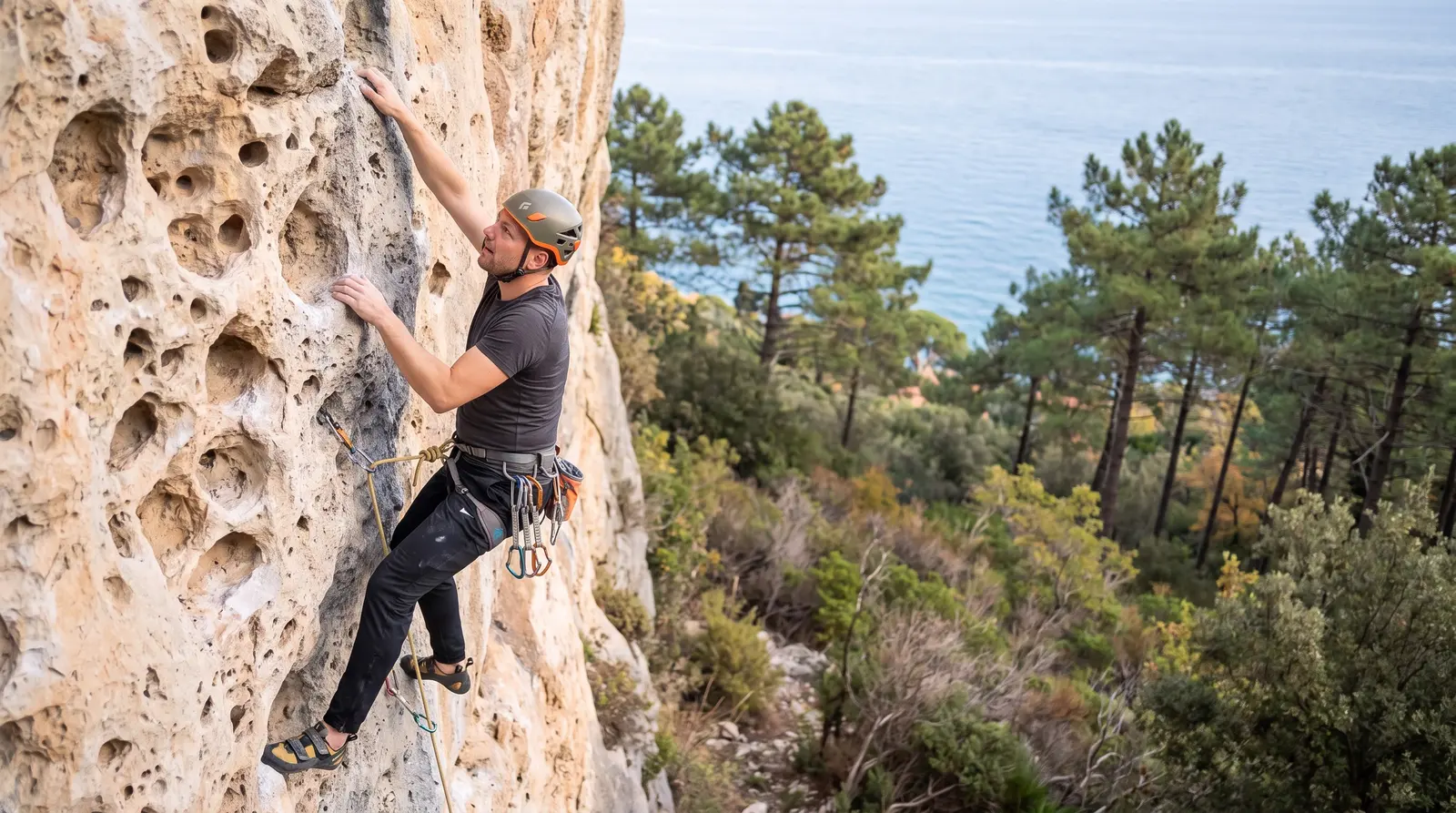
The rock shapes the style. Finale limestone is full of pockets, and theTopo's descriptions of the main crags keep coming back to the same words: technical, fingery, slabs and vertical walls, good footwork needed. You'll find steeper caves and tufas too, but the signature experience is a long vertical wall where you hunt for the next pocket and trust small feet. On popular routes and older classics, expect polish.
Grades are French. If you think in YDS, use our grade converter or the chart in climbing grades explained. A sensible plan for the first day or two is to climb a few grades below your usual level while you learn to read pockets and polished feet.
When to go: Finale month by month
Finale has a mild Mediterranean climate and you can climb year-round if you choose the right aspect. theTopo lists March to June and September to October as the best months for the area as a whole. The details:
| Months | Conditions | Where to climb |
|---|---|---|
November to February | Mild days, the best friction of the year on sunny walls. Cold northerly wind on some days; short daylight | Sun-facing sectors: most of Rocca di Perti (W/SW) and Monte Sordo (S/W), e.g. Lo Scorpione, Antri Rossi, Alveare |
January to July | Bird-nesting closures in force on several crags (see the access section) | Check the live crag status before you go |
March to June | Prime season | Almost anywhere; north-facing walls get pleasant as it warms up |
July and August | Hot and crowded on the coast | North and shaded walls: Rian Cornei (in shade after midday), Monte Cucco's Grottone and Canyon, Missili at Bric Pianarella, the north sectors of Rocca di Perti. Climb early or late |
September and October | Prime season again, warm sea for rest days | Almost anywhere |
A few walls stay climbable in light rain: theTopo lists Fenia and Grottone at Monte Cucco and Bocca di Bacco in Rian Cornei. Avoid Grotta dell'Edera on Monte Sordo in summer: it gets afternoon sun and no wind.
If you want a winter sport trip, Finale is one of the options in our winter climbing destinations guide.
Getting there and getting around
By car
The A10 motorway runs along the coast. Mountain Project gives the drive to Finale as about 1 hour from Genoa, 1.5 hours from Nice, 1:45 from Turin and 2 hours from Milan. Use the "Finale Ligure" exit for the town and Finalborgo, and the "Feglino" exit for the upper areas such as Monte Cucco, Rian Cornei and Bric Pianarella.
A car is the most practical choice, because the crags are spread over the hills behind town. But drive and park carefully:
- Car access to Rocca di Perti and Monte Sordo is restricted. theTopo asks climbers to use only the car parks shown in the topo; access to Contrada Valle is limited.
- Don't block narrow roads. Emergency vehicles need to get through.
- Monte Cucco has plenty of parking, with a bar at the highest car park.
Without a car
Finale Ligure Marina station is on the Genoa to Ventimiglia line, with regional trains and Intercity services towards Genoa, Milan and Rome. From town, a few crags are walkable: Paretina di Finalborgo is close to the village, and the Caprazoppa crags can be reached on marked trails from Finalborgo, though Mountain Project describes that as a walk of a few hours and recommends plenty of water. For a full trip without a car, expect fewer crags and longer approaches, or book a local guide who drives.
For the bigger picture (flights, budgets, who drives), see how to plan a climbing trip.
Where to stay
Free camping is banned in the municipality of Finale. theTopo reminds climbers to use campsites, especially in high season. Options climbers use:
- Finalborgo: the walled medieval town about 2 km inland, with climbing shops (including Rockstore on the main square), cafés and restaurants. Closest to many crags.
- Finalmarina: the beach side of town, with the train station, hotels and apartments. Best if your group wants sea and evenings out.
- Campsite at Monte Cucco: right at the foot of the crag, by the lower car park. Mountain Project warns that the terraces can get soaked in heavy rain.
- Le Manie plateau: east of Finale, with campsites and quick access to the Le Manie crags.
- Apartments, B&Bs and hotels in Finale and the surrounding villages, often good value for groups outside summer.
Book early in high season, especially if you want a campsite pitch.
The main climbing areas
Finale is not one crag but a cluster of hills, valleys and sea cliffs. Here are the areas most first-time visitors use, with figures from theTopo and Mountain Project. Route counts are approximate.
| Area | Size and grades | Aspect and sun | Best for |
|---|---|---|---|
Rocca di Perti | About 700 routes in 20+ sectors; average around 6th grade, up to 8c+ | Mostly W/SW, sun from mid-morning; some N sectors | Winter sun, easy slabs, historic multi-pitch |
Monte Sordo (Rocca Carpanea) | 400+ routes, 5 to 8c+; most around 6th grade | Mostly S and W, sun from mid-morning | Winter, a wide mix of easy and hard sectors |
Monte Cucco | Nearly 400 routes, beginner to 8th grade, up to 40 m long | Mostly W and NW; afternoon sun on many sectors, some never in sun | Families, campsite base, rain options |
Rian Cornei (north and south) | Over 1,000 routes across both sides of a 2 km valley | North side mostly N and E, in shade after midday | Summer and mid-season, technical pocket walls |
Bric Pianarella | Over 350 routes; many long routes up to 9 or 10 pitches | Mostly W (afternoon sun); Missili faces N | Multi-pitch and hard single pitches |
Capo Noli | Small: about 40 routes on sea cliffs, plus deep-water soloing | Sea-facing; morning or all-day sun depending on sector | Experienced climbers only |
Rocca di Perti
The biggest complex, two slopes running north to south for over 1.5 km at 130 to 360 m altitude, with approaches of 10 to 35 minutes. Most sectors face west or south-west, which makes Perti a winter favourite. Highlights by level, from theTopo:
- Easy: Falesia dei Tre Porcellini (about 30 routes, mainly 5+ to 6a, comfortable base, safe bolting); Parete delle Gemme (30+ routes, 4c to 6c, short approach, busy in winter and polished); Placca dell'Oasi (30+ technical slab routes around 6a).
- Middle grades: Ombre Blu (about 80 routes, mostly 5 and 6, recently re-equipped, some older routes still spaced); Settore Centrale (60+ routes, 5 to 8b).
- Hard: Grotta di Perti (overhanging cave, 7a to 8c), Tigrotto (steep, north-facing, up to 8b) and Scimmiodromo.
Skip La Cengia degli Androidi with children: the base is uncomfortable and exposed. Many anchors are French-style, so make sure you can thread and lower or abseil safely.
Monte Sordo
The hill between Rocca di Perti and Monte Cucco, also called Rocca Carpanea. Sectors face mainly south and west, so it's a winter crag too. The path network is confusing; theTopo suggests following the main ring path with GPS on. For newer climbers:
- Lo Scorpione (S/SW, 12 routes, 5 to 6b, close bolting): the easiest sector and a winter sun trap.
- Falesia della Lumaca (8 routes, 5+ and 6a, good protection).
- Avatar (long, easy lines, 5+ to 6b) and Pilastro di Mu (easy multi-pitch routes, a good first taste of multi-pitch with someone experienced).
The Monte Sordo sector itself (60 routes, 5+ to 7c+) is the most popular and can be polished. Stronger climbers head for Parete Dimenticata (50 routes, 5+ to 8b) and Alveare, home of Dingo (8c+). Grotta dell'Edera, a cave open to the sky, is a famous spot but best saved for cool days.
Monte Cucco
A hilltop crag with sea views, a campsite and a bar by the car park. Routes range from beginner level to 8th grade and reach 40 m on some walls. theTopo marks La Taverna, Grottone, Primi e Secondi Passi, Settore Centrale and Fenia as family-friendly. Grottone is never in the sun and, with Fenia, can be climbed in the rain; Fenia's popularity means polished holds. The Canyon needs a short roped scramble of about 20 m to reach and is best from May to September.
Rian Cornei
A wooded valley about 2 km long, split into north and south sides. The north side is in shade after midday, which makes it a summer and mid-season venue. Sectors range from family-friendly walls such as Ciappo delle Conche (moderate to easy routes on a south-facing wall) and Italsider's lower sector to steep, hard sectors like Vietcong. theTopo warns that the easy routes at Ronchiadilly Circus are poorly bolted and flags a large unstable block at Cobra, so take the topo's warnings seriously. There's generally no phone signal in the valley: download your topo offline before you go.
Bric Pianarella
Finale's "big wall", with many of the area's long routes (some nine or ten pitches) on west-facing walls that get afternoon sun. Most are well bolted, and the walk-off descent from the top is straightforward on most routes. The roadside boulder Il Sasso and La Mansarda are the family-friendly corners; Altro Livello and Missili are for strong, experienced climbers. Note that part of the wall is permanently closed for raptors (see below).
Capo Noli
Sea cliffs a short drive east along the coast, with a very different character: approaches from above, an abseil and an equipped traverse to reach some sectors, narrow bases, scarce or no bolted belays on some routes, and some top-rope-only sectors. theTopo marks it as not family-friendly and recommends some sectors for experienced climbers only. It's also known for deep-water soloing. Treat it as a special outing once you know Finale, not a first-day crag. The cliff above the Via Aurelia road is permanently closed.
Best sectors for beginners
Mountain Project and theTopo point to a handful of sectors with short approaches, easier grades and good bolting:
| Sector | Area | Grades | Why |
|---|---|---|---|
Falesia dei Tre Porcellini | Rocca di Perti | 5+ to 6a | About 30 routes, comfortable base, safe bolting |
Parete delle Gemme | Rocca di Perti | 4c to 6c | Short approach, lots of easy routes (busy and polished) |
Placca dell'Oasi | Rocca di Perti | Around 6a | Technical slab practice |
Lo Scorpione | Monte Sordo | 5 to 6b | Close bolting, sunny winter crag |
Falesia della Lumaca | Monte Sordo | 5+ to 6a | Good protection |
Primi e Secondi Passi, La Taverna | Monte Cucco | Easier grades | Marked family-friendly; next to the campsite |
La Cava di Rio Fine | Caprazoppa | Short routes | A quarry Mountain Project calls especially nice for beginners and children |
Two honest caveats. First, "easy" in Finale often means technical slab on small pockets, which can feel harder than the same grade indoors. Second, some sources say the area as a whole doesn't suit complete beginners. If you've never led outdoors, read climbing gear for beginners and consider booking one of the certified mountain guides who work in the area: the official tourism consortium can put you in touch with them.
Access, ethics and rules
This is the part most guides skip, and it matters. Finale's cliffs are home to nesting peregrine falcons and eagle-owls. Since 1994, an agreement between climbers, WWF, LIPU and the Province of Savona has closed some walls, either every year from 1 January to 31 July or permanently.
Seasonal closures (1 January to 31 July), reported by Montagna.tv in 2025: Monte Tolla, Bric Reseghe, La Fornace, Rocca degli Uccelli and the Bastionata di Boragni (right and central sectors). They reopen on 1 August.
Permanent closures, as listed in 2023:
- Caprazoppa: the east and south side from the TV mast down to the sea cliff below the Torre Colombara.
- Bric Pianarella: everything beyond the "Via Lunga" (which stays open) to San Bernardino.
- Casa delle Vacche: from after the route "Peter Pan" to the start of the Cornei valley near the Cornei bridge.
- Rocca di Corno: beyond the route "Il Futuro è un'Ipotesi" towards the Cornei bridge.
- Capo Noli: the whole cliff above the Via Aurelia.
Other local rules and good practice:
- No free camping in Finale's municipality.
- Park only in the car parks shown in the topo, and never block roads.
- Stay on marked paths. Several areas have confusing path networks; use GPS tracks.
- Don't crowd narrow ledges at the base of routes.
- Take all rubbish home, light no fires and go to the toilet well away from paths and crags.
- Consider the FOR YOU CARD. The local tourism consortium links this card to voluntary donations for maintaining the area's trails. It's a simple way to give something back.
Gear to bring
Finale is a sport climbing destination, so the kit list is short, but a few local details matter:
- Rope: some routes are long. Monte Cucco has routes up to 40 m, which need an 80 m rope to lower off. Check the sector length in the topo, and always tie a knot in the end of the rope. Our climbing rope guide explains lengths and diameters.
- Quickdraws: count the bolts on the longest routes you plan to climb and add two spare. Extenders help on wandering lines.
- Helmet: sensible everywhere, and important under multi-pitch routes, on Capo Noli and below loose sections flagged in the topo. See best climbing helmets.
- Multi-pitch kit for Pianarella or Perti's historic lines: belay device that works in guide mode, slings, lockers, abseil backup and the skills to use them. Some older routes have spaced or old bolts, and extra gear can help on a few long routes. See best belay devices and best climbing harnesses.
- Shoes: a precise, edging-friendly pair helps on tiny pockets and polished slab. See climbing shoe sizing.
- Offline topo and a power bank: signal is patchy in the valleys.
- Water and sun protection, even in winter on the sunny walls.
Kit picks: chalk bags, climbing chalk and finger tape.
Guidebooks and apps
The standard guide is Finale Climbing by Marco "Thomas" Tomassini, published by Versante Sud. The third edition (2022) is in English, has 792 pages and adds 21 crags compared with the previous edition. It includes aerial photos, GPS coordinates for parking, GPS tracks for approaches, colour topos, QR codes linking to crag videos and a code for a mobile app version. Climb Europe describes it as covering 213 sectors and around 4,000 routes. You can buy it at the climbing shops in Finalborgo or online before you go.
Apps and online databases:
- theTopo (formerly 27 Crags): detailed crag descriptions with aspect, sun hours, family-friendly flags and GPS paths for Finale.
- theCrag and Mountain Project: free route databases with user comments. Mountain Project lists only a fraction of Finale's routes, so don't rely on it alone.
- Finale Outdoor Region live info: open and closed crags plus weather.
If you want to explore beyond Finale, the nearby Val Pennavaire ("Oltre Finale") has its own topo, the Pennavalley Climbing guide (2023).
Rest days by the sea
Finale is one of the few sport destinations where rest days are as good as climbing days:
- The beach at Finalmarina, with promenades, bathing resorts and evening bars.
- Finalborgo, the walled medieval town with craft shops, trattorias and the climbing shops.
- Varigotti, a seaside village that belongs to Finale and was a port in Roman and Byzantine times.
- Mountain biking: the Finale Outdoor Region has over 200 MTB trails and bike shuttles. A big ride is not a rest day for your legs, so keep it easy.
- Hiking through olive groves, terraces and medieval ruins on the plateaus behind town.
From a conditioning point of view, Finale's danger is volume on small holds. Pocket climbing loads single fingers, and it's easy to stack too many hard days on sharp rock. Warm up properly with our climbing warm-up, take a rest day after two or three days on, look after your skin (see climbing skin care) and stop if a finger starts to hurt. Our climbing finger injuries guide explains the warning signs.
Costs, safety and insurance
- Costs: Finale is a seaside resort with everything from campsites to hotels. For a budget trip, a campsite or a shared apartment is the cheapest base, and a car shared by the group keeps crag days simple.
- Emergency number: 112 is the European emergency number and works in Italy. Know which sector you're at and where you parked; phone signal is patchy in some valleys.
- Rock and bolts: most routes are well bolted, but some older routes have spaced or old protection, and theTopo flags loose blocks in places. Read sector notes before you rope up.
- Heat: on sunny walls, even spring days get hot. Climb in the shade or early.
- Insurance: check that your policy covers rock climbing and mountain rescue. Our climbing travel insurance guide explains what to look for.
A sample 7-day Finale plan
A simple plan for a spring or autumn week, for climbers comfortable leading around 6a. Swap aspects to match the weather.
- Day 1: Rocca di Perti, Falesia dei Tre Porcellini or Parete delle Gemme. Learn the pockets and the polish.
- Day 2: Monte Sordo, Lo Scorpione then Falesia della Lumaca or Avatar.
- Day 3: Rest day: beach and Finalborgo.
- Day 4: Monte Cucco, family-friendly sectors in the morning, then Settore Centrale in the afternoon sun.
- Day 5: Rian Cornei for shade and technical walls, or Ombre Blu at Perti.
- Day 6: Rest or easy hike to Varigotti.
- Day 7: Your favourite crag of the week, or an easy multi-pitch such as Pilastro di Mu with an experienced partner or guide.
Comparing Finale with Lake Garda? See our Arco climbing guide. Whichever you choose, go with the topo downloaded, the closures checked and a rest day by the sea in the plan.
FAQ
When is the best time to climb in Finale Ligure?
Spring (March to June) and autumn (September and October) are the main seasons. Winter also works well on the sunny south- and west-facing sectors of Rocca di Perti and Monte Sordo. Summer is hot and busy, so climb early or late on shaded north-facing walls such as those in the Rian Cornei valley.
Is Finale Ligure good for beginner climbers?
Yes, if you choose sectors carefully. Most routes are 6a to 7a, but there are easier, well-protected sectors such as Falesia dei Tre Porcellini and Placca dell'Oasi at Rocca di Perti, Lo Scorpione and Falesia della Lumaca at Monte Sordo, and the family-friendly sectors at Monte Cucco. Expect technical, footwork-heavy climbing and some polished holds.
What kind of rock is Finale Ligure?
Finale is limestone, known for its pockets. The climbing is mostly technical: slabs and vertical walls on small pockets and crimps, plus some steeper overhangs and tufas. Older and popular routes can be polished.
Can you climb in Finale Ligure without a car?
Partly. Finale Ligure Marina station is on the Genoa to Ventimiglia line, and a few crags are reachable on foot from Finalborgo. But the crags are spread over the hills behind town, and most climbing guides recommend a car. Without one, plan on fewer areas and longer walks.
Sources
- theTopo (formerly 27 Crags), Finale Ligure area
- theTopo, Rocca di Perti crag description
- theTopo, Monte Sordo crag description
- theTopo, Monte Cucco crag description
- Mountain Project, Finale Ligure
- Montagna.tv, Le falesie del Finalese piacciono a climber e rapaci: attenzione ai divieti di arrampicata (2023)
- Montagna.tv, Riaprono l'uno agosto cinque settori di arrampicata del Finalese (2025)
- Finale Outdoor Region, Climbing live info