Arco Climbing Guide: Lake Garda Crags, Multi-Pitch, Via Ferrata and Climbing With Kids
 Petr Hess, strength & conditioning coach
Updated 2 Nov 2026 · 13 min read
Key takeaways
Best for: Sport, multi-pitch, via ferrata and family climbing trips to Lake Garda
- Go in spring or autumn, or climb year-round by choosing crags by aspect: north and east faces in summer, sheltered south faces in winter.
- Check the official Garda Trentino crag list before you go: in November 2026 Segrom, Placche di Baone and Massi delle Traole were listed as temporarily closed.
- You can climb car-free: several crags are walkable from Arco and the 2-euro Bus&Go crag service reaches Laghel, Padaro and Policromuro.
- Bring an 80 m rope if you want the 38-40 m routes at Abissi or Passo San Giovanni, and expect polished, stiff grades at Massone.
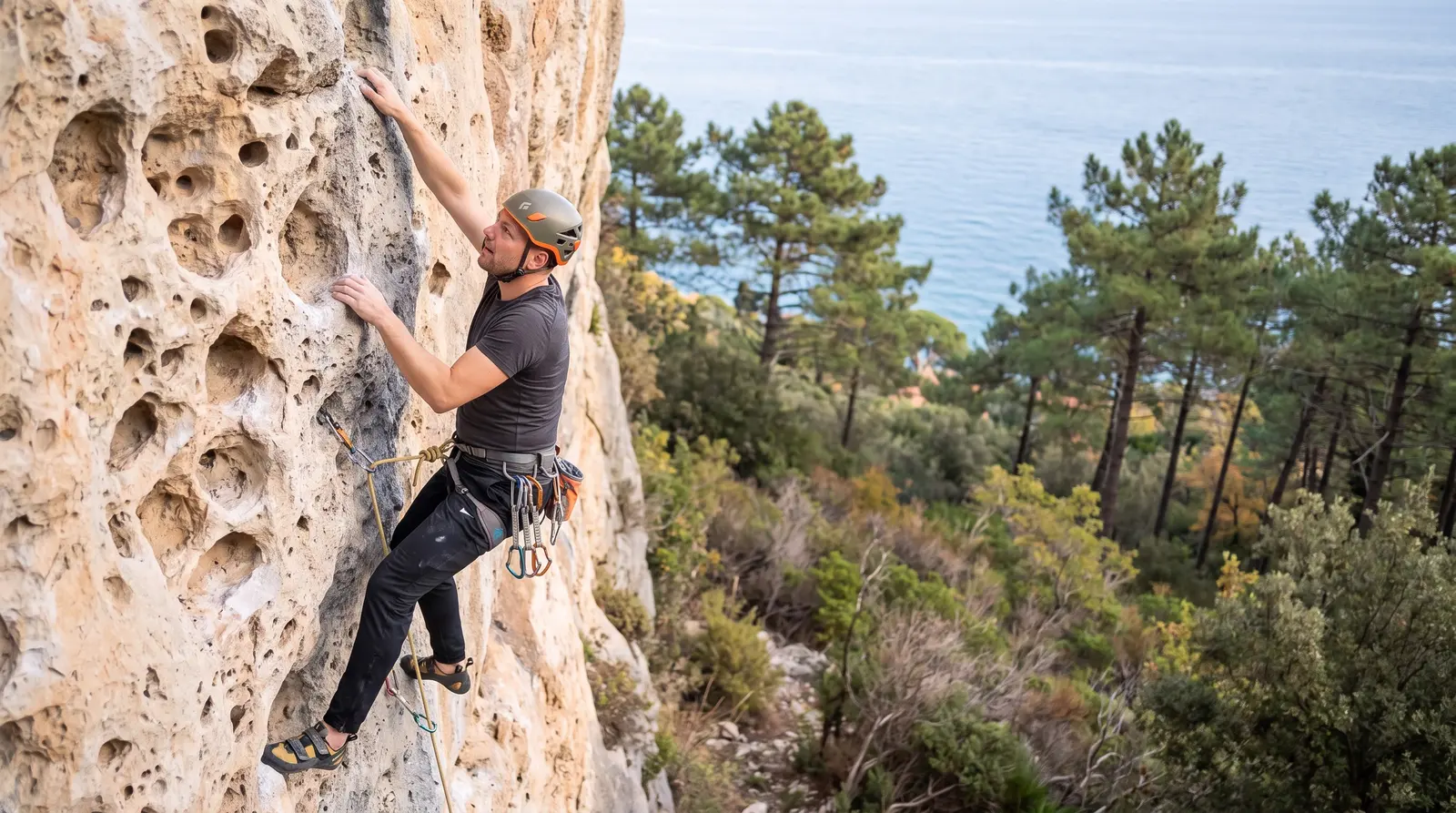
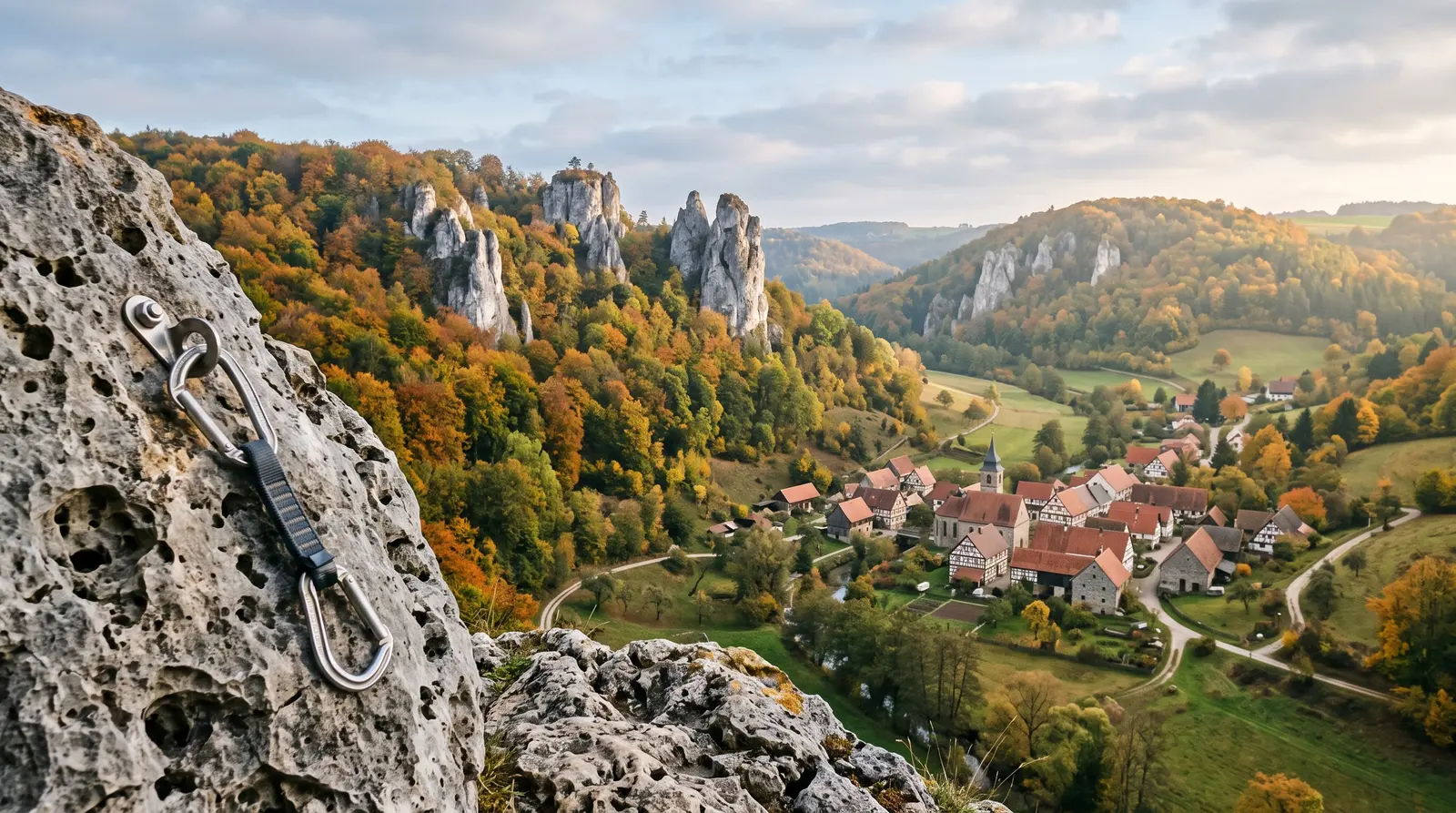
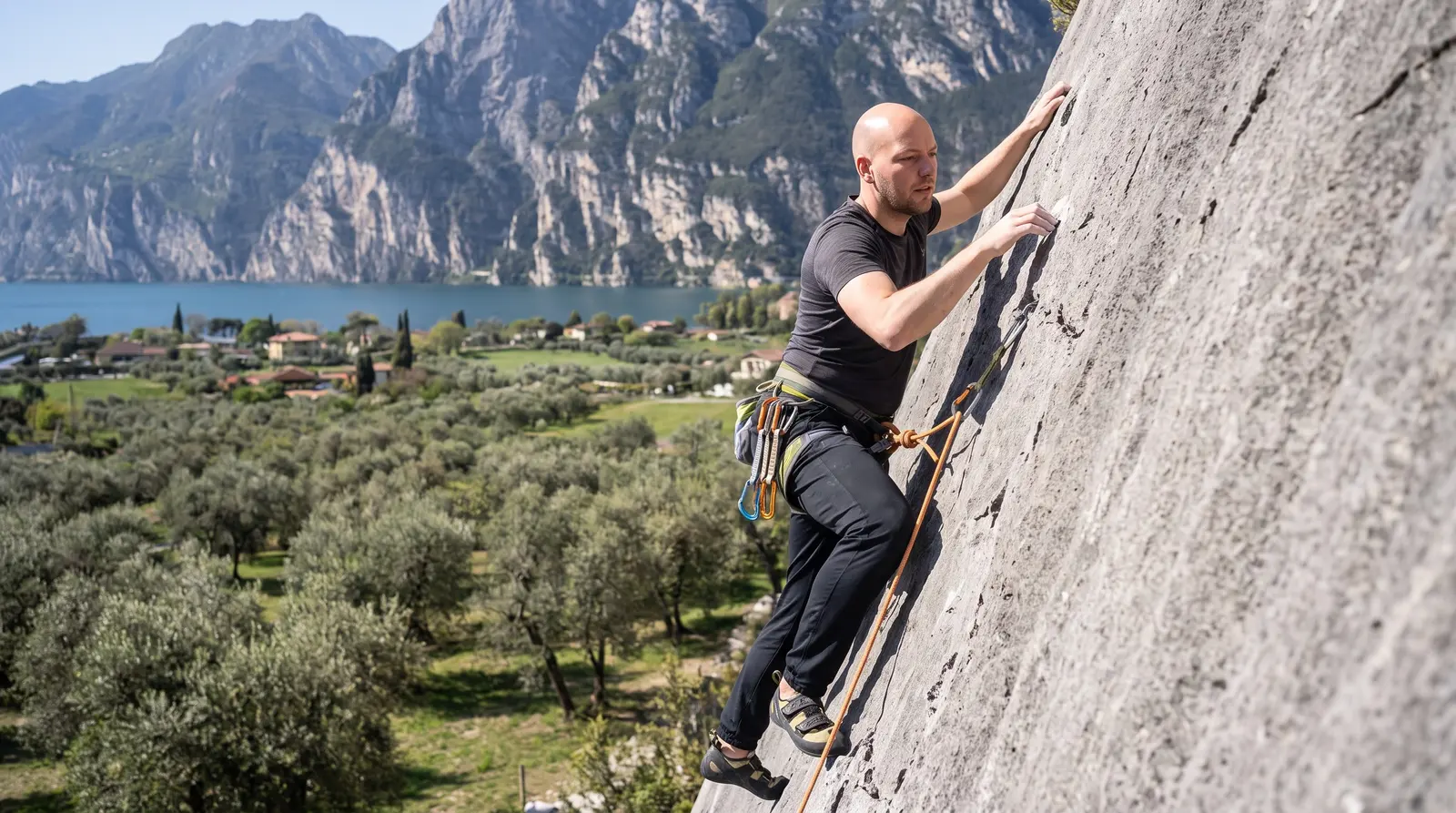
Arco climbing means limestone sport climbing in the Sarca Valley at the north tip of Lake Garda, in Italy's Trentino region: hundreds of crags from 3a family walls to 9b+, long multi-pitch routes on the valley walls, more than ten via ferratas and a town built around climbing. Go in spring or autumn (or pick crags by aspect and climb year-round), base yourself in Arco, and start at easy-access crags such as Massi di Prabi, Policromuro (Massone) or Belvedere. Before you go, check which crags are open: in November 2026 the official list shows Segrom, Placche di Baone and Massi delle Traole as temporarily closed.
I'm a strength and conditioning coach, not a mountain guide or a local, so this guide is built from official Garda Trentino crag data, theCrag and the current guidebooks, all cited at the bottom. Where it touches on training, warm-ups and skin, it's from an S&C point of view. If you're comparing Arco with other areas, see our best climbing destinations in Europe and the rest of our climbing trip guides.
Arco at a glance
| Topic | Arco and the Sarca Valley |
|---|---|
Rock | Limestone, from slabs and vertical walls to steep overhangs |
Style | Single-pitch sport (most visitors), long multi-pitch routes, via ferrata, some bouldering (Massi di Prabi) |
Grades | About 2c to 9b+. The official crags alone span 2c to 8c+; Excalibur (9b+) near Drena is listed by Garda Trentino as the hardest route in Italy |
Size | Garda Trentino maintains 24 crags with 731 routes; the 2022 Versante Sud guide covers 130 areas with over 5,000 routes |
Best months | March to May and September to November; summer and winter work if you choose by aspect |
Nearest airports | Verona (closest), Milan-Bergamo, Bologna |
Nearest train station | Rovereto, then Trentino Trasporti bus to Arco |
Base towns | Arco (most climbers), Riva del Garda, Nago-Torbole, Dro |
Rest days | Lake Garda, hiking, mountain biking, sailing, windsurfing, via ferrata |
Guidebook | Arco Falesie (Versante Sud, 2022) or Kletterführer Arco (Michael Meisl); apps listed below |
Emergency | 112 |
Why Arco matters in climbing history
Arco calls itself the "Home of Climbing", and the history backs it up. According to Garda Trentino, the east face of Monte Colodri, right above town, saw the birth of free climbing in Arco in the 1970s and 1980s. On the lakeside wall of Spiaggia delle Lucertole near Torbole, a group of climbers brought the ideas of modern American sport climbing to Italy about forty years ago and freed around twenty thin face routes that were then thought impossible; the grades there are still the ones the first ascensionists gave.
Competition climbing grew up here too. The official Rock Master site explains that it began in 1986 with Sport Roccia at the foot of Monte Colodri, Rock Master itself was born in 1987, and since 1988 it has been held at the Climbing Stadium in Arco. Today it is an invitational event with Lead Duel and KO Boulder formats for eight of the world's best men and eight women. If you want to watch, check rockmaster.com for the next edition's dates before you book.
The practical side of all this history: the classic crags close to town are polished. theCrag's area page warns that many routes in well-known sectors such as Massone are already very polished. Expect the popular lower grades to feel harder and slicker than their numbers suggest, and look to newer or less-visited crags for better friction.
When to go: season and aspect
theCrag describes Arco's high season as early spring to late autumn, with climbing possible year-round. Rather than one perfect month, the trick in Arco is choosing the crag for the conditions. Garda Trentino lists the aspect of every official crag, and its own notes point the way:
- Spring (March to May): prime time almost everywhere. Easter is the peak: theCrag notes that climbers from Germany and around the world flock here, campsites and popular accommodation can be fully booked, and the famous crags get crowded.
- Summer (June to August): hot in the valley. Choose north- and east-facing walls (Massi di Prabi faces north and sits in the shade of Monte Colodri; Policromuro and Abissi face east, so they get morning sun and afternoon shade), breezy crags above the lake (Garda Trentino says Segrom and Massi delle Traole stay pleasant on the hottest days, although both are temporarily closed as of November 2026), or higher crags such as Pizzocol in Val Concei, which the tourism board calls ideal for the summer months.
- Autumn (September to November): the second main season, usually quieter than Easter.
- Winter (December to February): climb on sunny, sheltered south-facing walls. The official brochure describes Castel Madruzzo as sheltered from north winds and pleasant even in winter, Margone as ideal for the mid-seasons and winter, San Siro as climbable all year thanks to its southern aspect, and Sunny Place above Stenico as ideal from autumn to spring.
Rain plan: Garda Trentino says the overhanging roof at Abissi gives excellent shelter when it rains. It is steep and starts at 6b, so it's a wet-day option for stronger climbers only. If you're comparing winter options, our guide to winter climbing destinations covers Arco alongside warmer areas.
Getting there and getting around
Flights and trains
Garda Trentino lists Verona as the nearest airport, with Milan-Bergamo and Bologna as alternatives. From Verona airport, the Aerobus runs to Verona Porta Nuova station, and from there you continue by train to Rovereto or by bus towards Lake Garda; in summer (roughly June to September) the public bus to Garda stops directly at the airport. By rail, the key station is Rovereto, with regular Trentino Trasporti buses to Torbole, Riva del Garda and Arco. On some bus routes tickets can't be bought on board, so buy before you travel.
By car
From the A22 Brenner motorway, exit at Rovereto Sud/Lago di Garda Nord and follow the SS240 towards the lake; Riva del Garda is about 17 km (11 miles) from the exit. From the north you can also leave the motorway at Trento Nord and drive down the Sarca Valley on the SS45b. If you're driving down from Germany or Austria, note that the Lueg Bridge on the Brenner motorway has had single-lane traffic since January 2025, so plan for delays at busy times.
Without a car: the crag bus
Arco is one of the few big sport-climbing areas you can enjoy without a car. Massi di Prabi starts two minutes from the municipal swimming pool car park in Arco, Calvario is five minutes from the start of the Via Crucis to Laghel, and Policromuro and Abissi are about 20 minutes on foot from town.
On top of that, the Bus&Go crag service ("servizio falesie") is an on-demand bus you book in the Bus&Go app. It runs to Laghel, Padaro and Policromuro (Massone) and costs 2 euros per ride (4 euros if you start from another town), or nothing with a Garda Guest Card. According to the official page, it runs Friday to Sunday in May and October and daily from June to September, with bookable rides from 9:00 to 13:00 and 14:00 to 18:00. In November and December it serves Laghel and Padaro but not Policromuro. Bikes aren't allowed on board. Check the current timetable in the app before you rely on it.
Parking
Parking is the access issue you're most likely to cause. Several official crag pages say there are only a few spaces and that roadside parking is prohibited (Policromuro and Abissi, for example), and the tourism board's own "conscious climbing" rules ask you to park only in marked areas or use the crag bus. Walk or cycle in when you can.
Where to stay
Arco has every type of accommodation: campsites (many within walking distance of crags), hostels, apartments, agriturismos (farm stays) and hotels. Riva del Garda and Nago-Torbole are good alternatives if you want to be on the lake, while Dro and the Sarca Valley villages put you closer to the northern crags. Book early for Easter and the May holidays.
The climbing: Arco's crags by level
The table below covers the official crags around Arco, Nago and Torbole that Garda Trentino maintains, with route counts, grades and aspect taken from each crag's official page. "Closed" means listed as temporarily closed on the official site in November 2026; always recheck before you go.
| Crag | Area | Routes and grades | Aspect | Route length | Good for |
|---|---|---|---|---|---|
Massi di Prabi | Arco | 46 routes, 3c–7a | North | 8–12 m | Beginners, families, summer shade, bouldering |
Muro dell'Asino | Arco (Monte Colodri) | 49 routes, 2c–7b | West | 8–28 m | Beginners and kids (separate kids' area) |
Family San Martino | Arco | Kids: 9 routes, 3a–4b; Junior: 8 routes, 4c–6b | South | 9–22 m | Families |
Policromuro (Massone) | Arco | 98 routes, 4a–8a | East | 8–27 m | Everyone; easy routes on the sides, harder in the middle |
Calvario | Arco | 27 routes, 4b–8a | East | 8–27 m | Mixed groups, short approach |
Abissi | Arco (Massone) | 40 routes, 6b–8a+ | East | 10–40 m | Strong climbers, rainy days |
Piazzole | Arco (Padaro road) | 22 routes, 5c–7b | South-east | 12–22 m | Intermediate |
Placche di Baone | Arco | 11 routes, 5a–6a | South | n/a | Closed (rockfall in spring 2022) |
Belvedere | Nago | 54 routes, 3a–7b+ | South | 10–25 m | Beginners (closely bolted lower sector), the view |
Segrom | Nago | 128 routes, 4b–8a | South | 8–40 m | Closed at the time of writing |
Massi delle Traole | Nago | 58 routes, 3a–8c+ | South-west | 6–18 m | Closed at the time of writing |
Passo San Giovanni | Nago | 36 routes, 4c–8a | South | 10–38 m | Intermediate, cooler months |
Spiaggia delle Lucertole | Torbole | 22 routes, 6a+–8a | South | 20–60 m | Technical slab and face climbing, history |
Corno di Bo | Torbole | 9 routes, 3a–5c | West | 25–125 m | Easy multi-pitch practice |
Massi di Gaggiolo | Dro | 27 routes, 3a–6c+ | East | 8–18 m | Beginners, 2 min from the road |
Beginner and first-trip crags
Massi di Prabi is the obvious first stop: the official page calls it "a true playground for all", with families, boulderers with pads, via ferrata parties and multi-pitch teams all sharing the trail at the foot of Monte Colodri. Belvedere, a 15-minute walk from the Al Coel car park near Nago, has a lower wall of about twenty closely bolted routes for beginners, with wooden steps leading up to harder routes, and one of the best views of Lake Garda from any crag. Muro dell'Asino has 30 routes in its main sector plus a kids' area with huge natural holds; it's about 15 minutes from Santa Maria di Laghel, or 30 minutes on foot from Arco. Massi di Gaggiolo in Dro is two minutes from the road.
Intermediate crags (6a to 7a)
Policromuro, usually just called Massone, is the heart of Arco sport climbing: 98 routes from 4a to 8a on an east-facing limestone wall north of San Martino. Garda Trentino describes easy routes on the left and right and harder routes in the centre. It is also where the polish is worst, so treat grades with suspicion. Calvario sits in an olive grove on the road up to Laghel, Piazzole above Padaro has 22 routes from 5c to 7b, and Passo San Giovanni near Nago is a south-facing option for the cooler months.
Further up the Sarca Valley, theCrag lists dozens more areas, including some of its most logged: Sarche, Castel Madruzzo, Le Piazzole and Parete di Padaro. Use a guidebook or app for these, because many are not part of the official maintained network.
Hard climbing
Abissi (6b to 8a+, up to 40 m and overhanging) and Spiaggia delle Lucertole (6a+ to 8a, thin, technical climbing on polished limestone, with many routes starting a few metres above the lake from belays on iron rungs) are the classic hard venues close to town. Margone (6b+ to 8a+) and San Siro (5b to 8b+/c) further north add more. At the top of the scale, Stefano Ghisolfi's Excalibur (9b+) near Drena is, according to Garda Trentino, the hardest route in Italy.
How grades feel
Arco uses French sport grades. Combine polish on the popular crags with short, steep cruxes and many visitors find the classics stiff for the grade, especially at Massone. Start a grade or two below your usual level for the first days. Our grade converter translates French grades to YDS, and climbing grades explained covers the systems in detail.
Multi-pitch climbing in Arco
The big walls of the Sarca Valley are why many climbers come back. Monte Colodri's east face, right above Arco, is where free climbing in Arco began, and Garda Trentino notes that the Colodri via ferrata was built as a descent path for the hundreds of teams climbing those walls. Further north, at the foot of Monte Brento, the tourism board describes routes freed more than forty years ago that are over a thousand metres long. theCrag also lists big-wall areas such as Monte Brento, Monte Casale, Parete di Padaro and Coste dell'Anglone.
Three things to know before you rope up:
- "Well bolted" is relative. theCrag's Arco page warns that in multi-pitch terms "well bolted" here often means bolts 5 to 15 m apart. Many routes need a small rack of nuts and cams, and the long Brento and Casale routes are serious alpine-style days.
- Start small. Corno di Bo near Torbole (9 routes, 3a to 5c, 25 to 125 m long) is an official, maintained crag for practising easy multi-pitch, and the Colodri walls give short routes with an easy walk-off via the ferrata path.
- Use the guidebook and a guide if needed. We don't name individual multi-pitch routes here because topos, bolting and rockfall status change; use a current topo (see guidebooks below). If you're new to multi-pitch, hire a local mountain guide or climbing school; Garda Trentino lists them on its climbing pages.
Arco via ferrata options
Garda Trentino counts more than ten via ferratas within a few kilometres. The most useful for a climbing trip, with distance, height gain and time from the official listing:
| Via ferrata | Area | Difficulty (official) | Distance | Height gain | Time |
|---|---|---|---|---|---|
Colodri - Colt | Arco | Intermediate | 4.0 km | 280 m | 2:00 |
Rio Sallagoni | Dro & Drena | Intermediate | 2.7 km | 205 m | 2:30 |
dell'Amicizia - Cima SAT | Riva del Garda | Intermediate | 4.0 km | 1,192 m | 4:00 |
Fausto Susatti - Cima Capi (from Riva) | Riva del Garda | Intermediate | 9.9 km | 900 m | 6:00 |
Rino Pisetta - Dain Piccolo | Valle dei Laghi | Difficult | 5.4 km | 800 m | 5:00 |
Che Guevara - Monte Casale | Dro, Comano, Valle dei Laghi | Difficult | 13.9 km | 1,590 m | 8:00 |
Colodri starts a few minutes from the Prabi car park and is, in Garda Trentino's words, the most popular via ferrata in the area for beginners and families, with a relatively simple line, rungs on the steeper sections and an easy descent path. Rino Pisetta is short but steep and strenuous; Che Guevara is a long mountain day.
The tourism board's rules are worth repeating: wear a helmet, harness and a ferrata set with energy absorber and two locking carabiners; keep both carabiners clipped to the cable; only one person between two anchors; don't go in thunderstorms; and don't go alone. See our via ferrata set guide for the kit, and remember that a ferrata set, not a climbing sling, is the only safe way to clip the cable.
Arco with kids
Few places are as well set up for climbing families. Garda Trentino runs dedicated family crags:
- Family San Martino (Arco): a "Kids" sector with 9 routes from 3a to 4b and a "Junior" sector with 8 routes from 4c to 6b. Few parking spaces; walk about 20 minutes from San Martino.
- Doss Pelà (Drena): about a dozen routes from 3a to 4c on one big boulder, 4 to 12 m long, with plenty of space at the base for learning to belay.
- Pizzocol (Val Concei, Ledro): 8 routes from 4a to 6c, five minutes from a picnic area with tables and barbecues, and good in summer.
- Muro dell'Asino kids' area and the easy routes at Massi di Prabi and Belvedere.
The official safety brochure is blunt: the crag base is not a playground, so keep children who aren't climbing away from it, and helmets are for everyone at the base, not just the climber. Rock Master's event village also includes a climbing wall for kids.
Access, ethics and rules
Garda Trentino's crag pages don't mention permits or fees, but there are rules, and access depends on climbers keeping them:
- Check closures. The official crag list shows each crag's status. Placche di Baone has been closed since a rockfall in spring 2022. Segrom and Massi delle Traole are listed as temporarily closed in November 2026. theCrag also notes that many crags around Arco sit on private land and that access problems with landowners come up from time to time.
- Climb only in authorised, marked areas and stay on marked paths.
- Park only in designated spaces, never on the roadside below Massone, or use the crag bus.
- Take all rubbish home; if there's no toilet, go well away from paths, bury organic waste and pack out toilet paper.
- Keep the noise down so climbing calls can be heard.
- Maintenance: on the official crags, qualified professionals inspect and replace the equipment every year, and the Garda Rangers check trails, crags and via ferratas several times a year. Outside that network, gear condition varies.
Safety
The Garda Trentino safety tips are short and worth following:
- Wear a helmet while climbing and at the base. Limestone sheds, and crowded crags mean more people above you. See our climbing helmet guide.
- Partner check before every route: harness, quickdraws, tie-in knot and belay device.
- Knot the rope end, especially on 35 to 40 m routes.
- Clip every bolt, even on easy ground.
- Remove rings and bracelets.
- Heat on south-facing walls in summer is a real problem: carry more water than you think and climb shady crags in the afternoon.
The emergency number in Italy is 112. Before a multi-pitch or via ferrata day, check that your insurance covers mountain rescue and helicopter evacuation; our climbing travel insurance guide explains what to look for.
Gear to bring
- Rope: a 70 m rope covers most single-pitch routes, but Abissi, Segrom and Passo San Giovanni list routes of 38 to 40 m, which need an 80 m rope to lower off. See our climbing rope guide.
- Quickdraws: 12 to 14 for most crags, 16 or more for the 35 to 40 m routes.
- Helmet for everyone at the crag, including belayers and kids.
- Belay device: an assisted-braking device is useful for long sessions on steep routes; see our belay device guide.
- Multi-pitch: half or twin ropes or a single rope plus tagline, a small rack, and gear for retreating.
- Via ferrata: helmet, harness and a certified via ferrata set.
- Pads only if you plan to boulder at Massi di Prabi (see crash pads).
- Skin care: sharp limestone pockets and polished edges are hard on fingertips; read climbing skin care.
If you forget something, Arco's centre has many climbing shops (theCrag lists several), and resolers in Arco and Dro if your shoes wear through; our guide to shoe care and resoling explains when to resole.
Guidebooks and apps
The most complete printed guide we found is Arco Falesie (Versante Sud, 2022) by Mario Manica, Antonella Cicogna and Roni Andres: 704 pages, 130 crags and more than 5,000 routes covering Arco, northern Lake Garda, the Sarca Valley, Valle di Ledro, the Giudicarie valleys and Trento, with GPS tracks for approaches. The edition listed by the Italian retailer Oliunìd is in Italian.
German speakers often use Kletterführer Arco by Michael Meisl, which theCrag lists among its recommended guidebooks for the area. Check the publisher's page for the latest edition before buying. For bouldering, theCrag lists Trentino Bouldering (Cristian Dorigatti and Morris Fontanari, 2022).
For apps, theCrag has a large Valle del Sarca database (with a sun/shade estimator), 27 Crags has a Massone topo (published by a local author), and Garda Trentino publishes an interactive map and a free crag brochure with topos for its maintained crags. Directions on general map apps can be wrong for some crags: the official pages recommend a hiking app such as OutdoorActive.
Rest days and costs
Rest days are easy: swim in or sail on Lake Garda, rent a mountain bike, hike Monte Colodri or the lakeside trails, or take the ferry to towns on the lake (free with a Garda Guest Card). Watching other climbers at the Rock Master Climbing Stadium or doing an easy via ferrata counts as an active rest day; on a true rest day, skip both and let your fingers recover.
Costs are middle-of-the-road for Western Europe: campsites and shared apartments keep things reasonable, while lakeside hotels at Easter and in summer are expensive. Climbing itself is free, and the crag bus costs 2 euros per ride.
A sample 7-day Arco climbing trip
A week for a pair of intermediate climbers (around 6a to 6c), car-free in Arco with a Garda Guest Card:
- Day 1: arrive via Verona and Rovereto. Short session at Massi di Prabi to get used to the rock. Do a proper climbing warm-up first.
- Day 2: Policromuro (Massone) by crag bus or on foot. Morning on the easier side routes, afternoon on 6s in the centre, and expect polish.
- Day 3: Calvario in the morning, then the Colodri via ferrata in the afternoon for the view over the valley.
- Day 4: rest: lake, ferry, gelato.
- Day 5: Belvedere above Nago (Bus&Go covers Nago-Torbole, or drive to the Al Coel car park); morning in spring or autumn, as it faces south.
- Day 6: Piazzole or Parete di Padaro via the crag bus to Padaro, or an easy guided multi-pitch.
- Day 7: half-day back at your favourite crag, then home.
Two days on, one off is a sensible rhythm for most people on a climbing trip, especially on sharp limestone. Our guide to planning a climbing trip covers fitness, skin and logistics before you go, and if you like Arco, Finale Ligure is the other classic Italian limestone destination.
FAQ
When is the best time to go climbing in Arco?
Spring and autumn are the main seasons, and theCrag describes high season as early spring to late autumn. You can climb year-round if you pick the crag by aspect: south-facing walls such as Margone, San Siro or Castel Madruzzo for winter, and shady or breezy spots such as Massi di Prabi or Segrom (when open) for summer. Easter is the busiest time of year.
Can you climb in Arco without a car?
Yes, more easily than at most European destinations. Massi di Prabi, Calvario, Policromuro and Muro dell'Asino are within walking or cycling distance of Arco, and the Bus&Go crag service runs to Laghel, Padaro and Policromuro for 2 euros per ride (free with a Garda Guest Card). For the Sarca Valley and outlying crags a car still helps.
Is Arco good for beginners and kids?
Yes. Garda Trentino maintains several family crags, such as Family San Martino near Arco (a kids sector from 3a to 4b), Doss Pelà near Drena and Pizzocol in Val Concei, plus beginner sectors at Belvedere, Muro dell'Asino and Massi di Prabi. The Colodri via ferrata is described as the most popular beginner and family via ferrata in the area.
What rope length do I need for Arco?
A 70 m rope covers most single-pitch crags, but several official crag pages list routes up to 38 to 40 m (Abissi, Segrom, Passo San Giovanni), which need an 80 m rope to lower off. Always tie a knot in the end of the rope.
Sources
- Garda Trentino, Crags in Garda Trentino (official crag list and status)
- Garda Trentino, Policromuro crag page
- Garda Trentino, Bus&Go and the crag service (servizio falesie)
- Garda Trentino, Via Ferrata Colodri - Colt
- theCrag, Valle del Sarca (Arco area)
- Rock Master, official site (history of Sport Roccia and Rock Master)