Red River Gorge Climbing Guide: Best Time, Muir Valley, PMRP and the Rules
 Petr Hess, strength & conditioning coach
Updated 2 Nov 2026 · 13 min read
Key takeaways
Best for: Sport and trad climbers planning a first trip to Kentucky's Red River Gorge
- Go in spring or fall; October is prime time and the busiest month, summer is hot and muggy.
- Sign two waivers before you climb: Muir Valley's (plus $15 daily parking per car) and the free RRGCC waiver for PMRP, Bald Rock and Miller Fork.
- Start at Muir Valley for moderates and save the steep Motherlode for when you climb 5.12.
- No overnight parking in RRGCC lots; in the national forest, overnight parking needs a Forest Service pass.
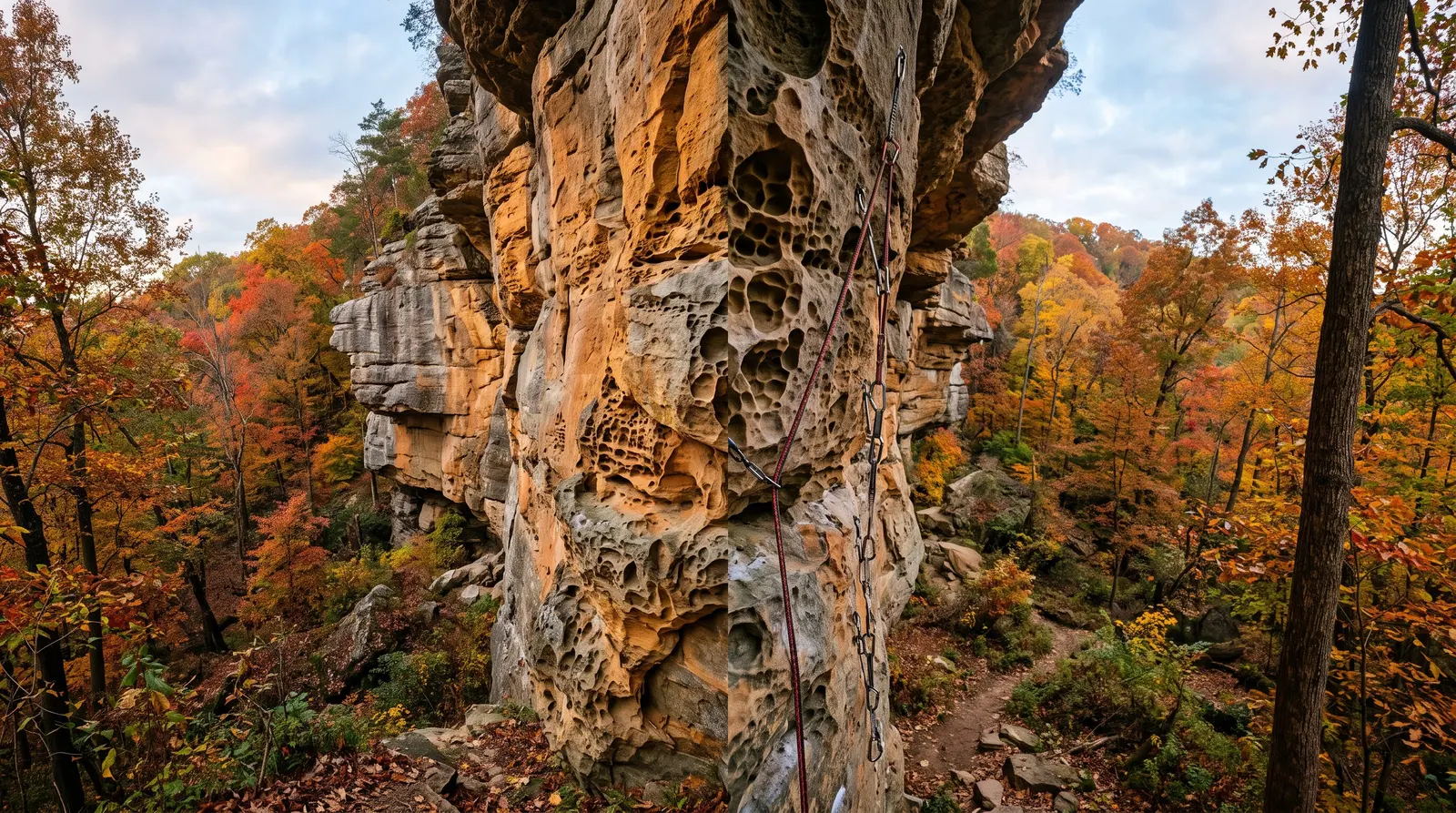
Red River Gorge climbing means steep, pocketed sandstone in the woods of eastern Kentucky: thousands of mostly single-pitch routes, with sport climbing on overhanging walls as the main draw and a big trad scene alongside it. Go in spring or fall, base yourself near Slade (home of Miguel's Pizza), start at Muir Valley if you are new to outdoor leading, and save PMRP and the Motherlode for when you can climb 5.11 and up. Before you clip a bolt, sign the right waiver: Muir Valley and the Red River Gorge Climbers' Coalition preserves each need their own.
I'm a strength and conditioning coach, not a climbing guide or a local, so this Red River Gorge climbing guide is built from the landowners' own rules, the Forest Service and Mountain Project (all cited at the bottom). Where it touches on fitness and recovery, it's from an S&C point of view. For more destinations and planning help, see our climbing trips hub and the guide on how to plan a climbing trip.
The Red at a glance
| Question | Answer |
|---|---|
Rock | Sandstone (Corbin Sandstone, with iron-oxide banding), mostly cliffs under 200 ft (61 m) |
Style | Steep sport on pockets, plates and huecos; plenty of trad cracks and some bouldering |
Size | Mountain Project lists over 4,100 climbs across the region |
Grade spread | Roughly 5.3 to 5.14; the deepest selection is 5.10 to 5.12 |
Best months | Spring and fall; October is peak (and busiest) |
Nearest airports | Lexington (about 1 hour by car); Cincinnati and Louisville (about 2 hours) |
Base | Slade and the KY 11 corridor (Miguel's, private campgrounds, cabins) |
Car needed? | Yes. High clearance helps for PMRP and Bald Rock |
Fees and paperwork | Muir Valley waiver + $15 daily parking per car; free RRGCC waiver for PMRP, BRRP and MFRP; Forest Service pass for overnight parking in the Gorge |
Rest days | Hiking to arches (Sky Bridge, Gray's Arch), Nada Tunnel, Gladie Visitor Center |
Guidebooks | Red River Gorge Select (2018), THE RED 2nd ed. (2022), Red River Gorge Trad (2026) |
What makes Red River Gorge climbing special
Wikipedia sums up the appeal in four words: "overhanging, pocketed sandstone." The Red River Gorge Geological Area covers about 29,000 acres (120 km²) of the Daniel Boone National Forest and holds more than 100 natural arches, the highest concentration east of the Mississippi. Most climbs are a single pitch, and sport climbing dominates.
What surprises first-timers is how steep and how juggy it is. Many routes overhang, and the holds are often pockets, plates and huecos rather than crimps. That has two consequences:
- Endurance matters more than finger strength. Long, steep routes reward pacing, shaking out and resting on big holds. If your forearms flood quickly, read our guide to forearm pump before the trip.
- Grades feel different. Climbers used to vertical crimping can find steep Red 5.11s easier than expected, and others find them brutal. Mountain Project notes that grading at Muir Valley is often soft. If you climb in French or UIAA grades, our grade converter and climbing grades explained will help.
Best time to climb in the Red River Gorge
The Red River Gorge Climbers' Coalition (RRGCC) calls spring and fall the premier seasons because temperatures are moderate. Mountain Project agrees: spring and fall are prime, summer is hot and humid, and winter is slow with occasional warm, sunny days.
| Period | What to expect | Where to climb |
|---|---|---|
March to May | Prime season returns; moderate temperatures | Anywhere; overhangs for wet days |
June to August | Hot and muggy (RRGCC); friction suffers | Shaded walls, early starts |
September to November | Prime season; October is the busiest month and lines form on classics | Anywhere; go midweek for popular walls |
December to February | Slow, but good on sunny days at sun-facing crags; no bugs or snakes (RRGCC) | Sunny walls, middle of the day |
Two planning tips. First, after rain, head for steep, overhanging walls, which stay drier than slabs and vertical faces; never climb on soaked sandstone. Second, check the sun direction for each crag. At the Motherlode, Mountain Project lists the Buckeye Buttress and Warm-Up Wall in sun from morning to early afternoon, the Madness Cave in afternoon sun and the Undertow Wall in evening sun, so you can chase or avoid the sun by sector.
Getting there and getting around
Fly into Lexington (LEX), about an hour away. Cincinnati (CVG) and Louisville (SDF) are about two hours' drive and, Mountain Project notes, sometimes cheaper. From Lexington, take I-64 east for about 15 miles (24 km), then the Bert T. Combs Mountain Parkway for about 33 miles (53 km) to exit 33 (KY 11, Slade). Miguel's Pizza is about two miles (3 km) south on KY 11.
You need a car. The crags are spread along rural roads, from the national forest north of the Parkway to the private preserves south of it, and there is no public transport between them. For PMRP and Bald Rock, a high-clearance vehicle helps: Mountain Project says many PMRP crags need one, two-wheel-drive cars should park at the top of the hill, and the "Lode hill" descent to the Motherlode lot is hard without four-wheel drive. Drive slowly on Bald Rock Fork Road, where there is a 10 mph (16 km/h) limit because dust affects residents.
Where to stay
The climbing community gathers around Slade and KY 11. Your options:
- Miguel's Pizza. The Red's best-known climber institution: a pizza restaurant in Slade with a climbers-only campground behind it, covered picnic areas and a basketball court. It has been the hub of Red climbing culture for decades. Expect a busy, sociable tent city in peak season, and check current camping rates and rules on arrival.
- Other private campgrounds and cabins. Mountain Project also lists Lago Linda's (camping with showers, close to the southern preserves) and Bedrock (private rooms and a bunkhouse). Many visitors rent cabins in the area; book early for October.
- Backcountry camping in the national forest. Allowed in the Daniel Boone National Forest with rules (see below), including an overnight parking pass.
- Not allowed: camping at Muir Valley, and leaving a car overnight in any RRGCC lot. The RRGCC permits backcountry camping on its land only if no vehicle is left in the lot.
The climbing: main areas by level
Mountain Project splits the Red into the Northern Gorge (national forest), the Natural Bridge region, Muir Valley and the Southern Region with the RRGCC preserves. The land owner matters as much as the grade, because each one has its own paperwork.
| Area | Land owner and paperwork | Best for | Example classics (Mountain Project) |
|---|---|---|---|
Muir Valley | Friends of Muir Valley; waiver + daily parking permit | First Red trip, moderate sport, groups | Plate Tectonics 5.10a (Tectonic Wall), Gettin' Lucky in Kentucky 5.10b (Tectonic Wall), Return of Manimal 5.10c/d (Bruise Brothers Wall), Air Ride Equipped 5.11a (Solarium) |
PMRP | RRGCC; free online waiver | Solid 5.10 to 5.12 sport climbers | 27 Years of Climbing 5.8, A Brief History of Climb 5.10b, Breakfast Burrito 5.10c/d, The Preacher's Daughter 5.11b, Check Your Grip 5.12a |
Bald Rock (BRRP) | RRGCC; free online waiver (plus a separate Motherlode waiver) | Steep 5.11 to 5.14 (Motherlode); varied grades (Chocolate Factory) | EGBG 5.10a and Snozzberries 5.11d (Chocolate Factory), Ale-8-One 5.12b and Tuna Town 5.12d (Motherlode) |
Northern Gorge | Daniel Boone National Forest; no waiver, Forest Service rules | Trad, multi-pitch moderates, historic sport | Caver's Route 5.3 (Tower Rock), Bedtime for Bonzo 5.6 and Party Time 5.7 (Fortress Wall), Rock Wars 5.10a (Long Wall), Twinkie 5.12a (Phantasia) |
Natural Bridge region | Mixed; check each crag's access status | Roadside moderates and mid-grade sport | Eureka 5.6 (Global Village), Roadside Attraction 5.7 trad (Roadside Crag), Ro Shampo 5.12a (Roadside Crag) |
Muir Valley: the best start for beginners
Muir Valley is a privately owned nature preserve of roughly 360 acres with over 400 trad and sport routes, according to its owners, spread over more than 30 walls. Cliffs run for over seven miles (11 km) and range from about 20 to over 200 ft (6–61 m) high. Walls are close together, routes are labelled, and Mountain Project recommends the Great Wall, Bruise Brothers Wall and Sunnyside for newer leaders. On a Mountain Project forum thread about a first trip at 5.10 and under, most replies pointed to Muir for its concentration of crags and clear route labelling. The Solarium is the place for steep 5.11 and 5.12 classics.
PMRP: the coalition's flagship
The Pendergrass-Murray Recreational Preserve is a roughly 700-acre property bought by the RRGCC in 2004 that, the coalition says, "will forever remain open to climbing." The RRGCC counts over 600 routes. Its sectors include Drive-By Crag, Bob Marley, the Gallery, the Crossroads, the Shire and the North 40, and Mountain Project groups them under Coal Bank Hollow, Drive-By Parking, Flat Hollow and Sore Heel Hollow. The classics cluster around 5.10 and 5.11, making PMRP ideal once you're comfortable leading at that level.
The Motherlode and Bald Rock
The RRGCC bought Bald Rock in 2017, securing access to the Motherlode, Chocolate Factory, Bear's Den and the Unlode. Mountain Project describes the Motherlode as having "the highest concentration of the steepest and longest routes at the Red," with 30+ 5.12s, about 15 5.13s and a few 5.14s, and says to be ready for 5.12 or harder. Access is dawn to dusk only, and Mountain Project says the Motherlode needs its own Motherlode waiver on top of the RRGCC one. The Chocolate Factory is the better choice for a mixed-ability group, with classics from 5.10a up.
Northern Gorge and trad
North of the Mountain Parkway, inside the national forest and Clifty Wilderness, you'll find the Red's original crags: Tower Rock, Fortress Wall, Long Wall, Military Wall, Phantasia and many more. This is the trad heart of the Red and home to the easiest multi-pitch lines, such as Caver's Route (5.3, four pitches) at Tower Rock. Wolverine Publishing released a dedicated guide, Red River Gorge Trad, in 2026.
Access, ethics and rules (read before you go)
The Red has three types of landowner, each with different rules. Getting this wrong can cost the community its access, so follow them to the letter.
Muir Valley rules
- Waiver: every climber needs an accepted waiver, signed online at muirvalley.org/waiver or on paper at the kiosk (paper waivers are good for three days). Climbers under 18 need a waiver signed by a parent or guardian.
- Parking: admission is free, but each vehicle needs a daily parking permit: $15 per car at the time of writing. Pay the attendant or use the honor system at the pavilion. Cars without a permit may be towed. Park only in the main lot.
- No dogs, not even in cars in the lot (documented service dogs excepted).
- Banned: camping, campfires, hammocks, alcohol, free soloing, mountain biking and climbing in caves.
- Climbing rules: don't climb above the anchors or top out; when top-roping, run the rope through your own quickdraws or carabiners on the anchor, not the fixed hardware. No new routes or bolts without written permission. Helmets are strongly advised.
RRGCC preserves (PMRP, Bald Rock, Miller Fork)
- Waiver: required. The RRGCC FAQ is blunt: without one "you are considered trespassing." It's free and online via rrgcc.org.
- Parking: designated areas only, no overnight parking in any coalition lot, and never block access to oil wells (the coalition owns the surface rights only, and the wells are active).
- Banned: hammocks, drones and open fires. Dogs must be leashed.
- Top-roping: use your own gear on the anchor, never the quick-links.
- Projects: don't touch tagged projects or gear left on them.
- New routes: tell the land manager before bolting or developing anything.
Daniel Boone National Forest (Northern Gorge)
- Overnight pass: if your car is parked overnight (10 p.m. to 6 a.m.) in the Red River Gorge or Indian Creek area, it needs a permit. The Forest Service lists $5 per day, $7 for three days or $50 per year, sold at Forest offices and local vendors.
- Camping: tents must be at least 300 ft (91 m) from roads, parking lots and official trails. Local guides also give a 100 ft (30 m) setback from cliff bases and rock shelters.
- Closed to climbing: climbing and rappelling are banned within 300 ft of the Sky Bridge, Gray's Arch, Nada Tunnel and Chimney Top Rock overlooks (Forest Service order 12-03-15).
- No new routes, fixed anchors or trails without Forest Service authorization.
Rules change, so check Muir Valley's information page, the RRGCC FAQ and the Forest Service page before each trip. If you climb at the coalition preserves, consider joining or donating to the RRGCC: their land purchases are why PMRP and the Motherlode are open at all.
Gear to bring: rope length and quickdraws
Rope length. Route lengths vary a lot, and the Motherlode has some of the longest routes in the area. We'd bring a 70 m (230 ft) rope rather than a 60 m one for extra margin, and check each route's length in the guidebook before you leave the ground. Always tie a stopper knot in the end of the rope and close the system. Our climbing rope guide explains lengths, diameters and dry treatment.
Quickdraws. Count the bolts on the longest routes on your list (the guidebook and Mountain Project give them), add a couple of spares for the anchor, and bring a few long draws or slings for wandering lines. Steep routes are the wrong place to run out of draws.
Lowering vs rappelling. Mountain Project notes that overhanging Red routes are especially hard to clean on rappel, and that sandy conditions wear anchors faster than in other areas. Muir Valley says rappelling is preferred where safe, but that climbers aren't expected to rappel on steep overhangs or very hard routes. Learn to clean steep routes safely (tram in with a draw) before the trip, and when top-roping, never run the rope through the fixed hardware.
The rest of the kit:
- A climbing helmet (strongly advised at Muir Valley, and smart under steep sandstone)
- Harness, belay device (assisted braking helps on long, steep projects), locking carabiners and a cleaning kit
- A trad rack if you plan to climb in the Northern Gorge
- A rope bag or tarp (sandy bases) and a chalk bag
- Rain jacket, bug spray and a headlamp
New to outdoor sport climbing? Start with our climbing gear for beginners list.
Guidebooks and apps
- Red River Gorge Select (Wolverine Publishing, 2018; Dario Ventura, Mike Williams and Ray Ellington). 340 pages covering the best climbs at 54+ crags across the Northern Gorge, Natural Bridge, Muir Valley, the Southern Region and Miller Fork. A good single book for a first trip.
- THE RED, 2nd edition (Brendan Leader, 2022). Listed by Mountain Project as a current guide; it follows Leader's earlier sport guide, Best of the Red.
- Red River Gorge Trad (Wolverine Publishing, 2026; Billy Simek). 364 pages covering the North crags, Tunnel Ridge Road, Natural Bridge and the Southern Region.
- Mountain Project lists over 4,100 climbs with route comments, sun notes and access warnings, and works offline in its app. theCrag also covers the area.
Older guides such as Ray Ellington's Red River Gorge North and South are out of print. Guidebook sales help fund the RRGCC, which is a good reason to buy a paper copy locally.
Safety, rest days and costs
Safety
- Emergencies: call 911. The RRGCC stresses that rescuers need to know which road you are on, not which crag, and that crews may not be climbers. Note your road and parking spot before you walk in.
- Anchors and bolts: sandy conditions wear anchors faster than elsewhere, and the RRGCC has a page for reporting bad bolts. Inspect hardware and report anything worn.
- Snakes and bugs are part of warm-season climbing; watch where you put your hands and feet at the base, and bring bug spray.
- Hunting is allowed in the national forest in season (it's banned at Muir Valley). Wear bright colours on approaches in the fall.
- Insurance: US healthcare and ambulance costs are high, so visitors from abroad need cover that includes climbing and rescue. See our climbing travel insurance guide.
Rest days
Hike to the arches: Sky Bridge and Gray's Arch are classic walks (no climbing near them, see the rules above). Drive through the historic Nada Tunnel, a 900 ft (270 m) logging tunnel dug between 1910 and 1912, or visit the Gladie Visitor Center off KY 715 for maps and passes. From an S&C point of view, rest days matter more in the Red than at a vertical crag: steep, pumpy routes load the forearms, elbows and shoulders day after day. Keep rest days genuinely easy, eat and sleep well, and read our climber's elbow guide if your elbows start to ache.
Costs (in words)
The Red is a budget-friendly trip once you've paid for flights and a rental car. Climbers' campgrounds are cheap, the RRGCC preserves are free (donations welcome) and the national forest overnight pass is a few dollars. The main daily costs are Muir Valley parking, fuel and food. Cabins cost more but split well in a group.
A sample 7-day Red River Gorge trip
For a group climbing 5.9 to 5.11, with a car:
- Day 1: Fly into Lexington, pick up the car, stock up on food, sign the Muir Valley and RRGCC waivers online, settle in near Slade.
- Day 2: Muir Valley, an easy day on moderate walls such as the Great Wall or Sunnyside to learn the rock and the grades.
- Day 3: Muir Valley again, Tectonic Wall or Bruise Brothers Wall for classic 5.10s.
- Day 4: Rest: hike to Sky Bridge or Gray's Arch, then pizza.
- Day 5: PMRP, one sector for the whole day, with 5.10 and 5.11 classics.
- Day 6: Chocolate Factory (or the Northern Gorge if you climb trad, or a steep wall if it rains).
- Day 7: A short morning session, then the drive back to the airport.
Leave one day flexible for weather, and save the Motherlode for a later trip unless you're already climbing 5.12. For a full planning checklist, see how to plan a climbing trip.
Common mistakes on a first Red trip
- Forgetting the waivers. Muir and the RRGCC each need their own; climbing on coalition land without one counts as trespassing.
- Leaving the car overnight at a coalition lot, or in the Gorge without a Forest Service pass.
- Bringing the dog to Muir. It's not allowed, even in the car.
- Top-roping through fixed anchors. Use your own draws or lockers.
- Taking a low car down the Lode hill. Park at the top and walk if in doubt.
- Going too hard on day one. Steep, pumpy routes add up fast. Warm up properly (see our climbing warm-up) and pace the week.
- Short rope, short rack. Check route lengths and bolt counts the night before.
FAQ
When is the best time to climb in the Red River Gorge?
Spring and fall. The Red River Gorge Climbers' Coalition calls them the premier seasons because temperatures are moderate. Summer is hot and muggy, so you hunt for shade. Winter can be good at sunny crags on warm days and has no bugs or snakes. October is peak season, so expect crowds and lines on popular routes.
Do I need to pay or sign anything to climb at Muir Valley?
Admission is free, but every climber must have an accepted Muir Valley waiver (online or on paper at the kiosk), and every vehicle needs a daily parking permit: $15 per car at the time of writing, or a 12-month pass for members. Dogs are not allowed, even in cars in the lot, and camping, hammocks and alcohol are banned.
Is the Red River Gorge good for beginners?
Yes, if you already lead sport routes indoors or come with an experienced partner. Muir Valley is the usual starting point: walls are close together, routes are clearly labelled and Mountain Project notes that grades there are often soft. Mountain Project suggests the Great Wall, Bruise Brothers Wall and Sunnyside for newer leaders. The Motherlode and other steep crags are better saved for 5.12 climbers.
Can I camp or park overnight at PMRP?
You can't leave a car overnight in any RRGCC lot, including PMRP, Bald Rock (BRRP) and Miller Fork (MFRP). The RRGCC allows backcountry camping on its land as long as no vehicle is left in the lot, and hammocks are banned. Most visitors camp at Miguel's or another private campground, or in the national forest with a Daniel Boone overnight pass.
Sources
- Mountain Project, Red River Gorge area page
- Mountain Project, Muir Valley
- Mountain Project, The Motherlode
- Muir Valley (Friends of Muir Valley), Important Information and rules
- Red River Gorge Climbers' Coalition, FAQ
- Red River Gorge Climbers' Coalition, Pendergrass-Murray Recreational Preserve
- USDA Forest Service, Daniel Boone National Forest: Red River Gorge
- USDA Forest Service, Climbing and rappelling prohibitions, order 12-03-15 (2015)