Joshua Tree Climbing Guide: Season, Campgrounds, Classic Routes and Park Rules
 Petr Hess, strength & conditioning coach
Updated 2 Nov 2026 · 13 min read
Key takeaways
Best for: Trad, top-rope and bouldering trips to the California desert from October to April
- Go October to April; October and March are usually best, and summer highs near 97°F (36°C) make it the off-season.
- Joshua Tree is trad and top-rope territory: bring a rack or a partner who can build natural anchors, and expect stiff grades.
- Hidden Valley Campground is first-come and fills by Friday afternoon in season; Ryan and Jumbo Rocks are reservable on recreation.gov, and none of them have water.
- Any new, replaced or removed bolt needs a park permit, most of the park is anchor-free, and you must clean chalk and tick marks after bouldering.
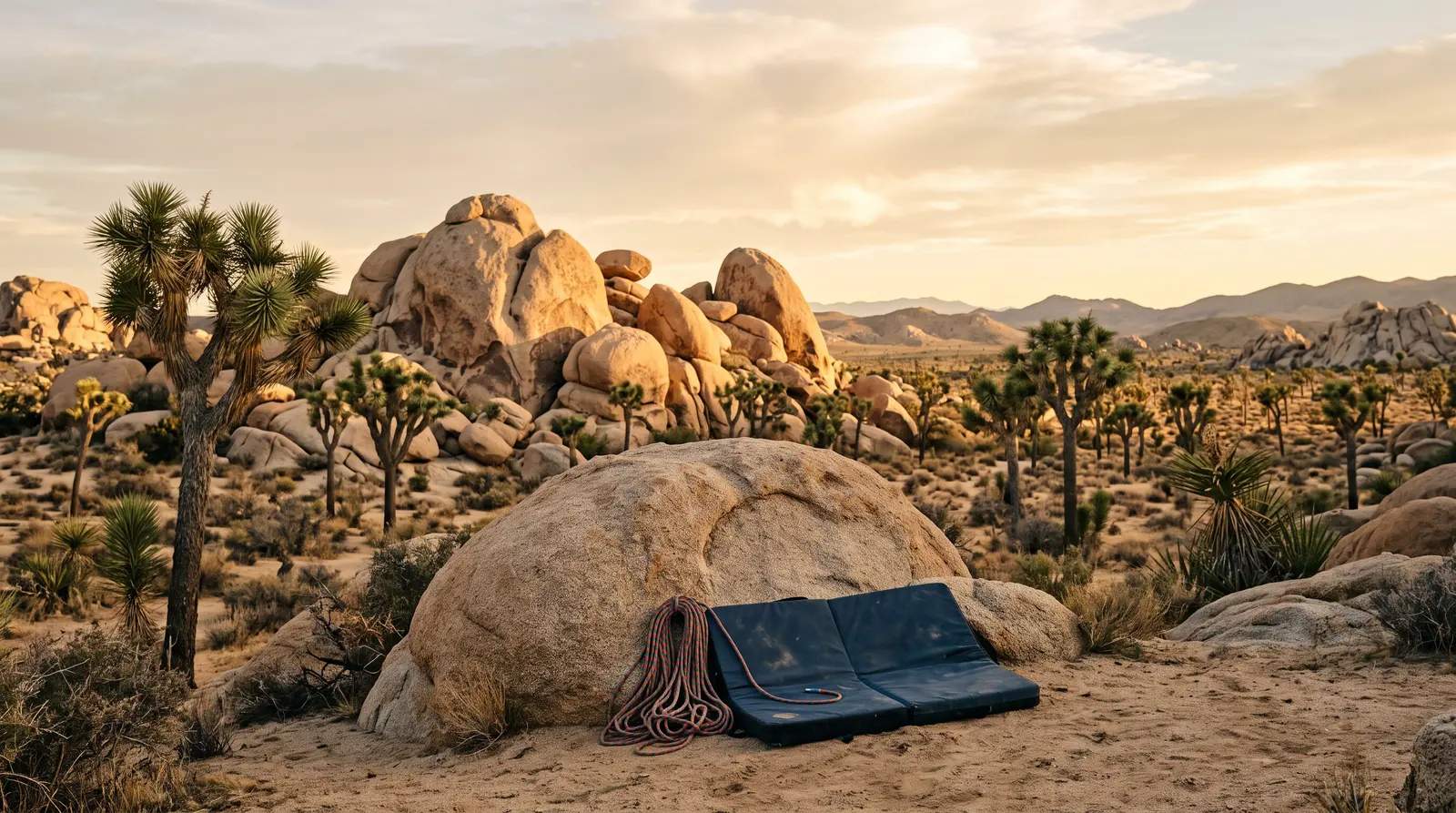
Joshua Tree climbing means rough, grippy granite in the California high desert: more than 8,000 routes and around 2,000 boulder problems, according to the National Park Service, almost all of them traditional cracks, slabs and short faces rather than bolted sport climbs. Go between October and April (October and March are usually the sweet spot), camp at Hidden Valley or Ryan if you can get a site, and come with a trad rack or a partner who can build top-rope anchors, because bolts are rare and placing new ones needs a park permit.
This guide is for climbers planning a first or second trip: when to go, where to camp, which areas suit which level, the bouldering, and the park rules that most other guides skip. I'm a strength and conditioning coach, not a guide or a local, so everything here is built from the park's own pages, Mountain Project and the current guidebooks (listed at the bottom). If you're new to outdoor climbing, start with our outdoor bouldering for beginners guide and the wider climbing trips section.
Joshua Tree at a glance
| What | Details |
|---|---|
Rock | Monzogranite (often called quartz monzonite): coarse, rough granite. The best rock has dark desert varnish; quiet routes can be gritty. |
Style | Trad cracks, friction slabs, steep faces, short multi-pitch; lots of top-roping; bouldering everywhere |
Size | 8,000+ routes and about 2,000 boulder problems (NPS) |
Grades | Routes for all levels; Mountain Project's park classics run from 5.6 to 5.11, boulder classics from V0 to V6 and beyond |
Best months | October–April; October and March usually best. Summer is dangerously hot. |
Elevation | Hidden Valley Campground 4,200 ft (1,280 m); Indian Cove Campground 3,200 ft (975 m), so warmer in winter |
Nearest airports | Palm Springs (PSP), about 44 mi / 70 km to the West Entrance; Ontario (ONT) about 93 mi / 150 km; Los Angeles (LAX) about 148 mi / 238 km; Las Vegas (LAS) about 225 mi / 362 km to the North Entrance |
Base towns | Joshua Tree, Yucca Valley, Twentynine Palms (motels, shops, food) |
Camping | Hidden Valley (first-come), Ryan and Jumbo Rocks (reservable), plus Indian Cove, Black Rock and others. No water at most sites. |
Entrance fee | $30 per private vehicle for 7 days; $55 park annual pass |
Guidebooks | Joshua Tree Rock Climbs (3rd ed., 2017) and Joshua Tree Bouldering (2nd ed., 2016), both by Robert Miramontes, Wolverine Publishing |
Rest days | Hiking in the park, Palm Springs, the desert towns along Highway 62 |
Best time to climb in Joshua Tree
The climbing season runs from October to April. Locals climb year-round, but Mountain Project's area page names October and March as normally the best months, and notes that weekends from November to May are crowded. The table below uses long-term averages for Cottonwood (about 3,100 ft), the only official station with a published normals table. Hidden Valley is roughly 1,100 ft higher, so expect it to be a few degrees cooler than this.
| Month | Avg high | Avg low | For climbing |
|---|---|---|---|
Nov–Feb | 59–67°F (15–20°C) | 35–40°F (1–5°C) | Good on sunny faces; cold mornings, short days, occasional storms. Shady walls can be too cold. |
March | 66°F (19°C) | 40°F (5°C) | Prime month. Busy, especially at weekends. |
April | 75°F (24°C) | 45°F (7°C) | Still good; chase shade by midday. Raptor closures in force. |
May | 84°F (29°C) | 52°F (11°C) | Marginal; early mornings and shade only. |
Jun–Sep | 91–98°F (33–37°C) | 60–67°F (16–19°C) | Off-season. Heat illness risk; several campgrounds close; fires banned from June 15. |
October | 80°F (27°C) | 49°F (10°C) | Prime month once the summer heat breaks. |
Two practical points. First, friction on rough granite is best when it's cool, so plan hard sends for shaded walls or late afternoon, and use the sun to stay warm in winter. Second, the desert sun and dry air dehydrate you faster than you'd think even in March. There's no water at Hidden Valley, Ryan or Jumbo Rocks, so bring more than you expect to drink: the NPS campground page lists water only at Black Rock and Cottonwood.
Getting there and getting around
Fly into Palm Springs for the shortest drive, or Los Angeles or Ontario for more flight choice and cheaper car hire. Most climbers enter through the West Entrance in the town of Joshua Tree, which leads straight to Hidden Valley, Quail Springs and Lost Horse.
Plan on a car. The park covers about 795,000 acres (3,200 km²), areas are spread along Park Boulevard and side roads, and you'll be carrying a rack, rope, pads and all your water. The North and West entrance stations take cards only; you can also buy the vehicle pass in advance on recreation.gov. Visitors from outside the US can buy the America the Beautiful non-resident annual pass ($250) if they'll visit several federal sites on the same trip.
Where to stay: Hidden Valley, Ryan and the other campgrounds
Most climbers camp in the park, close to the rock. The rules changed over the years, so older blog posts are often wrong about which sites you can book. Here is the current picture from the NPS campgrounds page (updated August 2026):
| Campground | Booking | Sites | Water | Why climbers use it |
|---|---|---|---|---|
Hidden Valley | First-come, first-served, $25/night, open year-round | 44 | No | The climbers' campground: Intersection Rock, The Old Woman, The Blob and Cyclops Rock are right in camp |
Ryan | Reservable, $30/night, closed in summer | 31 | No | Central; bouldering around the campground |
Jumbo Rocks | Reservable, $30/night | 124 | No | Largest in-park option near central areas |
Indian Cove | Reservable, $35/night | 101 | No | Lower and warmer for winter; separate road from Highway 62 |
Black Rock | Reservable, $35/night | 99 | Yes | Water and flush toilets; further from the main climbing |
Belle, White Tank | First-come, $25/night, closed in summer | 18 / 15 | No | Small, quieter overflow options |
A few things that catch visitors out:
- Hidden Valley fills fast. The NPS says sites are often full on weekends from September to May, and first-come sites typically fill by Friday afternoon. Arrive midweek or early.
- Reservable sites are booked on recreation.gov (up to six months ahead). Book as soon as your dates are fixed for spring weekends.
- Site limits: first-come sites take up to six people, three tents and two vehicles.
- No roadside sleeping. Sleeping in vehicles at pull-offs isn't allowed. If the park is full, the NPS points to Bureau of Land Management land outside the park; motels and rentals in Joshua Tree, Yucca Valley and Twentynine Palms are the other option.
- Campfires are banned from June 15 to October 1 unless the park says otherwise.
The climbing: trad, top-rope and the grade shock
Joshua Tree is a trad area. The NPS describes it as traditional-style crack, slab and steep face climbing, and the park's own fixed-anchor page puts it plainly: Joshua Tree has a lot of top-rope routes, "many of which are worth climbing, but not worth bolting." In practice that means:
- Most routes need a rack. Cams and nuts for the cracks, slings for horns and boulders. Bolts are rare and often old, so a leader needs to be solid at the grade and comfortable placing gear.
- Top-roping is huge. Many formations are short, with walk-off tops, so groups build anchors from gear, boulders or existing bolts and run top-ropes. You need someone who knows how to build and extend a safe anchor on natural features. The park also asks you never to leave a top-rope unattended and never to anchor on vegetation.
- Grades feel stiff. Climbers regularly describe J-Tree routes as "heady" and harder than the number. Coarse friction, flared cracks and old-school ratings all play a part. Start a couple of grades below your gym or sport level. Our climbing grades explained guide and grade converter help if you think in French or UIAA grades.
- The rock bites. The coarse crystals are great for friction and hard on skin, especially in cracks. Tape for jamming and look after your hands between days (see climbing skin care and how to tape fingers).
Main areas by level
| Area | Size (Mountain Project) | Why go | Best for |
|---|---|---|---|
Hidden Valley Campground | Intersection Rock, The Old Woman, The Blob, Cyclops Rock and more | Classics a few steps from your tent | First trip, easy trad, top-roping |
Hidden Valley (wider area) | About 1,000 routes | Real Hidden Valley, Echo Rock and other formations nearby | All levels |
Central Joshua Tree | About 1,400 routes | Barker Dam, Gunsmoke area, Planet X; huge variety | Intermediate trad, bouldering |
Lost Horse | About 750 routes | Long walls with many moderate cracks and faces | Intermediate |
Indian Cove | About 840 routes | Lower and warmer, separate access road | Winter days, top-roping |
Wonderland of Rocks | About 720 routes | Longer approaches, quieter, more adventurous | Experienced parties |
Quail Springs, Queen Valley | About 370 / 360 routes | Close to the West Entrance / central road | All levels |
Beginner routes in Hidden Valley Campground
These are long-established moderate classics listed on Mountain Project. They are all trad, they are popular, and you should expect a queue on spring weekends. Climb them with someone who can lead and build anchors, or with a permitted guide.
| Route | Grade | Formation | Notes |
|---|---|---|---|
The Bong | 5.4 | The Blob | Trad, a gentle first route |
The Eye | 5.4 | Cyclops Rock | Trad, rated PG-13 on Mountain Project; finishes through a hole in the rock |
Mike's Books | 5.6 | Intersection Rock | Trad, 2 pitches |
Toe Jam | 5.7 | The Old Woman | Trad crack, good backup when Double Cross is busy |
Overhang Bypass | 5.7 | Intersection Rock | Trad, 2 pitches |
Double Cross | 5.7+ | The Old Woman | Trad, the campground's most famous moderate |
The Flake | 5.8 | Intersection Rock | Trad |
Dogleg | 5.8+ | The Old Woman | Trad |
Park classics for the next level
Mountain Project's classics list for the park includes some routes worth planning a trip around: Mental Physics (5.7, 2 pitches), Sail Away (5.8), Dappled Mare (5.9, 4 pitches), Pope's Crack (5.9), Bird of Fire and Touch and Go (both 5.10a), Exorcist (5.10b), Illusion Dweller and Clean and Jerk (both 5.10c), and Rubicon (5.11a). Check the current Mountain Project page or the guidebook for the line, the descent and any seasonal closure before you go.
Joshua Tree bouldering
Bouldering here is as famous as the roped climbing. Mountain Project lists more than 1,700 problems across the park, with the biggest clusters around Hidden Valley (about 480) and Central Joshua Tree (about 460). Landings are often sand or gravel with rocks and plants around, so bring at least one pad per person and a spotter; our guides to how many crash pads you need and the best crash pads help with that.
Classics in the moderate range from Mountain Project's list:
| Problem | Grade | Area |
|---|---|---|
False Up 20 | V0- | Hidden Valley, JBMF Boulders |
White Rastafarian | V2 (R) | Hidden Valley, Outback |
The Chube | V2 | Central, Gunsmoke Area |
Fry Problem | V2 | Central, Fry Boulders |
Gunsmoke | V3 | Central, Gunsmoke Wall (an 80 ft traverse) |
Slashface | V3 (R) | Queen Valley, Western Belt |
Stem Gem | V4 | Hidden Valley Campground (west) |
Pigpen | V4 | Hidden Valley, Manx Boulders |
Saturday Night Live | V4 | Real Hidden Valley Circuit |
Sloper Safari | V4 | Central, Meadows Boulder |
Gunsmoke deserves a note: Mountain Project calls it perhaps the most classic boulder problem in the park, but it's crowded and bakes in the midday sun, so go late in the afternoon. Many J-Tree problems are tall and some carry an "R" rating, meaning a bad fall is possible; treat highballs with respect and read how to fall safely before you go.
Park rules: bolting, fixed anchors, chalk and closures
Joshua Tree is a national park with an active and sometimes contested climbing policy, so it pays to know the rules. All of the following come from the park's own pages.
Bolts and fixed anchors
- Any fixed anchor needs a permit. "The placement, replacement, and removal of fixed anchors requires a permit in all circumstances," in wilderness and non-wilderness, by hand or power drill, including rebolting. This has applied since February 4, 2022.
- Power drills may not be used without a permit.
- Most of the park is anchor-free. The east and south halves of the park and a section in the west are fixed-anchor-free zones, as is the area between the Barker Dam parking lot and the dam. In wilderness (nearly 85% of the park), anchors may only be replaced anchor-for-anchor, with a permit.
- Specs: stainless steel bolts and hangers are required, camouflaged to blend with the rock. Rap rings, quick links and chains should be neutral or rock-coloured.
- Nobody maintains the bolts. The NPS does not inspect, maintain or repair bolts or any other fixed gear. Back up anything that looks old.
- A management plan is pending. The park says it is "actively working on a Climbing Management Plan that could impact bolting regulations." Check the fixed-anchor page before any trip.
Chalk, trails and good practice
- Clean your chalk. After bouldering, brush chalk off holds and remove tick marks (a soft climbing brush does the job).
- Stay on climber trails, marked with brown posts, and stay off the dark, lumpy biological soil crust. Social trails kill plants and crush animal burrows.
- No vegetation as anchors, and don't break branches or remove lichen around boulders.
- No altering the rock: no chipping, "nailing" or "gardening".
- Respect cultural sites. Never climb on or near rock art; the park describes these pecked and painted images as sacred to the Chemehuevi. Respect every posted closure.
- Keep groups small, share popular rocks, skip the music, ask before climbing at an occupied campsite, and carry pads rather than drag them.
- Dogs are only allowed within 100 ft of roads, parking areas and campgrounds, on a 6 ft leash, and a dog tied up at the base while you climb counts as unattended.
- Guides must hold a park permit plus recognised guiding certification, first aid and insurance. If you hire one, ask to see it.
Seasonal raptor closures
Some formations close each spring for nesting birds. For 2026, Mountain Project's access notes listed closures from February 17 to June 7 (or until nests were abandoned) for routes including "Right On", "Orange Flake" and "Kid Caligula" (owl) and "Fat Freddie's Cat", Freak Brothers Dome, "The Weenie", "Pea Brain" and The Red Obelisk (prairie falcon). Closures change every year: check the park's climbing pages, visitor centres and posted signs before you climb.
Gear to bring
- Rack: a standard trad rack with cams from fingers to fist and a set of nuts covers most moderate cracks; check the guidebook for wide routes. Long slings and extra locking carabiners for top-rope anchors.
- Rope: a single dynamic rope covers most short formations with walk-off descents; check lengths and descents in the guidebook for multi-pitch routes, and bring a static line or long slings if you plan to rig top-ropes. See our climbing rope guide.
- Helmet and harness: loose flakes and gritty ledges are part of desert climbing (helmets, harnesses).
- Shoes: a comfortable all-day pair for cracks and slabs. Coarse granite eats rubber, so plan on a resole afterwards (shoe care and resoling).
- Bouldering: pads, brush, chalk and a chalk bucket.
- Desert kit: several gallons of water per person for multi-day stays, sun hat, sunscreen, warm layers for cold nights, headlamp, and tape for crack climbing.
Our trip packing list and climbing gear for beginners fill in the rest.
Guidebooks and apps
- Joshua Tree Rock Climbs, 3rd edition, Robert Miramontes (Wolverine Publishing, 2017). 524 colour pages, 3,000+ selected climbs across Quail Springs, Hidden Valley, Lost Horse, Wonderland of Rocks, Indian Cove and more, plus logistics and camping. The standard roped-climbing guide.
- Joshua Tree Bouldering, 2nd edition, Robert Miramontes (Wolverine Publishing, 2016). 484 pages, 2,000+ problems from Hidden Valley Campground to Barker Dam, Planet X and Indian Cove.
- Mountain Project (free app and website): the most complete online database for the park, with current access notes and closures on each area page.
Both books are a few years old, so cross-check closures and bolting rules online.
Safety in the desert
- Heat: even in shoulder season, climb in the shade, drink steadily and take a long break in the middle of the day. In summer, don't.
- Cell coverage is patchy to non-existent in much of the park. Mountain Project notes an emergency satellite phone at the Hidden Valley / Intersection Rock parking lot. In the US, dial 911 for emergencies.
- Hospitals: the nearest hospital is in the town of Joshua Tree; the nearest trauma centre is in the Palm Springs area, about an hour away. That's a long time with an injury, so climb conservatively and carry a first-aid kit.
- Fixed gear: nobody inspects the bolts, and many anchors are old. Back them up.
- Insurance: US medical and rescue costs can be very high for visitors. Read our climbing travel insurance guide before you book.
Rest days and costs
Rest days are easy here. Hike in the park (Ryan Mountain and the Hidden Valley loop are popular short options), drive down to Palm Springs, or explore the towns along Highway 62. From a training point of view, coarse granite and crack climbing are hard on skin and tendons. A simple rhythm of two days on, one day off works for most people, and plan an easy day after your hardest one. A good climbing warm-up on cold mornings is worth the ten minutes.
Costs are moderate if you camp: campsites run $25–35 a night and the vehicle pass is $30 for seven days. Car hire, flights and peak-season motels in the desert towns are the big costs.
A sample 7-day Joshua Tree trip
- Day 1: Arrive midweek, grab a Hidden Valley site (or check in to your reserved site), and climb easy routes in camp: The Bong or The Eye to get used to the friction.
- Day 2: Hidden Valley Campground moderates: Double Cross, Toe Jam, Mike's Books. Boulder in camp in the late afternoon.
- Day 3: Central Joshua Tree bouldering around the Gunsmoke area, with Gunsmoke itself late in the day.
- Day 4: Rest: hike, Palm Springs, resupply water.
- Day 5: Lost Horse or Quail Springs for longer moderate routes; or Mental Physics if you're comfortable on 5.7 multi-pitch.
- Day 6: Hidden Valley bouldering (Stem Gem, the Real Hidden Valley Circuit), or Indian Cove if it's cold.
- Day 7: A favourite area for a final project, clean up, pack out everything.
Joshua Tree rewards climbers who come ready for trad, plan around the heat and treat the park's rules seriously. Do that, and it's one of the best winter climbing trips in North America.
FAQ
When is the best time to climb in Joshua Tree?
October to April is the main season, and Mountain Project calls October and March normally the best months. Summer is too hot for most climbers: at Cottonwood (about 3,100 ft) average highs are around 97°F (36°C) in July. Winter days are often fine in the sun but nights drop close to freezing.
Is Joshua Tree good for beginner climbers?
Yes, if you climb with someone who can build trad anchors or hire a permitted guide. There are many easy routes, such as The Eye (5.4) and Double Cross (5.7+), and lots of top-rope climbing. But most routes need gear, there are few bolts, and grades often feel stiff, so it is not a place to learn leading on your own.
Do you need a permit to climb in Joshua Tree?
No permit is needed to climb, but you pay the park entrance fee. You do need a permit to place, replace or remove any bolt or fixed anchor, power drills need a permit, and most of the park is a fixed-anchor-free zone. Guides must hold a park permit to work there.
Can you reserve Hidden Valley Campground?
No. According to the NPS, Hidden Valley (44 sites, open year-round) is first-come, first-served and often fills by Friday afternoon from September to May. Ryan Campground (31 sites) is reservable on recreation.gov and closes in summer. Neither has water.
Sources
- National Park Service, Climbing – Joshua Tree National Park (updated 2022)
- National Park Service, Fixed Anchors – Joshua Tree National Park (updated 2025)
- National Park Service, Good Climbing Practices – Joshua Tree National Park (updated 2023)
- National Park Service, Campgrounds – Joshua Tree National Park (updated 2026)
- Mountain Project, Joshua Tree National Park climbing area
- Mountain Project, Joshua Tree Bouldering
- Sarah Horn, A Beginner's Climbing Guide to Joshua Tree, The Outbound (2017)
- Wolverine Publishing, Joshua Tree Rock Climbs, 3rd edition (Robert Miramontes, 2017)