Albarracín Bouldering Guide: Sectors, Season and the Rules You Must Know
 Petr Hess, strength & conditioning coach
Updated 2 Nov 2026 · 11 min read
Key takeaways
Best for: Boulderers planning a first trip to Albarracín's red sandstone roofs
- Since 2022 bouldering is legal only in three zones (Navazo, Cascantejo, Callejones) and only between sunrise and sunset.
- No permit or registration is needed for independent climbers, but camping, van overnights and chalk tick marks are banned.
- Península, Sol, Mirador and several other sectors are closed all year to protect nesting birds.
- Go in autumn or spring, rent a car, and bring a big pad for the roofs and the 2025 Roberto Palmer guidebook.
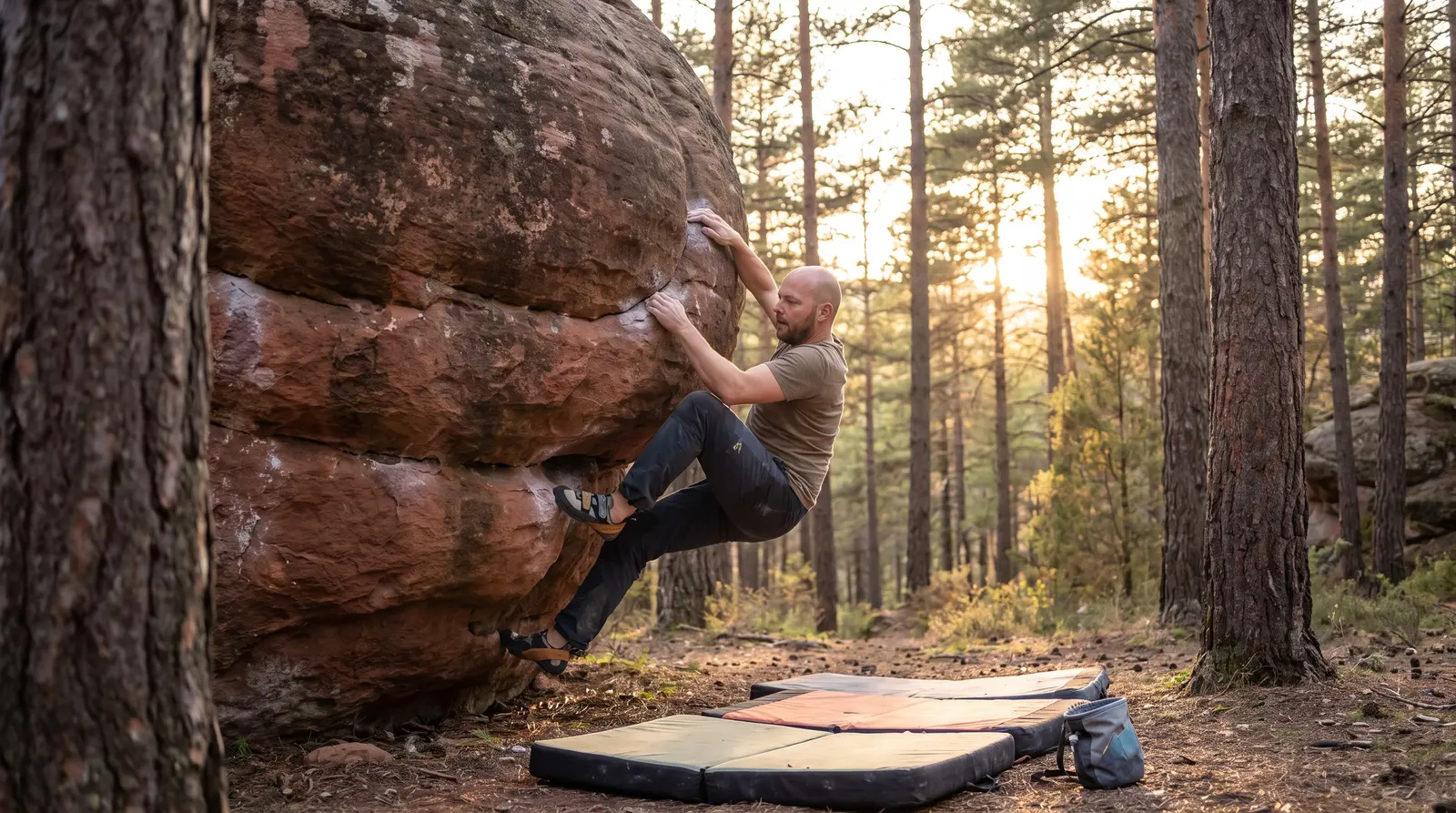
Albarracín is Spain's best-known bouldering area: thousands of problems on red sandstone in the pine forests of the Pinares de Rodeno, just outside a medieval village in Teruel province, Aragón. It is famous for steep roofs on pockets that finish with sloping mantels, and it suits everyone from first-timers to strong boulderers. Go in autumn or spring, bring at least one big pad, and above all learn the rules: since 2022 bouldering is only allowed in three designated zones, only in daylight, with tick marks, camping and van overnights banned and several sectors closed all year.
I'm a strength and conditioning coach, not a local or a climbing guide, so this guide is built from the official regulation, the local tourism office, the current guidebook and the topo databases (sources at the bottom). If you have never bouldered on real rock before, read our outdoor bouldering for beginners guide first. For other trip ideas, see our climbing trips hub and the best climbing destinations in Europe.
Prices and stock change often; the button opens the retailer or brand page so you can check today's price.
Albarracín bouldering at a glance
| Albarracín | |
|---|---|
Rock | Red sandstone and conglomerate ("rodeno") |
Style | Roofs and overhangs on pockets, slopers, slabs, highball-ish top-outs and mantels |
Size | Over 3,500 problems in 34 areas in the 2025 guidebook (Albarracín plus Bezas) |
Grades | Beginner to elite; graded on the Font scale (see our grade converter) |
Altitude | The village sits at about 1,180 m (3,880 ft) |
Best months | September–November and March–May; sunny winter days |
Nearest cities | Teruel (train station); Valencia, Zaragoza and Madrid for flights |
Base | Albarracín village; campsite and rentals in the village |
Rules | Protected landscape: designated zones only, daylight only, no camping, closed sectors (details below) |
Guidebook | Albarracin Bouldering, Roberto Palmer (October 2025) |
Rest days | Old town of Albarracín, Levantine rock art, walks in the Rodeno pine forest |
Access rules and regulation: read this before you go
Most of the boulders lie inside the Paisaje Protegido de los Pinares de Rodeno, a protected landscape declared in 1995 and enlarged in 2007, across the municipalities of Albarracín, Bezas and Gea de Albarracín. It also holds Levantine rock art. Climbing here is regulated by law, and the rules are enforced.
The current rules come from Orden AGM/456/2022 of 31 March, published in the Boletín Oficial de Aragón on 19 April 2022. The Aragon government says it stays in force until a new management plan (PRUG) for the protected landscape is published. When we checked in November 2026 we could not find a newer plan in force, so treat the 2022 order as current, but check the official announcement and the local tourism office for updates before each trip.
What the 2022 order says
- Bouldering only in three designated zones: Navazo (Albarracín), Cascantejo (Gea de Albarracín) and Callejones (Bezas). The exact boundaries are in the maps in Annex I of the order.
- Sport climbing and via ferratas are banned throughout the protected landscape. Trad ("escalada clásica") is allowed in the same zones only if all protection is removed.
- Not on rocks visible from the paved forest road from Albarracín to Dornaque (VF-TE-05), and not within 30 m of rock-art shelters.
- Daylight only: from sunrise to sunset, using the official times for Teruel. No headtorch sessions.
- No chalk tick marks. Marks must not stain or alter the rock and must be removed afterwards. Keep chalk to a minimum and clean it off.
- No clearing of vegetation to make a problem climbable.
- No camping of any kind, and no awnings, chairs, tables or hammocks outside recreation areas. Overnight stays on public land need the park director's authorisation (except at the Ligros and Casilla de Gea refuges).
- Park only in authorised, signposted car parks.
- Organised activities (clubs, courses, events) need authorisation from the park director.
- The director can temporarily close areas by resolution if conservation requires it; closures are announced and signposted.
Permits, registration and climber numbers
This is the question most English-language guides skip. Based on the order and the official announcements, independent climbers do not need a permit or to register to boulder in the permitted zones, and the order sets no cap on climber numbers. The participant caps in the order apply to organised sports events (for example 400 people for events on foot), not to climbers. If you come as a guided group, club or course, the organiser needs authorisation.
Closed sectors
Some well-known sectors from older topos are closed all year. The notice on 27 Crags lists Península, Madriles/Acantilados, the upper part of Valle de la Madera, Psicokiller, Mirador, Sol and Masía, closed since 2014 to protect nesting birds after some climbers ignored the earlier seasonal closures. Old videos and topos still show problems in these areas. Don't climb them, and follow the current guidebook and signs on site.
When to go: Albarracín season month by month
The boulders sit at around 1,200 m in a dry inland climate, which is why friction is often good. The nearest official weather station is in Teruel, which is lower than the boulders, so expect it to be a few degrees colder in the forest. AEMET's averages for Teruel give a feel for the year:
| Months | Teruel average high / low | What it means for bouldering |
|---|---|---|
December–February | about 10–12 °C / −2 °C (50–54 °F / 28 °F) | Crisp sunny days can be excellent; cold mornings, frost and occasional snow. Short days, and you must stop at sunset. |
March–May | 16–22 °C / 1–7 °C (60–71 °F / 34–44 °F) | Prime season. May is the wettest month on average, so keep backup days. |
June–August | 27–31 °C / 10–13 °C (81–88 °F / 50–55 °F) | Hot afternoons. Climb early and late in the shade, but remember the daylight-only rule. |
September–November | 13–25 °C / 1–10 °C (56–77 °F / 34–50 °F) | Prime season, especially October and November. October brings some rain. |
Annual rainfall in Teruel is low, under 400 mm. But sandstone is weak when damp, and holds can snap. Do not climb on wet rock; give it time to dry after rain, especially in shaded spots.
Getting there and around
A car is close to essential. The village is almost 4 km from the rocks, and sectors are spread out along forest roads.
- From Valencia or Zaragoza: take the A-23 motorway towards Teruel, then turn off at exit 124 onto the A-1512 to Albarracín, according to the local tourism office. Valencia airport is the usual international option for the south and east; Zaragoza for the north.
- From Madrid: the tourism office lists routes via Cuenca (CM-2106 and local roads) or via Guadalajara (N-211). Madrid has the most international flights, but the drive is longer than from Valencia or Zaragoza.
- Train: the nearest stations are Teruel and Cella (Renfe). From Teruel, regional buses run to Albarracín; check Albarracín Movilidad for current lines and times, as they change.
Without a car you can reach the village by train and bus, but you will be walking the road to the sectors with a pad every day. Most climbers rent a car at the airport.
Where to stay
Because camping and overnight stays in vans are banned in the protected landscape, plan your bed in or near the village:
- Campsite: Camping Ciudad de Albarracín is open all year, with pitches, bungalows, hot showers and a bar, within walking distance of the village. It is the obvious choice for vans and tents.
- Apartments and rural houses: plenty in Albarracín itself and in nearby villages, good value for groups.
- Hotels and guesthouses in the old town, often busy at weekends and holidays because Albarracín is a popular tourist village.
The climbing: main sectors
The 2025 guidebook covers more than 3,500 problems in 34 areas around Albarracín and Bezas. On 27 Crags, the biggest Albarracín sectors are:
| Sector | Problems on 27 Crags | Notes |
|---|---|---|
Arrastradero | 453 | The biggest and most classic area: roofs and lines in every grade. About 10 minutes' walk on a red paved path signed "pinturas" from the main car park. |
Techos | 344 | "Techos" means roofs. Big area with many classic lines and a longer walk. |
Tierra Media | 338 | Large, varied sector. |
La Fuente | 264 | Large sector with a wide grade range. |
Valle de la Madera | 208 | Upper part closed; check the guidebook. |
Entre Aguas, Cañón / Loma de la Tejería, Cabrerizo | 170–185 each | Mid-sized sectors, good for spreading out from the crowds. |
Parking | 127 | Close to the car park, handy for a short session. |
Prado del Navazo, Mezquita, Champiñones | 90–115 each | Smaller sectors. |
Bezas (La Mina, El Bosque) | 475 and 154 | A separate area near the village of Bezas; often quieter. |
Counts change as the database grows, and inclusion on an app does not mean a boulder is inside the legal zones. Use the current guidebook for boundaries. We have not listed individual classic problems here because we could not verify names and grades from an open, current source; the guidebook and 27 Crags have them.
How it climbs and how the grades feel
The signature Albarracín problem starts low in a roof on pockets and finishes with a mantel on slopers. Expect powerful pulling, heel and toe hooks, and committing top-outs. If most of your climbing is on gym walls, the steepness will feel familiar but the top-outs will not. Practise mantels on easy problems first, and keep your first days a couple of grades below your indoor level. Our guides to how to fall safely and types of climbing holds help with both.
Sun and shade
The pine forest gives shade on many boulders, which helps in spring and autumn afternoons. In winter, look for boulders in open sun; in warm spells, shaded, north-facing sides. The guidebook marks aspects for each sector. Shaded and sheltered boulders also stay damp longer after rain.
Gear to bring
- Crash pads: roofs and uneven forest floors make pads matter more than at many areas. Bring at least one big pad per pair and more for highballs. See how many crash pads you need and our best crash pads guide.
- Shoes: a downturned pair for roofs and pockets, plus a comfortable pair for easy problems (see best bouldering shoes).
- A soft brush for cleaning chalk off before you leave (see best climbing brushes). Chalk tick marks are not allowed.
- Chalk, used sparingly (best climbing chalk).
- Skin kit: file, balm and tape. Sandstone pockets are hard on fingers; see climbing skin care.
- Warm layers: it is cold in the morning and after sunset for much of the season.
Our bouldering trip packing list has the full checklist.
Our research picks
Albarracin Bouldering (Roberto Palmer, 2025). The current guide, in Spanish and English, published in October 2025: 520 pages, more than 3,500 problems in 34 areas, including Bezas. It is the most complete source for sector boundaries, aspects and problem grades. Main drawback: it weighs about 1 kg. Skip it if you will only climb for a day or two and are happy with an app.
Organic 5" Big Pad. A large landing (45 x 58 in) with 5 in of foam, according to Organic Climbing, which suits the roofs and awkward landings typical here. Main drawback: 20 lb (about 9 kg) is a lot to carry and to fit in a rental car with luggage. Skip it if you are flying in and can rent or borrow pads.
Organic Full Pad. A standard 36 x 48 in pad with 4 in of three-layer foam, a good second pad to cover the gaps around a big one. Main drawback: too small as your only pad on steep problems. Skip it if your group already has two full-size pads.
Guidebooks and apps
- Albarracin Bouldering by Roberto Palmer (October 2025, Spanish/English, ISBN 978-84-09-62644-1), sold through albarracinbouldering.com and climbing shops. Older editions exist, so check you are buying the current one.
- 27 Crags (now also at theTopo): sectors, topos, approach paths and the closed-sector notice.
- theCrag: another database of Albarracín sectors and problems.
Ethics, safety and rest days
Looking after the Rodeno
- Never climb on wet rock, and never chip or "improve" holds.
- Brush off chalk and any marks before you leave; no tick marks.
- Stay on paths; carry, don't drag, your pads.
- Keep dogs on a lead and pick up after them, as the 27 Crags access notes ask.
- Pack out all rubbish, tape and cigarette ends. No fires.
- Don't block forest roads or farm access when you park.
- Stay 30 m away from rock-art shelters, and never touch the paintings.
See our bouldering etiquette guide for crowded-boulder manners.
Safety
Spot each other on top-outs, move pads as you climb, and don't do committing mantels alone. In an emergency in Spain, call 112. Mobile coverage in the forest can be patchy, so tell someone which sector you are going to. Check your insurance covers climbing; our guide to climbing travel insurance explains what to look for.
From an S&C point of view, the main trip risk is volume on steep rock. Roofs load fingers, elbows and shoulders hard, and it is easy to pull on small pockets for days in a row. Do a proper warm-up, take a rest day after two or three days on, and stop if you feel sharp finger pain (see climbing finger injuries).
Rest days
Albarracín's walled medieval old town, set in a meander of the Guadalaviar river, makes an easy rest day. The Rodeno also has Levantine rock art, protected as a Bien de Interés Cultural, and marked walking trails. Teruel, the provincial capital, is the nearest city for shopping.
Sample 7-day plan
- Day 1: arrive, buy or collect the guidebook, short session at Parking to learn the rock.
- Day 2: Arrastradero: easy circuits of problems, then a few roofs at your level.
- Day 3: Techos or La Fuente.
- Day 4: rest: old town and rock-art walk.
- Day 5: Tierra Media or Cabrerizo, chosen by sun or shade for the weather.
- Day 6: Bezas, for a quieter day.
- Day 7: return to your best projects in the morning, then drive out before dark.
Check the weather each evening and swap sectors, or rest, if the rock is wet. Budget-wise, the big items are the rental car and accommodation; the climbing itself is free.
FAQ
Do you need a permit to boulder in Albarracín?
No individual permit or registration was required for bouldering in the current rules (Orden AGM/456/2022) when we checked in November 2026, and the order sets no limit on climber numbers. You must stay inside the permitted zones, climb only between sunrise and sunset, and respect the closed sectors. Organised group activities and overnight stays on public land need authorisation from the park director.
When is the best time to boulder in Albarracín?
Autumn (September to November) and spring (March to May) usually give the best friction. The area sits at around 1,200 m, so winter days can be good in the sun but nights are below freezing, and summer afternoons are hot. Never climb on wet sandstone.
Can you sleep in your van at the Albarracín boulders?
No. Camping in any form is banned in the Pinares de Rodeno protected landscape, overnight stays on public land need the park director's authorisation, and parking is only allowed in signposted car parks. Use the campsite in Albarracín or other accommodation in the village.
Which sectors are closed in Albarracín?
An access notice on 27 Crags (The Topo) lists sectors closed all year, such as Península, Madriles/Acantilados, Psicokiller, Mirador, Sol, Masía and the upper part of Valle de la Madera, mainly to protect nesting birds; check the current list before you go. It is also banned on rocks visible from the paved road to Dornaque and within 30 m of rock-art shelters. Check the current guidebook and on-site signs before you climb.
Sources
- Aragón Hoy (Gobierno de Aragón), El Paisaje Protegido de los Pinares de Rodeno cuenta con una nueva regulación para actividades deportivas y de ocio (2022)
- Turismo Sierra de Albarracín, Publicada la nueva regulación de la escalada en el Paisaje Protegido de los Pinares de Rodeno (2022)
- Barrabés, Albarracín: nuevos permisos y prohibiciones sobre búlder, escalada, acampada y pernocta (2022)
- 27 Crags / theTopo, Albarracín area page and closed-sector notice
- Roberto Palmer, Albarracin Bouldering guidebook (2025)
- AEMET, Valores climatológicos normales: Teruel (1986–2010)